
What is an apostille?
An apostille is a certificate that authenticates the signature of a public official on a document so it can be used in another country. The California Secretary of State defines it precisely: “An Apostille is a certificate that authenticates the signature of a public official on a document for use in another country.” It certifies three things — “the authenticity of the signature of the public official who signed the document, the capacity in which that public official acted, and when appropriate, the identity of the seal or stamp which the document bears, e.g. a notary public seal.”
The apostille comes from the 1961 Hague Apostille Convention, the treaty that abolished the older, slower requirement of “legalisation” for foreign public documents. Instead of a stack of embassy stamps, a single apostille certificate does the job — but only among the countries that joined the treaty. As of the HCCH status table updated June 30, 2026, the Convention has 130 Contracting Parties, and the list keeps growing, so your document’s destination usually — but not always — accepts an apostille.
One word-sense note: “apostille” names the certificate itself, not a process performed on your signature. You do not “get apostilled” the way you get a document notarized — the state attaches an apostille certificate to a document that already carries an official’s signature.
What an apostille looks like
Article 4 of the Hague Convention prescribes the certificate’s form: the apostille is “placed on the document itself or on an ‘allonge’” — an attached slip — and follows a model certificate annexed to the Convention. Its title must appear in French, “Apostille (Convention de La Haye du 5 octobre 1961)”, no matter which country issues it or what language the rest of the certificate uses. That French heading is the quickest way to recognize a genuine apostille anywhere in the world.
Under Article 1, the Convention covers public documents — documents from courts, administrative authorities, notarial acts, and official certificates placed on private documents. It expressly excludes documents executed by diplomatic or consular agents and administrative documents dealing directly with commercial or customs operations.
Some states have refined the format further. The Texas Secretary of State issues a universal apostille — a single certificate the office describes as acting “as both an authentication and an apostille,” so one Texas certificate serves Hague and non-Hague destinations alike (non-Hague destinations still require additional federal and consular authentication on top of it).
What an apostille certifies — and what it does not
An apostille verifies who signed a document and in what capacity; it says nothing about whether the document’s contents are true. As the California Secretary of State puts it plainly: “The Apostille does not validate the contents of the document.” Article 3 of the Convention matches this — the apostille certifies “the authenticity of the signature, the capacity in which the person signing the document has acted and, where appropriate, the identity of the seal or stamp which it bears.”
So an apostille on a notarized affidavit confirms the notary’s signature and commission are genuine — not that the sworn statement itself is accurate. That is a useful reminder of what notarization does in the first place: if you are unclear on what “notarized” actually means, the notary confirms the signer’s identity and witnesses the signing, and the apostille later confirms that notary was validly commissioned. The truth of the contents remains the signer’s responsibility at every stage.
Notarization vs. apostille vs. authentication
Three distinct steps get conflated constantly. A notarization happens first, at the document level; an apostille or authentication happens later, at the government level; and which of the two you need depends on the destination country.
| Notarization | Apostille | Authentication (legalization) chain | |
|---|---|---|---|
| What it verifies | The signer’s identity and the act of signing | The official’s (e.g., notary’s) signature, capacity, and seal | The same — but through multiple certificates |
| Who performs it | A commissioned notary public | The state’s competent authority or the U.S. Department of State | State agency + U.S. Dept. of State + destination country’s consulate |
| When you need it | Whenever a document requires a notarial act | Destination country is a Hague Convention party | Destination country is not a Hague party |
| How many certificates | One notarial certificate on the document | One apostille | Several, ending at the foreign embassy or consulate |
| Relative speed | Same day — in person or on live video | One government step | Slowest — a multi-office chain that varies by country |
USA.gov draws the dividing line directly: an apostille is used when “the country where you want to use your document is on the 1961 Hague Convention member list,” while an authentication certificate is required when it “is not” on that list. The National Notary Association describes the non-member path: “Instead of a single apostille, the document needs several authentication certificates, including those from your commissioning agency, the U.S. Department of State, the consul of the destination country and potentially another government official in the destination country.” Because the member list changes over time, confirm your destination’s current status on the HCCH status table before you start.
Who issues an apostille in the United States?
This is the most common point of confusion: a notary cannot issue an apostille. The National Notary Association is explicit: “Notaries cannot issue apostilles themselves. Apostilles are issued after the notarization by the appropriate state agency and no action is required by the Notary.” The issuing authority depends on who signed the underlying document.
| Document type | Who issues the apostille |
|---|---|
| State-issued or notarized documents | The state’s competent authority — usually the Secretary of State of the state that issued the document or commissioned the notary |
| U.S. federal government documents | The U.S. Department of State, Office of Authentications |
| Any document | Not the notary — and not an online notarization platform |
The U.S. Department of State lists exactly whose signatures trigger the federal route: a document signed by a “U.S. federal official,” a “U.S. consular officer,” a “foreign consul registered with the U.S. Department of State’s Office of Protocol,” or a “military notary or judge advocate” must get its apostille from the Department’s Office of Authentications. For a state document going to a Hague country, the Department’s instruction is the opposite: “get it certified by the state that issued the document — you do not need an apostille certificate” from the federal office.
Two state-level wrinkles worth knowing:
- The office is not always called “Secretary of State.” In New York, the Department of State issues apostilles, and it “only authenticates public documents issued in New York State which are signed by a New York State official or county clerk” — so a notarized New York document routes through the county clerk level before the state can act on it.
- The apostille must come from the right state. Texas states it plainly: “The Office is not able to authenticate or apostille documents issued from other states or countries.” For a notarized document, that means the state where the notary is commissioned — if a California-commissioned notary notarized your document, only California can apostille it, even if the underlying record came from elsewhere.
The jurisdictions where “Secretary of State” is the wrong answer
“Usually the Secretary of State” is the rule, and most guides stop there. The authoritative list is not a guide at all — it is the register of designated Competent Authorities that the United States has filed with the Hague Conference on Private International Law (HCCH), the body that administers the 1961 Convention. That register, last updated 16 June 2026, records several designations that will send your document to the wrong office if you assume the Secretary of State:
| Jurisdiction | Who is actually designated | Why it matters |
|---|---|---|
| Georgia | The Georgia Superior Court Clerks’ Cooperative Authority — not the Secretary of State | By a Note dated 12 December 1997, the Legislature designated it “as the only appropriate entity to issue apostilles in the state of Georgia effective 1 February 1998” |
| New Jersey | The New Jersey Division of Revenue | Updated by communication dated 2 November 2006: “for New Jersey, the competent authority is now the New Jersey Division of Revenue” |
| Wisconsin | Two authorities — the Office of the Secretary of State, and the Department of Financial Institutions | DFI’s competence is bounded to Wisconsin public documents “signed by a notary public or Wisconsin public officer, or signed or issued by a Wisconsin school officer, or are a Wisconsin vital record” |
| Alaska, Hawaii, Utah | The Lieutenant Governor | Hawaii designates the “Lieutenant Governor of the State of Hawaii”; Alaska adds the Attorney General and Clerk of the Appellate Courts |
| Massachusetts, Pennsylvania, Virginia | The Secretary of the Commonwealth | Same function, different title — and different search terms when you look for the fee page |
| U.S. Virgin Islands | No authority designated | The register’s entry reads, in full: “Virgin Islands of the United States — no authority designated” |
That last row is the one worth planning around. The U.S. Virgin Islands is a U.S. jurisdiction with no competent authority designated under the Convention, so there is no local office that can apostille a USVI-issued public document. If your document originates there, raise it with the receiving party or with counsel before you build a deadline around an apostille.
One more route most guides omit entirely: the clerks of U.S. federal courts are themselves designated competent authorities for documents those courts issue. A judgment or order from a U.S. District Court gets its apostille from that court’s clerk — not from the state, and not from the Department of State.
Which documents get an apostille?
USA.gov summarizes the range: “Apostilles and authentication certificates verify signatures, stamps, or seals on important documents. These documents can include court orders, contracts, vital records, educational diplomas, and more.” The NNA’s list of documents that commonly need authentication for use abroad includes affidavits, agreements, articles of incorporation, company bylaws, deeds of assignment, diplomas, home studies, income verification, powers of attorney, transcripts, and certificates of good standing — plus adoption dossiers for parents adopting a child abroad. Registrars and schools that field transcript and diploma requests for use abroad can see our education document notarization page. If the paperwork is bound for an immigration case, see our guide to notarization for immigration paperwork.
The Texas Secretary of State draws a distinction that most guides skip and that determines how you prepare the document. Texas sorts public records into two categories:
| Recordable documents | Non-recordable documents | |
|---|---|---|
| What they are | Officially recorded and issued by state or county officials | Not recorded with a state or county official |
| Examples | Birth and death certificates, marriage licenses, divorce decrees, probated wills, judgments, state-issued background checks | Powers of attorney, notarized affidavits and letters, copies of diplomas, transcripts, passports, contracts |
| Can a notary touch them? | No — they “cannot be notarized or turned into certified copies by a notary public” (and in Texas must be less than 5 years old) | Yes — they “can be notarized by a Texas Notary Public” |
| How to prepare | Order a certified copy from the issuing office | Notarize the signer’s statement, then submit |
The practical takeaway generalizes: never notarize a copy of a vital record and expect an apostille. A birth certificate needs a fresh certified copy from the vital-records office; a power of attorney needs a proper notarization. Our guide to copy certification by a notary covers which documents a notary can and cannot certify. Texas also warns that documents containing the term “Notario Publico,” or notarial statements that exceed a notary’s authority, will be rejected outright.
Do I need to notarize before getting an apostille?
Often, yes — but the answer splits three ways depending on the document:
- Private documents (powers of attorney, affidavits, letters, business documents): notarize first. The California Secretary of State advises: “If notarial services are needed, you should have the document notarized prior to submitting your Apostille request.” You can handle this step online by live video or with an in-person notary; the apostille then authenticates the notary’s signature and commission.
- State-issued records (birth, marriage, death certificates, court records): do not notarize. Order a certified copy from the issuing office and submit that — a notarized photocopy is not a public document the state can apostille.
- Federal documents (FBI background checks, IRS residency certifications, USCIS records): never notarize. The U.S. Department of State’s guidance is blunt: “Do not notarize your document. Your document will no longer be valid if it is notarized.” One exception inside the federal process: if the destination country requires a translation, the Department instructs you to have the translation notarized — just “do not get the original document notarized.”
Powers of attorney, single-status affidavits, and diplomas are among the documents most often signed abroad and sent back for an apostille. If you are outside the country, notarizing a document from overseas by live video is frequently the practical first step before your U.S. Secretary of State can issue the apostille.
How to request an apostille, step by step
Requests go in writing to the state’s competent authority — per the NNA, usually the Secretary of State’s office. A complete request generally contains:
- An explanation of why the apostille or authentication is needed, including the document’s final destination country — the office uses the destination to determine whether you get an apostille or an authentication certificate.
- The original document, including the notary’s completed notarial certificate if it was notarized, or a certified copy if it is a recordable government record.
- A postage-paid return envelope addressed to the document custodian or the document’s final destination.
- The required fee, which varies by state (see the fee section below).
For federal documents, the request goes to the U.S. Department of State’s Office of Authentications instead, with Form DS-4194, the fee, and an original or certified copy bearing a date of issuance.
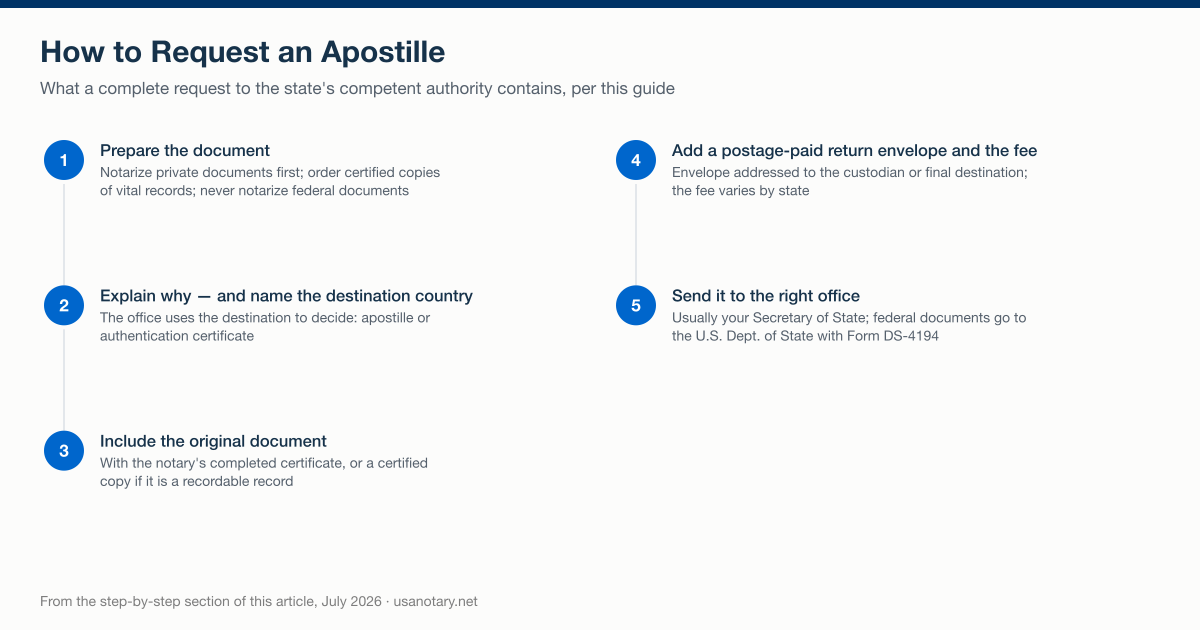
The apostille request process described in this guide, July 2026.
Expect queue-based processing rather than instant turnaround. Minnesota, for example, processes requests “first-come, first-served,” limits in-person appointments to 10 documents, and offers no expedited processing; New York warns that drop-off requests “will not be treated as a priority.” Build the state’s processing time into any deadline the receiving country has given you.
How much does an apostille cost?
Apostille fees are set by each issuing authority, so the amount varies widely by state:
| Issuing authority | Fee (verified July 2026) |
|---|---|
| Minnesota Secretary of State | $5.00 per apostille certificate |
| California Secretary of State | $20.00 per apostille + $6.00 special-handling fee per different public official’s signature (in-person requests) |
| Texas Secretary of State (adoption documents) | $10.00 per document, capped at $100.00 per adopted child |
| U.S. Department of State, Office of Authentications (federal documents) | $8.00 per document |
| U.S. Department of State, Passport Services, Vital Records Office | No fee for an apostille on a document bearing the seal of a U.S. embassy or consulate |
The HCCH register also publishes the national spread, which is the number to budget against when you do not yet know the state: “The fees charged by individual US states vary, ranging from US $ 3 to US $ 20.” That range is the state apostille fee only — it excludes the underlying notarization, expedite options, and courier costs.
Check your own Secretary of State’s fee page for the current amount — these figures are examples, not a national schedule. Remember that the apostille fee is separate from the cost of the underlying notarization and from any courier or third-party facilitation fee. On USA Notary, online notarization costs $25 per document — the state apostille fee is charged later and separately by the government office that issues it.
Can an online-notarized (RON) document be apostilled?
Online notarization is legally valid in all 50 states for the consumer service — but whether a state will apostille an online-notarized document is a separate, state-by-state question, and the two largest published policies point in opposite directions:
- Texas: yes, with extra paperwork. The Texas Secretary of State apostilles online (RON) notarizations when presented with “a notarization ledger, detailing the date and time signatures were applied to the document, document description, and signer information,” plus a notarial certificate stating the document was notarized via “electronic or online notarization by two-way audio and visual communication.”
- Minnesota: no, re-notarize first. The Minnesota Secretary of State “views a printed notarized document signed electronically by a Minnesota Notary Public as a copy of the original document, therefore the copy is not a public document and will need to be appropriately notarized before an Apostille is issued.”
Texas adds a second caution that applies everywhere: “some countries do not accept online (RON) notarized documents, even if properly authenticated.” So before you notarize online for apostille use, confirm two things — that your Secretary of State apostilles RON documents, and that the destination country or receiving agency accepts them. When both answers are yes, the signer appears on live video, the document is notarized electronically, and the printed package goes to the state with whatever certificate or ledger the state requires. When either answer is no, use a conventional pen-and-paper notarization instead.
Does an apostille work in every country? (2026 status)
No — an apostille is only valid between Contracting Parties to the Hague Convention. The HCCH status table (updated June 30, 2026) lists 130 Contracting Parties, and the membership is actively expanding:
- Bangladesh — Convention in force March 30, 2025
- Algeria — in force July 9, 2026
- Vietnam — in force September 11, 2026
- Thailand — accession deposited June 30, 2026; in force February 28, 2027
The timing matters: a country that required the full legalization chain last year may accept a single apostille this year — and until a deposited accession actually enters into force, the old chain still applies. If your destination is not (yet) a party, the document needs the authentication route instead: certificates from your state, the U.S. Department of State, and the destination country’s embassy or consulate. Always check the status table on the date you start the process, not the date you last looked.
Where online notarization fits in
USA Notary handles the step that comes before the apostille: notarizing your document. You can notarize online by live video, then send the notarized document to your Secretary of State for the apostille. To be clear about roles — USA Notary (like any notary) provides notary services for the underlying document; the apostille itself is issued by the state, not by a notary or an online platform. If you’d like help with the apostille step after your notarization, USA Notary can assist with facilitating the request — contact us to arrange it.
If your document isn’t notarized yet, see how a live-video notarization works or compare in-person notary options near you.