
What is a FIRPTA affidavit?
A FIRPTA affidavit — formally a certification of non-foreign status — is the document a seller signs at closing certifying, under penalties of perjury, that the seller is not a foreign person for U.S. tax purposes. The certification matters because of 26 U.S.C. § 1445: when a foreign person disposes of a U.S. real property interest, the buyer must deduct and withhold 15 percent of the amount realized and pay it to the IRS. The affidavit is what takes an ordinary domestic sale out of that regime. Section 1445(b)(2) excuses the buyer from withholding when the seller furnishes “an affidavit by the transferor stating, under penalty of perjury, the transferor’s United States taxpayer identification number and that the transferor is not a foreign person.”
One document carries two names. The Internal Revenue Code and Treasury regulations call it a certification of non-foreign status; closing packages, escrow checklists, and title-company form libraries call it a FIRPTA affidavit, after the Foreign Investment in Real Property Tax Act of 1980 (FIRPTA) that created the withholding rule. Both labels describe the same piece of paper — but the industry’s choice of the word affidavit is, as the next section shows, the entire reason the notarization question exists.
“Foreign person” here is a tax classification, not an immigration status. The IRS defines a foreign person for FIRPTA purposes as “a nonresident alien individual or foreign corporation that has not made an election under section 897(i) of the Internal Revenue Code to be treated as a domestic corporation, foreign partnership, foreign trust, or foreign estate” — and the same definition states plainly: “It does not include a resident alien individual.” A resident alien selling a house signs the certification exactly the way a citizen-seller does. What the affidavit certifies is tax status; what a green card or visa says about immigration is a separate question the form never asks.
Does a FIRPTA affidavit need to be notarized?
The IRS does not require a FIRPTA affidavit to be notarized — notarization is title and escrow practice, not federal law. Neither the statute nor the regulation governing the certification mentions a notary anywhere. What the law demands is a statement signed under penalties of perjury; what most closing rooms produce is a sworn, notarized affidavit. Both satisfy the IRS. Only one satisfies the form actually sitting in the closing package.
What the statute and regulation actually require
Section 1445(b)(2) asks only for an affidavit “stating, under penalty of perjury, the transferor’s United States taxpayer identification number and that the transferor is not a foreign person.” The implementing regulation, 26 CFR § 1.1445-2, fills in the content: the certification must state that the seller is not a foreign person, must set forth the seller’s name, identifying number, and home address (office address for an entity), and must be signed under penalties of perjury. Then the regulation goes out of its way to keep the formalities light: “No particular form is needed for a certification pursuant to this paragraph (b), nor is any particular language required, so long as the document meets the requirements of this paragraph (b)(2)(i).”
No notary. No witness. No acknowledgment. The regulation’s own sample certification for an individual ends with a perjury declaration and a signature line — “Under penalties of perjury I declare that I have examined this certification and to the best of my knowledge and belief it is true, correct, and complete” — and nothing after it.
Why the closing-package form has a notary block anyway
Specimen FIRPTA affidavits circulated in the title industry are drafted as sworn documents. Foundation Title’s specimen Certificate of Non Foreign Status (FIRPTA Affidavit) closes with “Signed and Sworn before me on this ___ day of ___” above a Notary Public signature line. That closing language is a jurat — wording only an oath-administering officer can complete. Once a form is drafted with a jurat, a notary must complete it for the document to be executed as written, whatever the IRS thinks. Our guide to the difference between a jurat and an acknowledgment covers why that distinction controls how a document gets signed.
Three practical drivers keep the notary block on the form:
- The word “affidavit” imports the formality. An affidavit is, by ordinary legal usage, a sworn statement — so when the industry renamed the IRS’s “certification” an affidavit, drafters built the oath ceremony into the form. The label chose the execution method.
- The buyer’s protection is conditional on good faith. Under § 1445(b)(7), the exemption does not apply if the buyer “has actual knowledge that the affidavit… is false” or receives notice from an agent that it is false — and § 1445(d) obligates agents who know of a false affidavit to notify the buyer or assume withholding duty themselves (capped at their compensation from the deal). With that liability structure, the parties relying on the affidavit want the strongest execution evidence available, and identity verification by a notary adds evidence of who signed.
- Uniform execution across the seller package. The deed beside the affidavit is notarized in every state. Running one sworn document through a different, looser signing standard invites handling errors, so escrow teams execute the package to a single standard.
Here is the gap between the two regimes at a glance:
| Question | IRS rule (26 CFR § 1.1445-2) | Title-company form in practice |
|---|---|---|
| Signature standard | Signed under penalties of perjury | Sworn before a notary (jurat) |
| Required contents | Name, U.S. TIN, address, non-foreign statement | Same, plus property description on many specimens |
| Prescribed form? | ”No particular form is needed” | Underwriter or agency specimen form |
| Notary required? | No — never mentioned | Yes, if the form carries a jurat block |
| Who keeps it | Buyer retains it until the end of the fifth taxable year after transfer | Escrow delivers it to the buyer’s side at closing |
The practical rule
If the FIRPTA affidavit in your closing package contains a jurat block, treat notarization as required — required by the form, not by the IRS. Signing above an empty notary section leaves a sworn document incompletely executed, and an escrow processor will send it back. If the package instead uses a plain penalties-of-perjury certification modeled on the regulation’s sample language, a bare signature is legally sufficient. The seller doesn’t get to choose which version arrives; the title agent’s form library does.
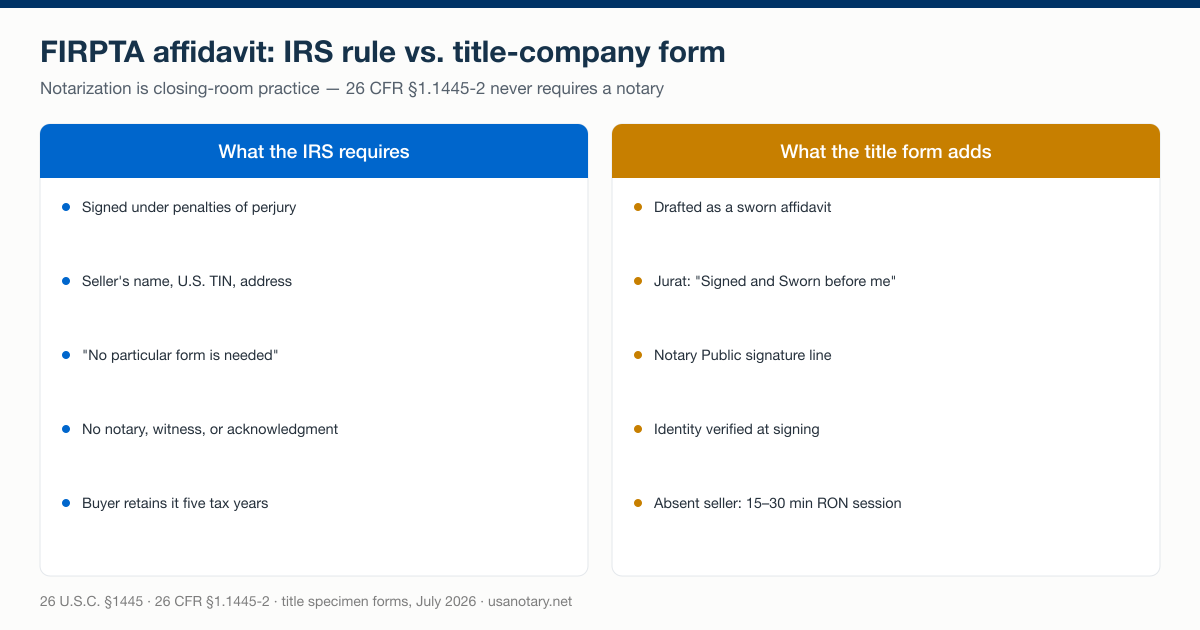
What 26 CFR § 1.1445-2 requires versus what the title-company specimen form adds — the notary block is practice, not law.
When does FIRPTA withholding apply — and how much is withheld?
FIRPTA withholding applies when a foreign person disposes of a U.S. real property interest — and the buyer, not the seller, carries the duty. The IRS states it directly: “In most cases, the buyer (transferee) is the withholding agent.” The buyer must determine whether the seller is a foreign person and withhold accordingly; the general rate is 15 percent of the amount realized for dispositions on or after February 17, 2016 (10 percent for earlier dispositions).
The statute builds two residence-based tiers under the general rate:
| Sale scenario | Withholding rate | Authority |
|---|---|---|
| Buyer acquires the property as a residence and the amount realized is $300,000 or less | 0% — no withholding | 26 U.S.C. § 1445(b)(5) |
| Buyer acquires the property as a residence and the amount realized is $1,000,000 or less (and the $300,000 exception doesn’t apply) | 10% | 26 U.S.C. § 1445(c)(4) |
| All other dispositions by a foreign person | 15% | 26 U.S.C. § 1445(a) |
The residence test in the $300,000 exception is more specific than most closing summaries let on. Per the IRS exceptions page, the buyer or a member of the buyer’s family “must have definite plans to reside at the property for at least 50% of the number of days the property is used by any person during each of the first two 12-month periods following the date of transfer.” A $290,000 purchase intended as a rental doesn’t qualify.
Notice what the tiers have in common: every one of them presumes the seller is a foreign person. The FIRPTA affidavit operates a level above the table — when the seller certifies non-foreign status under § 1445(b)(2), withholding is switched off at any price point, no residence plans required. That is why the affidavit appears in virtually every closing package for domestic sellers: it is the cheapest, fastest exit from the entire withholding analysis, and it protects a buyer who would otherwise have to make the foreign-or-not determination alone.
Who signs the FIRPTA affidavit — and what goes into it?
The seller signs — and for entities, the regulation names exactly who holds the pen. 26 CFR § 1.1445-2 requires the certification to be signed “by a responsible officer in the case of a corporation, by a general partner in the case of a partnership, and by a trustee, executor, or equivalent fiduciary in the case of a trust or estate.” One structure trips up closers more than any other: the single-member LLC. Per the IRS FIRPTA definitions page, “the owner of a disregarded entity is treated as the transferor of the property, not the entity” — so the certification comes from the LLC’s owner, certifying the owner’s status, not the company’s.
| Seller of record | Who signs the certification | Whose status is certified |
|---|---|---|
| Individual | The seller personally | The individual’s |
| Corporation | A responsible officer | The corporation’s |
| Partnership | A general partner | The partnership’s |
| Trust or estate | Trustee, executor, or equivalent fiduciary | The trust’s or estate’s |
| Single-member LLC (disregarded entity) | The LLC’s owner | The owner’s — not the LLC’s |
The contents are short, and the regulation’s sample language shows how short. For an individual: a statement that the seller is not a nonresident alien for purposes of U.S. income taxation, the seller’s U.S. taxpayer identifying number (Social Security number), a home address, and the penalties-of-perjury declaration. For an entity: a statement that it is not a foreign corporation, foreign partnership, foreign trust, or foreign estate, its U.S. employer identification number, and its office address. Specimen title-company forms typically add the property’s legal description and an acknowledgment that the certification may be disclosed to the IRS — the Foundation Title specimen includes both.
After closing, the certification is retained, not filed. The regulation requires the buyer to keep it “until the end of the fifth taxable year following the taxable year in which the transfer takes place.” It is not recorded with the deed and does not accompany a tax return; it sits in the buyer’s file as the proof that withholding was properly skipped.
What happens without the affidavit? Forms 8288, 8288-A, and buyer liability
Without a certification of non-foreign status — or another exception — withholding applies and the buyer becomes a tax collector on a deadline. The buyer reports and pays using two forms, per the IRS reporting and paying page: Form 8288, the withholding tax return that transmits the payment, and Form 8288-A, a statement prepared for each person subject to withholding. Both are generally due “by the 20th day after the date of the disposition.” Twenty days is not much runway when a closing wire has already been disbursed, which is why escrow instructions handle FIRPTA before funding, not after.
The withheld money is not lost to the seller — it’s a prepayment. The IRS stamps copy B of Form 8288-A and sends it to the seller, who files a U.S. income tax return and attaches the stamped copy to claim credit for the amount withheld. A seller whose taxpayer identification number is missing from the form doesn’t receive the stamped copy, which stalls the credit — one more reason the TIN line on these forms is never optional. A foreign seller expecting to owe less than the withheld amount can also apply for a reduced amount using Form 8288-B, the application for a withholding certificate.
For the buyer, the affidavit’s protection has a sharp edge worth restating: § 1445(b)(7) strips the exemption when the buyer has actual knowledge the affidavit is false or receives notice of falsity from an agent in the transaction. A FIRPTA affidavit is a shield for the honest buyer relying on it in good faith — it is not a device a knowing buyer can hide behind. That allocation of risk explains much of the ceremony around this one-page document at closing tables.
How does an out-of-state or overseas seller sign a FIRPTA affidavit online?
Remote online notarization lets a seller complete the sworn FIRPTA form from anywhere, in a 15–30 minute video session — and the seller who needs this is, by definition, not a foreign person. Read that again if it sounds backwards: only a non-foreign seller signs a certification of non-foreign status. The remote-signing problem is a U.S. taxpayer who happens to be somewhere else — a seller who relocated out of state before closing day, a citizen working abroad, a deployed service member, an executor administering a sale from across the country. The National Association of Secretaries of State reports 47 states and the District of Columbia have a law allowing remote e-notarization, so the jurat on a title company’s FIRPTA form can be completed over live video instead of through a courier loop.
Here is how the session runs on our platform:
- Upload the escrow package’s form. The notary notarizes the signature on the form the title agent supplied — jurat block and all — without altering it. Sessions run 24/7, so a seller eleven time zones ahead signs on their morning, not yours.
- Verify identity before the session starts. Identity verification combines credential analysis of a government-issued ID with knowledge-based authentication, run by a third-party identity-verification service — evidence of who signed that a walk-in signing never generates.
- Swear and sign on camera. A commissioned notary administers the oath the jurat requires and watches the signature happen. Co-sellers on title can join as multiple signers in one session, and signers can connect from all 50 states.
- Deliver the executed affidavit to escrow the same day. The session produces a tamper-evident PDF plus a complete audit trail, with the audio-video recording and electronic journal entry retained for the period the seller’s state sets for remote-notarization records — a deeper execution record than any wet-ink signing.
The general mechanics of sworn documents online are covered in our walkthrough of how to notarize an affidavit; the FIRPTA form follows the same path with one wrinkle — because it certifies U.S. tax status, the signer almost always holds U.S. identification and a Social Security number, which keeps identity verification straightforward even from abroad. For a signer physically outside the United States, some states attach conditions to serving remote signers abroad — our guide to notarizing documents from overseas maps which states allow it and on what terms.
How title and escrow teams handle FIRPTA affidavits
Escrow teams treat the FIRPTA affidavit as a seller-package document, and the seller package is exactly where remote sessions earn their keep. The affidavit rarely travels alone — it rides with the deed, and where the seller can’t appear, the whole set historically went out as a courier package with instructions to find a local notary. A staff-initiated online session replaces that loop: the escrow officer uploads the seller documents, initiates the session, and receives the executed set back the same day, with the FIRPTA form’s jurat completed on camera. How the rest of the package behaves in a remote signing — the deed, the recording step, the underwriter’s evidence file — is covered in our guide to online notarization in a real estate closing.
Pricing is flat and public: $25 per document, with volume pricing for teams running recurring seller packages. For a settlement operation, the FIRPTA affidavit is a high-frequency, low-drama document — precisely the kind of signing that shouldn’t cost three days of courier float. Our online notarization service for title and escrow teams supports business-initiated workflows, so your closers control when the session happens instead of emailing a signer a link and hoping.
The rule to remember: the IRS requires a penalties-of-perjury signature; the form in your package usually requires more. Check the form’s closing block before the signing appointment — if a jurat is printed on it, a notary must complete it, and a video session completes it from wherever the seller is. Questions about a specific file or a recurring seller-package workflow? Call 804-767-7500 or reach us here.