
Which mortgage documents are notarized at closing?
Your closing package splits cleanly into two piles: documents that are notarized, and documents that only need your signature. The Consumer Financial Protection Bureau’s list of closing documents covers the whole package — Loan Estimate, Closing Disclosure, promissory note, security instrument, plus state-mandated and lender-added forms. Only a few of those ever see a notary seal.
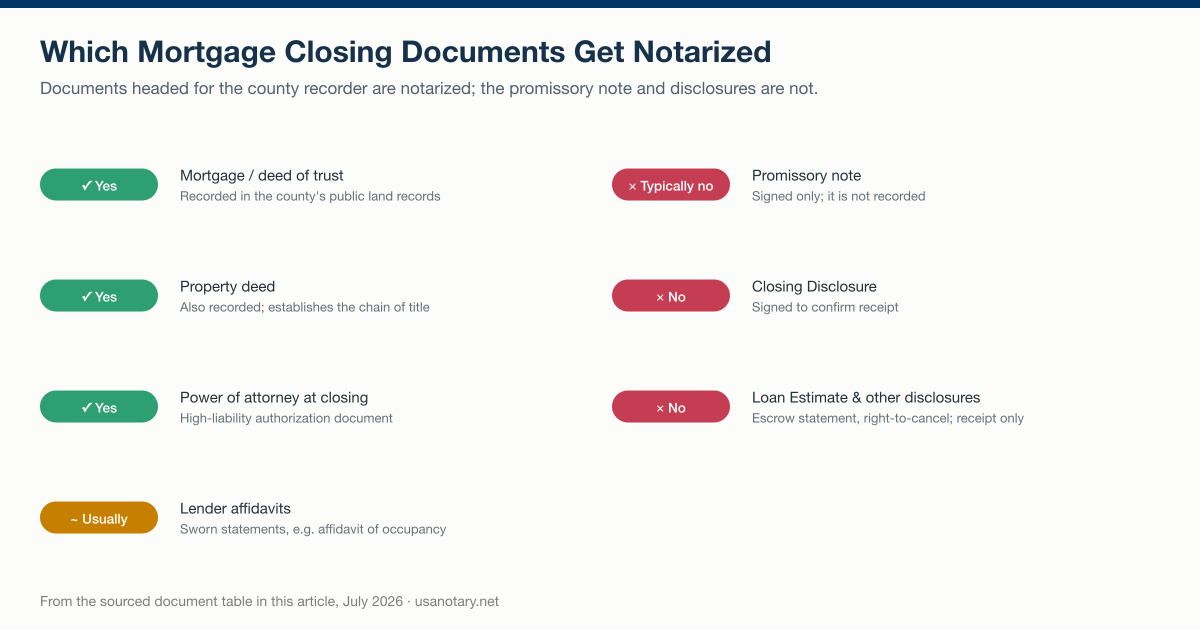
Notarization verdicts for the seven closing-package documents covered in this article, July 2026.
| Document | Notarized? | Why |
|---|---|---|
| Mortgage / deed of trust (security instrument) | Yes | Recorded in the county’s public land records |
| Property deed (purchase transactions) | Yes | Also recorded; establishes the chain of title |
| Lender affidavits (e.g., affidavit of occupancy) | Usually | Sworn statements the lender requires |
| Power of attorney (if someone signs for you) | Yes | High-liability authorization document |
| Promissory note | Typically no | Signed only; it is not recorded |
| Closing Disclosure | No | Signed to confirm receipt |
| Loan Estimate, escrow statement, right-to-cancel notice | No | Disclosures; signature or receipt only |
The pattern behind the table comes from title-industry practice: PropLogix’s guide to critical closing documents explains that the security instrument is “signed, notarized, and recorded in the public land records” — and describes the same signed-notarized-recorded path for the deed — while the promissory note “typically … doesn’t require notarization” and the Closing Disclosure needs no notarization at all. So the honest answer to “do mortgage documents need to be notarized” is: the ones headed for the county recorder do; most of the rest don’t.
Why the mortgage or deed of trust is notarized
Recording is the reason. The mortgage, deed of trust, or other security instrument gives your lender the right to foreclose if you fail to make payments as agreed — the CFPB’s description of what the document does — and that instrument is entered into the county’s public land records. County recorders have requirements documents must meet before recording, and for deeds and security instruments, notarization sits in that pipeline — the same sign–notarize–record sequence the table above reflects.
Notarization also carries the anti-fraud weight. PropLogix notes that recording officials don’t check a document’s validity before recording it — the notary is the checkpoint. When a signer completes a notarization on a deed or security instrument, the notary verifies identity and confirms the signature is willingly given, which is what lets title professionals, lenders, and future buyers rely on the record. The property deed follows the same logic, and it has its own quirks — witnesses in some states, grantor/grantee formalities — covered in our guide to getting a deed notarized.
The promissory note sits outside this system. It’s the IOU between you and your lender — it never gets recorded, so it typically carries no notarization. Fannie Mae’s Selling Guide treats it as a special document for a different reason: a paper promissory note must be ink-signed unless the lender has approval to deliver electronic notes (eNotes).
Do I need to find my own notary for a mortgage closing?
No — and this is the question closing-day borrowers ask most. At a managed closing, the notary comes to you, arranged by whichever company is running the signing. PropLogix describes the arrangement from the notary’s side: the contracting company that assigns the loan signing “could be the lender, the title company, or a loan signing service.” Your job is to show up with valid ID; the signing logistics are someone else’s checklist item.
The exception is stray paperwork outside a managed closing. If your loan servicer mails you a subordination agreement or a payoff affidavit and tells you to return it notarized, finding the notary is on you — and booking one through our online real estate notarization service takes minutes, with the session itself done in 15–30, instead of a trip to a bank branch. A remote session verifies your identity on camera, witnesses the signature, and produces a tamper-evident PDF and audit trail your servicer can validate.
Can my mortgage be notarized online?
In most states, yes. Remote online notarization (RON) is defined in Fannie Mae’s Selling Guide as an electronic notarization in which the signer and the notary are in different physical locations and communicate over real-time, two-way audio-visual technology, with signatures and the notarial seal applied electronically. The legal footing is broad: the National Association of Secretaries of State reports that 47 states and the District of Columbia have a law that allows for remote e-notarization.
For a full closing, RON acceptance runs through three parties, and all three have said yes in most of the country:
- Your state’s law — 47 states plus DC authorize remote e-notarization, per NASS.
- The loan’s investor — Fannie Mae permits remotely notarized loan documents when its RON requirements are met, and Freddie Mac permits the RON process in 46 states, the District of Columbia, and Guam, per its Exhibit 48 list. Freddie Mac’s FAQ also confirms a RON closing can still use a wet-ink-signed promissory note — the online notarization applies to the recorded documents, not necessarily every page you sign.
- The county recorder — Fannie Mae requires that the recorder in the county where the property sits accept the remotely notarized document for recording.
Because those three switches are flipped by your lender and title company, not by you, the practical move is to ask your loan officer early: “Can we close with remote online notarization?” What the session itself looks like — the ID checks, the camera, the e-signing order — is walked through in our guide to online notarization for a real estate closing.
Is RON accepted for mortgage closings in my state?
Almost everywhere, with named exceptions. NASS’s count — 47 states plus DC — leaves a small set of states where notaries can’t yet perform full RON under their own state’s law, and investor rules add edge cases: Fannie Mae’s RON requirements exclude Texas Section 50(a)(6) loans (Texas home-equity loans), and its rules require the notary to be licensed and physically located in the state where the notarial act is performed. Freddie Mac’s Exhibit 48 is the authoritative list for its loans.
If you want to pressure-test your own closing, three questions settle it:
- Ask your lender whether this loan program permits a RON closing.
- Ask your title company whether it will insure a remotely notarized security instrument in your county.
- Ask either party whether your county recorder accepts remotely notarized documents for recording.
A “yes” on all three means your mortgage can be notarized from your kitchen table. Signers in all 50 states can join a remote session as a matter of consumer access — the state-law variation is about where notaries are commissioned, not where signers may sit.
What does the notary at a mortgage closing actually do?
The person across the table (or across the video call) at most closings is a notary signing agent — a commissioned notary with extra training in loan packages. Their role is narrow by design: present each document, state its general purpose, point to signature lines, and notarize the documents that require it. They verify each signer’s identity, but they cannot explain loan terms or give advice — questions about your rate or fees go back to the lender or closing agent. The difference between a garden-variety notary and a signing agent — training, background screening, and who hires whom — is mapped out in notary vs. signing agent.
In a remote closing, the same duties move on-screen: the notary verifies identity through credential analysis and on-camera checks, witnesses the e-signatures, and the session produces a tamper-evident PDF and audit trail. Fannie Mae’s RON requirements lean on exactly that artifact — lenders must store the tamper-sealed audit trail the RON system produces for the loan file.
Closing the loop: borrowers, lenders, and the notary layer
For borrowers, the takeaway is short: your security instrument is notarized, your note typically isn’t, the notary is arranged for you at closing, and in most states the whole thing can be completed online in a 15–30 minute session — with multiple signers, like both borrowers on a joint mortgage, joining the same session.
For the companies on the other side of the table, the notary layer is an operations question. Lenders running staff-initiated RON workflows can standardize closings at $25 per document with volume pricing — the platform build-out is covered on our page for mortgage lender notarization workflows. Title and escrow teams, who shepherd the recorded documents through the county, have their own integration path: notarization for title and escrow companies. Questions about either fit best on a call — 804-767-7500.