
Does my spouse need to sign closing documents?
Often, yes — and the reason is state property law, not the lender being difficult. A non-titled or non-borrowing spouse must sign certain closing documents in three kinds of states: homestead states, where neither spouse may sell, convey, or encumber the family home without the other’s joinder; community-property states, where property acquired during the marriage belongs to both spouses regardless of whose name is on the deed; and the few remaining dower states, where a spouse holds a survivorship interest in the other’s real estate that must be released in writing.
What the spouse signs is just as specific as whether they sign: the joinder statutes reach the deed and the mortgage or deed of trust, not the promissory note — which is why a non-borrowing spouse can sign at closing without becoming liable for the loan.
Every state rule in this guide is checked against the current statute text, quoted and linked section by section — and the last two sections cover the practical problem that sends people to this page: a spouse who cannot be in the room on closing day.
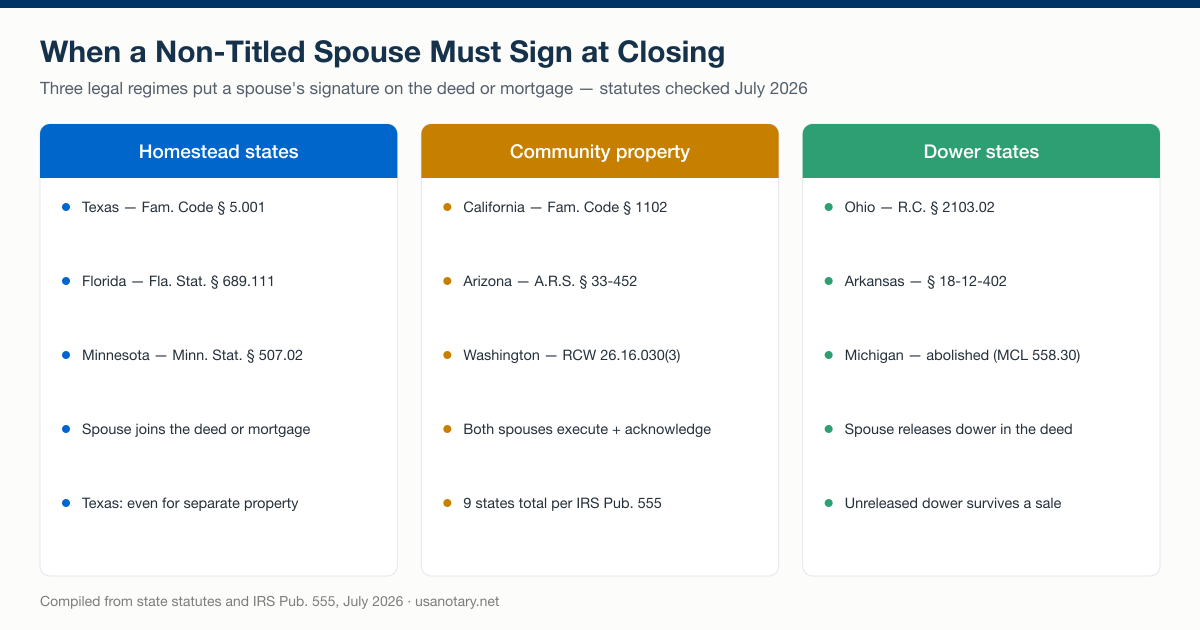
The three legal regimes that put a non-titled spouse’s signature on the closing package — statutes checked July 2026.
Why does the title company ask whether you’re married?
The title company asks because marital property rights attach by operation of law — they exist whether or not the spouse’s name appears anywhere in the chain of title. A title search confirms who holds record title; it cannot reveal a homestead right, a community-property interest, or an unreleased dower claim unless the marital-status question gets asked at file opening.
Those rights have teeth. Minnesota Statutes § 507.02 provides that if the owner is married, no conveyance of the homestead “shall be valid without the signatures of both spouses”; Arizona Revised Statutes § 33-452 provides that a conveyance or encumbrance of community property “is not valid unless executed and acknowledged by both husband and wife.” An instrument that fails those statutes is a deed or mortgage that may convey nothing and secure nothing.
That risk lands on everyone in the file: the buyer needs a deed that transfers title, the lender needs a lien that attaches, and the title underwriter is asked to insure both. So the escrow officer flags the spousal-signature question on day one and builds the extra signer into the closing calendar — discovering a required spouse on closing day is how fundings slip. Remote closings surface the same question in the same place; our guide to online notarization for a real estate closing walks through where the notarization happens in that workflow.
When must a spouse sign in homestead states?
A non-titled spouse must sign in homestead states whenever the transaction sells, conveys, or encumbers the couple’s primary residence — even when the home is titled in one spouse’s name alone. Homestead protection attaches to the family’s occupancy of the home, not to the deed, so the signature requirement follows the marriage rather than the title.
Texas: joinder even for separate property
Texas states the rule in one sentence. Texas Family Code § 5.001 provides: “Neither spouse may sell, convey, or encumber the homestead without the joinder of the other spouse except as provided in this chapter or by other rules of law.” The section applies whether the homestead is separate property or community property — a Texas home bought before the marriage and titled in one name still needs both signatures once it is the couple’s homestead.
Florida: joinder required, POA permitted
Florida’s rule appears in the homestead-conveyance statute. Florida Statutes § 689.111 confirms “the requirement that husband and wife join in the conveyance or mortgage of homestead realty,” and adds a practical escape hatch: “the joinder may be accomplished through the exercise of a power of attorney.” A Florida closing on a married person’s homestead carries the spouse’s signature on the deed or the mortgage — in person, or through a properly executed POA.
Minnesota: “shall be valid” language with narrow exceptions
Minnesota puts the consequence in the statute itself. Under Minnesota Statutes § 507.02, if the owner is married, no conveyance of the homestead “shall be valid without the signatures of both spouses.” The statute carves out three exceptions — a purchase-money mortgage under § 507.03, a conveyance between the spouses themselves, and a severance of a joint tenancy — and it allows a spouse’s signature to be made by a duly appointed attorney-in-fact. Outside those exceptions, a Minnesota homestead deed or refinance mortgage without both signatures fails.
Other states impose homestead signature requirements of their own; the three above are the ones this article verified against current statute text. Wherever the property sits, the escrow officer’s file-opening question does the sorting.
What is the rule in community-property states?
Community-property states require both spouses to join in executing the instruments that sell, convey, or encumber community real property — because the law treats property acquired during the marriage as owned by both spouses, whichever name the deed carries. IRS Publication 555 lists the nine community-property states: Arizona, California, Idaho, Louisiana, Nevada, New Mexico, Texas, Washington, and Wisconsin.
The three largest by transaction volume state the joinder rule plainly:
- California. Family Code § 1102 requires that “both spouses, either personally or by a duly authorized agent, are required to join in executing an instrument by which that community real property or an interest therein is leased for a longer period than one year, or is sold, conveyed, or encumbered.”
- Arizona. A.R.S. § 33-452 provides that a conveyance or encumbrance of community property “is not valid unless executed and acknowledged by both husband and wife.”
- Washington. RCW 26.16.030(3) provides that neither spouse or domestic partner “shall sell, convey, or encumber the community real property without the other spouse or other domestic partner joining in the execution of the deed or other instrument … and such deed or other instrument must be acknowledged by both spouses or both domestic partners.”
Two details in those texts matter at the closing table. First, Arizona and Washington do not stop at signatures — the instrument must be acknowledged by both spouses, which means notarization is required for each of them, not just the titled owner. Second, Texas appears on both lists in this guide: it is a community-property state whose homestead statute independently requires joinder, so the spousal-signature question in Texas has two separate legal sources.
The remaining six community-property states run on their own marital-property codes, and escrow confirms the exact joinder rule when the file opens. The practical takeaway holds across all nine: on community real property, the non-titled spouse must sign the deed or the security instrument for the transaction to hold.
What are dower states — and does dower still matter?
Dower still matters in a small number of states, and it is the oldest reason a non-titled spouse must sign at closing. Dower (and its mirror, curtesy) gives a spouse a survivorship interest in real property the other spouse owned during the marriage — one that can outlive a sale the spouse never joined.
Ohio is the clearest surviving example. Ohio Revised Code § 2103.02 endows a spouse “who has not relinquished or been barred from it” with an estate for life in one third of the other spouse’s real property — and dower continues in real property “conveyed by the deceased consort during the marriage” when the spouse never relinquished it. At the closing table, that means an Ohio seller’s spouse signs the deed to release dower, or the buyer takes title subject to a life-estate claim that ripens at the seller’s death. The mechanics of getting a deed properly executed and notarized are covered in our guide to notarizing a deed.
Arkansas handles release the same way. Arkansas Code § 18-12-402 provides that a married person may relinquish dower or curtesy in a spouse’s real estate “by joining with the spouse in the deed of conveyance thereof, or by a separate instrument executed to spouse’s grantee.” Either way, the release is a signed, executed instrument — the spouse’s signature is the release.
Michigan shows the modern direction. MCL § 558.30 abolishes a wife’s dower right as “abolished and unenforceable either through statute or at common law,” preserving it only for widows whose husbands died before the abolition took effect. A Michigan closing today does not collect a dower release — but a title examiner tracing an older Michigan chain of title may still encounter one.
State-by-state: who signs what
The verified rules in one place. Every row is checked against the statute text linked in the right-hand column:
| State | Regime | What the statute requires |
|---|---|---|
| Texas | Homestead (also community property) | Neither spouse may sell, convey, or encumber the homestead without the other’s joinder — applies to separate and community property alike (Fam. Code § 5.001) |
| Florida | Homestead | Husband and wife join in the conveyance or mortgage of homestead realty; joinder may be accomplished by power of attorney (Fla. Stat. § 689.111) |
| Minnesota | Homestead | No conveyance of a married owner’s homestead is valid without both spouses’ signatures; purchase-money mortgages and inter-spousal deeds excepted (Minn. Stat. § 507.02) |
| California | Community property | Both spouses join in executing any instrument that sells, conveys, or encumbers community real property (Fam. Code § 1102) |
| Arizona | Community property | A conveyance or encumbrance of community property is not valid unless executed and acknowledged by both spouses (A.R.S. § 33-452) |
| Washington | Community property | Neither spouse sells, conveys, or encumbers community real property without the other joining in execution; the instrument must be acknowledged by both (RCW 26.16.030(3)) |
| Ohio | Dower | Non-titled spouse holds a life estate in one third of the other’s real property; unreleased dower survives a conveyance made during the marriage (R.C. § 2103.02) |
| Arkansas | Dower/curtesy | Spouse relinquishes dower or curtesy by joining in the deed of conveyance or by a separate executed instrument (Ark. Code § 18-12-402) |
| Michigan | Dower abolished | A wife’s dower right is abolished and unenforceable, preserved only for widows whose husbands died before the abolition took effect (MCL § 558.30) |
This table is not a 50-state survey — it covers the states verified against current statute text for this article. For any live file, the controlling answer comes from the escrow officer’s title commitment, not a blog table.
Which closing documents does a non-titled spouse sign — and which not?
The non-titled spouse signs the instruments that convey or encumber the property, and skips the instruments that create the debt. Every joinder statute quoted above uses some version of the same verbs — sell, convey, or encumber — and those verbs select the documents:
| Document | Non-titled spouse signs? | Why |
|---|---|---|
| Deed (sale of the property) | Yes, in homestead, community-property, and dower states | The deed conveys the property; joinder statutes reach conveyances, and a dower release rides on the deed |
| Mortgage / deed of trust | Yes, in homestead and community-property states | The security instrument encumbers the property — the lender’s lien does not fully attach without the required joinder |
| Promissory note | No | The note is the promise to repay. Joinder statutes reach the property, not the debt — staying off the note is what keeps the spouse off the loan |
| Notice of right to rescind (loans subject to rescission) | Receives it — and holds the right | Under Regulation Z, 12 CFR § 1026.23, each consumer “whose ownership interest is or will be subject to the security interest” may rescind, and each consumer entitled to rescind receives two copies of the notice |
| Spousal-consent or homestead-waiver pages | Where the closing package includes them | Some states’ form practice adds a separate consent or waiver page rather than a joinder line on the security instrument |
Regulation Z is the federal layer on top of the state rules. On transactions subject to the right of rescission (Reg Z exempts certain transactions in § 1026.23(f)), the rescission right runs until midnight of the third business day after consummation or delivery of the required notice and disclosures, whichever comes last — and if those never arrive, the window can stretch to three years. A lender that ignores a non-borrowing spouse with an ownership interest is leaving a federal rescission clock running on top of a defective lien, which is why the spouse’s copies of the rescission notice are standard in refinance packages even though the spouse never touches the note.
Whether each of these documents is notarized is its own question — the deed and the security instrument are the acknowledgment-heavy ones, and our breakdown of which mortgage documents need to be notarized covers the full loan package.
What happens if the spouse doesn’t sign?
The transaction fails at the exact point the statute names. The consequence language is already in the quoted texts: a Minnesota homestead conveyance is not valid without both spouses’ signatures; an Arizona conveyance or encumbrance of community property “is not valid” without both spouses’ execution and acknowledgment; an unreleased Ohio dower interest survives the sale and waits.
In practice the failure shows up three ways:
- Before closing — the best case. The title commitment flags the required spouse, and the only cost is calendar time to schedule the extra signer.
- At funding — the expensive case. A missing spousal signature in the final document review stops the wire; corrected documents go out, and if the absent spouse is out of state, the delay is measured in courier days.
- After recording — the litigation case. The deed or mortgage is recorded, but the instrument is invalid or the property remains subject to an unreleased marital interest. A later sale, foreclosure, or estate surfaces the defect, and the title insurer inherits a claim one signature would have prevented.
Title underwriters price that third scenario into their requirements, which is why no amount of “my spouse doesn’t care about this house” moves an escrow officer. The signature requirement belongs to the statute, and the statute does not take a verbal waiver.
How does an absent spouse sign closing documents online?
An absent spouse signs by remote online notarization in most of the country — the National Association of Secretaries of State reports that 47 states and the District of Columbia have a law allowing remote e-notarization. That is the answer to the oldest scheduling problem in title work: every borrower is in the room, and the one required signature belongs to a spouse who is deployed, traveling, or living in another state mid-relocation.
The traditional fallback is shipping documents out for a local signing — the courier round-trip our guide to mail-away closings walks through, with the days it adds and the re-sign risk it carries. The remote session replaces that loop:
- Escrow uploads the spouse’s documents. The deed, security instrument, or consent pages go into the session — title and escrow teams can initiate it themselves through a staff-initiated workflow, so the signer never manages the paperwork.
- The spouse verifies identity. Identity verification runs through credential analysis of a government-issued ID plus knowledge-based authentication before the notary appears.
- The spouse signs before a commissioned notary on live video. Sessions run 24/7 and take 15–30 minutes, and multi-signer sessions let a spouse in another city sign alongside the titled owner in one appointment — the interstate mechanics are covered in whether remote notarization is valid out of state.
- Escrow receives the completed documents the same day. The session produces a tamper-evident PDF with a complete audit trail, and the audio-video recording and electronic journal are retained for 10 years or longer where state law requires — evidence a paper mail-away package never generates.
The math favors the session, too: at $25 per document with volume pricing, the remote signing costs less than the overnight courier envelope it replaces, before counting the funding days saved. Title and escrow teams that hit the absent-spouse problem weekly can standardize the workflow through online notarization built for title and escrow operations.
One caveat belongs here: Arizona- and Washington-style statutes require the spouse’s signature to be acknowledged, so the remote session must be a true notarization, not a bare e-signature — the notary completes the acknowledgment certificate exactly as an in-person notary would.
Can a power of attorney replace a spouse’s signature?
Sometimes — expressly, in two of the statutes quoted above. Florida Statutes § 689.111 states that the required joinder “may be accomplished through the exercise of a power of attorney,” Minnesota Statutes § 507.02 allows a spouse’s signature by a duly appointed attorney-in-fact, and California Family Code § 1102 contemplates spouses joining “personally or by a duly authorized agent.”
The practical constraints are the same as for any closing POA: the title company and lender review the instrument before closing day, it generally must be specific enough to cover the transaction, and where the security instrument is recorded, the POA typically is recorded with it. Getting the POA itself executed is a notarization job of its own — our guide to notarizing a power of attorney online covers it.
The comparison worth making first: a POA must be drafted, approved, signed, notarized, and delivered before closing — a multi-day critical path with rejection risk at the review step — while a remote session for the spouse is a 15–30 minute appointment the same day the documents are final. When the only obstacle is geography, the session is the shorter path; the POA earns its keep when the spouse will be genuinely unreachable through the closing window.
Questions about a spousal-signature file, or a title operation that hits this weekly? Call 804-767-7500 or reach us here — sessions run 24/7, and signers can join from all 50 states.