
What does the online notary market actually charge?
Online notary pricing looks like a solved question — every major platform advertises $25 — and turns out to be anything but. On July 17, 2026, USA Notary captured the published pricing pages of seven U.S. online notarization platforms on a single day and recorded every figure exactly as printed; on October 1, 2026, we re-checked every figure against each provider’s own pricing page. The result is a dataset of what this market discloses, what it doesn’t, and where the real costs hide — with a dated record of what changed in between.
Prices checked 2026-10-01 against each provider’s published pricing page: USA Notary · Proof / Notarize (and its business page) · OneNotary · NotaryLive · NotaryCam · DocuSign Notary · BlueNotary. Prices change without notice; each provider’s live page controls.
How we check: we read each provider’s own pricing page for the price of one consumer online notarization and every add-on it prints, record each figure exactly as printed, and record “not published” where the page prints none; we do not test checkout flows, negotiate custom rates, or rank providers on the strength of these cells. USA Notary (USA Notary Services LLC) is one of the seven providers and runs this study under the same rules as the other six, so every competitor figure links to the page it came from and our own row uses the rate on our pricing page.
Four findings summarize the October 1 check:
- All seven platforms print $25 as the entry price. USA Notary ($25 per document), Proof (Notarize) ($25 with the Notarize Network), OneNotary ($25 for one stamp and one signer), NotaryLive (“$25/ Session”), NotaryCam (“$25 Per Seal”), and BlueNotary (“Starts at just $25”) print it as the first number a consumer sees; DocuSign routes consumers to partner OneNotary at “Starting at $25.*”
- The market bills in three non-comparable units. $25 per seal (Proof, OneNotary, NotaryCam, and BlueNotary print $25 for the first seal), $25 per document (USA Notary), and $25 per session (NotaryLive, with the first 25 pages included) are three different prices wearing the same sticker.
- Four of seven platforms print an additional-seal rate. Proof ($15), OneNotary ($10), BlueNotary ($8 per additional stamp), and NotaryLive (“No Extra Charge”) do; USA Notary (which bills per document), NotaryCam, and DocuSign do not.
- Published add-on fees run from no extra charge to $79. An additional seal costs nothing extra at NotaryLive and $8 to $15 at the three other platforms that print a rate; an additional signer costs $5 to $10; a witness supplied by the platform costs $10 to $15; and NotaryCam prints a $79 fee for signers without a U.S. Social Security number — the largest single add-on in the dataset.
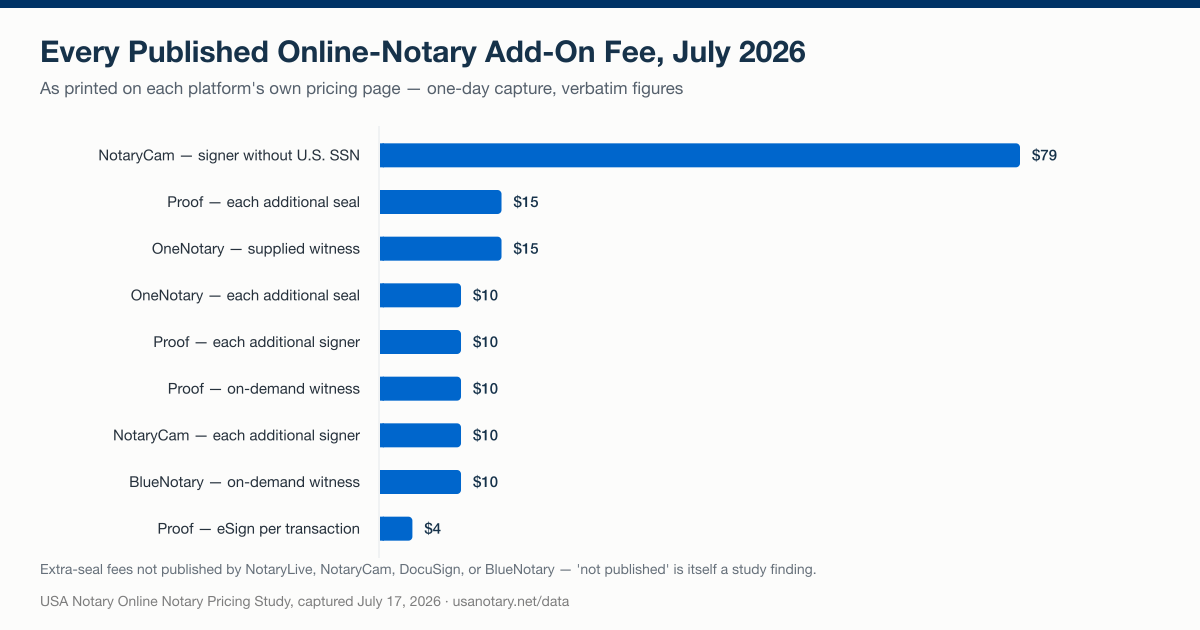
Add-on fees printed on each platform’s pricing page, checked October 1, 2026 — providers that print the same fee share a bar.
Methodology
Each platform’s own pricing page was fetched on October 1, 2026 — the pages used in the July 17 capture, plus NotaryLive’s pricing page, which the July capture did not include — and every figure was recorded as printed on the page. Each page’s served text was read directly; BlueNotary’s page draws its prices with JavaScript, so we also read the script file that holds its price list and a rendered scrape of the page. Where a page printed no figure, the dataset records “not published” — no figure in this study is estimated, averaged, or carried over from earlier coverage. USA Notary operates one of the platforms studied and is recorded under identical rules, including its own “not published” cells. The unit of study is what a consumer can learn from the pricing page before signing up — support chats, checkout flows, and unlisted rates are out of scope by design.
We use Internet Archive copies only to date a change: a price history appears below only where we opened the archived copy ourselves and can quote what it printed.
That scope is the point: a price a platform doesn’t publish is a price a consumer can’t comparison-shop.
The dataset
Figures as printed on each platform’s pricing page on October 1, 2026.
| Platform | Entry price (as printed) | Unit | Extra seal | Extra signer | Witness | Largest other published fee |
|---|---|---|---|---|---|---|
| USA Notary | $25 per document | per document | not published — each document $25 all-inclusive | not published | not published | notary membership $19.95/mo (notaries, not signers) |
| Proof / Notarize | $25 with the Notarize Network | per seal | $15 | $10 | $15 | eSign $4/transaction |
| OneNotary | $25 (1 stamp, 1 signer) | per seal | $10 | $10 | $15 | mobile notarization from $80 |
| NotaryLive | $25/ Session | per session (first 25 pages included) | no extra charge | $5 | $10 | $5 per additional 25 pages; Business plan $59/mo |
| NotaryCam | $25 Per Seal | per seal | not published | $10 | not published | $79 no-SSN signer fee; real-estate closings from $199 |
| DocuSign Notary | “Starting at $25*” via OneNotary | not published | not published | not published | not published | — |
| BlueNotary | $25 per notarization (first seal) | per seal | $8 per additional stamp | $5 | not published ($0 if you provide your own) | Notary Pro $27/mo (notaries, not signers) |
The original July 17 capture is kept as a dated record; the table above supersedes it wherever the two differ, and the next section lists every difference.
What changed since the July 17 capture?
Four of the seven platforms’ pricing pages differ from our July capture in at least one cell. Two of those differences are corrections to our own capture, not price changes by the platforms; the table quotes the July entry, the October 1 page, and the archived copy that dates each change.
| Platform | July 17 capture recorded | October 1 page prints | Dated evidence |
|---|---|---|---|
| Proof / Notarize (consumer page) | $15 per additional seal · $10 per additional signer · $10 on-demand witness | $15 per additional seal · $10 per additional signer · $15 per on-demand witness | Archived copies: May 18 printed seal $10, witness $10, signer $5; June 25 printed seal $15, witness $10, signer $10; September 3 printed seal $15, witness $15, signer $10. The $25 entry price held throughout. |
| Proof (business page) | Pro plan: $10 per additional seal · $5 per additional signer | Pro ($0 / month + transaction fees) and Pro+ ($199 / month + transaction fees) both print $15 per additional seal · $10 per additional signer · $15 per on-demand witness | September 3 archived copy: Pro printed $10 per additional seal, $5 per additional signer, $10 per on-demand witness. |
| NotaryLive | No additional-seal or additional-signer price; “$25 per Session*” with no footnote | “$25/ Session” · “First 25 Pages Included” · “$5 per Additional Signer” · “$5 per Additional 25 Pages” · “$10 per On-Demand Witness” · “No Extra Charge For: Additional Seals” | Correction. The July capture read notarylive.com and its bulk-discount page, not notarylive.com/pricing. Archived copies of that page from March 11 and June 13 already printed the same lines, except the witness fee, which the June 13 copy does not list. |
| BlueNotary | No consumer notarization price · Notary Pro $24.75/month · business $37 per notary per month with two free sessions | Under “I need something notarized”: “Per notarization $25 first seal” · “Additional signer $5 each” · “Additional stamp $8 each” · “Witness $0 you provide”; Notary Pro “$27 /month” or “$297 /year”; business “From $47/notary/mo” | The July 26 archived copy printed the same per-use rates in a business section (“PER GNW NOTARIZATION” $25, “ADDITIONAL STAMPS” $8, “ADDITIONAL SIGNERS” $5) and “$37 per notary per month + 2 free sessions”; we did not treat them as consumer pricing. $24.75 is the $297 annual plan divided by 12; the monthly plan is $27. |
| NotaryCam | Wills & Trusts plan at $175 per document · 7am–11pm ET hours on the real-estate and wills plans | No Wills & Trusts card on the page · “Available 7am - 11pm ET” on the Real Estate Closings card only · “$25 Per Seal,” “$10 per additional signer,” and “$79 Signer(s) without US SSN fee” unchanged | The July 3 archived copy shows a “Wills & Trusts” card (“Where Online Notarization is Approved”) at “$175 Per Document”; the September 21 copy does not. |
| OneNotary · DocuSign Notary · USA Notary | “$25” with “Every additional seal $10 · Every additional signer $10 · OneNotary witness $15”; “Starting at $25*”; $25 per document | Same | Match the July capture. |
Correction. The July 17 version of this study reported that NotaryLive publishes no additional-seal price and that BlueNotary publishes no consumer price, and it counted both among “3 of 7 platforms” with no complete consumer price list. NotaryLive’s pricing page was not in our July capture, and BlueNotary’s per-use rates appeared in a business section that we did not treat as consumer pricing. We have replaced that finding with the four-of-seven count above and corrected the affected cells. The July statement that every “not published” cell was a stable fact about disclosure did not hold for NotaryLive, and we have removed it.
Why the sticker prices converge on $25
All seven platforms print $25 as the entry price. One plausible reason is regulation: some states cap what a notary may charge for an online notarization. Texas allows an online notary to charge up to $25 for the online notarization itself, in addition to the ordinary act fee (Gov’t Code §406.111), and Ohio allows up to $30 plus a technology fee of up to $10 (R.C. 147.08); our state-by-state fee table has the rest. That is our inference — none of the seven platforms says it prices to a cap. What the data does show is that the differences sit after the first seal: additional seals, extra signers, witnesses, pages, and the billing unit itself.
The unit is the quietest lever. A three-seal document set costs $55 on a $25-first/$15-extra per-seal platform (Proof), $45 at $10 per extra seal (OneNotary), $41 at $8 (BlueNotary), and $25 at a platform that prints additional seals as “No Extra Charge” (NotaryLive, within one session and its first 25 pages) — and one advertised price tells you none of that. The arithmetic only works if the platform prints its extra-seal rate, which four of seven do. For a consumer-facing walkthrough of how to run that arithmetic before choosing a platform, see our comparison of the seven services’ published pricing; the study you’re reading is the dataset underneath it.
What “not published” costs consumers
The most consequential finding is no longer a headline count — it’s which cells stay blank. Three of seven platforms print no additional-seal rate: USA Notary, which bills per document; NotaryCam, which prints “$25 Per Seal” and nothing more; and DocuSign, which prints only a “Starting at $25” partner referral. A consumer cannot compute the cost of a two-seal job from NotaryCam’s or DocuSign’s public pages, which makes published price completeness one of the few things a consumer can compare before signing up. Whether online notarization is accepted for your document and state is a separate question, covered in is online notarization legal.
We’ll re-check the dataset quarterly and note material changes here with dated updates — pricing pages change, and a study of published prices is only as good as its check date.