
Proof (Notarize) for Notaries:
What It Pays and What It Costs
Proof (Notarize) lists no subscription for notaries: on-demand notaries earn $5 for a first seal and $25 per full real-estate transaction, while notary-sourced transactions cost the notary $10 each (verified October 1, 2026). The on-demand queue is live in five states. This review is published by USA Notary, a competing membership platform.
Last updated: October 1, 2026 · By Andrew Ray Yon, MBA, ChFC — CEO & Founder, USA Notary
Competitor information verified: October 1, 2026 against Proof's own pages — pay guide, NST fees, NST overview, and pricing (method and full source log below). USA Notary's own fees carry their own date: August 20, 2026.
What Proof Is for Notaries: ODN vs NST
Proof runs two separate notary tracks, defined in its own help center. Which one you get depends entirely on where you are commissioned.
On-Demand Notary (ODN)
On-Demand Notaries answer live calls from Proof's queue — the Notarize Network — and are paid per act on a published schedule. Proof's support article is unambiguous about eligibility: the queue is live only for notaries commissioned in Florida, Nevada, Pennsylvania, Texas, or Virginia (as of October 1, 2026). Everyone else is invited to "add your name to the waiting list."
ODNs must clear NNA screening, NSA certification, and carry $25,000 in E&O insurance — a notary-funded stack detailed below.
Notary-Sourced Transactions (NST)
NST notaries use Proof as software to serve clients they find themselves. Proof's NST overview describes it plainly: "creating and sending transactions for their own clients, setting their own fees." In this track the notary creates and sends the transactions and sets the price; Proof takes a $10 per-transaction fee plus $3 per additional seal (as of October 1, 2026).
NST is live in 32 states; the five ODN states get dual capacity under one account.
The distinction that matters
Of the two tracks, only ODN sends notaries work — through the on-demand queue, which covers five states. In the other 27 states where Proof lists NST, "working on Proof" means the NST track: software with a per-transaction fee, and client acquisition entirely on you. In the remaining 19 jurisdictions neither track is open yet. Platforms that route assigned sessions handle this differently — see how USA Notary assigns opportunities to members.
What Proof Pays: The Published Schedule
Proof publishes its full On-Demand Notary pay structure in its help center — a transparency point in its favor. The figures below are Proof's own, re-verified on October 1, 2026.
| Transaction type | Proof pays the notary |
|---|---|
| Retail & business notarization | $5 first stamp or seal, $1 each additional |
| Full real-estate transaction (title/lender-initiated) | $25 per completed transaction |
| HELOC | $20 per completed transaction |
| "Other" / trailing documents | $5 first seal, $1 each additional |
| Remote witness | $3.50 per qualifying meeting |
| Trusted referee (Identify) | $5 per completed transaction, regardless of result |
Source: Proof Help Center, "Pay Structure and Payout Guide for On-Demand Notaries," retrieved October 1, 2026. Proof notes its pricing plans are subject to change.
Do the retail math
The schedule pays per seal, not per minute. A retail call with two seals pays $5 + $1 = $6 under Proof's published rates — however many signers join and however long identity verification, document review, and the session itself take. Proof's own consumer pricing page charges that same retail signer $25 for the first seal (as of October 1, 2026), so on a single-seal retail call the notary's $5 is 20% of what the signer paid.
Computed from Proof's published payout and consumer-pricing pages — not an estimate.
Where the queue pays most
The $25 full real-estate payout is the highest figure in Proof's published schedule; HELOCs pay $20. Proof defines a full real-estate transaction as one "initiated by a title agent or lender" — transaction flow that an individual notary does not source personally. That work carries stricter requirements than retail: Proof's E&O article sets a minimum of $100,000 per occurrence for real estate against $25,000 for retail and business, and its pay guide reserves remote-witness and trusted-referee calls for "notaries permitted to handle real estate transactions." How the payout compares across the field is in our comparison of the best RON platforms to work on.
What It Costs to Start
Proof lists no subscription and describes the electronic seal and signature as "free" — real strengths. The on-demand track still requires a notary-funded credential stack before the first call.
| Line item | ODN (on-demand) | NST (own clients) |
|---|---|---|
| Platform subscription | $0 — none published | $0 — none published |
| Digital certificate, e-signature & seal | Provided by Proof; no separate charge listed in its fee articles | Electronic seal and signature described as "free"; Proof Digital Certificate provided |
| Per-transaction fee to Proof | None listed for queue calls (Proof pays you) | $10 + $3/extra seal + $7.50/on-demand witness |
| NNA ID + NSA certification (background check + exam) | Required — the NNA says certification "starts at $199"; NNA membership not required | NSA exam and background check not required; NNA number optional depending on state |
| E&O insurance (minimum coverage) | Required — $25,000 per occurrence for retail and business; $100,000 for real estate | Optional |
| Proof Academy training | 2–3 hours of platform training + Notary Skills and Platform Training assessments at 80%+ | Platform training and notary-skills training required |
| RON commission & state registration | Varies by state — required before either track | |
Sources: Proof Help Center ("On-Demand Notary Overview," "Fees for Notary-Sourced Transactions," "NST Overview," "Errors and Omissions Insurance") and nationalnotary.org signing-agent pricing — all retrieved October 1, 2026 (links in the source log). Sweeteners Proof publishes: first NST transaction free, and one free transaction per 10 completed meetings.
The ODN onboarding path, per Proof's own checklist
- 1
Confirm a commission in one of the five active states (FL, NV, PA, TX, VA).
- 2
Obtain an NNA ID (create an NNA account, purchase the background check and NSA training) and complete NSA certification (the NSA exam plus that background check); NNA membership is not required.
- 3
Upload an E&O policy of at least $25,000 (Proof's E&O article lists $100,000 per occurrence for real estate) with expiration date and coverage amount.
- 4
Complete the notary profile: personal info, commission details, insurance, signature & seal, payment.
- 5
Finish 2–3 hours of Proof Academy platform training and pass both assessments — Notary Skills and Platform Training — at 80% or higher.
- 6
Verify identity and receive the Proof digital certificate; wait for Network Community Operations review.
The 5-State Problem
The map below is Proof's own eligibility rule, drawn from its support article: five states get the on-demand queue; forty-six jurisdictions get a waitlist.
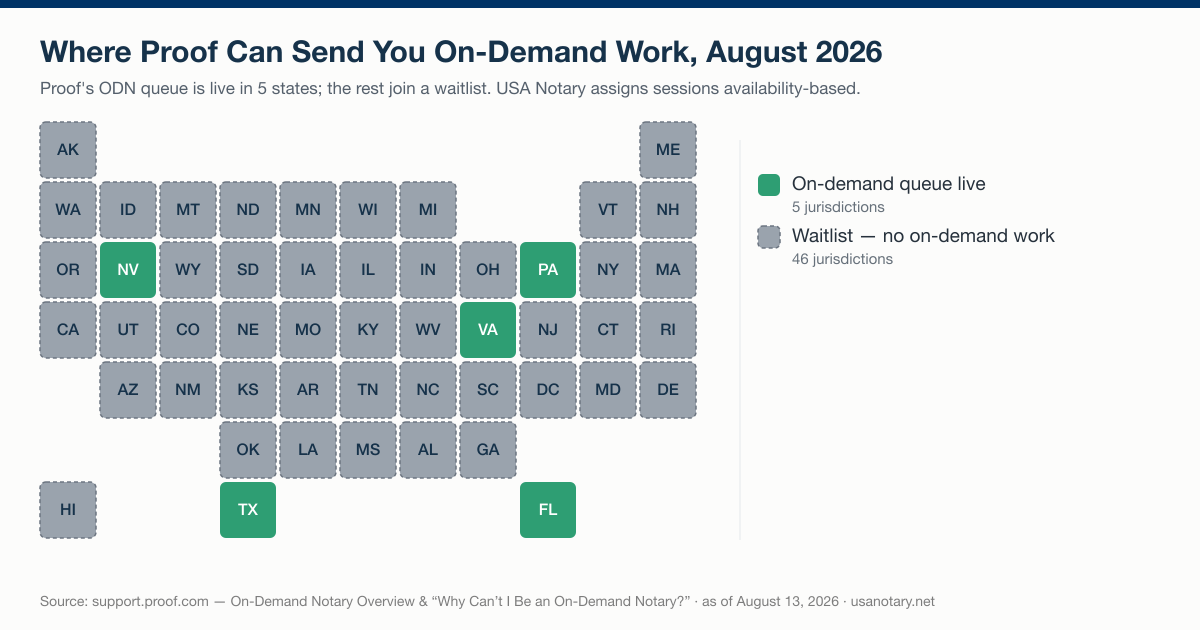
The map graphic was rendered August 13, 2026. The five-state list was re-checked against Proof's support article and notaries page on October 1, 2026 and is unchanged.
Why the map looks like this
Proof's on-demand queue covers five states while its NST list covers 32. Proof's own explanation is that it is "constantly working to expand the On-Demand Network as state regulations evolve." In every RON transaction, the notary's commissioning state authorizes the act, so the map shows where Proof sends customers, not where RON is authorized. Ohio and Arizona, for example, appear on Proof's NST list but not its on-demand list: a notary commissioned there finds every client. Proof's advice to notaries outside the five states is the waitlist, or the NST track where it is available.
What to check before you sign up
- Commissioned in FL, NV, PA, TX, or VA? Dual capacity: queue work plus own clients.
- In one of the other 27 NST states? Software only — no assigned work.
- Elsewhere? Neither track is open; Proof offers the waitlist.
Getting Paid and Workflow Friction
Payout mechanics are documented in Proof's help center. Three details deserve attention before you build a business on the platform.
Stripe payouts — with a 30-business-day correction window
ODN earnings arrive via Stripe Connect on a daily, weekly, or monthly frequency you pick — a clean setup. Proof's own payout guide adds one caveat worth planning around: allow up to 30 business days for payout correction requests to reflect in your account (as of October 1, 2026). If a payout is wrong, the fix can take up to six calendar weeks.
ODN-hybrids must bill their own clients off-platform
An ODN who also serves their own clients as an NST cannot collect payment through Proof at all. Proof's instructions: "you may only charge signers outside of the Proof platform via a third party such as Zelle, Venmo, or CashApp." Your assigned work is paid through Stripe; your own clients pay through a third-party app, so a hybrid notary operates two billing systems. NST-only notaries outside the five ODN states have another option: Proof's NST overview says signers can pay through Proof, with funds routed through Stripe and paid out daily, weekly, or monthly.
No bookable time slots for your clients
Proof's NST FAQ states it directly: "A customer cannot schedule a meeting with you for a specific date and time on the Proof platform." The workaround is coordinating outside the platform, attaching a date to the transaction — and accepting that "the time shown … does not lock access before or after." For a bring-your-own-clients product, scheduling is the workflow gap.
Proof vs the Membership Model
Affiliation disclosed: USA Notary operates the membership model described here. The structural difference between the two approaches is factual either way.
How we compare
- Inclusion criteria. Our full platform comparison includes platforms with a public notary sign-up page and notary-side terms stated on their own pages. Proof qualifies: it publishes a per-transaction price and a payout schedule, and it states its coverage (five on-demand states, 32 NST states).
- Where each figure comes from. Proof's own help-center, pricing, and notaries pages, plus the NNA's own page for the signing-agent price, all linked in the source log and retrieved October 1, 2026. Proof notes that its pricing plans are subject to change, so the linked page controls.
- Arithmetic. Take-rates use two published numbers, what Proof pays the notary and what Proof charges the signer, and show both inputs.
- Disclosure. USA Notary publishes this review and competes with Proof for notary members. USA Notary's own fees carry their own date (August 20, 2026).
| Proof (Notarize) | USA Notary membership | |
|---|---|---|
| Monthly cost | $0 (verified October 1, 2026) | $19.95 / $29.95 / $49.95 tiers |
| Per-transaction cost | NST: $10 + $3/extra seal; queue calls: none listed (verified October 1, 2026) | Per-session fee of $12 / $10 / $8 by tier, + $3 IDV/KBA |
| Assigned work | ODN queue in 5 states; waitlist elsewhere | Assigned signing sessions included in membership, availability-based |
| Own-client tools | NST track — no customer-booked meeting times; ODN-hybrids bill off-platform (NST-only notaries can have signers pay through Proof) | SharpNote tools to bring, keep, and serve your own clients |
| Digital certificate | Provided by Proof; no separate charge listed | Included in platform onboarding |
Choose Proof if
You hold a commission in Florida, Nevada, Pennsylvania, Texas, or Virginia and want title-agent and lender-initiated real-estate work at $25 per completed transaction with no subscription — or you want a no-subscription RON tool for occasional own-client work and can live without customer-booked meeting times (and, in the five ODN states, without on-platform billing for your own clients). Proof's no-subscription pricing and published pay schedule are real strengths.
Choose a membership if
You are commissioned outside the five ODN states, or you want assigned work and an own-client business on one system. USA Notary assigns paid signing sessions to member notaries — availability-based, in any state where members are commissioned — and bundles the client database, follow-ups, and billing under one login. See how the notary side of the platform works and compare current membership tiers and per-session pricing.
Weighing more than one platform?
This page covers Proof alone. For all-in monthly costs, payout schedules, and who actually sends work across the major platforms, read the full RON platform comparison for working notaries.
View USA Notary membership pricingFrequently Asked Questions
Source log — pages retrieved October 1, 2026
- Proof Help Center: Pay Structure and Payout Guide for On-Demand Notaries — payouts, active states, Stripe Connect, 30-business-day corrections.
- Proof Help Center: Fees for Notary-Sourced Transactions — $10, $3, $7.50, first transaction free, one free per ten meetings.
- Proof Help Center: Notary-Sourced Transactions (NST) Overview — 32 NST states, dual capacity, how NST signers pay, scheduling limit, requirements by capacity.
- Proof Help Center: On-Demand Notary Overview — NNA ID steps, $25,000 E&O, Proof Academy training, waitlist wording.
- Proof Help Center: Why Can't I Be an On-Demand Notary? — the five active states and the waitlist.
- Proof Help Center: NNA and NSA Requirements | On-Demand Notaries — NNA ID and NSA certification required; NNA membership not required.
- Proof Help Center: Errors and Omissions Insurance (E&O) — $25,000 (retail and business) and $100,000 (real estate) per occurrence.
- Notarize (Proof): Pricing — $25 consumer price, "Join for free," $5 on-demand earnings, $10 + $3 notary-sourced fees; Notarize for notaries — "Available In" state lists.
- National Notary Association: How to Become a Notary Signing Agent — "starts at $199."
- USA Notary (ours): usanotary.net/pricing — membership and session fees, as of August 20, 2026.