
For Notaries · Platform Comparison
Best Remote Online Notarization Platforms for Notaries (2026)
No single RON platform wins for every notary: Proof publishes payouts of $5–$25 but runs its on-demand queue in only five states. USA Notary is our platform, disclosed; every competitor figure below comes from that platform's own public pages.
Last updated: October 1, 2026 · By Andrew Ray Yon, MBA, ChFC — CEO & Founder, USA Notary
Competitor information verified: October 1, 2026 against Proof, OneNotary, BlueNotary, Notary Hub, and NotaryLive (each platform's own page; the method and full source log are below). USA Notary's own fees carry their own date: August 20, 2026.
Are You a Notary or a Signer?
This page is for commissioned notaries choosing where to work — it compares what each platform costs you and pays you. If you are a signer who needs a document notarized, the platforms are ranked on completely different criteria (price per document, hours, international support): see our consumer comparison of the best online notary services instead.
This page compares six remote online notarization platforms for commissioned notaries: USA Notary, Proof (Notarize), OneNotary, BlueNotary, Notary Hub, and NotaryLive. We first fetched their published pricing pages, fee schedules, and notary help-center articles on August 13, 2026 and re-fetched them on October 1, 2026 (the source log is in the methodology). From those published numbers we computed two tables: the all-in monthly cost of running 5, 15, and 30 sessions on each platform, and a league table of what each platform pays when it sends the work. The arithmetic is shown so you can check it.
What a RON Platform Does for a Notary
A RON platform supplies the technology a commissioned notary needs to notarize over live video: identity proofing (IDV) and knowledge-based authentication (KBA) of the signer, credential analysis, the audio-video session itself, session recording and storage, an electronic journal, and the digital seal workflow. The platform is infrastructure, not authority — the notary's commissioning state authorizes the act, and no platform can extend your commission beyond what your state permits.
Platforms differ on two axes that decide what you actually earn. First, the fee model: a monthly subscription, a per-session fee, or both — and whether IDV/KBA and extra seals cost more. Second, the work model: whether the platform only hosts sessions for clients you bring, or also routes its own consumer demand to you — and if so, whether that routing is a first-come queue, an invitation tier, or an assignment system. The marketing pages blur these axes; the fee schedules and help-center articles, quoted below, do not.
The 6 Platforms Compared
All competitor prices and fees below are as published on each platform's own pages. USA Notary is our platform — treat its row with the same scrutiny as the others.
How we compare
- Who is included. Platforms with a public sign-up page for commissioned notaries and notary-side terms stated on their own public pages: the price or fee, the payout where the platform pays one, and the states it serves or hires in where it routes work. NotaryLive is included although it publishes no per-session pay for notaries; its rows say "not published" instead of estimating.
- Where each figure comes from. The platform's own pricing, fee-schedule, payout, jobs, or help-center page, linked in the source log. No figure in the competitor rows comes from a review site, forum, or third-party list.
- How fresh it is. Competitor figures were re-fetched on October 1, 2026. Plan prices change, so the linked page controls. USA Notary's own fees carry their own date (August 20, 2026).
- How cost is computed. Published subscription plus published per-session fee times the number of sessions, with the formula shown in the table. Where a platform publishes no per-session fee for notaries, the cell says "not computable".
- Disclosure. USA Notary is our platform; its rows are marked "(ours)" and come from our own published pricing. The order of platforms in these tables is not a ranking.
Competitors verified October 1, 2026 · USA Notary fees as of August 20, 2026
| Platform | Subscription | Own-client session fee | Free tier? | Sends you work? | Business tools |
|---|---|---|---|---|---|
| BlueNotary | Notary Pro $27/mo month-to-month; $297/yr (≈ $24.75/mo) or $648 for 3 yrs (≈ $18.00/mo); Basic is free | $5 first seal, $0 extra seals (private billing, Pro only); $10 per notarization if BlueNotary bills the signer | Yes — "Get started free" | Open calls — first-come grab, Pro only | Free eSeal & digital certificate (Pro); eJournal and 10-year storage on free Basic |
| Notary Hub | $35/mo or $325/yr | $5 per signing (1–3 stamps), $9 (4+); IDV/KBA $0 | No (1 free signing/mo once subscribed) | Occasional "organic opportunities," which it calls "not guaranteed" | Storefront booking, MISMO-certified platform |
| NotaryLive | None — free software | Not published — earnings are "specified prior to each session" | Yes — free at every level | Pool sessions from the invite-only Silver level up; Bronze waits for a spot | Dashboard, public profile, session storage |
| OneNotary | $0 (Basic) or $25/mo (Professional) | $13 + $5/extra seal (Basic); $10 + $4/extra seal (Pro) | Yes — real $0/mo, pay-per-use | Jobs page hiring in FL, PA, VA (approved profile + onboarding quiz) | Browser-based sessions, e-journal, 10-year session-video storage |
| Proof (Notarize) | None | $10 per transaction + $3 per extra seal | Free to join; first transaction free | On-demand queue in 5 states only | Templates, document tagging, per-transaction fee setting; customers cannot book a set meeting time on-platform (its NST FAQ) |
| USA Notary (ours) | $19.95 / $29.95 / $49.95 per month | $12 / $10 / $8 per session by tier, + $3 IDV/KBA ($2 IDV + $1 KBA) | No | Yes — assigned, availability-based | SharpNote suite: client database, follow-ups, testimonials, payments |
USA Notary — the disclosed membership model
USA Notary is our platform, so read this paragraph as a vendor describing itself. Membership runs $19.95, $29.95, or $49.95 a month, with a per-session fee of $12, $10, or $8 by tier plus $3 IDV/KBA ($2 IDV + $1 KBA) — the full membership pricing is published here. Two things distinguish the model: USA Notary assigns paid signing sessions to member notaries from its consumer service — assignment is availability-based and not guaranteed in volume — and membership includes SharpNote tools to bring, keep, and serve your own clients (client database, automated follow-ups, testimonials, payments). The honest trade-off shows in the cost table below: at pure software economics, USA Notary is not the cheapest seat in this comparison. The membership is priced as a bundle of software plus assignment access, with no course upsells.
Proof (Notarize) — no subscription, published payouts, five-state queue
Proof lets notaries "Join for free" and lists no subscription: notary-sourced transactions cost $10 per transaction plus $3 per additional seal (verified October 1, 2026), with the first transaction free and a free transaction earned every 10 completed meetings. Proof also publishes its on-demand payout schedule in full — a transparency point in its favor. The catch is scope: its on-demand queue operates in five states (Florida, Nevada, Pennsylvania, Texas, Virginia), and payout corrections can take up to 30 business days per its own payout guide. Our deep dive on what working on Proof actually pays covers the on-demand economics line by line.
OneNotary — the real $0 tier, priced per use
OneNotary's Basic tier is genuinely $0 a month: you pay $13 per session with one seal plus $5 per extra seal (verified October 1, 2026); the Professional tier is $25 a month at $10 per session plus $4 per extra seal. Run the arithmetic and Basic stops being the cheaper option at about nine sessions a month ($13 × 9 = $117 versus $25 + $10 × 9 = $115). OneNotary also recruits notaries for work it sources — its jobs page is hiring in three states (Florida, Pennsylvania, Virginia) and lists "Growing volume of notarization requests" among what it offers, behind profile approval and an onboarding quiz. We compare it head-to-head in OneNotary vs BlueNotary for working notaries.
BlueNotary — low own-client fee, first-come open calls
BlueNotary's Notary Pro costs $27 on its month-to-month plan, $297 a year (about $24.75 a month), or $648 for three years (about $18.00 a month) per its pricing page (verified October 1, 2026). When a Pro member bills the client privately, the platform fee is $5 for the first seal and $0 for additional seals per its published fee schedule — the lowest own-client cost we computed at 15 and 30 sessions — and a free Basic tier exists. The weakness is the work model: BlueNotary-sourced jobs arrive as "open calls" that are first-come, first-serve, pay $5–$10 per completed call, exclude Alabama notaries, come with no guaranteed volume, and carry account-suspension risk if you pick one up and fail to complete it — all per BlueNotary's own help center. BlueNotary's help pages also disagree with each other on the private-billing fee (see the methodology). If that model is why you're shopping, start with our BlueNotary alternatives guide for working notaries.
Notary Hub — all-inclusive sessions, supplementary work
Notary Hub charges $35 a month or $325 a year (verified October 1, 2026) plus $5 per signing covering up to three stamps ($9 for four or more), with IDV and KBA included at no extra charge and one free signing a month — a clean, genuinely all-inclusive session price. Its platform is MISMO-certified and the storefront booking page is well built. Two caveats from its own pages: cloud-based document signing requires a separate X.509 signing certificate, and Notary Hub itself says its organic opportunities are "supplementary and not designed to be your primary source of business" and "not guaranteed" — this is own-client software, not a work source.
NotaryLive — free software, undisclosed pay
NotaryLive gives notaries free RON software at every level and pays for completed pool sessions — but publishes no rate: its own page states "Compensation varies depending on certain conditions. The amount you will earn is specified prior to each session" (verified October 1, 2026). Its notary-levels table lists "Get paid notarizing individual sessions from our general customer pool" at Silver and above, and Silver, Gold, and Platinum are marked "Invite Only." NotaryLive onboards notaries in 29 listed states, and Bronze notaries are told "we will reach out to you once a spot opens up." Free is real here; predictable is not.
All-in Cost at 5, 15, and 30 Sessions a Month
Subscription prices are what platforms advertise; the per-session fee is what determines your real monthly bill. The table below computes subscription plus platform fees for an own-client general-notary-work practice at three volumes, from the published numbers above. Each platform is priced on its month-to-month plan where it offers one.
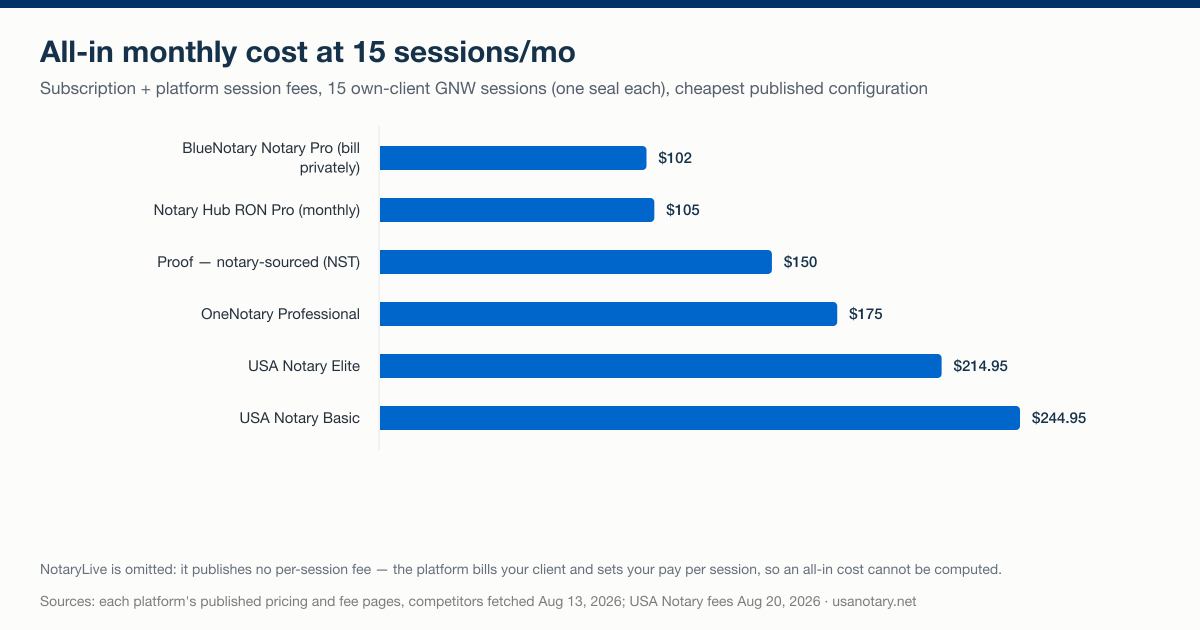
All-in monthly cost at 15 sessions/mo on month-to-month plans, computed from each platform's published pricing pages: competitor figures verified October 1, 2026; USA Notary's own fees as of August 20, 2026.
Competitors verified October 1, 2026 · USA Notary fees as of August 20, 2026
| Platform & plan | Monthly cost formula | 5 sessions | 15 sessions | 30 sessions | Sends you work? |
|---|---|---|---|---|---|
| BlueNotary Notary Pro monthly (bill privately) | $27 + $5 × N | $52 | $102 | $177 | Open calls — first-come grab, Pro only |
| Notary Hub RON Pro (monthly) | $35 + $5 × (N − 1) | $55 | $105 | $180 | Occasional "organic opportunities," which it calls "not guaranteed" |
| NotaryLive | Not computable — no per-session fee for notaries is published; NotaryLive says the amount you earn "is specified prior to each session" | Pool sessions from the invite-only Silver level up | |||
| OneNotary Basic | $0 + $13 × N | $65 | $195 | $390 | Jobs page hiring in FL, PA, VA |
| OneNotary Professional | $25 + $10 × N | $75 | $175 | $325 | Jobs page hiring in FL, PA, VA |
| Proof — notary-sourced (NST) | $0 + $10 × N | $50 | $150 | $300 | On-demand queue in 5 states only |
| USA Notary Basic (ours) | $19.95 + ($12 + $3) × N | $94.95 | $244.95 | $469.95 | Yes — assigned, availability-based |
| USA Notary Pro (ours) | $29.95 + ($10 + $3) × N | $94.95 | $224.95 | $419.95 | Yes — assigned, availability-based |
| USA Notary Elite (ours) | $49.95 + ($8 + $3) × N | $104.95 | $214.95 | $379.95 | Yes — assigned, availability-based |
Read the table both ways. On raw software cost, BlueNotary and Notary Hub are cheapest at 15 and 30 sessions, Proof's no-subscription $10 per transaction is cheapest at 5, and USA Notary's membership costs more than those three at every volume computed here — that is the honest price of a bundle that also includes assignment access and the SharpNote business suite, and you should weigh whether that bundle earns its premium for your practice using the full costs-and-fees breakdown. Note also what each fee buys: Proof's $10 and Notary Hub's $5 include IDV/KBA, OneNotary's session prices include identity proofing, BlueNotary's $5 private-billing fee covers KBA and ID processing, and USA Notary itemizes IDV/KBA at $3 ($2 IDV + $1 KBA) on top of the per-session fee.
Methodology & sources
- Scenario: N own-client general-notary-work sessions per month, one seal and one signer each, each session inside 30 minutes (USA Notary bills $0.25/minute past 30), notary billing the client directly wherever the platform allows it.
- Each cell = published subscription + published platform fee × N. Example, USA Notary Basic at 15: $19.95 + ($12 + $3) × 15 = $244.95. Example, BlueNotary Pro monthly at 15: $27 + $5 × 15 = $102.
- Notary Hub's row deducts its published 1 free signing per month: $35 + $5 × (N − 1). Its $325/year plan (= $27.08/month) would lower each cell by $7.92.
- BlueNotary's row uses the $27 month-to-month Notary Pro plan with private billing ($5 first seal, Notary Pro only). BlueNotary's pricing page also lists Notary Pro Annual at $297 a year (≈ $24.75 a month) and Notary Pro 3-Year at $648 (≈ $18.00 a month), which would lower each cell by $2.25 or $9.00. If BlueNotary bills the signer instead (standard billing), the earnings calculator on its pricing page deducts $10 per notarization, making the cells $77 / $177 / $327.
- BlueNotary's own help pages state the private-billing fee for the first seal three ways: $5 (Notary Fee Schedule, article dated December 19, 2025, and the pricing page), $3 ("Invoice the client on your own/outside of BlueNotary", updated August 28, 2026), and $10 ("Notary - Billing Your Customer", updated June 23, 2026). We use $5, the figure on the fee schedule and the pricing page; at $3 the 15-session cell would be $72, and at $10 it would be $177.
- Proof's row excludes its promotional credits (first transaction free; one free transaction per 10 completed meetings), which would lower real-world cells slightly.
- Excluded everywhere: state commission costs, digital-certificate costs (Notary Hub's cloud signing requires a separate X.509 certificate per its plan-features table), E&O insurance, and payment-processor fees.
- Sources: the log below lists every platform page behind a competitor figure. Each was retrieved October 1, 2026 from the platform's own site.
Source log — competitor pages retrieved October 1, 2026
| Platform | Source page (own site) | What we took from it |
|---|---|---|
| Proof | Pay Structure and Payout Guide for On-Demand Notaries | On-demand states; payout per act; Stripe Connect payouts; 30-business-day correction window |
| Proof | Fees for Notary-Sourced Transactions | $10 per transaction and $3 per additional seal; first transaction free; one free transaction per ten meetings |
| Proof | Notary-Sourced Transactions (NST) Overview | No customer-booked meeting times; features list; how NST signers pay |
| Proof | Why Can't I Be an On-Demand Notary? | Five active on-demand states; waitlist |
| OneNotary | Become an Online Notary (plans) | Basic and Professional prices and per-session fees; what the session price includes |
| OneNotary | Join the OneNotary Team (jobs) | Hiring states; approved-profile and onboarding-quiz gate |
| OneNotary | How to Become an Online Notary guide | Earnings per notarization (published June 25, 2020; modified December 7, 2022) |
| BlueNotary | Pricing (notary plans) | Notary Pro monthly, annual, and 3-year prices; free Basic; platform fees; earnings calculator |
| BlueNotary | Notary Fee Schedule | Private-billing fees and platform payouts |
| BlueNotary | Open Calls | First-come rule; $5–$10 payout; Alabama exclusion; suspension risk; no volume guarantee |
| BlueNotary | Invoice the client on your own and Notary - Billing Your Customer | The $3 and $10 private-billing fees that conflict with the $5 above |
| Notary Hub | Pricing | Monthly and yearly prices; $5 and $9 per-signing fees; IDV/KBA included; one free signing a month; X.509 certificate note |
| Notary Hub | Does Notary Hub Provide Work Opportunities for Notaries? | "Supplementary" and "not guaranteed" wording; the 70% / 30% notification split |
| NotaryLive | Join our Platform (notary page) | Free software; compensation wording; 29 onboarding states; Bronze wording |
| NotaryLive | Notary Levels | Bronze-to-Platinum table; which levels are invite-only and get pool sessions |
| USA Notary (ours) | USA Notary pricing | Our own membership and session fees, as of August 20, 2026 |
What Each Platform Pays per Signing
Payouts apply only when the platform sources the work. Three of the six publish a schedule; the other three either don't pay per signing or don't publish the number. All competitor figures come from the pages in the source log above.
Competitors verified October 1, 2026 · USA Notary fees as of August 20, 2026
| Platform | Published payout for platform-sourced work |
|---|---|
| BlueNotary | Open-call seal: $5–$10 · seal by invitation: $20 (Pro) / $15 (free member) · additional seals: $4 · closing by open call: $30 · closing by invitation: $125 (signer charged $150) |
| Notary Hub | No payout schedule published. You set your own client rates and "keep what you charge, platform fees apply" (its pricing page). |
| NotaryLive | Not published — "Compensation varies depending on certain conditions. The amount you will earn is specified prior to each session." |
| OneNotary | $10 first notarization + $3 each additional; after 100 notarizations, platform requests drop to $6 — per OneNotary's own guide (published June 2020, last modified December 2022; treat as dated) |
| Proof (Notarize) | Retail/business: $5 first seal + $1 each additional · full real-estate signing: $25 · HELOC: $20 · remote witness: $3.50 · trusted referee: $5 |
| USA Notary (ours) | Per-assignment payment for assigned sessions; USA Notary publishes no payout schedule and makes no earnings claims. |
The take-rate math is worth doing once. A $25 general notarization sourced by the platform pays the notary $5 of $25 (20%) on Proof's retail queue, $5–$10 of $25 (20–40%) on a BlueNotary open call, and $10 of the $25 the signer pays (40%) on OneNotary per its dated guide. The highest single published payout anywhere in this comparison is BlueNotary's $125 closing by invitation. The structural point: where a platform publishes a payout for its own sourced general notary work, the notary receives a fraction of the consumer fee. Notary Hub draws the practical conclusion in its own words: organic opportunities are "supplementary and not designed to be your primary source of business," and its most successful notaries "take an active role in business development through their personalized Notary Storefront."
Who Actually Sends You Work — In Their Own Words
"Does the platform send work?" is the question this table answers, and each platform addresses it on its own pages — usually in the help center rather than the homepage. Quoted verbatim from those pages, retrieved October 1, 2026:
| Platform | Its own words | What that means for you |
|---|---|---|
| BlueNotary | "Open calls are first come, first serve." · "If you do pick up an open call and fail to complete the session, you may risk suspension of your account." · "We do not guarantee a certain volume for open calls." · "Alabama Notaries Public are not eligible" | A grab race, not an assignment; $5–$10 per completed call, Pro members only, no volume guarantee |
| Notary Hub | Organic opportunities "are supplementary and not designed to be your primary source of business" · "They are not guaranteed" · notifications go out "in waves," ~70% to established notaries, 30% reserved for newcomers | Occasional organic opportunities by its own description; the storefront is the product |
| NotaryLive | "Notaries join our team based on demand." · "However, we may periodically send sessions from NotaryLive's general customer pool." · Bronze notaries: "we will reach out to you once a spot opens up" · Silver, Gold, and Platinum are marked "Invite Only" | Pool sessions are discretionary ("may periodically send"), and its levels table puts pool pay at the invite-only Silver level up; pay is specified per session, not up front |
| OneNotary | "We're hiring Remote Online Notaries in Florida, Pennsylvania, and Virginia!" — behind an approved profile and an onboarding quiz | Hiring is open in 3 states, after profile approval and a quiz |
| Proof | "To join the Notarize Network as an On-Demand Notary, you must currently hold a commission in one of five active states" — Florida, Nevada, Pennsylvania, Texas, Virginia | An on-demand queue exists only in 5 states; everyone else joins a waitlist or brings their own clients |
| USA Notary (ours) | USA Notary assigns paid signing sessions to member notaries; assignment is availability-based and not guaranteed in volume or frequency | Assigned work is part of the membership, with the same no-volume-promise honesty we hold competitors to — how USA Notary assigns opportunities |
The pattern across all six: none of the pages we read promises a volume of work, and the platforms that route consumer demand gate it — by state, by invitation, by testing, or by grab race. Notary Hub states the hybrid approach outright — platform-sourced work as a supplement, your own client base as the foundation — and Proof, BlueNotary, OneNotary, and NotaryLive each also sell a way to serve your own clients.
How to Choose by Situation
You already have clients and want the cheapest seat: BlueNotary Notary Pro with private billing ($27 + $5/session) or Notary Hub ($35 + $5/signing, IDV/KBA included) produce the lowest all-in bills at 15 and 30 sessions a month; at 5 sessions Proof's $0 + $10/transaction is lower. Budget for Notary Hub's separate X.509 certificate if you need cloud signing. Both prices assume you bring the work: BlueNotary's assignments are first-come open calls on the Pro plan only, and Notary Hub's own documentation calls its organic opportunities "supplementary and not designed to be your primary source of business" and "not guaranteed" — so the cheapest seat is the right answer when you already have a client book, and the wrong one when you need the platform to supply signings.
You want zero fixed cost while volume is uncertain: OneNotary Basic ($0 + $13/session) or Proof NST ($0 + $10/transaction) let you pay only when you work. On OneNotary, Professional becomes the cheaper plan at about 9 sessions a month (the crossover computed above); Proof has no subscription tier to switch to, and at 15 sessions its $10 per transaction costs $150 against $102–$105 for BlueNotary Pro and Notary Hub. Pay-per-use quietly becomes the expensive option at volume.
You're commissioned in FL, NV, PA, TX, or VA and want queue volume: Proof's on-demand queue is live in exactly those five states, at $5 + $1 retail rates and $25 full real-estate signings. Read our Proof/Notarize notary review before committing — the startup stack is notary-funded.
You want assigned work plus tools to build your own book: USA Notary bundles both — assigned sessions (availability-based) and the SharpNote business suite — for a flat membership with a published per-session fee and no course upsells. BlueNotary Pro and OneNotary also pair own-client tools with platform-sourced work, on different terms (first-come open calls; hiring in three states). USA Notary's bundle costs more than bare software; compare the membership tiers against the cost table above and decide with the numbers in front of you.
You want free software and accept opaque pay: NotaryLive's software costs nothing at any level — the trade is that it specifies your compensation session by session ("prior to each session") and pool pay starts at the invite-only Silver level.
Run Your Own Numbers
Take your real monthly session count, run it through the cost formulas above, and weigh the platforms' published payouts against what you charge your own clients. If the assigned-work-plus-tools bundle fits your practice, see what membership includes and what it costs — every number is published.