
BlueNotary Alternatives:
5 Platforms for Notaries Compared
By Andrew Ray Yon, MBA, ChFC — CEO & Founder · Last updated: October 1, 2026 · Competitor information verified: October 1, 2026
BlueNotary sends platform-sourced work to Notary Pro members ($27/month) as first-come, first-serve open calls paying $5–$10 a seal, and its helpdesk says volume is not guaranteed. The five alternatives differ on who brings the work: USA Notary (our platform — affiliation disclosed) includes assigned sessions in membership, Proof pays a published schedule with no subscription listed, OneNotary's jobs page names three states, NotaryLive offers free own-client software, and Notary Hub bundles IDV/KBA. Competitor figures were read from each provider's own pages on October 1, 2026.
On this page
Why Notaries Look for a BlueNotary Alternative
BlueNotary's open-call work model — not its notarization software — sets the limits on platform-sourced work. BlueNotary-sourced jobs arrive as "open calls" that are, in the platform's own words, "first come, first serve." Its helpdesk article on open calls (updated June 23, 2026) states plainly: "DISCLAIMER: We do not guarantee a certain volume for open calls." The same article adds that picking up a call and failing to complete it "may risk suspension of your account," and that Alabama notaries are not eligible to participate. Open calls pay $5–$10 per completed seal and are available only to Notary Pro plan users ($27/month billed monthly, $297/year billed annually; as of October 1, 2026).
BlueNotary, LLC's profile with the BBB of Chicago & Northern Illinois shows the business is not BBB Accredited and lists 14 complaints in the last three years, 11 of them unanswered (3 answered), per BBB's complaint-status breakdown as of October 1, 2026. Complaint themes include refund refusals on memberships and courses, digital-certificate and e-seal problems, and earnings expectations: one complainant on a paid Pro plan wrote in August 2025 that they had "only been able to successfully claim 1 witness session making $5.00." Those are BBB complainants' own accounts — BBB notes it does not verify third-party information and that profiles generally cover a three-year reporting period.
Summarized from BlueNotary's own published pages, the four friction points are:
- A grab race, not an assignment. Open calls go to whoever clicks first — speed, not availability scheduling, decides who works.
- No volume guarantee. BlueNotary's helpdesk disclaims any certain volume of open calls — the $27/month Pro fee buys eligibility, not work.
- Suspension risk. Accepting an open call and not completing it can put the account at risk, per the same article.
- Coverage gaps. Alabama notaries are "not eligible to participate at this time" in open calls (as of October 1, 2026).
The 5 BlueNotary Alternatives, Ranked by Work Model
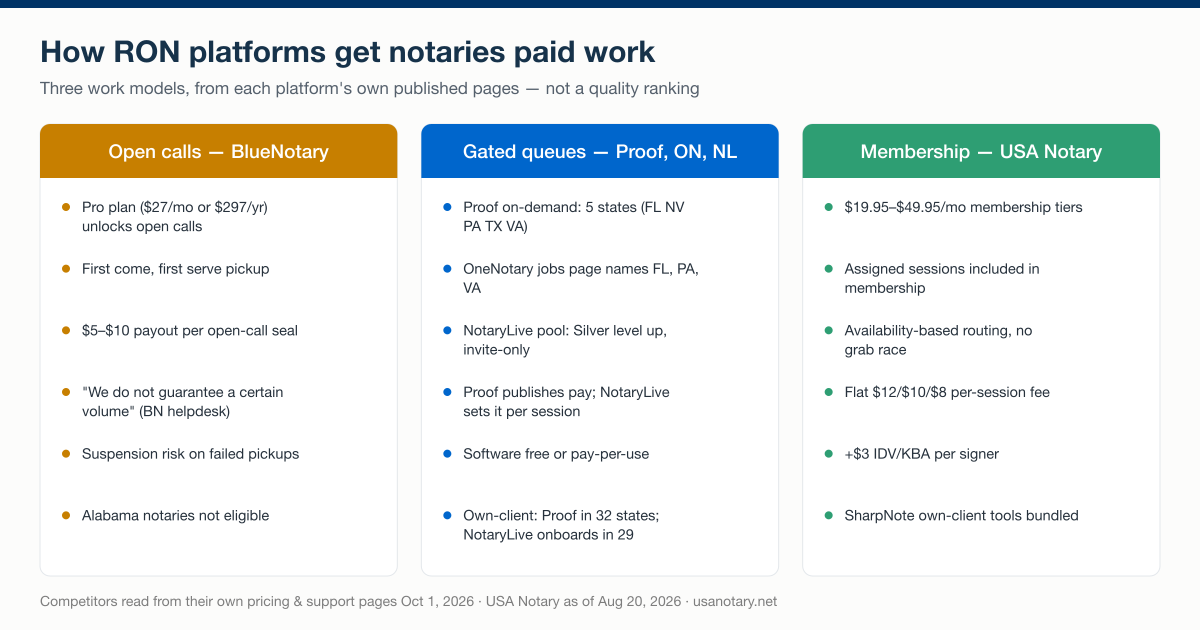
Every RON platform answers one question differently: who brings the work? The chart below groups the field into three models; the table and profiles that follow use each platform's own published pricing. The numbering follows work model, not quality. For the full six-platform economics, see our six-platform RON comparison.
| Platform | Monthly cost | Per-session cost or cut | Sends you work? | Best for |
|---|---|---|---|---|
| BlueNotary (baseline) | Free Basic; Pro $27/mo, or $297/yr billed annually | $10 per BN-billed GNW notarization; $5 first seal if you bill privately (Pro) | Open calls: Pro-only, first-come, $5–$10/seal, volume not guaranteed | Free-tier own-client GNW |
| 1. USA Notary (ours) | $19.95 / $29.95 / $49.95 | $12 / $10 / $8 + $3 IDV/KBA | Yes — assigned sessions included, availability-based | Assigned work + own-client tools in one membership |
| 2. OneNotary | $0 Basic; $25 Pro | $13 + $5/extra seal (Basic); $10 + $4 (Pro) | Jobs page names FL, PA and VA; approved profile + onboarding quiz first | $0-to-start, low volume |
| 3. Proof (Notarize) | $0 listed — per-transaction fees only | You pay $10/transaction + $3/extra seal (NST); queue pays $5 + $1/seal retail, $25 real estate, $20 HELOC | On-demand queue in 5 states (FL, NV, PA, TX, VA); own-client (NST) in 32 states; waitlist for other states | No-subscription queue in its 5 states |
| 4. NotaryLive | $0 | Not publicly available — pay "specified prior to each session" | Pool sessions from Silver level up, by invite; onboarding notaries in 29 states | Free own-client RON software |
| 5. Notary Hub | $35 (or $325/yr) | $5 per signing up to 3 stamps; $9 for 4+; IDV/KBA included | Platform-sourced "organic opportunities" are "supplementary and not designed to be your primary source of business" and "not guaranteed" (its article) | Storefront-driven own-client businesses |
GNW = general notary work, the term BlueNotary and OneNotary use for standard notarizations (not loan signings or closings). NST = notary-sourced transaction, Proof's term for a session with your own client. Competitor prices and fees are from each provider's own pricing or support pages, read October 1, 2026; USA Notary's own per-session and IDV/KBA fees are as of August 20, 2026. BlueNotary's own pages list three different first-seal fees for private billing; the table uses the pricing page's $5 (see the breakeven math).
Competitor information verified October 1, 2026
Every competitor figure on this page was read on October 1, 2026 from the provider's own pages or, for the BBB and Trustpilot records, from those sites — all linked below. USA Notary (our platform) is the publisher; its own rows are dated August 20, 2026 and were not re-checked in this update.
| Provider | Pages read on October 1, 2026 | Figures taken from them |
|---|---|---|
| BlueNotary | Pricing · Notary fee schedule · Open calls · Billing your customer · Invoicing outside BlueNotary | Plan prices, platform fees, payouts, open-call terms |
| OneNotary | Notary pricing · Jobs · Pay guide (June 2020, last modified December 2022) | Plan and per-session fees, hiring states |
| Proof (Notarize) | Payout guide · Notary-sourced fees · On-demand states · NST overview | Payouts, notary-sourced fees, on-demand states (5), notary-sourced states (32) |
| NotaryLive | Become an online notary · Notary levels | Onboarding states (29), level rules, pay wording |
| Notary Hub | Pricing · Work-opportunities article | Plan prices, per-signing fees, organic-opportunity rules |
| Third-party records | BBB profile · BBB complaints · Trustpilot | BlueNotary accreditation, complaint counts, TrustScore — counts roll, so each is shown as displayed on October 1, 2026 |
Method
- Read at the source. Each figure comes from the provider's own pricing, help-center or jobs page. BlueNotary's pricing page builds its plan and fee tables with JavaScript, so those figures were read from the script that renders them (bluenotary.us/js/components.js); Proof's support articles were read through the public Help Center feed of support.proof.com, which returns the same article text.
- Conflicts are printed, not settled. Where a provider's own pages disagree, every figure is listed with its page and date, and the page says which one it uses (see BlueNotary's private-billing fee under the breakeven math).
- Nothing is estimated. A cell says "not published" when the provider publishes no number. Breakevens and take-rates are our arithmetic on published figures and are labelled that way.
- Dates matter. Providers change pages without notice, and BBB and Trustpilot counts roll daily, so every figure is stamped with the day it was read.
1. USA Notary — best if you want assigned work included
Disclosure: USA Notary is our platform. The facts below are the same ones we hold competitors to.
USA Notary replaces the open-call race with membership routing: the platform assigns paid signing sessions to member notaries from its consumer RON service, and assignment is availability-based — you indicate when you can work instead of racing a dashboard (see how opportunities are assigned). Like BlueNotary, we do not guarantee volume. Membership also includes SharpNote tools to bring, keep, and serve your own clients: client database, automated follow-ups, testimonial collection, and payments. Tiers run $19.95, $29.95, and $49.95/month with a flat $12, $10, or $8 per-session fee plus $3 IDV/KBA ($2 IDV + $1 KBA). No training-course upsells.
- Pro: assignment and own-client software in one membership; flat published fees.
- Con: no free tier, and the per-session fee exceeds BlueNotary's $5 private-billing first seal (see the breakeven math below).
2. OneNotary — best free start for low volume
OneNotary's Basic plan is $0/month: unlimited GNW signings at $13 per single-seal session plus $5 per extra seal, and loan signings at a $30 per-session service cost with unlimited seals ("3 free loan signings" is how its plan card words it). Professional is $25/month at $10 per session plus $4 per extra seal (as of October 1, 2026). The arithmetic favors Basic below nine sessions a month ($13 × 8 = $104 vs $25 + $10 × 8 = $105) and Pro above it. OneNotary's jobs program is narrow: its jobs page (updated July 31, 2026) says "We're hiring Remote Online Notaries in Florida, Pennsylvania, and Virginia," and says the opportunity is open to notaries with approved OneNotary profiles who complete an onboarding quiz. Full head-to-head: OneNotary vs BlueNotary compared.
- Pro: true $0 entry; browser-based; IDology KBA and 10-year storage included.
- Con: the jobs page names three states; pay-per-use pricing compounds at volume.
3. Proof (Notarize) — best no-subscription queue, if you live in the right state
Proof's notary pages list no subscription and publish its payout schedule: on-demand notaries earn $5 for the first seal and $1 for each additional on retail and business calls, $25 per completed full real-estate transaction, $20 per HELOC, and $3.50 as a remote witness (per support.proof.com, as of October 1, 2026). The catch is access: the on-demand queue admits notaries commissioned in just five states — Florida, Nevada, Pennsylvania, Texas, and Virginia. Notaries commissioned in the other states on Proof's 32-state notary-sourced list can use Proof only for notary-sourced transactions (your own clients), paying Proof $10 per transaction plus $3 per extra seal — with the first transaction free and a free transaction per 10 completed meetings. Proof's payout article also notes correction requests can take up to 30 business days. Full detail: Proof (Notarize) for notaries: what it pays and what it costs.
- Pro: no subscription listed, published payouts, and own-client (notary-sourced) access in 32 states.
- Con: the on-demand queue is open in only 5 states; retail queue pay starts at $5 + $1 per extra seal.
4. NotaryLive — best free software, opaque pay
NotaryLive gives every notary free RON software to serve their own clients and is onboarding notaries in 29 states (as of October 1, 2026). Paid sessions from its general customer pool start at the Silver level and are invite-only: all notaries begin at Bronze, and NotaryLive says it will "reach out to you once a spot opens up," with notaries "upgraded generally or specifically to meet demand" and "selected based on several factors (e.g. rank, fluent language(s), experience, certifications, etc.)." Its join page adds that it "may periodically send sessions from NotaryLive's general customer pool." Its per-session pay schedule is not publicly available — the site states compensation "varies depending on certain conditions" and "is specified prior to each session."
- Pro: free own-client RON at every level, a public profile, and online storage of session records.
- Con: you cannot price-compare what pool work pays before joining, and access to it is invitation-only.
5. Notary Hub — best storefront for building your own book
Notary Hub charges $35/month or $325/year for RON Pro, with a $5 fee per signing up to three stamps ($9 for four or more), one free signing monthly, and ID verification and KBA included at no extra charge (as of October 1, 2026). Its pitch is the personal storefront: booking, document upload, and payment collection under your own link, plus live video support twice a week. On platform-sourced work, Notary Hub's own article is candid: organic opportunities are "not designed to be your primary source of business" and "not guaranteed," distributed in notification waves (approximately 70% to established notaries, 30% reserved for notaries who joined within the last 90 days). Its plan table notes that cloud-based document signing "Requires Cloud-Based X.509 Document Signing Certificate," and its article makes an "active X509 signing certificate subscription" (or an Identrust certificate) a condition for receiving organic opportunities.
- Pro: IDV/KBA bundled; its RON Pro feature table lists "MISMO Certified Notary Platform"; storefront for client booking, document upload and payment collection.
- Con: the highest entry price for a paid plan in this list ($35/month against $19.95 to $27 for the other paid plans), and the platform itself tells you not to rely on it for work.
BlueNotary vs the Alternatives on Cost: the Breakeven Math
Honest arithmetic first: for own-client, single-seal GNW sessions, BlueNotary Pro is the cheaper software at almost any volume. The table shows monthly platform cost with the formula visible — BlueNotary Pro at $27/month billed monthly plus a $10 cut per BN-billed notarization (or $5 first seal when you bill privately), against USA Notary's membership plus flat per-session fee and $3 IDV/KBA. All inputs are from bluenotary.us/pricing, BlueNotary's helpdesk fee schedule, and our published notary membership pricing, read October 1, 2026 for BlueNotary, with USA Notary's own fees as of August 20, 2026.
| Sessions / month | BlueNotary Pro, BN bills client $27 + ($10 × N) | BlueNotary Pro, you bill privately $27 + ($5 × N) | USA Notary Basic $19.95 + ($12 + $3) × N | USA Notary Elite $49.95 + ($8 + $3) × N |
|---|---|---|---|---|
| 5 | $77.00 | $52.00 | $94.95 | $104.95 |
| 15 | $177.00 | $102.00 | $244.95 | $214.95 |
| 30 | $327.00 | $177.00 | $469.95 | $379.95 |
N = own-client, single-seal GNW sessions per month. Extra seals, signers, and witnesses priced separately on both platforms. BlueNotary fees as of October 1, 2026; USA Notary fees as of August 20, 2026. BlueNotary lists its annual plan ($297/year) at ≈ $24.75 a month and its three-year plan ($648) at ≈ $18.00 a month, which takes $2.25 or $9.00 a month off every BlueNotary figure above (our arithmetic on its published rates).
BlueNotary's own pages list three different private-billing fees
The "you bill privately" column uses $5, the figure on BlueNotary's pricing page and notary fee schedule. Two other BlueNotary help articles list a different platform fee when a Notary Pro member invoices the client outside BlueNotary (all read October 1, 2026):
| BlueNotary page | Date shown | First-seal platform fee | Additional stamp |
|---|---|---|---|
| Pricing page ("Our cut") | Read October 1, 2026 | $5 | $0 |
| Notary fee schedule | Updated January 30, 2026 (heading: December 19, 2025) | $5 | $0 |
| Billing your customer ("Your Own Invoice") | Updated June 23, 2026 | $10 | $2 |
| Invoicing outside BlueNotary | Updated August 28, 2026 | $3 | $0 |
The pages do not say which figure supersedes the others. At $3 a seal BlueNotary's lead in the table widens further; at $10 the private-billing column equals the BN-billed one. The BN-billed column has a similar split: the pricing-page calculator applies a $10 fee per notarization to Basic and Pro alike, while the fee schedule pays $20 per invitation seal to Pro members and $15 to free members. Confirm the current fee with BlueNotary before relying on any one of them; the full comparison is in OneNotary vs BlueNotary.
What the arithmetic does and doesn't say
The crossover against USA Notary Basic sits between one and two BN-billed sessions a month (at one, $27 + $10 = $37 vs $19.95 + $15 = $34.95; at two, $27 + $20 = $47 vs $19.95 + $30 = $49.95) — beyond that, BlueNotary Pro wins on raw software cost, and private billing at $5 a seal widens its lead. If a spreadsheet of per-seal costs were the whole decision, you would stay on BlueNotary.
The two fees buy different things. BlueNotary's $27 buys software plus eligibility to race first-come open calls paying $5–$10 a seal, with volume expressly not guaranteed. USA Notary's membership includes assigned sessions — the platform assigns paid signing sessions to member notaries on an availability-based schedule — alongside the SharpNote own-client suite, with no training-course upsells. Which model earns more depends on whether you already have clients; the honest answer for a notary with a full book of their own business and no interest in assignments is that BlueNotary or NotaryLive will cost less.
What BlueNotary Does Well
Fairness requires the other column. BlueNotary's free Basic tier is real: its pricing page lists an eJournal, automatic billing and recordings stored for 10 years at no monthly fee, and its fee schedule lists a $15 payout per invitation seal for free members (as of October 1, 2026). BlueNotary publishes that fee schedule on its helpdesk, while NotaryLive publishes no per-session pay figure, though BlueNotary's own pages do not always agree with each other (see the breakeven math above). And BlueNotary is well reviewed overall: Trustpilot's listing for bluenotary.us shows an "Excellent" TrustScore of 4.9 out of 5 across 2,947 reviews (per Trustpilot, as of October 1, 2026).
Both records can be true at once. The 14 BBB complaints over three years that describe what the complainant bought come from notaries and course buyers: refused refunds on memberships and courses, digital-certificate and e-seal problems, and open-call earnings that fell short of expectations. A notary evaluating BlueNotary as a business partner should weight that BBB record alongside the Trustpilot score.
How to Switch From BlueNotary
- 1
Confirm your state authorization carries over. Your RON authority comes from your commission, not your vendor — the notary's commissioning state authorizes the act. Some states require you to notify the state or list your new technology vendor before using it — Delaware, for example, requires notaries approved for electronic or remote notarization to use one of its approved providers and indicate the provider in their Notary Profile (checked October 1, 2026).
- 2
Check your digital certificate's portability before you cancel. Platforms differ on whether an externally issued X.509 certificate is accepted or a platform-issued one transfers out. One BBB complainant reported (January 2024) that a BlueNotary "Lifetime" certificate was not accepted by another platform — that is the complainant's account, but verify with your next vendor either way.
- 3
Export your journal and session records. Your commissioning state sets how long RON journals and recordings must be kept after the act. Download everything before access lapses.
- 4
Mind the billing terms. Several BBB complaints against BlueNotary concern refused refunds on memberships and course purchases; if you are mid-cycle, note your renewal date and cancel ahead of it rather than expecting a prorated refund.
- 5
Run both platforms for a month. Free tiers (OneNotary, NotaryLive) and no-subscription options (Proof) let you trial the workflow with a real session before moving your client base — and before committing to any membership, including the USA Notary platform for notaries.
Frequently Asked Questions
Compare the Membership Model Yourself
Every number above is published and dated. Put ours next to them: membership tiers, flat session fees, and what an assigned session actually looks like.