
Does Bank of America notarize documents?
Yes — Bank of America notarizes documents through notaries on staff at its financial centers, and it charges nothing for the service. The bank’s official notary services page describes it as “available at no cost in many of our financial centers,” with requests routed through the bank’s appointment scheduler rather than walk-up service.
Two qualifiers in that sentence do a lot of work, and the bank’s own page confirms both. First, many financial centers — not all — offer the service, so a notary isn’t guaranteed at your nearest branch. Second, the notary decides at the appointment “whether we are able to complete the notarization,” which means you can arrive with a valid document and still leave without a seal. The rest of this guide covers exactly when that happens and what to do about it.
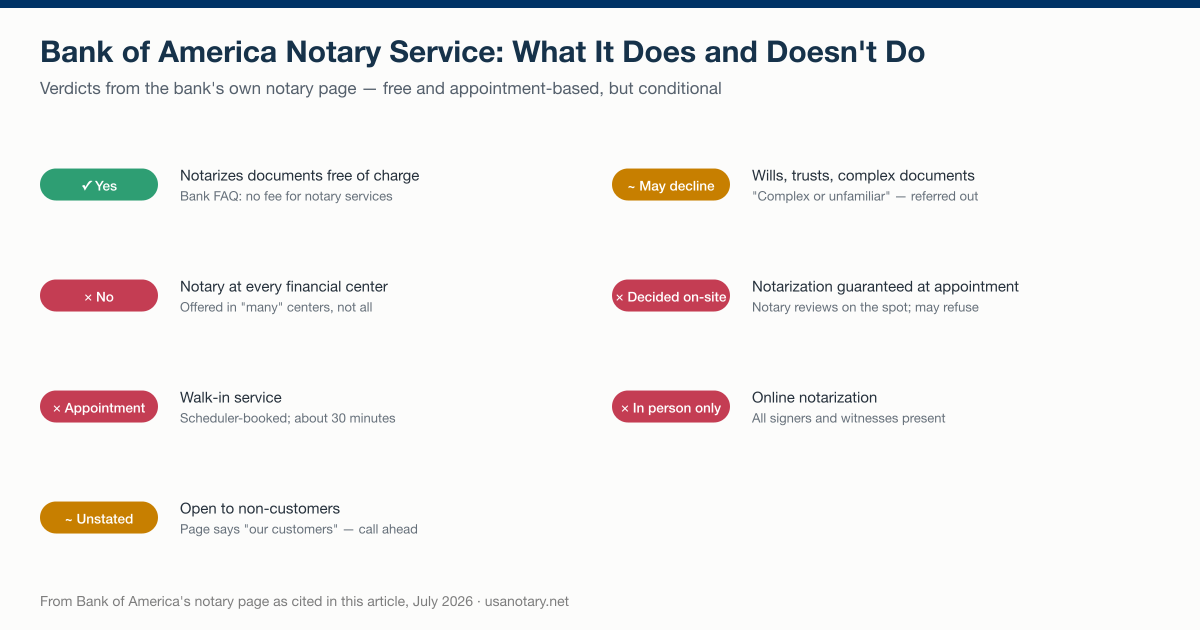
Seven verdicts on Bank of America’s notary service, drawn from the bank’s own notary page as cited in this article, July 2026.
Who can use Bank of America’s notary service?
Bank of America’s notary page never states a customer-only requirement outright — but its service description reads “at no cost to our customers,” and the appointment scheduler sits behind the bank’s own booking system. The page simply doesn’t address non-customers either way.
That silence is the honest answer to the most-asked question about this service. In practice, branch staff apply their own discretion, so a non-customer calling ahead will get a more reliable answer than any web page — including the bank’s. If you don’t bank there and don’t want to gamble on a branch’s policy, a free notary at a bank, library, or credit union you already use is the same zero-cost outcome without the ambiguity.
What to bring to a Bank of America notary appointment
The bank’s page gives three pieces of preparation guidance before you schedule:
- Don’t sign or date the document beforehand — the bank suggests waiting because some documents must be signed and dated in the presence of a notary.
- Bring every page, not just the signature page — the notary reviews the whole document.
- Every signer needs state-acceptable ID, and all signers plus any required witnesses must be physically present at the financial center.
Bank of America says a typical appointment takes about 30 minutes from start to finish. Once you’re in the room, the process follows six steps the bank attributes to state law rather than its own policy: the notary requires the signer to be present in person, examines the document, positively identifies the signer, performs the verbal confirmation, completes the notarial certificate, and records the act in a journal where the state requires one. Only after all six is your document notarized.
When a Bank of America notary will refuse your document
This is the part Bank of America’s marketing copy doesn’t lead with, but its own FAQ lists the refusal conditions explicitly. A notary at the bank “may be unable to complete a notarization” in any of these situations:
| Refusal trigger | Why it blocks the notarization |
|---|---|
| A signer isn’t physically present | Personal appearance is the core requirement of the act |
| Missing pages or blank spaces that affect the document’s intent | The notary can’t certify an incomplete instrument |
| The signer can’t produce ID and isn’t personally known to the notary (California notaries must obtain ID in every case) | Identity can’t be established |
| The notary believes the document may be changed after signing | Tampering risk voids the act |
| No notarial certificate, and the signer can’t say which notarial act is needed | Notaries can’t choose the act for you — that’s legal advice |
| The signer and notary can’t communicate with each other | Willingness and awareness can’t be confirmed |
| The signer doesn’t appear to understand what they’re signing | Capacity is a precondition of the act |
One more line from the bank’s FAQ deserves quoting in full, because it’s the closest Bank of America comes to naming what it won’t handle: “For certain notarial requests that involve complex rules or unfamiliar notarial types, or due to other work obligations, the Notary may recommend that you obtain further consultation with other notary service providers or legal counsel.” Translated: wills, trusts, out-of-state forms, and anything with unusual certificate wording can be turned away not because it’s invalid, but because a bank-branch notary isn’t equipped — or doesn’t have time — to handle it. The bank publishes no list of declined document types, so the review happens at your appointment, after you’ve already made the trip.
The missing-certificate row matters more than it looks: if your document has no pre-printed notarial certificate, the notary cannot tell you whether you need an acknowledgment or a jurat — and at a free bank appointment, that dead-ends the session.
Bank of America notary vs. online notarization
Both routes end with the same thing — your document is notarized and legally recognized. The difference is everything before the seal:
| Bank of America financial center | Remote online notarization | |
|---|---|---|
| Cost | Free (bank FAQ: no fee for notary services) | $25 per document |
| Availability | Appointment at a participating financial center, banking hours | 24/7, from anywhere |
| Time | Typical appointment about 30 minutes, plus the trip | Sessions take 15–30 minutes |
| Who must show up | All signers and witnesses, in person, same branch | Multiple signers can join one session remotely |
| Document review | At the appointment — refusal happens after you arrive | At the start of the session — no trip wasted |
| Output | Paper document with ink seal | Tamper-evident notarized PDF plus a digital audit trail |
Online notarization rests on the same legal footing in nearly every state: the National Association of Secretaries of State confirms that 47 states and the District of Columbia have a law allowing remote e-notarization. The trade is simple — the branch is free but conditional; the online session costs $25 and removes the conditions.
What to do when the branch can’t notarize it
A refusal at the branch doesn’t mean your document has a problem — most of the triggers above are about the notary’s constraints, not your paperwork. When the financial center turns you away, or there’s no participating branch near you, a remote online notarization closes the gap: the platform verifies your identity by video, a commissioned notary reviews the document at the start of the session rather than after a drive to a branch, and the signer completes the notarization in 15–30 minutes. The session produces a tamper-evident PDF and audit trail, and signers in all 50 states can use it — including for the multi-signer situations a single branch appointment makes painful.
One boundary worth restating: getting a document notarized and getting it accepted are separate questions. The venue never controls the recipient’s policy, so if the notarized document is headed to a financial institution, check whether your bank will accept an online notarization before your session.
Other banks and venues that notarize
Bank of America’s model — free, appointment-based, staff-dependent — is the standard big-bank pattern; for how Chase handles notary requests — it publishes less about its policy — see our companion guide, does Chase Bank notarize?. If neither bank works for you, shipping stores, libraries, credit unions, and mobile notaries each trade cost against convenience differently — the full rundown of where to get a document notarized compares them, and what a notary costs at each venue covers the fee side, from free bank appointments to $25 flat online.