
Does Chase Bank notarize documents?
Chase does not publish a notary policy — and its only acknowledgment that branch notaries exist at all is a single line in a branch-services disclosure PDF that lists “Notary Services” among products and services “generally offered” at branches, as of 12/31/2025. That one line is the whole Chase Bank notarization answer in Chase’s own words: no fees, no eligibility rules, no appointment path, and no way to tell which of its roughly 5,000 branches actually staffs a notary. Beyond that PDF, a search of Chase’s site turns up an education article about what notary services are in general, a mortgage explainer about notary signing agents, and branch pages that never mention a notary.
The rest is generic bank guidance in Chase’s own article: banks “may offer complimentary notary services to their customers — for instance, those who hold checking accounts,” and “some banks limit notary services to their customers, and availability can differ by location.” Every word of that is hedged, and none of it commits Chase to anything. In practice a specific branch may well have a notary on staff — but you find that out by calling the branch, not by reading Chase’s website. The rest of this page shows exactly what Chase does publish, how to check your branch in two minutes, and the online route that skips the phone calls entirely.
What Chase’s own pages say about notary service
We pulled the Chase pages a “does Chase notarize” search surfaces — including the branch-services disclosure PDF most searchers never open — and read what each one actually confirms. The gap between what searchers expect and what Chase publishes is stark:
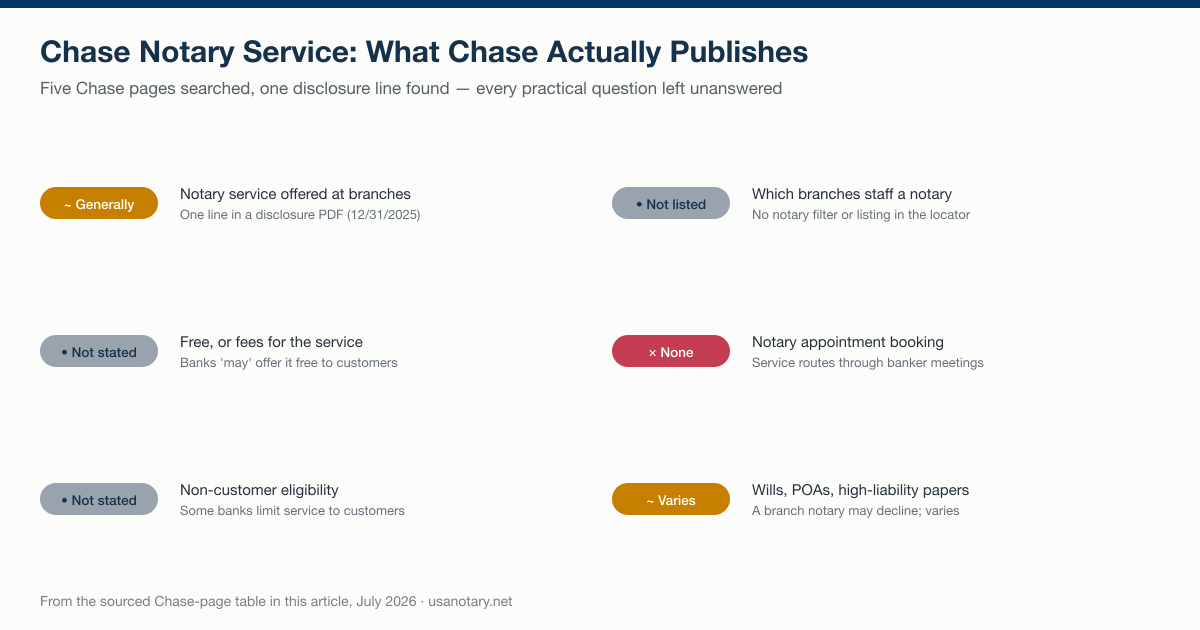
What Chase publishes about branch notary service, from the sourced Chase-page review in this article, July 2026.
| Chase page | What it covers | What it confirms about branch notary service |
|---|---|---|
| What are notary services? (education center) | Generic explainer: what a notary does, where to find one, typical costs | Nothing Chase-specific. Says banks “may” offer complimentary notary services to customers and that “availability can differ by location” |
| Notary signing agents in real estate (mortgage education) | Loan signing agents for mortgage closings | Nothing about branch service — it’s about hiring a signing agent for a home loan, and even suggests “checking with your bank” |
| Power of Attorney Services | Adding a POA agent to a Chase account | Notes a POA sometimes “must be notarized or witnessed” and that a Chase POA form requires an in-person branch visit — but never says a branch notary will perform that notarization |
| Branch locator pages (e.g., Union Square, New York) | Hours, ATM details, branch services | The “Branch services” list names business banking, Chase Private Client, home lending, and J.P. Morgan Wealth Management. Notary service is not listed |
| List of Services disclosure (PDF, as of 12/31/2025) | Branch products-and-services disclosure | Names “Notary Services” as generally offered at branches — but publishes no fees, eligibility, appointment path, or per-branch availability |
That first mortgage page is what Google currently returns as Chase’s top result for the query — a page about hiring a signing agent for a closing, not about walking into a branch with an affidavit. The takeaway: Chase treats notary availability as a branch-level operational detail, not a promoted, bookable service. Its disclosure says notary services are “generally offered,” but documents are notarized at a given Chase branch by whoever on staff holds a notary commission — and no Chase page promises a notary at your branch.
Chase vs. other banks: who publishes a notary policy
The contrast with Chase’s biggest competitor makes the silence more visible. Bank of America maintains a dedicated notary-services page stating the service is “available at no cost in many of our financial centers,” with an online appointment scheduler and a checklist of what to bring — it even tells you a typical appointment takes about 30 minutes. Chase offers no equivalent page, no notary appointment category, and no branch-locator filter.
That doesn’t mean Chase branches lack notaries — it means the two banks made different publishing choices. With Bank of America you can book a notary appointment from the website; with Chase you’re calling a branch and asking. We break down the Bank of America process in our companion guide at the end of this post.
How to confirm notary service at your Chase branch
Since Chase’s website won’t answer for your branch, two minutes of checking will:
- Find your branch on the Chase locator and note the branch phone number on its page — each branch lists a direct line.
- Call and ask three questions: Is a notary on staff? Is the service free for account holders (and available to non-customers)? Do I need an appointment, or can I walk in?
- Ask about your specific document. A branch notary who handles account forms all day may decline a will, a trust, or an out-of-state deed — better to hear that on the phone than at the counter.
- Book through Chase’s meeting scheduler if the branch prefers appointments. Chase routes most in-branch service, including POA paperwork, through scheduled banker meetings.
If the branch confirms a notary, bring the complete, unsigned document and a government-issued ID for every signer. Chase’s own guidance is explicit on the first point: “signing the document before you arrive at the notary may make it invalid.” All signers must appear together — a notary cannot notarize a signature belonging to someone who isn’t present.
When a Chase branch isn’t the right venue
A branch notary — where one exists — suits simple, low-stakes paperwork for account holders during banking hours. Several situations point elsewhere:
- No notary on duty. Commissioned staff take lunch, vacations, and transfers; a branch that had a notary in March may not in July. Every visit is a fresh phone call.
- High-liability documents. A branch notary may decline wills, trusts, and complex estate paperwork under internal risk policies — practices vary by institution, whatever state law allows.
- You’re not a Chase customer. Chase’s article notes some banks restrict notary service to customers; a non-customer has better odds at a genuinely free notary venue like a public library — or a paid one with no membership test.
- Evenings, weekends, or urgency. Branch notaries work branch hours. A document due tomorrow morning doesn’t wait for Monday at 9.
Our guide to getting documents notarized at a bank covers what branch notaries will and won’t handle across institutions, and the full venue comparison of everywhere to get something notarized weighs banks against shipping stores, libraries, and mobile notaries.
Notarize online instead of calling branches
Remote online notarization removes the branch variable altogether. NASS reports that 47 states and the District of Columbia have a law allowing remote e-notarization, and a signer in any of the 50 states can complete a notarization with an online notary commissioned in a RON state. (Chase’s education article cautions that “not all states accept documents that have been notarized electronically” — the NASS count shows how narrow that exception has become.)
The mechanics are simpler than a branch visit: you notarize a document online in a recorded video session where the notary verifies your identity on camera. Sessions run 24/7, take 15–30 minutes, allow multiple signers to join, and each session produces a tamper-evident notarized PDF and a digital audit trail — for $25 per document, no account relationship required.
One boundary worth naming: this page answers whether Chase will perform a notarization. Whether Chase will accept a document you notarized online is a separate question with its own answer — covered in will my bank accept an online notarization. And if you bank across the street, the same venue question for the other big branch network is answered in does Bank of America notarize documents.