
Does a lien waiver need to be notarized?
In most states, no. A lien waiver — the document a contractor, subcontractor, or supplier signs to give up mechanics lien rights in exchange for payment — is enforceable in the large majority of states with nothing more than the claimant’s signature. Two states are the real exceptions: Mississippi and Wyoming both build a notary’s certificate into their statutory lien waiver forms, so waivers in those states are notarized as part of matching the required form.
The confusion in almost every older article comes from Texas. Texas did require notarized lien waivers for a decade — and then removed the requirement. The current Texas Property Code § 53.281 makes a waiver effective if it substantially complies with the statutory form and “is signed by the claimant or the claimant’s authorized agent” — no notary. The statute’s own history line shows the change: amended by HB 2237, effective January 1, 2022. Any list that still names Texas as a notarization state is running on pre-2022 law.
One more wrinkle before the table: state law is only the floor. A prime contract can require notarized waivers anywhere, and in Mississippi and Wyoming the requirement sits in the form itself. Everything below is checked against the current statute text, section by section.
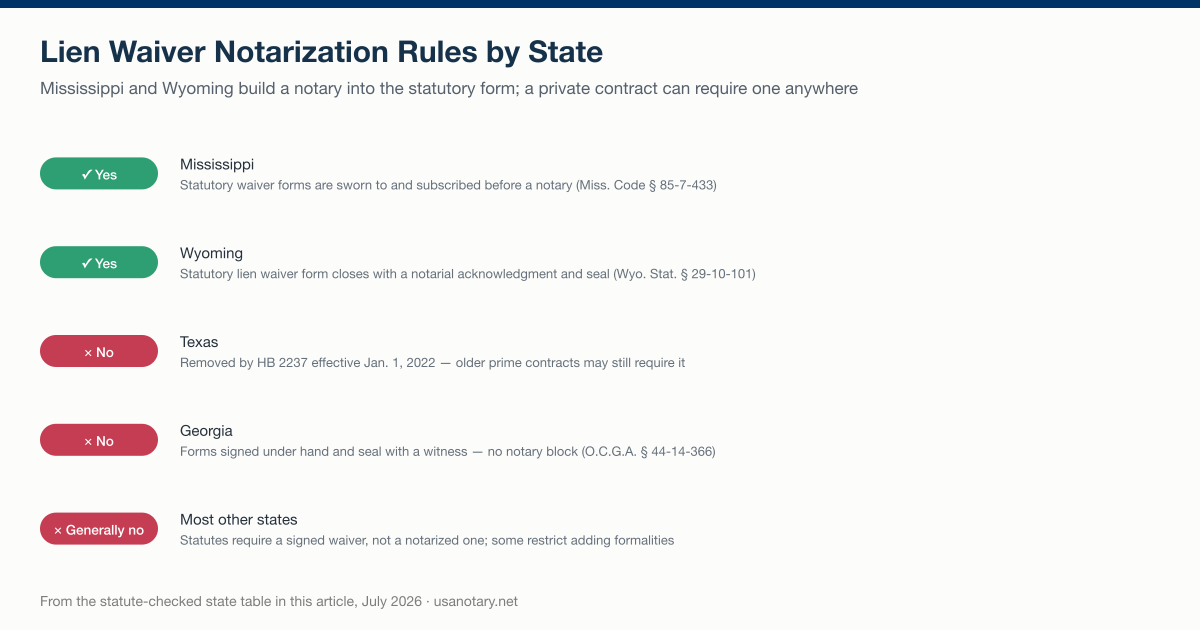
The statute-checked verdicts from this article’s state table — only Mississippi and Wyoming build a notary into the waiver form, July 2026.
Which states require a notarized lien waiver?
Here is the state-by-state picture as confirmed against current statute text (2024–2025 code editions):
| State | Notarization required? | What the statute says |
|---|---|---|
| Mississippi | Yes | The statutory Interim and Final Waiver and Release forms in Miss. Code § 85-7-433 end with “SWORN TO AND SUBSCRIBED BEFORE ME … NOTARY PUBLIC” |
| Wyoming | Yes | The statutory lien waiver form in Wyo. Stat. § 29-10-101 closes with a notarial acknowledgment (“This instrument was acknowledged before me…”) and seal |
| Texas | No — removed effective Jan. 1, 2022 | Tex. Prop. Code § 53.281 requires only substantial compliance with the statutory form plus the claimant’s signature; amended by HB 2237 |
| Georgia | No | The waiver forms in O.C.G.A. § 44-14-366 are given “under hand and seal” with a witness line — no notary block on the waiver |
| Most other states | Generally no | State lien statutes typically require a signed waiver, not a notarized one; several states restrict adding execution formalities to statutory forms |
Two honest caveats. First, this table covers the states where the notarization question actually turns — it is not a 50-state survey, and lien statutes get amended. Second, the “restrict” note matters: SuperConstruct’s 2025 guide reports that states including Arizona, California, Connecticut, Michigan, and Nevada prescribe specific waiver forms and restrict adding conditions like notarization, since extra formalities can undermine the statutory form. In a strict-form state, the safe move is the statutory form exactly as written.
Georgia deserves the extra sentence because outdated lists still name it. Before its statute was amended (effective January 1, 2021), Georgia’s waiver forms carried different execution requirements — but the current forms in § 44-14-366 need a signature and a witness, not a notary. Only Georgia’s affidavit of nonpayment — the document a claimant files when the payment behind a waiver never arrives — is sworn before a notary public.
Why don’t most lien waivers need notarization?
A lien waiver is a creature of statute, and most legislatures chose a different reliability mechanism than the notary seal: the prescribed form. States like Texas, Georgia, California, and Mississippi write the exact waiver language into the lien statute itself. The protection comes from the mandated wording — conditional language, notice warnings in capital letters, deadlines for an affidavit of nonpayment — rather than from verifying who signed.
That design also explains why some states go further and restrict notarization. When a statute says the waiver “shall substantially follow” a prescribed form, bolting on extra execution requirements creates two risks: the added formality may make the form non-compliant, and it gives a paying party a new excuse to reject a waiver and delay payment. Lien waivers move with progress payments throughout a project, so legislatures have generally kept the execution burden low on purpose.
The result is the rule of thumb the table shows: the waiver’s content is heavily regulated almost everywhere, while the waiver’s notarization is required almost nowhere.
Didn’t Texas require notarized lien waivers?
It did — from January 1, 2012 through the end of 2021. The waiver subchapter added to the Property Code in 2011 originally required waivers to be notarized, and a missing notary certificate could render a Texas waiver unenforceable. HB 2237, the 2021 mechanics lien reform bill, struck that element: the amendment took effect January 1, 2022, and the current § 53.281(b) lists only form compliance, the claimant’s signature, and — for conditional releases — evidence of payment.
The transition still has teeth on long-running projects. The Texas Construction Association maintains two complete sets of sample waiver forms for exactly this reason: waivers tied to prime contracts signed before the changeover must still be notarized, while waivers under newer prime contracts do not need to be. A subcontractor on a project whose prime contract predates the reform should keep notarizing waivers until that contract closes out.
Why do parties notarize lien waivers anyway?
Plenty of notarized lien waivers get signed in states that don’t require them. Three practical reasons drive it:
- The contract says so. Owners and general contractors sometimes write notarized waivers into payment terms as an execution formality on high-value projects. A contract requirement binds you even where the statute is silent.
- Identity assurance on the paying side. A notary verifies identity before the signature goes on. For an owner releasing a six-figure progress payment against an unconditional waiver, that verification is the point — an unconditional waiver takes effect when signed, so the payer wants certainty about who signed it.
- Out-of-state processing habits. Title companies, lenders, and escrow agents that handle waivers alongside deeds and affidavits often prefer one uniform execution standard across the whole closing package.
None of this is a legal requirement outside Mississippi, Wyoming, and legacy Texas contracts — it’s risk preference. The caution runs the other way too: in a strict-form state, adding a notary block a statute doesn’t contemplate is the riskier choice, not the safer one.
How to complete a notarized lien waiver online
When a waiver does need notarization — a Mississippi or Wyoming project, an older Texas prime contract, or a contract clause — nobody on a job site wants to leave the project to find a notary. Remote online notarization solves that: the National Association of Secretaries of State reports that 47 states and the District of Columbia have a law allowing remote e-notarization, and the legal grounding is covered in our guide to whether online notarization is legit.
Here’s how a subcontractor completes a notarized waiver online:
- Upload the waiver. Use the statutory form your state prescribes — the notary notarizes your signature on it, and does not draft or alter the form.
- Verify your identity. The platform verifies identity before the session starts, so the notary knows exactly who is signing.
- Join the video session. A commissioned notary meets you on live video — sessions run 24/7 and take 15–30 minutes, and multiple signers can join one session if the waiver needs a company officer plus a witness.
- Sign and receive the completed document. The session produces a tamper-evident notarized PDF and a digital audit trail — a stronger record than a stamped paper waiver, and easy to attach to a pay application the same day.
At $25 per document through the business document notarization service, a remotely notarized waiver costs less than the drive time it replaces. Construction back offices that handle waivers, affidavits of nonpayment, and payment-bond paperwork every month can set up staff-initiated workflows through our online notarization service for construction teams.
Get the waiver notarized without leaving the job site
The rule to remember: the form is regulated everywhere; the notary is required almost nowhere. Check your state’s statute first, then your contract — and when either one calls for a notary, a video session handles it from a truck cab or a site trailer. The mechanics are the same as for any document: our walkthrough of how to notarize a document covers what to have ready, and if your project also involves sworn statements like an affidavit of nonpayment, see how to notarize an affidavit — those are sworn documents in every state, not just two.
Questions about a specific waiver or a recurring workflow? Call 804-767-7500 or book a demo.