
Can you close a HELOC online?
You can close a HELOC online with a growing list of lenders — the application, the disclosures, and even the notary session happen over your own screen. Aven, for one, has borrowers “sign the closing documents via an online notarization session” as a published part of its process. The webcam ceremony is legal because remote online notarization (RON) now has statutory backing almost everywhere: the National Association of Secretaries of State reports that 47 states and the District of Columbia have a law that allows for remote e-notarization.
Two qualifiers bound that yes, and they shape everything below. First, closing online does not mean funding instantly — on a primary residence, Regulation Z’s three-business-day right of rescission delays funding no matter how fast the signing was. Second, geography still vetoes the webcam in places: a HELOC secured by a Texas homestead must close at a physical office by constitutional command, and a few states still lack a RON law entirely.
One sense-check before going further, because half the search results for this question answer the wrong one: closing a HELOC here means completing the closing — signing the credit agreement and the lien documents so the line of credit opens. It is not closing out a HELOC, which means paying off and canceling an existing line. If you’re trying to end a HELOC, you want a payoff statement and a recorded release from your lender, not a closing appointment.
This guide covers what actually gets signed, which document is notarized, what three lenders’ own pages promise, why the money waits three business days, and who besides the borrower has to sign.
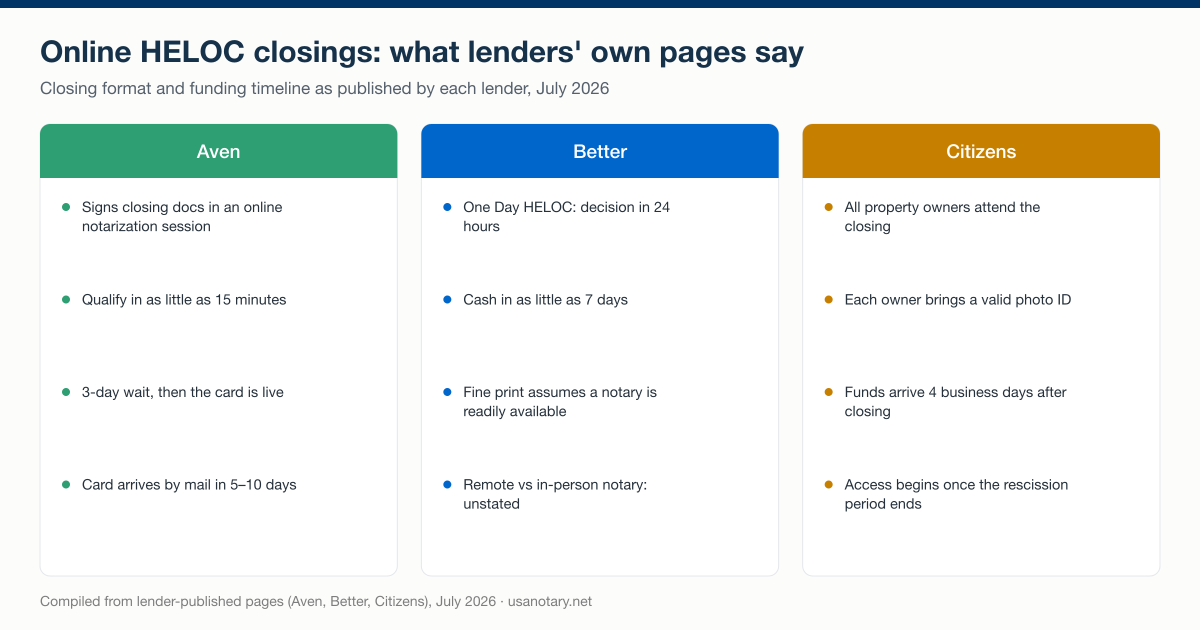
What each lender’s own published page says about its HELOC closing, compiled July 2026.
Which documents do you sign at a HELOC closing — and which one is notarized?
A HELOC closing package centers on four items — the credit agreement, the Truth in Lending disclosure, the notice of your right to rescind, and the security instrument — and the security instrument is the one that is notarized. The CFPB’s rescission guidance names the first three directly: the three-day clock doesn’t start until you sign the credit contract (usually the promissory note), receive a Truth in Lending disclosure, and receive two copies of a notice explaining your right to rescind.
| Document | What it does | Notarized? |
|---|---|---|
| Credit agreement / promissory note | Your promise to repay what you draw, at the stated rate and terms | Generally no |
| Truth in Lending disclosure | Federal disclosure of the line’s cost and terms | No |
| Notice of right to rescind (two copies) | Explains your three-business-day cancellation right | No |
| Mortgage or deed of trust (security instrument) | Creates the lender’s lien on your home; is recorded with the county | Yes |
Why the security instrument is notarized
The mortgage or deed of trust is the document that pledges your house, and it is recorded in the county land records so the lien binds the title. Recording is the reason notarization is required: recorders generally demand a notarial acknowledgment before an instrument is recorded. The same recording logic governs the rest of the mortgage world — our guide to which mortgage documents require a notary walks through the full origination stack, and the short version holds for HELOCs: promises to pay are signed, liens are notarized.
That one notarized document is the entire reason a “100% online HELOC” needs more than eSignatures. E-signing handles the note and disclosures fine; the security instrument needs a commissioned notary to verify your identity and complete a notarial certificate. Whether that notary appears on your screen or across a desk is exactly what separates the lenders in the next section.
Which lenders close a HELOC fully online?
Aven publishes a fully online closing — borrowers sign via an online notarization session — while Better publishes speed with an unstated notary format, and Citizens still runs a scheduled closing that all property owners attend. Those three verdicts come from each lender’s own published pages, fetched and checked in July 2026, not from review roundups:
| Lender | What its own page publishes | Closing format |
|---|---|---|
| Aven | Borrowers “sign the closing documents via an online notarization session, which substantially shortens the approval process”; qualifying can take “as little as 15 minutes”; after the three-day waiting period the card works anywhere cards are accepted, and it arrives by mail within 5–10 days | Fully online, RON-based |
| Better | “With Better’s One Day HELOC, for example, you could get a decision in 24 hours, cash in 7 days” — but the fine print behind that claim assumes, among other conditions, that “a notary is readily available”; the page never states whether that notary is remote or in person | Digital application; notary format unstated |
| Citizens | Its closing checklist tells borrowers to “ensure that all property owners can attend the closing,” that “each property owner must bring a valid photo ID,” and that a one-time deposit arrives “four business days after your closing,” once the rescission period ends | Scheduled, attended closing |
Three practical readings of that table. First, “online HELOC” in a lender’s marketing usually describes the application; whether the closing ceremony itself is remote is a separate, quieter fact you have to dig out of FAQ pages and footnotes. Better’s page is the instructive example — a genuinely fast digital process whose own disclaimer still turns on a notary appointment. Second, lender policies move: these are the published positions as of July 2026, and the lender’s own current page is always the authority. Third, even a lender that closes online everywhere it can will paper out where it can’t — product footprints and notarization rules vary by property state, which is the subject two sections down.
For a purchase or refinance — a different animal, with a settlement agent and a full closing package — see how purchase and refinance closings work online. A HELOC closing is leaner: no settlement table, usually no title-company ceremony, just borrower, lender, and the notarized security instrument.
Why isn’t the money instant? The three-business-day rescission clock
Federal law, not lender caution, delays funding on a primary-residence HELOC: Regulation Z gives each consumer whose ownership interest is subject to the lien the right to rescind, and it forbids disbursing money until that right expires. The regulation’s delay-of-performance rule at 12 CFR § 1026.15(c) is blunt: “no money shall be disbursed other than in escrow, no services shall be performed, and no materials delivered until after the rescission period has expired.”
So a same-day online signing still produces a several-day wait for cash. Citizens tells its borrowers the one-time deposit lands four business days after closing — consistent with three business days of rescission plus a disbursement day. Aven’s education page says the same thing in card form: “after the three-day waiting period, you can use it anywhere credit cards are accepted.”
When the three-day clock starts
The rescission period runs until midnight of the third business day after the last of three events: you sign the credit contract, you receive the Truth in Lending disclosure, and you receive two copies of the notice of your right to rescind. Miss one of those deliveries and the clock hasn’t started — under § 1026.15, if the required disclosures are never provided, the right to rescind can stretch to three years.
Counting business days
Business days for rescission include Saturdays but not Sundays or legal public holidays, per the CFPB’s rescission guidance. Its worked example: when the last triggering event happens on a Friday with no holiday in between, the borrower can rescind until midnight the following Tuesday. A Thursday-evening webcam closing therefore funds no sooner than the middle of the next week.
Waiving the wait in an emergency
A borrower may waive rescission only for a bona fide personal financial emergency. Section 1026.15(e) requires a dated, signed written statement that describes the emergency and specifically waives or modifies the right, signed by every consumer entitled to rescind — and printed waiver forms are prohibited. Lenders cannot fold a routine waiver into the closing package, which is why almost no online HELOC funds inside three business days on a primary residence.
Second homes skip the wait
The rescission right applies when a security interest is retained or acquired in the consumer’s principal dwelling. A HELOC on a vacation home or rental carries no federal three-day cancellation right, so those closings can fund on the lender’s own schedule. The trade-off cuts the other way at signing: it’s the same notarized security instrument, wherever the property sits.
Who else has to sign? The spousal-consent catch
A spouse who isn’t on the HELOC often still signs the lien — and an online closing has to plan for that second signer or it fails at the finish line. The CFPB draws the line precisely: a lender generally can’t require your spouse to co-sign the loan, but it can require your spouse to sign documents that make the property available to satisfy the debt — “for example, a lender or broker may require your spouse to sign documents to create a valid lien or pass clear title.”
The pattern shows up in lender checklists as well as federal guidance. Citizens doesn’t say “spouse”; it says all property owners must attend the closing, each with valid photo ID. Anyone on the title — a spouse, a co-owning parent, a sibling from an inheritance — signs the security instrument so the lien attaches to the whole property.
Texas: consent of each owner and each owner’s spouse
Texas writes the rule into its constitution. A home-equity lien on a homestead must be created under a written agreement “with the consent of each owner and each owner’s spouse” — Article XVI, § 50(a)(6)(A). A non-borrowing spouse in Texas is not a courtesy signature; the lien is invalid without that consent.
What this means for an online closing
The webcam has to fit everyone. A closing that needs the borrower in one city and a co-owner spouse in another is exactly where remote notarization outperforms the branch appointment: multi-signer sessions put both signers in front of the same commissioned notary from different locations, instead of forcing a shared calendar slot at a branch. Lenders that mail packages to catch the second signature — and wait weeks for the envelope — are solving a logistics problem that a scheduled two-signer video session closes in under an hour.
When does a HELOC closing still require in-person signing?
In-person signing survives in three places: Texas homesteads, the few states without a RON law, and lenders that simply haven’t built the online workflow. Each is worth checking before anyone promises a couch closing.
Texas homesteads close at an office — period
Article XVI, § 50(a)(6)(N) of the Texas Constitution requires a home-equity loan to close “only at the office of the lender, an attorney at law, or a title company.” A HELOC secured by a Texas homestead is a home-equity extension of credit governed by the same § 50 — the section’s subsection (t) defines the home equity line of credit variant — so the location rule reaches it. No RON statute overrides a state constitution: the Texas borrower drives to one of those three offices, whatever the lender’s technology stack can do elsewhere.
States without a RON law
With 47 states plus DC on the NASS count, a small remainder still has no law allowing remote e-notarization — and there, the security instrument is notarized in person even when everything else in the file is electronic. Where the notary, the borrower, and the property sit in different states, the rules interact; our guide to whether a remote notarization holds up across state lines untangles which state’s law governs, and the state-by-state RON guides cover each state’s specific authorization.
Lender choice
Nothing obligates a lender to offer RON where it’s legal. Better’s One Day HELOC fine print — “a notary is readily available” — is a reminder that plenty of digital-first lenders still resolve the notarization step with whatever notary is nearest, not with a built-in video session. For the borrower, the question to ask before application is simply: is your closing notarization remote or in person in my state? The published answer, as the table above shows, is often buried or absent.
How a remote online HELOC closing session works
The online session compresses the notarized piece of a HELOC closing into a 15–30 minute video appointment. Here is the sequence a borrower — or the lender’s operations team, through a business-initiated workflow — follows:
- Upload the documents. The lender’s closing package, security instrument included, goes into the platform ahead of the session. Nothing about the documents changes; the notarization method does.
- Verify identity. Before the notary appears, the signer completes credential analysis of a government-issued photo ID plus knowledge-based authentication, run by a third-party identity-verification service — a stricter gate than a glance at a driver’s license across a desk.
- Join the video session. A commissioned notary meets the signer on live audio-video. Sessions run 24/7, so a borrower can sign after work the same day final approval lands; signers can join from all 50 states.
- Bring every required signer. Multi-signer sessions handle the co-owner and non-borrowing-spouse signatures from separate locations, and remote witnesses are supported where state law and the document’s rules permit.
- Receive the completed package. The session produces a tamper-evident notarized PDF with a complete audit trail; the audio-video recording and electronic journal entry are retained for 10 years or longer where state law requires — evidence a paper closing never generates.
Pricing is flat: $25 per document, with volume pricing for lenders running closings at scale. For a HELOC, that typically means one notarized security instrument per closing — not a per-package or per-seat platform fee.
The bottom line — for borrowers and for lenders building the workflow
For a borrower, the answer to “can you close a HELOC online” is yes with two asterisks: the money still waits out the rescission clock, and Texas homesteads plus a handful of non-RON states still require an office or an in-person notary. Pick a lender whose own page states the closing format, have every owner and spouse ready to sign, and count business days — Saturdays included — before planning around the cash.
For a lender or servicer, the notarized security instrument is the last analog step between “approved” and “booked,” and it’s the step borrowers abandon when it means a branch trip or a mailed package. Wiring a RON session into the HELOC workflow — same documents, same signers, 15–30 minutes on video — is what our online notarization service for mortgage lenders and servicers was built for, from single closings to staff-initiated pipelines. Questions about a specific state or a recurring workflow? Call 804-767-7500 or get in touch.