
What is a satisfaction of mortgage?
A satisfaction of mortgage is the recorded document that proves a loan is paid off and clears the lien from the county land records. Cornell Law School’s Legal Information Institute defines it as “a document that proves the borrower has paid off the mortgage in full, freeing the loan’s lien on the property and giving the title to the borrower.” Until that instrument is recorded, the public record still shows the paid-off loan as a live lien against the property — which is why the satisfaction matters long after the final payment has cleared.
The satisfaction travels under several names depending on the state and the security instrument: release of mortgage, certificate of discharge, certificate of satisfaction, or — in deed-of-trust states like California — full reconveyance. Whatever the label, the instrument does one job: it tells the county recorder that the debt behind a specific recorded mortgage or deed of trust has been paid, so the lien no longer encumbers the title.
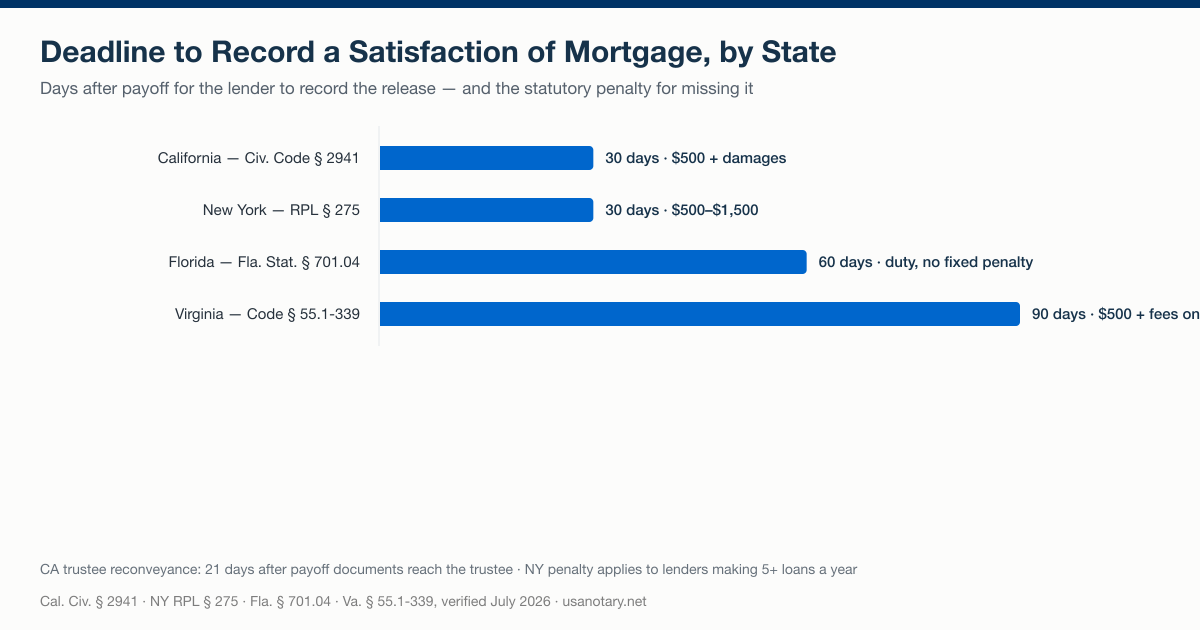
Statute-checked recording deadlines and penalties from the four state release laws verified for this guide, July 2026.
Two boundaries keep this guide focused. The documents signed at the start of a loan — the note, the security instrument, the riders — are a different lifecycle, covered in our guide to which mortgage documents are notarized at signing. And the satisfaction is not a conveyance: it removes a lien rather than transferring ownership, which separates it from the warranty and quitclaim instruments in our walkthrough of how a deed is notarized and recorded. This page covers only the release instrument: who signs it, when it must be recorded, what the penalties are, and what to do when it goes missing.
Who prepares, signs, and records a satisfaction of mortgage?
The lender or its servicer prepares, signs, and records the satisfaction — the borrower signs nothing. Every release statute verified for this guide places the duty on the lender’s side of the table: California’s Civil Code § 2941 directs that “the mortgagee or the assignee of the mortgagee shall execute a certificate of the discharge,” Florida’s § 701.04 puts the obligation on “the mortgagee or mortgage servicer,” New York’s Real Property Law § 275 requires the mortgagee to arrange recording of the certificate of discharge, and Virginia’s § 55.1-339 assigns the delivery duty to the lien creditor. LII’s Wex entry summarizes the same allocation: “Mortgage lenders are obligated to prepare a satisfaction of mortgage document.”
For home loans that conform to Fannie Mae’s rules, the operational requirement is explicit. Servicing Guide C-1.2-04 states: “Once payoff funds are received, the servicer must take all actions necessary to satisfy a mortgage loan, including recording a release of lien in the real property records, in a timely manner.”
Who actually signs at the servicer
Execution depends on who holds the position of mortgagee of record. Under Fannie Mae’s guide, a servicer that is not the mortgagee of record “must execute any required satisfaction documents in its own name (or in MERS’ name, if applicable for a MERS-registered mortgage loan).” When Fannie Mae itself is the mortgagee of record and the servicer lacks a limited power of attorney covering release documents, the servicer must send the satisfaction to Fannie Mae for execution. In practice, that means a specific authorized officer — someone in the servicer’s lien-release or document-execution unit — signs each satisfaction as part of a high-volume lien-release workflow.
Why the satisfaction is notarized
The satisfaction is notarized because the county will not record it otherwise. A satisfaction is a land-records instrument, and recording statutes condition acceptance on proper acknowledgment. Florida’s release statute spells the standard out: the mortgagee or servicer must “execute in writing an instrument acknowledging release of the mortgage; have the instrument acknowledged, or proven, and send it or cause it to be sent for recording.” Acknowledged here has its notarial sense — the signing officer appears before a notary public, confirms identity, and acknowledges the signature, and the notary completes a certificate on the instrument. The precise acknowledgment form varies by state, so servicers releasing liens across many states match the certificate to the property state’s recording rules.
Recording itself happens at the county land-records office — the recorder, register of deeds, or clerk for the county where the property sits. Wake County’s Register of Deeds, for example, notes that electronic recordings of satisfactions are “usually submitted by a mortgage vendor” on the secured creditor’s behalf. Recording fees follow the release: Fannie Mae’s guide lets the servicer request reimbursement of recording fees that cannot legally be charged to the borrower.
How long does the lender have to record the satisfaction?
The deadline runs from payoff and varies by state — among the four release statutes verified against current text for this guide, it spans 30 to 90 days, and several states attach automatic money penalties for missing it. Here is what each statute actually says:
| State | Statute | Deadline after payoff | Penalty for missing it |
|---|---|---|---|
| California | Civ. Code § 2941 | 30 days for the mortgagee to execute a certificate of discharge; the trustee has 21 calendar days after receiving the note, deed of trust, and reconveyance request to execute the full reconveyance | $500, plus “all damages which that person may sustain by reason of the violation” |
| New York | Real Property Law § 275 | 30 days to arrange presentation of the certificate of discharge for recording in the county where the mortgage is recorded | Escalates: $500 past 30 days, $1,000 past 60 days, $1,500 past 90 days — for lenders making five or more mortgage loans a year |
| Florida | Fla. Stat. § 701.04 | 60 days after full payment to execute the release instrument, have it acknowledged, and send it for recording | No fixed dollar penalty; the prevailing party in a civil action to enforce the release duty recovers reasonable attorney fees and costs |
| Virginia | Code § 55.1-339 | 90 days after payment to deliver the certificate of satisfaction to the clerk’s office (or, when a settlement agent sends notice requesting it, to that settlement agent) | Forfeits $500 to the lien obligor; unpaid 10 business days after written demand, the lender also owes court costs and reasonable attorney fees |
Three details in those statutes deserve a closer look, because they change how the deadline works in practice.
The clock starts at different events
California and Florida run the clock from satisfaction of the debt — 30 and 60 days respectively. Virginia’s 90 days run from payment, and the certificate can go to either the settlement agent or directly to the clerk. California adds a second, shorter clock for deed-of-trust payoffs: once the trustee receives the original note, the deed of trust, and the request for full reconveyance, it has 21 calendar days to execute the reconveyance. A servicer working a multi-state portfolio is therefore tracking several different trigger events at once, not one uniform deadline.
Penalties escalate — and stack with damages
New York’s structure is built to escalate: a lender that makes five or more mortgage loans a year owes the mortgagor $500 if the certificate of discharge isn’t presented for recording within 30 days, $1,000 past 60 days, and $1,500 past 90 days. California’s $500 penalty is a floor, not a ceiling — the statute adds liability for “all damages which that person may sustain by reason of the violation,” which is where a delayed release that kills a sale or refinance becomes expensive. Virginia’s forfeiture has a procedural sting: the $500 is automatic, and if the lender doesn’t pay within 10 business days of a written demand, court costs and attorney fees follow. Virginia also blocks settlement agents and attorneys from taking an assignment of the borrower’s right to that $500 — the penalty belongs to the borrower.
The deadline is the servicer’s problem, not the borrower’s task
Nothing in these statutes asks the borrower to do anything at payoff. The satisfaction is recorded by the lender’s side, and the deadlines exist precisely because borrowers historically had no lever to force a release. The borrower’s role begins only when the deadline passes: verifying the record, demanding the release, and invoking the penalty. That is covered two sections down.
Satisfaction, release, discharge, or reconveyance — which name applies?
The name follows the state’s security instrument, and all four labels describe the same lien-clearing step. Confusing them causes real friction — a borrower calling a California servicer to demand a “satisfaction of mortgage” will be routed to a reconveyance team, and a title search in New York looks for a “certificate of discharge,” not a release deed.
- Satisfaction of mortgage — the generic and most-searched term, and Florida’s historical usage; Florida’s current statute describes “an instrument acknowledging release of the mortgage.”
- Certificate of discharge — the instrument named in both New York’s RPL § 275 and California’s Civ. Code § 2941 for true mortgages.
- Certificate of satisfaction — Virginia’s term under § 55.1-339 for releasing a deed of trust or other lien.
- Full reconveyance — California’s deed-of-trust mechanism: the trustee, not the lender directly, executes a deed conveying the security interest back, within 21 days of receiving the payoff documents.
- Trustee’s satisfaction / affidavit of satisfaction — North Carolina variants that appear on the Wake County Register of Deeds’ menu of recordable satisfaction instruments.
The practical takeaway: when checking whether a lien was cleared, search the county index for any of these instrument types against the property, and use the property state’s own vocabulary when corresponding with a servicer. The naming differences are cosmetic; the recording requirement — and the notarial acknowledgment that recording depends on — is constant.
What happens when a satisfaction of mortgage is never recorded?
An unrecorded satisfaction leaves a paid-off loan sitting on the title as an open lien, and the problem typically surfaces years later — when the property is being sold or refinanced and a title search flags a mortgage from a lender the owner paid off long ago. The debt is gone; the record disagrees. Until a satisfaction, discharge, or reconveyance is recorded, anyone examining the title must treat the old lien as potentially live.
Missing satisfactions happen in predictable ways: a release executed but never delivered to the county, a recording rejected for a defective acknowledgment and never resubmitted, a loan paid off during a servicing transfer where neither servicer completed the release, or a lender that later merged or dissolved. Whatever the cause, the fix follows the same sequence:
- Confirm the gap. Search the county land records for the property (most recorders offer online indexes) for any satisfaction, discharge, or reconveyance recorded against the original mortgage. Pull your payoff statement and proof of final payment while you’re at it — every later step relies on them.
- Demand the release in writing. Send the servicer — or its successor, if the loan changed hands — a written request identifying the loan, the payoff date, and the recording gap. In Virginia, that written demand is also the trigger that converts the $500 forfeiture into $500 plus court costs and attorney fees if the lender stalls another 10 business days.
- Invoke the statute. Cite the property state’s release statute and its penalty. The deadlines in the table above are enforceable obligations, and servicers’ lien-release units prioritize files that arrive with a statute number attached.
- Use the state’s workaround if the lender won’t act. Some states let a third party cure the record. North Carolina is the clearest example verified for this guide: the Wake County Register of Deeds records an affidavit of satisfaction “signed by an attorney licensed to practice law in North Carolina and acting as a ‘Satisfaction Agent’” where a lender has unjustifiably failed to provide the satisfaction. A trustee’s satisfaction of deed of trust is another recordable route where a trustee holds the security instrument.
- Bring in the title professionals for the hard cases. When the original lender no longer exists and no workaround statute fits, resolving the lien becomes curative title work — the province of the title agent or attorney handling the current transaction, who will know which instrument the property state accepts.
The common thread: the record is fixed by recording something — a late satisfaction from the servicer, an affidavit from a statutory satisfaction agent, a trustee’s instrument. Each of those is a signed, acknowledged document, which means each one passes through a notary before the county will accept it. A missing-release problem is, mechanically, a get-a-document-notarized-and-recorded problem on a deadline, usually with a closing date bearing down on it.
How do servicers notarize release documents online?
A servicer’s authorized officer signs the satisfaction before a commissioned online notary in a live audio-video session — no branch notary, no shipping the instrument between offices. The legal foundation is broad: the National Association of Secretaries of State reports that 47 states and the District of Columbia have a law allowing remote e-notarization. For lien-release desks, the fit is direct, because the volume is steady, the documents are uniform, and every one of them faces a statutory clock from the table above.
Here is how the workflow runs on our platform:
- The business initiates the session. Release staff upload the executed-ready satisfaction, discharge, or reconveyance; staff-initiated workflows queue documents for signing without each officer managing their own account.
- The signing officer joins from their desk. Sessions run 24/7 and take 15–30 minutes. Identity verification — credential analysis plus knowledge-based authentication run by a third-party identity-verification service — completes before the notary appears.
- The officer signs and the notary acknowledges. The notary completes the acknowledgment certificate matched to the property state’s form. Where a document’s rules call for witnesses, remote witnesses are supported where state law and the document’s rules permit.
- The completed instrument returns as a recordable file. The session produces a tamper-evident PDF backed by a complete audit trail, with the audio-video recording and electronic journal entry retained for 10 years or longer where state law requires — a durable answer if a recording, or a release, is ever challenged.
One question release desks reasonably ask: the officer signs in one state, the property sits in another — does the acknowledgment hold? Notarial acts are generally recognized across state lines, and the mechanics are covered in our guide to whether a remote notarization is valid out of state. The recording side deserves the same diligence servicers already apply to any electronically executed instrument: Fannie Mae’s guide directs servicers to determine the appropriate satisfaction documents for an electronic mortgage “based on the requirements of the state in which the security property is located,” and the same property-state check applies to how the county accepts a remotely notarized release.
The economics favor the release desk. At $25 per document, with volume pricing for recurring workloads, a notarized satisfaction costs less than the internal routing it replaces — and it comes back the same day the payoff posts, not at the end of a paper loop that eats a 30-day statutory window. Lien-release teams, sub-servicers, and document-execution vendors can stand up recurring, staff-initiated notarization workflows for mortgage lenders and servicers that treat every release like what it is: a deadline document.
Clear the lien before the deadline does its work
The satisfaction of mortgage is a small document with a strict lifecycle: the servicer must record it, a state statute sets the clock at 30 to 90 days, and penalty provisions — $500 in California plus damages, up to $1,500 in New York, $500 plus fees in Virginia — give the deadline teeth. Borrowers should verify the recording after any payoff; servicers should treat the notarization step as the throughput constraint it usually is. When a release, discharge, or reconveyance needs an acknowledgment today instead of next week, an online session handles it in 15–30 minutes.
Questions about a lien-release workflow or a stack of satisfactions on a statutory clock? Call 804-767-7500 or reach us through the contact page.