
How do you get a title for an abandoned vehicle?
Title to an abandoned vehicle is issued by the state — it is never signed over by a seller, because there is no seller. Every state replaces the missing owner’s signature with a legal process: the vehicle is reported to a state agency or law enforcement, the agency searches title and crime records, notice is sent to the last-known owner and lienholders, and only after a claim window expires — 15 days in Virginia, 20 in Texas, 30 in Arizona and Missouri — can the person in possession file a title application. Skip a step and the application fails; in Arizona, a tow operator who misses the filing deadline forfeits every towing and storage charge and commits a class 2 misdemeanor.
That process is a different legal animal from an ordinary sale. When an owner is present and signing, the question is whether the title assignment gets notarized — seven states require a notary for an owner-signed car title transfer. When the owner is gone, the state builds its safeguard differently: sworn paperwork from the person claiming the vehicle. Missouri says it plainly on Form 4576 — the Abandoned Property Affidavit must be “signed by the tower and notarized by a notary public.”
This guide walks through the three legal routes, a six-state comparison of how the abandoned vehicle title process actually runs, and exactly where the notarized affidavit appears — whether you are a property owner with a dead sedan in your lot or a tow yard that files these packets every week.
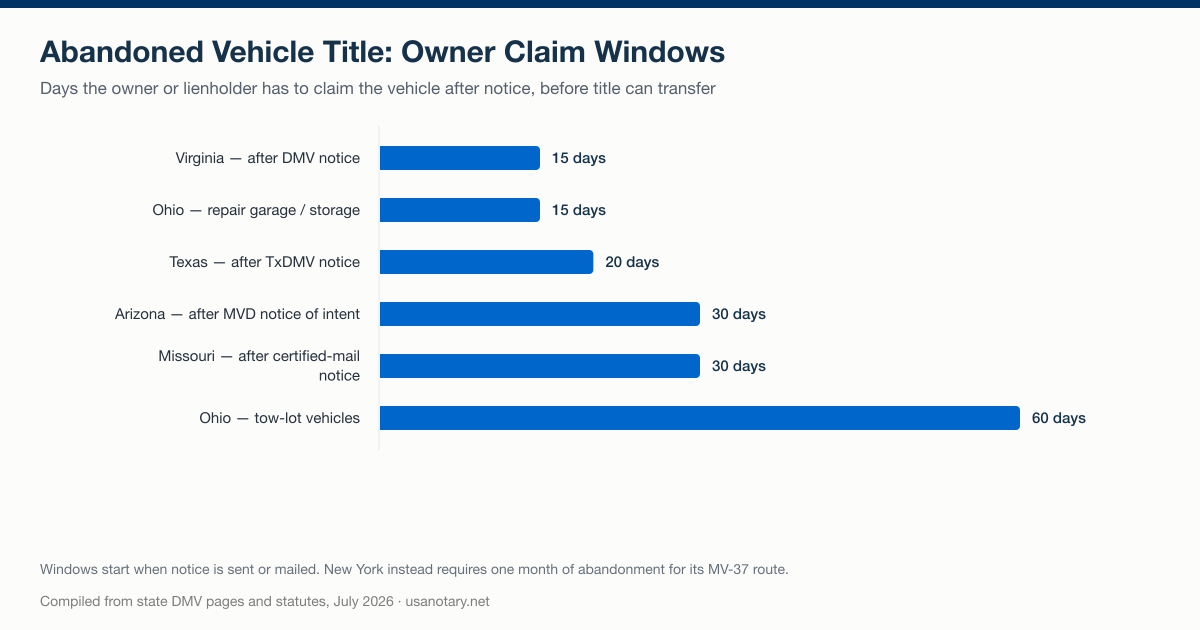
The claim windows verified for this article — how long the owner or lienholder has to claim the vehicle after notice before title can transfer, re-verified October 2026.
What legally counts as an abandoned vehicle?
An abandoned vehicle is a defined legal term, and each state’s definition sets the clock that starts its process — “abandoned” in the everyday sense (dusty, unmoved, no plates) proves nothing until the statutory time threshold passes. The thresholds are shorter than most people expect:
| State | Time threshold | Where it applies |
|---|---|---|
| Texas | 24 hours | Right-of-way of a turnpike or controlled-access highway |
| Texas | 48 hours | Public property (if inoperable and 5+ years old, or illegally parked); private property without consent; county/state/federal highway right-of-way |
| Virginia | 48 hours | Public property in violation of law; private property without the owner’s consent; any period on the shoulder of a primary highway |
| Arizona | 48 hours | Right-of-way of any highway, road, or street (prima facie evidence of abandonment) |
| Arizona | 72 hours | Public or private property or elsewhere in the state (prima facie evidence) |
| New York | 96 hours | Property of another, left without the owner’s permission |
The fine print matters. Virginia’s definition in Code § 46.2-1200 only covers vehicles weighing at least 75 pounds. Texas adds prongs the table can’t fit: an impounded commercial vehicle becomes abandoned when its delinquent administrative penalty goes unpaid by the 11th day. And Arizona’s thresholds create a presumption — “prima facie evidence” — that the vehicle was abandoned, which the owner can still rebut by showing up during the notice period.
One threshold does something none of the others do: New York’s disposal shortcut. A vehicle qualifies for direct transfer to a dismantler or collector on form MV-37 only if it has a wholesale value of $1,250 or less, is 10 or more model years old, and has been abandoned at least one month. Anything newer or more valuable goes through the local authority instead.
Which legal route applies: police disposition, DMV process, or storage lien?
The route is chosen by who holds the vehicle and how it got there — not by preference. Across the six states verified for this guide, every path to an abandoned vehicle title falls into one of three patterns:
Route 1 — law-enforcement or local-authority disposition. Police or the city take custody, and the vehicle is sold or scrapped under public authority. Texas works this way: law enforcement auctions abandoned vehicles, and TxDMV lists the “law enforcement auction sales receipt” as valid ownership evidence for the buyer’s title application. New York gives primary jurisdiction to the city, town, or village where the vehicle sits. If you want to own an abandoned vehicle in these states, you usually buy it at the auction rather than claim it directly.
Route 2 — the possessor-initiated agency process. The person in possession reports the vehicle to the motor-vehicle agency and works the process themselves. Virginia, Arizona, and Missouri run this way, and it is where the sworn paperwork lives.
Route 3 — the unclaimed-at-garage route. A repair garage or storage facility left holding a low-value vehicle applies for title directly. Ohio’s R.C. § 4505.101 is the model: vehicle worth under $3,500, unclaimed 15 days after the repair or storage term ends, certified-mail notice, then title — supported by an affidavit.
Whatever the route, the sequence underneath is the same five steps:
- The vehicle is reported to the state agency or law enforcement — in Arizona, within five days after a mandatory ten-day hold (A.R.S. § 28-4838).
- Records are searched. Virginia’s DMV checks its own records, a nationally recognized crime database, and a national title database for a $40 fee. Arizona’s MVD queries other states if the vehicle is registered elsewhere. New York tells property owners to contact police first to confirm the vehicle is not stolen.
- Notice is sent to the owner and every lienholder — certified mail in Virginia and Missouri; first-class mail or website posting in Texas; in Arizona, website publication for at least 30 days when the owner can’t be identified.
- The claim window runs. The owner may reclaim the vehicle (usually by paying towing and storage) at any point before it closes.
- The title application is filed by the person in possession — with the sworn affidavit or certified statement the state prescribes — and title is issued by the state, in Arizona “free and clear of all liens or encumbrances.”
How does the abandoned vehicle title process work state by state?
Each state assembles those five steps differently — different agencies, claim windows, and paperwork. Here is the six-state comparison, checked against each state’s own statute or motor-vehicle agency page:
| State | Who runs the process | Claim window after notice | Sworn paperwork required |
|---|---|---|---|
| Virginia | Person in possession, through DMV (§ 46.2-1202) | 15 days (120 for manufactured homes); owner then waives all right, title, and interest | DMV-prescribed process; $40 record search |
| Texas | Law enforcement (auction) or property owner via TxDMV Form VTR-71-2, $2 fee | 20 days; certificate of authority issued on the 21st day | Application for authority to dispose — demolisher route only |
| Arizona | Person in possession, through MVD (§§ 28-4838–4842) | 30 days from MVD’s notice of intent | Certified statement: no one has presented proof of ownership; applicant is in possession |
| New York | Local authority; or direct MV-37 transfer to a dismantler/collector for vehicles with a wholesale value of $1,250 or less and 10+ model years old | Vehicle must be abandoned at least one month for the MV-37 route | MV-37 statement of abandoned vehicle |
| Missouri | Tower or property owner, through the Department of Revenue | 30 days after certified-mail notification | Notarized Abandoned Property Affidavit (Form 4576) |
| Ohio | Repair garage, storage facility, or tow yard (R.C. § 4505.101) | 15 days after notice (garage/storage); 60 days unclaimed for tow-lot vehicles | Affidavit in the registrar’s form: value, time unclaimed, notice sent, records searched |
Three details from the table deserve a closer look.
Texas splits “getting rid of it” from “keeping it.” The $2 Form VTR-71-2 application authorizes disposal to a demolisher — it destroys the vehicle rather than titling it to you. TxDMV mails or posts notice, the owner and lienholders get 20 days to claim, and the certificate of authority is issued on the 21st day. A Texan who wants to keep an abandoned vehicle buys it at a law-enforcement auction and titles it with the auction sales receipt.
Arizona penalizes slow filers hard. After the ten-day hold, the possessor has five days to submit the electronic abandoned vehicle report, the transfer application, the vehicle identification form, and — for private-property tows — the property owner’s signed authorization. Miss the deadline and § 28-4838 imposes both consequences at once: forfeiture of all towing and storage claims, and a class 2 misdemeanor.
Ohio prices the route by value. The § 4505.101 garage-and-storage route (effective April 7, 2023, under House Bill 507) only opens for vehicles worth less than $3,500. A lienholder who ignores the certified-mail notice for 15 days loses the lien entirely — the statute declares it invalid.
Where does the notarized abandoned-vehicle affidavit come in?
The affidavit is the state’s substitute for the owner’s signature — since no owner swears to the transfer, the possessor swears to the process. Notarization is required on that affidavit in Missouri, and sworn or certified statements appear in the Arizona and Ohio packets.
Missouri is the clearest case in the country. Under § 304.156, RSMo, thirty days after the notification is mailed, the tower may apply to the Director of Revenue for an original title, a salvage certificate marked “Salvage or Abandoned Property,” or a junking certificate, based on the vehicle’s condition. The affidavit is notarized — the form’s instructions require Form 4576 “properly completed, signed by the tower and notarized by a notary public” — and in it the tower swears, under penalties of perjury, to a specific investigation:
- Possession of the abandoned property for at least 30 days, with no payment arrangements made by the owner or lienholder;
- A physical search of the vehicle for license plates, temporary permits, inspection stickers, or decals pointing to registration in another state;
- A check of the law-enforcement report for a plate or registration number, if the vehicle was towed at an agency’s request;
- A review of the tow ticket to see whether a plate was on the vehicle at the start of a private tow; and
- A check for any out-of-state address on the driver-license information in the impound report.
The full Missouri packet stacks up: the title application in the tower’s company name (no title fee), the notarized Form 4576, the Form 4577 owner-and-lienholder notification sent by certified mail, certified-mail receipts at least 30 days old, a copy of the record search, a Form 551 vehicle examination certificate for original titles, and a Crime Inquiry and Inspection Report completed by law enforcement. Private-property tows without law-enforcement authorization add Form 4669, signed by the property owner, the towing company, and law enforcement.
Arizona and Ohio reach the same goal with different instruments. Arizona’s transfer application contains a certified statement — that no person has presented proof of ownership and that the applicant currently possesses the vehicle — rather than a notarized affidavit. Ohio’s § 4505.101 requires the garage or storage facility’s agent to execute an affidavit in the registrar’s prescribed form, itemizing the vehicle’s value, the time unclaimed, the notice sent, and the records searched. The mechanics of swearing to a document before a notary are the same as for any sworn statement — our guide to how an affidavit is notarized covers the jurat, the oath, and what the notary verifies.
One boundary worth drawing: the abandoned-vehicle affidavit is not a bill of sale. A bill of sale documents a voluntary transfer between two parties; the affidavit documents a process run without the other party. If you later sell the vehicle you titled through this process, ordinary transfer rules take over — including whether the bill of sale needs notarization in your state and, because vehicles that end up abandoned skew old, whether federal law still requires a mileage disclosure on an older vehicle at that point at all.
Private property owner vs tow or storage lot: whose process applies?
The applicant’s identity changes the paperwork, even inside one state. Statutes consistently draw the line between a property owner who found a vehicle, a tow company that hauled one, and a storage or repair business the owner simply never came back to.
Property owners rarely file alone. In Arizona, a private-property tow requires the property owner’s signed authorization form under § 28-4834 — the tow company files the report, but the landowner signs. In Missouri, a private-property tow without law-enforcement authorization triggers Form 4669, the Abandoned Property Report, completed jointly by the property owner, the towing company, and law enforcement. In New York, the property owner’s first call is the local police (stolen-vehicle check), then the local authority — the MV-37 shortcut to a dismantler only opens for old, low-value vehicles.
Tow companies carry the deadlines. Arizona’s ten-day hold, five-day filing window, and misdemeanor exposure all sit on “a person who has knowledge and custody” of the vehicle — in practice, the tow yard. Missouri’s Form 4576 is written for “the tower” by name.
Storage lots and repair garages get their own routes. Arizona § 28-4839 declares a vehicle abandoned when it sits in a public garage or parking lot more than ten days without a written storage contract. Ohio’s § 4505.101 lets a repair garage or storage facility title a sub-$3,500 vehicle after 15 unclaimed days — and lets a tow yard do the same after 60.
For a business, the difference is volume. A homeowner files this packet once; a tow or salvage operation files it every week, and each Missouri filing needs a notary on Form 4576.
How do tow and salvage yards notarize abandoned-vehicle affidavits online?
Remote online notarization replaces the drive to a notary with a recorded video session — and for an operation that swears out abandoned-property affidavits weekly, it turns a recurring errand into a desk task. The National Association of Secretaries of State reports that 47 states and the District of Columbia have a law allowing remote e-notarization, so in most of the country the affidavit in a title packet can be sworn over live video.
The workflow for a yard manager or dispatcher:
- Upload the affidavit — Missouri’s Form 4576, an Ohio registrar’s-form affidavit, or whatever sworn statement your state’s packet prescribes. The notary notarizes the signature; the state’s form stays exactly as issued.
- Verify identity. Credential analysis and knowledge-based authentication are run by a third-party identity-verification service before the notary appears.
- Swear and sign on video. Sessions run 24/7 and take 15–30 minutes. The notary administers the oath — these are sworn documents, not mere acknowledgments — and completes the jurat.
- File the tamper-evident PDF. The session produces a tamper-evident notarized PDF with a complete audit trail, and the audio-video recording and electronic journal entry are retained for 10 years or longer where state law requires — a useful record if a vanished owner ever resurfaces to contest the transfer.
At $25 per document with volume pricing for recurring filers, the notarization costs less than the staff time it replaces, and staff-initiated workflows let one dispatcher queue affidavits for every driver on the roster. Tow operators, salvage yards, and dealerships that handle abandoned-vehicle packets alongside title work can set up recurring, business-initiated sessions through our online notarization service for automotive businesses.
One honest caveat: the state agency receiving the packet decides what it accepts. Missouri’s Form 4576 instructions require notarization but do not address remote vs. in-person execution, so confirm with the Motor Vehicle Bureau — or your state’s equivalent — before switching a batch process over.
The rule that holds across all six states: the state issues the title; the process earns it. Report the vehicle, run the search, send the notice, wait out the claim window — and when the packet calls for a sworn affidavit, a notary session from the yard office finishes it the same day. Questions about a recurring abandoned-vehicle workflow? Call 804-767-7500 or reach us here.