
What does an affidavit of non-use do?
An affidavit of non-use is a filing that tells a state motor vehicle agency a registered vehicle will not be driven, so the owner can cancel liability insurance or skip a registration renewal without being treated as a violator. Every state that offers one is solving the same problem from a different angle: registration records and insurance records are matched against each other, and a vehicle that stays registered after its insurance ends looks — to the computer — exactly like an uninsured car on the road. The affidavit of non-use is the paperwork that breaks that false match for a car that is genuinely parked.
The stakes vary by state, and Nevada shows the ceiling. The Nevada DMV states flatly: “Nevada has no grace period. A one day lapse may result in possible suspension and reinstatement fines.” A first-offense lapse of 1–30 days carries a $250 reinstatement fee, a lapse of 181 days or more totals $1,250 in fees and fines, a lapse over 90 days triggers an SR-22 filing requirement for three years, and if the registration is suspended, “Nevada law enforcement officers are required to confiscate the license plates from a vehicle driven on a suspended registration.” California sits at the friendlier end: a vehicle with an Affidavit of Non-Use on record is not subject to suspension, and no reinstatement fee is due because the DMV cancels the registration outright.
Who actually files these? The Nevada form answers that in its own definitions. NVL-003 defines a seasonal vehicle as one not used “because of seasonal residency, weather or other factors” — the snowbird’s stored car — for a period of not less than three months, and covers mechanical circumstances where a vehicle “cannot be operated” for thirty days to six months. Stored classics, deployment absences, long repairs, and second cars at a seasonal residence are the recurring cases.
One name, four different documents
“Affidavit of non-use” is the umbrella term, but the four states this guide covers each run a different instrument under it. California’s REG 5090 is a web filing with no signature ceremony at all. Louisiana’s Statement of Non-Use is a notice to the OMV that protects you from an insurance-cancellation flag. Indiana’s Affidavit of Nonuse (State Form 56164) is signed at a BMV branch in lieu of renewal. Nevada’s Dormant Vehicle Affidavit (NVL-003) is a sworn, notarized document filed after the fact to reduce reinstatement fees. Same family, very different execution rules — which is exactly why the notarization question has no single answer.
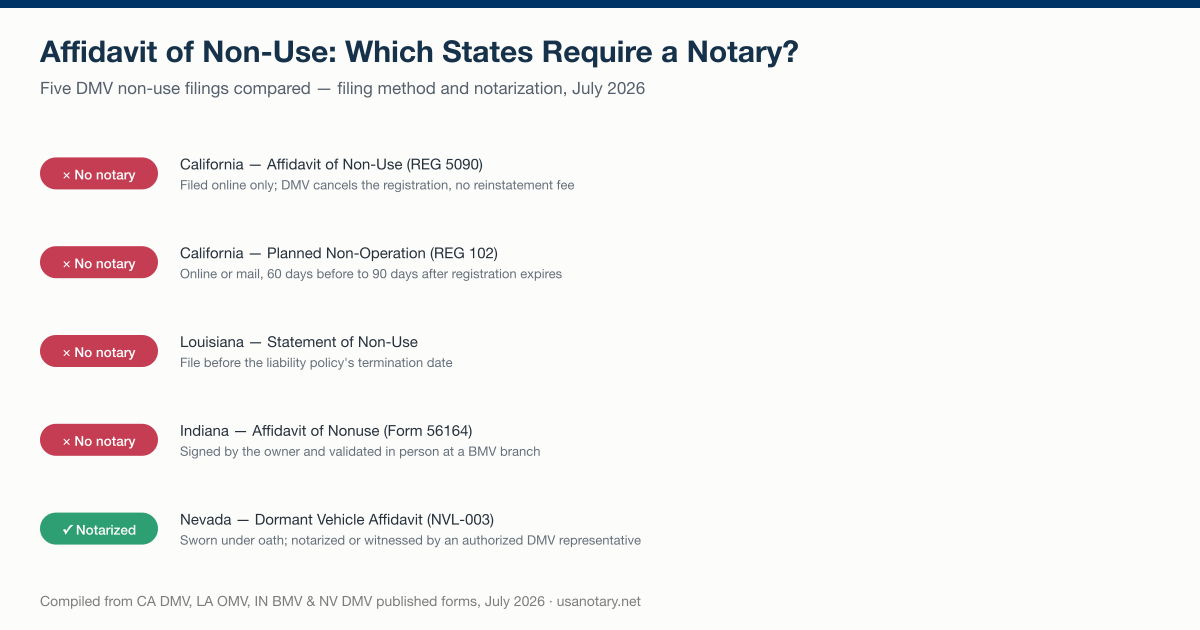
The verdicts from this guide’s state comparison — of the five major DMV non-use filings, only Nevada’s NVL-003 carries a notary block, re-checked October 2026.
Which states use an affidavit of non-use — and is a notary required?
Notarization is required on only one of the five major non-use filings across these four states: Nevada’s Dormant Vehicle Affidavit. California, Louisiana, and Indiana all accept their versions without a notary — California’s is exclusively electronic, and Indiana substitutes branch-staff validation for a notarial act. Here is the comparison, checked against each agency’s current published instructions:
| State | Form | How it’s filed | Notary required? | Key rule or deadline |
|---|---|---|---|---|
| California | Affidavit of Non-Use (REG 5090) | Through the DMV’s online service | No | Filed for a currently registered vehicle whose liability insurance has been cancelled; DMV cancels the registration, no reinstatement fee |
| California | Planned Non-Operation (REG 102) | Online or by mail | No | Accepted up to 60 days before or 90 days after registration expires; covers the entire registration year |
| Louisiana | Statement of Non-Use | Online (expresslane.la.gov), by mail, or at an OMV office | No | Must be submitted before the liability policy’s termination date; cannot clear an existing insurance cancellation |
| Indiana | Affidavit of Nonuse (State Form 56164) | In person at a BMV branch | No — signed by the owner and validated by branch staff | Vehicle off Indiana roads for at least 90 consecutive days; filed in lieu of a timely renewal |
| Nevada | Dormant Vehicle Affidavit (NVL-003) | Presented at a full-service DMV office or county assessor | Yes — “completed in full and notarized or witnessed by an authorized DMV Representative” | Filed at reinstatement with original receipts covering the uninsured period; reduces the reinstatement fee to $50 |
Two honest notes on the table. First, these are the four states whose non-use filings dominate the question — other states handle stored vehicles through their own registration-cancellation or suspension-waiver processes, and several publish county-level forms with their own execution rules, so always pull the current form from your own DMV before relying on a summary. Second, form requirements change; every row above was re-verified against the agency’s live page or the current form PDF on October 1, 2026, and the sources are listed at the end of this guide.
The pattern behind the table is worth naming: states that collect the filing before the insurance lapse (California, Louisiana) trust an online declaration, while Nevada — which collects the affidavit after an uninsured period, when money is on the line — demands a sworn, notarized statement plus documentary proof. Notarization is required exactly where the state is being asked to forgive something retroactively.
How does California’s REG 5090 work — and where does PNO fit?
California’s Affidavit of Non-Use is filed through the DMV’s online service — the DMV page describes no notary, no branch visit, and no paper ceremony. The DMV describes REG 5090 as a formal notification that “a currently registered vehicle is not being operated or parked on any California roadway, and that the liability coverage has been cancelled.” On submission, the DMV cancels the registration, and the DMV notes that “a reinstatement fee is not due when the registration is cancelled.” Vehicles with an ANU on record “are not subject to suspension.” If a template site tells you REG 5090 must be printed and notarized, it is describing a form that does not work that way — the California DMV runs it as a web service.
California pairs the ANU with a second, differently-timed instrument: Planned Non-Operation. A PNO filing (Certificate of Non-Operation/Planned Non-Operation Certification, REG 102) declares that “the vehicle will not be driven, towed, stored, or parked on public roads or highways for the entire registration year.” The DMV accepts PNO filings up to 60 days before registration expires or up to 90 days after — file later than that and late penalties attach. REG 102 goes in online or by mail; notarization is not required on this form either.
ANU or PNO: pick by where you are in the registration cycle
The two filings answer different moments. The ANU is the mid-cycle tool: your vehicle is currently registered, you have stopped insuring it, and you need the DMV to know before the insurance-record match flags you. PNO is the renewal-time tool: the registration notice has arrived, the car will sit for the whole coming year, and you file REG 102 instead of paying for full registration. Coming off PNO has a defined cost — “full registration renewal fees (including full or prorated weight fees for commercial vehicles) must be paid prior to operating the vehicle” — with one narrow exception, a one-day Vehicle Moving Permit (REG 172) issued at a DMV office for moves like relocation, repairs, or inspection.
When is an affidavit of non-use notarized? The Nevada case
Notarization is required on Nevada’s Dormant Vehicle Affidavit, and the form says so in its own instructions: the “Affidavit must be completed in full and notarized or witnessed by an authorized DMV Representative.” NVL-003 is the sworn exception among non-use filings because of what it asks the state to do — retroactively reduce the penalty for an insurance lapse that already happened.
The mechanics come straight from the form. Nevada law (NRS 485.320.3, cited on NVL-003) requires the owner of a dormant vehicle who cancels or lets liability insurance expire to surrender the vehicle registration on or before the date the policy ends. Skip that step and “the vehicle registration will be suspended,” with the tiered reinstatement fees described earlier. The Dormant Vehicle Affidavit is the recovery path: an owner who can prove the vehicle genuinely sat — storage receipts, repair orders — swears to the non-operation period and, if the DMV accepts the documentation, “may qualify to pay a reduced reinstatement fee” of $50 instead of the tiered insurance-verification amounts.
The form’s own instructions list five requirements for reinstatement:
- Present original receipts and/or documentation verifying the circumstance and time frame — a storage agreement, a mechanic’s work order, or receipts for major component parts.
- Present evidence of current Nevada motor vehicle liability insurance — the vehicle must be insured again before it comes back.
- Complete the affidavit in full, notarized or witnessed by an authorized DMV representative.
- Pay the $50 reinstatement fee plus any applicable fines that survive the waiver.
- Complete the Declaration of Responsibility, NVL-019.
The signature block is a jurat — an oath, not just a stamp
NVL-003’s execution block reads “Signed and sworn to (or affirmed) before me on…” above the notary’s signature line, and the owner’s statement declares “under penalty of perjury that the foregoing is true and correct and the vehicle was not operated during this time frame.” That format is a jurat: the notary administers an oath and watches the signature happen, rather than merely confirming identity after the fact. The distinction matters when you’re arranging the notarization, and our guide to the difference between a jurat and an acknowledgment covers how each certificate works.
The hidden second notarization: the property owner’s affidavit
NVL-003 carries a requirement most owners discover late. For a seasonal vehicle “stored on private property,” the supporting documentation is a “notarized affidavit from property owner” (the Nevada DMV’s insurance page names it the Property Owner Affidavit, NVL-025, whose jurat reads “Subscribed and sworn to before me” and which states that “photocopies are not accepted”) — a second sworn document, signed by a different person, who may live hundreds of miles from wherever the vehicle owner spends the season. A snowbird whose car sat in a relative’s Reno garage all winter needs that relative’s notarized statement before the DMV counter visit, which is precisely the kind of two-person, two-location paperwork that remote notarization untangles.
How do you get a non-use affidavit notarized online?
A notarized non-use affidavit can be completed over live video instead of at a walk-in notary desk. The National Association of Secretaries of State reports that “47 states and the District of Columbia have a law that allows for remote e-notarization,” and the sworn-oath step that a jurat demands is administered on the recorded video call. For the people these filings serve — the seasonal resident two states away, the deployed owner, the person whose only car is the one sitting on jack stands — the video option is the difference between handling it today and waiting for a trip home. Owners abroad have the same path; see our walkthrough for getting documents notarized from overseas.
Here is how the remote session works for a form like NVL-003:
- Upload the completed-but-unsigned affidavit. The notary notarizes your signature on the state’s form — the form itself is never altered.
- Verify your identity. Credential analysis and knowledge-based verification run before the session starts.
- Join the video session and take the oath. A commissioned notary administers the “sworn to (or affirmed)” oath on live video — sessions run 24/7 and take 15–30 minutes.
- Sign, and let the notary complete the jurat. Multi-signer sessions can bring in a second affiant, so a property owner’s storage affidavit can be sworn in its own session or alongside yours.
- Receive the notarized PDF. The session produces a tamper-evident notarized document with a complete audit trail, ready to print and present at the DMV counter with your receipts.
One candid caveat, because it belongs in any honest guide: the receiving office decides what it accepts. Remote notarization is lawful in most of the country, and a remotely notarized document is generally entitled to recognition across state lines — our guide on whether remote notarization is valid out of state explains the recognition rules — but a DMV counter processing your reinstatement can have format preferences. A two-minute call to the office before your visit costs nothing; a rejected packet costs another trip.
The economics favor the video session for exactly this document class. At $25 per document, the notarization costs less than the fuel to drive a stored vehicle’s paperwork across town — and the general process is the same one covered in our guide to notarizing an affidavit online. Motor vehicle agencies and other government offices on the receiving end of sworn filings can also run the process from their side: staff-initiated sessions through our online notarization service for government agencies let a clerk send the signer a session link instead of sending them away to find a notary.
Non-use filing, PNO, or cancelling the registration: which applies to you?
The right instrument depends on where you stand in the insurance-and-renewal cycle, and the four states’ own instructions sort it cleanly:
- Insurance is about to end, vehicle stays registered. File before the policy dies. Louisiana is explicit that the Statement of Non-Use “must be submitted to the Office of Motor Vehicles prior to the termination date of the liability insurance policy” and “cannot be used as compliance to clear a cancellation of liability insurance.” California’s ANU covers the same moment. Nevada’s page puts the principle in bold advice: “Cancel your registration before you drop liability insurance for any reason!”
- Renewal is coming and the vehicle will sit. Use the renewal-time instruments — California’s PNO within its 60-before/90-after window, or Indiana’s Affidavit of Nonuse, which is “completed in lieu of a timely new registration or a timely renewal registration” for a vehicle off Indiana roads at least 90 consecutive days.
- The lapse already happened. Only Nevada offers a retroactive fix, and it is the one that must be notarized: the Dormant Vehicle Affidavit, sworn and supported by receipts, filed when you reinstate.
Indiana deserves one extra caution flag: the BMV states the affidavit “does not exempt a person from owing registration fees or taxes upon registration.” It buys you out of the administrative penalty for late renewal, not out of the fees themselves.
How do you put the vehicle back on the road?
Reinstatement runs in reverse, and each state prices it differently. California is the gentlest: insure the vehicle, then remove the Affidavit of Non-Use through the same DMV online add/remove service you used to file it — the DMV requires a 3-business-day wait after the original filing before removal, and no reinstatement fee applies because the registration was cancelled, not suspended. A California vehicle coming off PNO pays full registration renewal fees before it can legally operate.
Nevada is the paperwork-heavy end: the owner presents the notarized NVL-003, original receipts covering the uninsured period, and evidence of current Nevada liability insurance at a full-service DMV office or county assessor, pays the $50 reduced reinstatement fee, and completes the NVL-019 Declaration of Responsibility. The form warns that only fines “associated with the dormancy” are waived — and that the waiver “is counted as an offense,” so it is not an unlimited reset button. Indiana owners simply register again, paying the accumulated fees and taxes the affidavit deferred.
The one-line rule for non-use affidavits
File before the lapse and you almost never need a notary; file after the lapse and — in Nevada, the state that offers that second chance — notarization is required, receipts and all. Check your own state’s current form first, since names and rules shift between “affidavit of non-use,” “statement of non-use,” “planned non-operation,” and “dormant vehicle affidavit.” And when a notary block does appear on your form, a 15–30 minute video session handles it from wherever you and the stored vehicle happen to be — no trip back across the country required.
Questions about a sworn DMV filing, or a counter workflow that keeps sending constituents away to find a notary? Call 804-767-7500 or reach us through the contact page.