
What is an affidavit of repossession?
An affidavit of repossession is a sworn statement a lienholder files with the state title agency certifying that it lawfully repossessed a vehicle after the borrower defaulted on the loan. The affidavit converts physical possession into paperwork the title agency will act on: it supports the lender’s application for a new title — often called a repossession title — so the vehicle can be reassigned and resold. The document goes by slightly different names on different state forms: Texas titles it the Repossessed Motor Vehicle Affidavit (VTR-264), Georgia the Affidavit of Repossession (T-16), South Carolina the Affidavit for Repossessed Motor Vehicle (4034), and Arizona and Washington simply the Repossession Affidavit. Same document family, same job.
The affidavit exists because possession and title are two different things. UCC § 9-609 gives a secured party the right, after default, to “take possession of the collateral” — either “pursuant to judicial process” or “without judicial process, if it proceeds without breach of the peace.” That is the legal basis for the repo truck. But self-help repossession transfers no title. The borrower’s name still sits on the certificate, and the borrower is in no position to sign it over. The affidavit of repossession is the state’s substitute for the missing owner signature: a sworn certification, under penalty of perjury, that the lien was real, the default happened, and the repossession was lawful.
Georgia’s form states the purpose plainly: the T-16 “is to be used by a repossessor to certify that a motor vehicle has been repossessed because of the vehicle owner(s)’ failure to meet his/her obligation for settlement of a lien or security interest on said vehicle.” Every other state’s version says some dialect of the same thing.
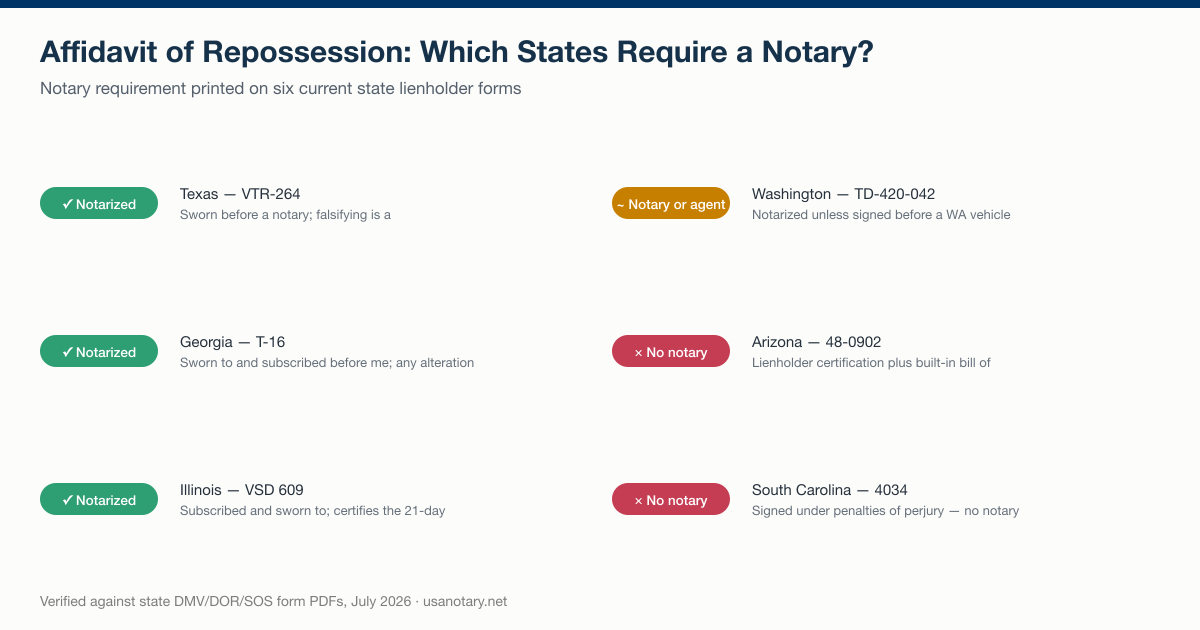
The notary requirement on six state repossession affidavit forms, verified against the current form PDFs, July 2026.
When does a lienholder file an affidavit of repossession?
The lienholder files the affidavit of repossession at title-transfer time — when it applies to retitle the vehicle or assigns it to a buyer — not at the moment of the tow. Texas makes the sequencing explicit: VTR-264’s instructions say the completed form “must be submitted to a county tax assessor-collector’s office in addition to all other required documents at the time of title transfer.” The affidavit is a title-desk document, which is why it lands on the lender’s remarketing or asset-recovery staff weeks after the recovery agent has done their part.
The repossession itself can happen several ways, and the state forms enumerate them as checkboxes. Texas VTR-264 lists three methods: repossession under the terms of the security (lien) agreement, sequestration (a court-ordered seizure, which requires attaching the sheriff’s bill of sale), and a floor plan lien — the inventory-financing scenario where a lender repossesses vehicles from a defaulting dealership. South Carolina’s 4034 offers its own three: terms of lien or mortgage, voluntary surrender, and public sale. A voluntary surrender still produces an affidavit — the borrower handing back the keys does not retitle the car.
Who signs the affidavit — and who doesn’t
An authorized agent of the lienholder signs the affidavit. On VTR-264 the certification reads: “I, the authorized agent for the lienholder listed above, certify the statements herein are true and correct and the vehicle described above was repossessed.” Georgia’s T-16 collects the authorized agent’s name, position, and signature in its certification section. The person swearing is the affiant — typically a title clerk, remarketing manager, or loan-servicing officer at the lender.
Two parties who never sign: the borrower, whose cooperation the affidavit is designed to replace, and the recovery agency that physically towed the vehicle. The repo agent’s job ends at the storage lot; the affidavit is the lienholder’s certification about its own lien and its own compliance. For a buy-here-pay-here dealer that finances its own paper, the dealership is the lienholder — its title clerk signs the affidavit the same way a bank’s would.
What the affiant certifies varies by state
The certification language is not uniform, and lending staff who work across state lines should read each form before signing:
- Georgia and South Carolina both require the affiant to certify that other recorded lienholders were told. Georgia’s T-16: “all holders of unsatisfied liens and/or security interests recorded against this vehicle… have been duly notified to protect any interests they have in the vehicle.” South Carolina’s 4034 carries a near-identical certification under penalties of perjury.
- Illinois ties the affidavit to consumer-protection steps. On VSD 609, the lienholder certifies that the Notice of Redemption required by 625 ILCS 5/3-114(f-5)(1) was delivered or mailed to the owner and any other lienholder of record, and that “the sale of the vehicle occurred after the expiration of 21 days from the date of mailing or delivery of the Notice.” For non-commercial vehicles, the form adds the Affidavit of Defense requirement — mailed to the owner, with no response received within 21 days.
- Arizona keeps it short: the lienholder certifies it is “the legal owner and a lienholder of record,” that “the vehicle is physically located in Arizona,” and that it repossessed the vehicle upon default — while releasing the state from liability for relying on the affidavit.
- Washington has the legal owner declare “under penalty of perjury under the law of Washington” that the company holds the vehicle “due to a default on a security agreement,” naming the repossession date and the registered owner.
Which repossession affidavit form does each state use?
Each state title agency issues its own repossession affidavit form, and the six below were verified against the current form PDFs in July 2026. The notarization column is the one that changes the workflow — it decides whether the lender’s signer needs a notary before the packet ships.
| State | Form | Notarization on the form? | Filed with |
|---|---|---|---|
| Texas | VTR-264, Repossessed Motor Vehicle Affidavit (Rev. 08/16) | Yes — sworn before a notary; “NOTARY STAMP HERE” block printed on the form | County tax assessor-collector’s office, at title transfer |
| Georgia | T-16, Affidavit of Repossession (Rev. 10-2017) | Yes — Section E is a notary public acknowledgment: “Sworn to and subscribed before me” | County tag office, with the current Georgia title |
| Illinois | VSD 609, Affidavit of Repossession (Sept. 2022) | Yes — “Subscribed and sworn to before me,” with notary seal and commission expiration | Secretary of State, Vehicle Services Department |
| Washington | TD-420-042, Repossession Affidavit (R/8/18) | Conditional — notarized unless signed in front of a WA vehicle licensing agent who certifies the signature | Any vehicle licensing office, with a title application |
| Arizona | 48-0902, Repossession Affidavit (R05/25) | No notary block — lienholder certification plus a built-in bill of sale and odometer statement | Arizona MVD |
| South Carolina | 4034, Affidavit for Repossessed Motor Vehicle (Rev. 4/5/18) | No notary block — signed under penalties of perjury | SC DMV, accompanying the assigned Certificate of Title |
A few form-specific details worth flagging before a packet gets rejected:
Georgia voids altered affidavits. The T-16 warns in red across the top: “ANY CORRECTION OR ALTERATION WILL VOID THIS AFFIDAVIT.” A crossed-out VIN digit means a fresh form, a fresh signature, and a fresh notarization. Georgia also attaches real money to the filing — an $18.00 title fee, any penalty fee, and Title Ad Valorem Tax if applicable — and requires the current Georgia title as a supporting document.
South Carolina returns incomplete affidavits. The 4034’s instructions state it “must be completed in every detail” and warn: “AN INCOMPLETE AFFIDAVIT WILL BE RETURNED.” The affidavit travels in a four-document packet — the SC title showing the recorded lien, Form 400 (title and registration application), Form 4034, and Form 4031 (secured bill of sale) — and the form itself notes it “must accompany the Certificate of Title, which must be properly assigned to the new owner on the back of the title.”
Arizona folds the resale into the affidavit. Form 48-0902 combines the repossession certification with a bill of sale and the federal odometer statement on a single page — and warns that “Sequential Bills Of Sale Will Not Be Accepted,” meaning the form documents one transfer, not a chain of flips.
Washington covers vessels too. TD-420-042 is written for “a vehicle or vessel,” so marine lenders in Washington use the same affidavit as auto lenders.
Other states issue their own forms in the same family; the table covers the six verified for this guide. Whatever the state, the pattern holds: the affidavit is filed with the title agency alongside the title application, and its execution requirements come printed on the form itself.
Does an affidavit of repossession need to be notarized?
In Texas, Georgia, and Illinois, notarization is required — the notary block is printed on the affidavit itself, so an unsworn form is simply incomplete. The language on all three forms is oath language, not mere identity confirmation. Texas VTR-264: the signer, “being by me first duly sworn, declared that the statements herein contained are true and correct.” Georgia T-16: “Sworn to and subscribed before me.” Illinois VSD 609: “Subscribed and sworn to before me.” In notarial terms these are jurats — the notary administers an oath and the affiant swears to the contents — which is a different act from an acknowledgment, where a signer merely confirms a signature is theirs. The distinction matters when booking a notarization, and our guide to the difference between a jurat and an acknowledgment covers it in full.
Washington splits the difference: TD-420-042’s execution block is headed “Notarization/Certification” and notes, “You don’t need your signature notarized if you sign in front of a WA vehicle licensing agent, who can certify your signature.” A lender mailing the form from out of state has no licensing agent handy — which makes notarization the practical route for remote filers.
Arizona and South Carolina print no notary block at all. Arizona’s 48-0902 takes the lienholder agent’s signature on the certification; South Carolina’s 4034 substitutes the “under penalties of perjury” declaration for the oath before a notary. No notary block on the form means no notarization requirement to satisfy — for those two states, the workflow question disappears.
What a false affidavit costs
The states did not make these forms sworn documents as a formality. Texas prints the warning directly in the certification header: “State law makes falsifying information a third degree felony.” Illinois extracts a different price — on VSD 609 the lienholder “will assume all liability and costs for any litigation that may arise from the issuance of a Certificate of Title,” which is why the form walks through the redemption-notice timeline step by step. South Carolina and Washington both anchor their forms to perjury exposure. For the lending staff signing these affidavits weekly, the practical takeaway is procedural: confirm the default, the notice dates, and the lien recording before the affidavit is sworn, because the affidavit is the document a court will read back later.
How do lenders and dealers notarize repossession affidavits online?
Remote online notarization handles the sworn-affidavit step without anyone leaving the loan-servicing floor. The legal footing is broad: the National Association of Secretaries of State reports that 47 states and the District of Columbia have a law allowing remote e-notarization. For a recovery team that files affidavits in multiple states — a regional credit union, a national auto lender, a buy-here-pay-here group with lots in three states — the alternative is hunting down a walk-in notary every time a title packet comes due.
Here is the workflow for a lender’s agent notarizing a repossession affidavit remotely:
- Upload the state’s current form. Use the exact form the receiving state prescribes — VTR-264 for a Texas filing, T-16 for Georgia, VSD 609 for Illinois. The notary notarizes the affiant’s signature on the form; the affiant remains responsible for the accuracy of every field.
- Verify identity. Before the session, the platform runs credential analysis on the signer’s government ID plus knowledge-based authentication through a third-party identity-verification service — so the notary knows exactly who is swearing.
- Join the video session and take the oath. A commissioned notary administers the oath on live video — the same jurat the printed notary block calls for. Sessions run 24/7 and take 15–30 minutes, and multi-signer sessions are supported if a second officer needs to sign in the same sitting.
- Receive the completed affidavit. The session produces a tamper-evident notarized PDF backed by a complete audit trail, with the audio-video recording and electronic journal entry retained for 10 years or longer where state law requires.
- Print and ship the title packet. The notarized affidavit joins the title, the application, and the state’s supporting documents at the county or state title office.
One caveat belongs in every recovery team’s checklist: acceptance runs through the receiving office. Before the packet ships, confirm the county tax assessor-collector, tag office, or state title agency processing the filing accepts remotely notarized documents — a two-minute call that prevents a returned packet.
For teams filing at volume, the per-document economics stay flat: $25 per document, with volume pricing for recurring workloads. Staff-initiated workflows fit this document especially well — the borrower plays no role in the session, so the lender’s title clerk can queue affidavits business-side and swear to each in a scheduled block. That workflow, along with the rest of the repossession, lien-release, and title paperwork a recovery operation generates, is what our online notarization service for auto lenders and dealerships is built around. The generic mechanics of sworn documents — what to have ready, how the oath works on video — are covered in our walkthrough of how to notarize an affidavit online.
What happens after the affidavit of repossession is filed?
The state issues title based on the repossession, and the resale can proceed — but the mechanics differ by state, and the affidavit forms themselves spell out the forks:
- Texas turns on whether the lienholder is recorded on the Texas title. VTR-264’s instructions: a recorded lienholder “may reassign the title to a subsequent purchaser,” while a lienholder not recorded on the title “must apply for a Texas title in their name with a certified copy of the security agreement before transferring the vehicle.”
- Georgia generally requires the repossessor to obtain a Georgia title in its own name first when the current title is not available — with a narrow exception for vehicles exempt from federal odometer-disclosure requirements, where a bill of sale plus the completed T-16 can accompany the sale. When the repossessor sells, the T-16 instructions direct it to complete the first title assignment to the purchaser using the buyer’s full legal name.
- Illinois issues the Certificate of Title through the Secretary of State, with the lienholder having assumed liability for litigation arising from that issuance — and the form’s damage checkboxes (over or under 50% of fair market value) feed into whether a clean or salvage-branded title results.
- South Carolina processes the affidavit alongside the assigned title: the 4034 certifies the vehicle “has been assigned to” a named party “for disposition or sale,” with the sales tax number recorded when tax is collected on the reassignment.
From that point forward, the vehicle re-enters ordinary title-transfer territory — and whether the next transfer needs a notary depends on the buyer’s state, which is a different question with its own 50-state map. Our guide to vehicle title notarization rules by state covers that side of the desk.
One more reason the sworn, recorded version of this document earns its keep: repossessions get disputed. When a former borrower later challenges the default or claims the affidavit was never properly executed, a remotely notarized affidavit carries evidence a stamp and a paper journal cannot match — identity verification results, the session recording, and what an audit trail records about every action taken on the document.
Get the affidavit sworn before the title packet ships
The affidavit of repossession is a small document with an outsized ability to stall a resale: three of the six verified state forms require notarization, the sworn statements carry felony and perjury exposure, and Georgia will void the whole affidavit over a single correction. The efficient workflow is the one that treats notarization as a scheduled step, not a scramble — queue the affidavit, verify the signer, swear it on video, and ship a complete packet the first time.
Questions about a recurring repossession-title workflow, or a state not covered in the table? Call 804-767-7500 or reach the team here.