
What is an affidavit of residency?
An affidavit of residency is a written statement in which a person swears, under penalty of law, that they live at a specific address — or that someone else does. State agencies title it “Residency Affidavit” (Texas DPS form DL-5, Arizona MVD form 40-5143) or “Affidavit of Residency” (Louisiana’s TOPS scholarship form TP005), and the oath is what separates it from ordinary proof of residency. A utility bill shows an address; an affidavit of residency attaches sworn legal consequences to it. Louisiana’s form opens with the classic oath formula — “BEFORE ME, undersigned Notary, personally came and appeared [name], who after being duly sworn, did depose and say” — and closes by warning the signer that giving false or misleading information means they “may be fined, sent to prison or both.”
Penalty language like that appears on every version of the document, whether or not a notary is involved. On Texas’s DL-5, the applicant certifies that “it is a crime to knowingly make any false statement relating to the application for a driver license or identification card.” Arizona’s 40-5143 is certified “under penalty of perjury” and names the offense outright: a Class 2 misdemeanor under A.R.S. 28-3478. The person swearing the statement is the affiant — the same role explained in our guide to what an affiant is — and the affiant is not always the person whose residency is being proven, a wrinkle covered below.
Agencies request an affidavit of residency for one recurring reason: the standard paper trail does not fit the person’s living situation. A family staying in a relative’s house has no lease in the parent’s name. A teenager applying for a first driver license has no utility bill. A college applicant’s parents moved back to the state two years ago and the scholarship agency wants sworn confirmation. The affidavit of residency bridges the gap between where someone actually lives and what the file folder can show.
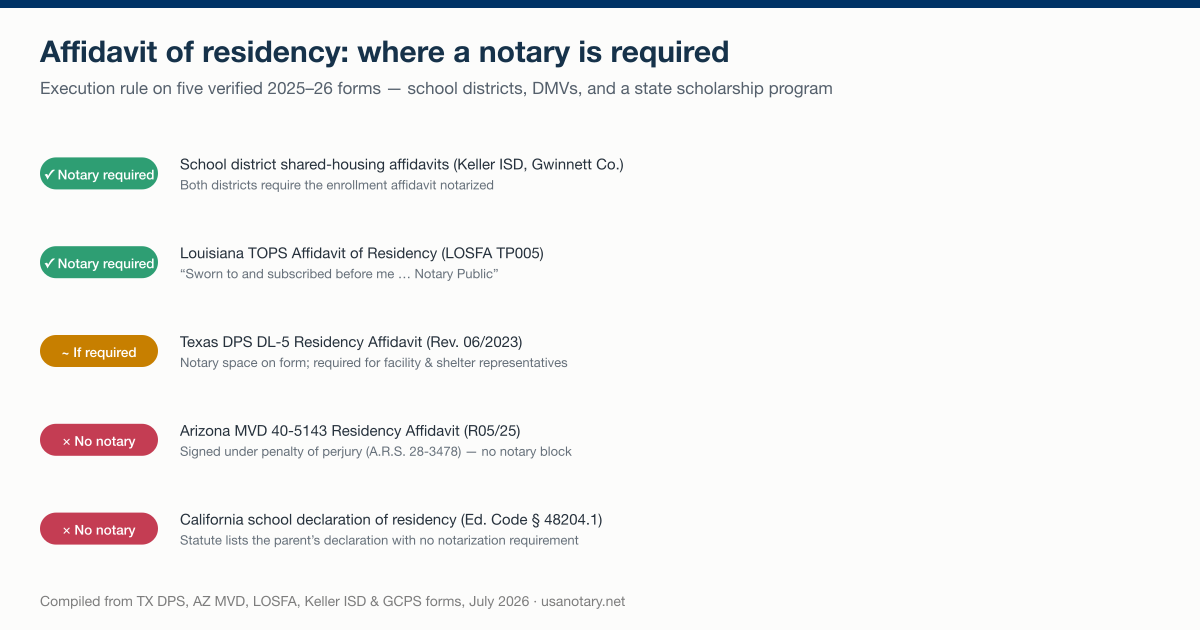
The execution rule on five current forms checked for this article — two require a notary, two don’t, and Texas’s DL-5 sits in between, July 2026.
Who asks for an affidavit of residency?
Three kinds of agencies request an affidavit of residency routinely, and each attaches its own execution rules to the same basic document:
- School districts ask for one when an enrolling family lives in a home the parent or guardian does not own or rent — the shared-housing scenario where every utility bill is in someone else’s name. Districts including Keller ISD in Texas and Gwinnett County Public Schools in Georgia publish standing affidavit requirements for exactly this case.
- DMVs and driver-license agencies ask for one when a license or ID applicant cannot produce the required residency documents in their own name. Texas DPS uses form DL-5; Arizona MVD uses form 40-5143.
- State benefit and scholarship programs ask for one when eligibility turns on residency history. Louisiana’s Office of Student Financial Assistance requires a notarized Affidavit of Residency from TOPS scholarship applicants whose families haven’t met the in-state high-school attendance test.
Courts round out the list less predictably. Sworn residency statements surface in court files whenever residency itself is disputed — but the form and execution requirements come from the individual court or clerk, so the filing instructions for your specific case govern there, not a statewide form.
One naming note to keep the terms straight: this article covers the affidavit of residency an agency requests from a living person. It is not the “affidavit of domicile” used in estate transfers, and it is not the general-purpose sworn statement covered in our walkthrough of notarizing an affidavit online — though the notarization mechanics there apply to this document too.
Does an affidavit of residency need to be notarized?
Notarization is required on some residency affidavits and not others — the form’s execution block decides, not the word “affidavit” in the title. The forms verified for this article split cleanly. Louisiana’s TOPS affidavit builds the notary in twice: the opening “BEFORE ME, undersigned Notary” and a closing “SWORN TO AND SUBSCRIBED before me, the undersigned, Notary” certificate, with instructions ordering the affiant to “complete and sign this affidavit” in the presence of a Notary Public. Arizona’s 40-5143 goes the opposite way: the applicant certifies under penalty of perjury and signs — no notary block appears anywhere on the form. And Texas’s DL-5 hedges with a line few people read correctly: “Notarization (if required) may be provided in the space below.”
Here is how to tell which camp your form falls into, in about thirty seconds:
- Look for a notary certificate. Wording like “sworn to and subscribed before me” or “acknowledged before me” followed by a signature line for a notary public means notarization is required as part of the form itself. (The two certificate types differ — our comparison of jurats and acknowledgments explains why residency affidavits almost always carry the sworn kind.)
- Look for penalty-of-perjury self-certification. Language like Arizona’s “I hereby certify under penalty of perjury that all statements in this application are true and correct” standing alone — with no notary signature line — means the agency accepted an unsworn certification and no notary is involved.
- Read the instruction sheet, not just the signature page. Louisiana’s requirement appears in instruction J (“You must sign the affidavit in front of a person who is a Notary in the state where you complete the affidavit”), and the Texas DL-5’s real notarization trigger hides in instruction 5 on the back of the form.
- When the form says “if required,” ask the receiving agency. The Texas DL-5’s conditional line exists because notarization is required for some signers (facility and shelter representatives) and not others. The clerk who will process your application is the only authority on which case is yours.
The safest operating assumption: if the document calls itself an affidavit and a government office asked for it, check before signing. An affidavit signed in advance, outside the notary’s presence, generally has to be re-signed during the notarization — the oath is administered live.
Do schools require a notarized affidavit of residency for enrollment?
Many districts require the affidavit of residency notarized when an enrolling family lives in someone else’s home — and the requirement lands on the homeowner, not just the parent. Keller ISD in Texas requires an Affidavit of Residency whenever parents or guardians “do not own or rent their current residence, cannot provide proof of residency at their current address in their own name, and they are currently living in the home of someone that is NOT the parent/guardian,” and states plainly that the affidavit “must be notarized and signed by a certified notary public.” The owner or renter of the home must add a utility bill dated within 60 days and a government-issued photo ID.
Gwinnett County Public Schools, one of the largest districts in Georgia, runs the same play with two extra steps: the notarized Residency Affidavit is “signed by the individual with whom the student’s parent/guardian is residing,” that individual must accompany the parent to the school with identification and their own proof of residency, and affidavits “should be renewed by families each school year.” An apartment household adds the apartment manager as a witness. Multiply that by every family in shared housing, every August, and the school-office line writes itself.
The legal floor underneath these policies is state education law. Texas Education Code § 25.001(c) directs each district’s board to “establish minimum proof of residency acceptable to the district” and permits “reasonable inquiries to verify a person’s eligibility for admission” — which is why affidavit requirements vary district by district rather than following one state form. California pushes the other direction: Education Code § 48204.1 requires districts to accept reasonable evidence from a list that includes property tax receipts, a lease, utility statements, pay stubs, voter registration, government correspondence — or simply a “declaration of residency executed by the parent or legal guardian,” with no notarization requirement in the statute. The same section says districts cannot demand all of the listed items.
When a district cannot ask for residency paperwork at all
Federal law overrides every district checklist for one group. The McKinney-Vento Act, 42 U.S.C. § 11432(g)(3)(C)(i), requires that the selected school “shall immediately enroll the homeless child or youth, even if the child or youth is unable to produce records normally required for enrollment,” and the statute names “proof of residency” in its list of records that cannot delay enrollment. California’s § 48204.1 repeats the guarantee in state law. A family doubled up in a relative’s home after losing housing may qualify as homeless under the Act — a question worth raising with the district’s homeless-education liaison before scrambling for a notary.
The timing problem: registration week
School residency affidavits carry a built-in deadline: the first day of school. The affidavit typically cannot be executed until the host household agrees to sign, and the host works the same business hours as every notary’s office. That collision — two adults, one notarization, zero overlapping free hours in registration week — is the single most common reason families complete this document online rather than in person. The how-to section below covers the mechanics, including getting the parent and the homeowner into one session.
Which DMV residency affidavits require a notary?
DMV residency affidavits split the same way school forms do, and Texas and Arizona make the cleanest verified pair. Both forms exist for the applicant who cannot produce standard residency documents in their own name — but their execution rules differ on every axis that matters.
Texas: form DL-5 (Rev. 06/2023). Texas DPS requires a license or ID applicant to prove Texas residency with two acceptable documents — a deed or lease, a utility bill dated within 180 days, a bank statement, a paycheck stub, and about a dozen other options listed on the form’s back page, each showing the applicant’s name, Texas address, and at least 30 days of Texas residence before the application. An applicant who cannot produce two of them completes the DL-5 instead: the applicant certifies their address in Section A, and a second party completes Section B — either the individual who lives at the address (who must supply two acceptable residency documents of their own) or a representative who provides services to the applicant there. Two conditions decide the formalities. A Section B signer who is not related to the applicant must accompany the applicant and submit the affidavit in person. And a representative of a governmental entity, not-for-profit, assisted-care facility, homeless shelter, transitional service provider, or group home must provide a notarized letter or notarized DL-5 in lieu of the two residency documents — the case the form’s “Notarization (if required)” line exists for.
Arizona: form 40-5143 (R05/25). Arizona MVD treats its Residency Affidavit as “one acceptable document for proof of residency.” The applicant self-certifies their Arizona address in Section A, or a representative or parent/guardian certifies on the applicant’s behalf in Section B (attaching their own proof of residency). Notarization is not required anywhere on the form — the signature is made under penalty of perjury, with A.R.S. 28-3478’s Class 2 misdemeanor doing the work a notary’s oath does elsewhere. For Arizona’s Travel ID credential, the affidavit counts as only one of the required proofs; the form notes the second can be “any mailed document from MVD.”
The five forms verified for this article, side by side:
| Form | Agency & context | Who signs | Is notarization required? |
|---|---|---|---|
| DL-5 Texas Residency Affidavit (Rev. 06/2023) | Texas DPS — driver license / ID | Applicant + the individual at the address or a service representative | Conditional — form provides notary space “if required”; a notarized DL-5 or notarized letter is required from facility, shelter, and agency representatives |
| 40-5143 Arizona Residency Affidavit (R05/25) | Arizona MVD — driver license / ID / Travel ID | Applicant, or representative or parent/guardian | No — signed under penalty of perjury (A.R.S. 28-3478); no notary block on the form |
| TOPS Affidavit of Residency (TP005) | Louisiana LOSFA — state scholarship eligibility | Parent, court-ordered custodian, or independent-student applicant | Yes — “SWORN TO AND SUBSCRIBED before me … NOTARY PUBLIC” |
| Declaration of residency (Cal. Ed. Code § 48204.1) | California school districts — enrollment | Parent or legal guardian | No — the statute lists the parent’s declaration with no notarization requirement |
| District residency affidavits (Keller ISD, Gwinnett County Public Schools) | Local school districts — shared-housing enrollment | Homeowner or leaseholder hosting the family | Yes — both districts require the affidavit notarized |
Two of five require a notary, two don’t, and the biggest state’s DMV form answers “it depends.” That spread is the honest headline of this whole topic: the title “affidavit of residency” tells you nothing about execution until you read the specific form.
Who signs an affidavit of residency?
The affiant is whoever swears to the residency facts — and on most versions of this document, that is not only (or not even) the person whose residency is being proven. The pattern across the verified forms:
The person themselves. Arizona’s Section A is pure self-certification: the applicant swears to their own address. Louisiana allows the same only for an “independent student” — someone 24 or older, married, a veteran, a graduate student, or meeting the form’s other independence tests.
The host. Texas’s DL-5 Section B is completed by “the individual who resides at the address” — the friend, relative, or landlord whose documents actually carry the address — and school-district affidavits work the same way, with Gwinnett requiring the signature of “the individual with whom the student’s parent/guardian is residing.” The host swears the family lives there; the host’s utility bill and ID back it up. Anyone asked to host a family should understand they are signing sworn statements with criminal penalties attached, which is precisely why districts want the signature notarized.
A parent or custodian. Louisiana’s TOPS affidavit must be completed by a parent or court-ordered custodian when the applicant is a dependent student — the parent swears to their own 24 consecutive months of Louisiana residency before the student’s high-school graduation month, supported by voter registration, a driver’s license, vehicle registration, or two years of state tax returns.
A service representative. Both DMV forms accept certification from a representative of an organization serving the applicant — a shelter, an assisted-living facility, a transitional-housing provider — and Texas is strictest here, requiring that representative’s certification notarized.
Multi-party execution is the practical takeaway. A school affidavit routinely needs the homeowner’s sworn signature plus the parent’s supporting paperwork; the Texas DL-5 needs the applicant and the Section B signer. When a notarization is required and the signers can’t be in the same room, a multi-signer remote session solves what a trip to a notary’s counter can’t.
How do you notarize an affidavit of residency online?
Remote online notarization completes a residency affidavit the same day the agency asks for it, without the affiant leaving home. The legal foundation is broad: the National Association of Secretaries of State reports that 47 states and the District of Columbia have a law allowing remote e-notarization. The oath that makes an affidavit an affidavit — the same “duly sworn” formula printed on Louisiana’s form — is administered by the notary over live audio-video, and the session is recorded.
The process, start to finish:
- Upload the unsigned affidavit. Leave the signature line blank — a sworn affidavit is signed in the notary’s presence, and on a remote session that presence is the live video connection.
- Verify your identity. Credential analysis checks the security features of your government ID and knowledge-based authentication confirms you are its holder, both run by a third-party identity-verification service before the notary appears.
- Swear and sign on camera. The notary administers the oath, watches you sign, and completes the notarial certificate — the “sworn to and subscribed before me” block the school district or scholarship office is looking for. Sessions run 24/7 and take 15–30 minutes, and a multi-signer session puts the homeowner and the parent in front of the notary together even if they’re in different places that day.
- Deliver the tamper-evident PDF. The completed affidavit arrives as a tamper-evident PDF backed by a complete audit trail, with the session recording and electronic journal entry retained for 10 years or longer where state law requires.
One cross-state wrinkle deserves a sentence, because Louisiana’s instructions raise it: the TOPS form directs the affiant to sign before “a Notary in the state where you complete the affidavit.” An online notary is commissioned by their own state and performs the notarization under that state’s law — how that holds up when the document travels is covered in our guide to remote notarization across state lines. When the stakes are high and the receiving agency’s instructions name a specific state, confirm with that agency first; acceptance is always the receiver’s call.
Pricing is flat: $25 per document, with volume pricing for organizations that process these in batches. That last part matters on the other side of the counter too — school registrars, DMV clerks, and benefit-program staff who receive residency affidavits all season can route families to a staff-initiated notarization workflow instead of turning them away to hunt for a notary. That receiving-agency setup is what our online notarization service for government agencies is built for.
Get the affidavit sworn before the deadline
The rule this article keeps landing on: the form decides, so read the execution block before you plan your week. Louisiana’s scholarship affidavit and the district enrollment affidavits are notarized documents, full stop. Arizona’s DMV form never sees a notary. Texas’s DL-5 depends on who signs Section B. And every one of them carries criminal-penalty language that makes casual signing a bad idea — sworn means sworn.
When your form does require a notary and the school year, license appointment, or scholarship deadline is bearing down, a 15–30 minute video session completes it — affiant, host signer, oath, seal, and tamper-evident PDF — before the office closes. Questions about a specific form, or about setting up a workflow for the affidavits your agency receives? Call 804-767-7500 or reach us through the contact page.