
Does a certificate of trust need to be notarized?
In two states checked for this article, yes; in the Uniform Trust Code states, no — and that split is exactly why the top search results contradict each other. Uniform Trust Code § 1013, the model law behind most states’ certification statutes, says a certification of trust “may be signed or otherwise authenticated by any trustee.” No notary appears anywhere in the section. California takes the opposite position: Probate Code § 18100.5 requires the certification to be “in the form of an acknowledged declaration” — an acknowledgment is a notarial act, so notarization is required. Minnesota goes further still: its statute requires the signature to be made “under oath before a notary public or other official authorized to administer oaths.”
Terminology first, because the search results mix it freely. Certification of trust, certificate of trust, abstract of trust, and memorandum of trust all name the same document: a short, signed summary that proves a trust exists and identifies who has authority to act for it, presented to a bank, brokerage, or title company instead of the full trust instrument. The certification is not the trust. The trust instrument itself is a separate document with its own signing formalities, covered in our guide to how a trust is notarized — this article is only about the summary document the bank asks for at account opening.
The practical answer is narrower than the legal one. A bank can request a notarized certification even in a state whose statute does not require one, and institutions routinely do — Florida estate attorneys at PTM Trust and Estate Law put it plainly: “The notarization makes it more likely that third parties will accept the document as valid.” So the working rule for a trustee is two-layered: state law decides whether notarization is required; bank policy decides whether it is requested. The statute-by-statute reconciliation below covers both layers, quoting each execution rule verbatim.
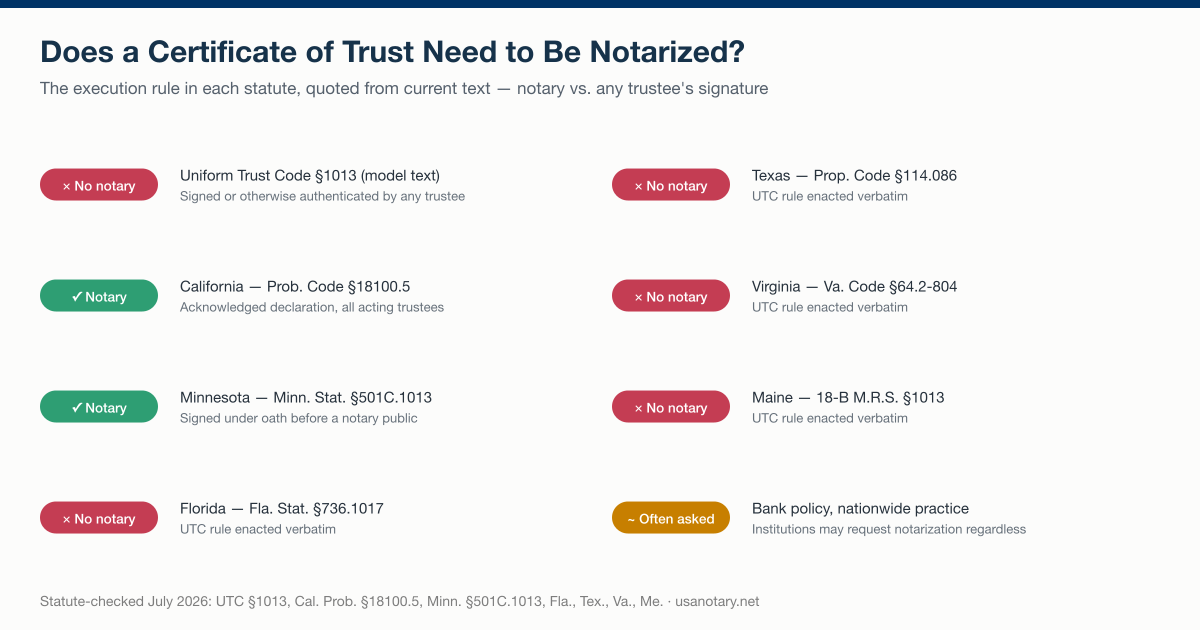
The execution rule in each statute checked for this article, July 2026 — two of seven require a notary.
What does UTC § 1013 require for a certification of trust?
UTC § 1013 requires a signature from any one trustee plus a specific set of contents — notarization is not required by the uniform text. Subsection (b) is one sentence: “A certification of trust may be signed or otherwise authenticated by any trustee.” The phrase “or otherwise authenticated” was written for electronic execution, and the section’s companion, UTC § 1102, expressly validates electronic records and signatures.
Subsection (a) lists what the certification must contain. Instead of furnishing a copy of the trust instrument, the trustee may furnish a certification stating:
- That the trust exists and the date the trust instrument was executed
- The identity of the settlor
- The identity and address of the currently acting trustee
- The powers of the trustee
- The revocability or irrevocability of the trust, and the identity of any person holding a power to revoke it
- The authority of cotrustees to sign or otherwise authenticate, and whether all or less than all are required to exercise the trustee’s powers
- The trust’s taxpayer identification number
- The manner of taking title to trust property
Two more subsections do the quiet work. Subsection (c) requires the certification to state “that the trust has not been revoked, modified, or amended in any manner that would cause the representations contained in the certification of trust to be incorrect” — the freshness guarantee a bank is actually relying on. And subsection (d) states the document’s entire reason for existing: “A certification of trust need not contain the dispositive terms of a trust.” The official comment explains that the section “is designed to protect the privacy of a trust instrument by discouraging requests from persons other than beneficiaries for complete copies of the instrument in order to verify a trustee’s authority.”
Which states enacted the UTC rule verbatim?
Florida, Texas, Virginia, and Maine — each checked against current statute text for this article — enacted § 1013(b)‘s execution sentence word for word. Florida Statutes § 736.1017(2), Texas Property Code § 114.086(b), Virginia Code § 64.2-804, and Maine tit. 18-B § 1013(2) all read: “A certification of trust may be signed or otherwise authenticated by any trustee.” In those four states, notarization is not required by statute, full stop.
Which states require a notarized certification of trust?
California and Minnesota require a notary; every UTC-verbatim statute checked requires only a trustee’s signature. Here is the reconciliation, with each statute’s execution language quoted directly:
| Jurisdiction | Statute | Execution language (verbatim) | Notarization required? |
|---|---|---|---|
| Uniform Trust Code (model text) | UTC § 1013(b) | “A certification of trust may be signed or otherwise authenticated by any trustee” | No |
| California | Prob. Code § 18100.5(c) | “The certification shall be in the form of an acknowledged declaration signed by all currently acting trustees” | Yes — acknowledgment, all acting trustees |
| Minnesota | Minn. Stat. § 501C.1013 | ”The signature of the settlor or trustee must be under oath before a notary public or other official authorized to administer oaths” | Yes — oath before a notary |
| Florida | Fla. Stat. § 736.1017(2) | “A certification of trust may be signed or otherwise authenticated by any trustee” | No |
| Texas | Prop. Code § 114.086(b) | “A certification of trust may be signed or otherwise authenticated by any trustee” | No |
| Virginia | Va. Code § 64.2-804 | ”A certification of trust may be signed or otherwise authenticated by any trustee” | No |
| Maine | 18-B M.R.S. § 1013(2) | “A certification of trust may be signed or otherwise authenticated by any trustee” | No |
Two caveats keep this table honest. First, it covers the model text plus six enactments verified against current statute text — it is not a 50-state survey, and certification statutes get amended. If your state is not in the table, read your state’s certification-of-trust statute before relying on either answer. Second, the table’s “who signs” differences matter as much as the notary column: under the UTC rule any single trustee signs, while California requires all currently acting trustees and Minnesota permits the settlor or a trustee. A co-trusteed California trust needs every acting trustee in front of a notary — a logistics problem the online option at the end of this article solves directly.
What about recording the certification with a deed?
Real-property transactions add a layer this table does not cover. When trust real estate changes hands, title companies and county recorders may ask for a recordable certification alongside the deed, and recording offices impose their own execution formalities on documents entering the land records. That is a recording-law question, not a trust-law question — check the recorder’s requirements in the county where the property sits.
Why do the top search answers contradict each other?
Each ranking answer is right for exactly one state and wrong as a national rule. A generic estate-planning site that says a certificate of trust “must be notarized” is describing California or Minnesota practice. A Florida firm answering “no” — as PTM Trust and Estate Law does, citing § 736.1017 and noting that “notarization is never mentioned as a requirement” — is correct for Florida and misleading for a Californian. Neither page is lying; both are answering a state-law question as if it were a federal one.
The deeper irony sits in the UTC’s own drafting history. The official comment to § 1013 opens: “This section, derived from California Probate Code Section 18100.5, is designed to protect the privacy of a trust instrument.” The uniform drafters borrowed California’s document — and dropped California’s notary. So the state that invented the modern certification of trust is the state whose execution rule the rest of the country declined to copy. Anyone reconciling the contradictory search results is really just watching that 25-year-old drafting decision play out across state lines.
Acknowledgment vs. oath: the two different notarial acts
California and Minnesota do not even require the same kind of notarization. California’s “acknowledged declaration” calls for an acknowledgment — the trustee confirms to the notary that the signature is theirs, made willingly. Minnesota’s “under oath before a notary public” calls for a jurat — the signer swears to the truth of the document’s contents, and the notary administers the oath. The distinction changes what certificate wording the notary completes, and presenting the wrong one is a common rejection reason. Our comparison of jurat vs. acknowledgment walks through when each applies and what each certificate looks like.
Why do banks require a notarized certification even where the statute doesn’t?
Banks request notarization because their protection under the certification statutes runs on reliance, and notarization hardens the thing being relied on. UTC § 1013(f) protects “a person who acts in reliance upon a certification of trust without knowledge that the representations contained therein are incorrect,” and § 1013(g) lets a person who relies in good faith “enforce the transaction against the trust property as if the representations contained in the certification were correct.” Those protections attach to the document — but the account officer accepting it still wants assurance that the trustee named in the certification is the person who signed it. A notarial act supplies exactly that identity layer, which is why PTM’s practice advice — notarization “makes it more likely that third parties will accept the document as valid” — matches what trustees encounter at branch desks nationwide.
Institutional standardization does the rest. A bank or credit union operating across state lines does not maintain seven execution policies for seven statutes; it standardizes on the strictest rule it faces, and the strictest rule is California’s notarized, all-trustee declaration. A notarized certification is the one version that satisfies every statute in the table at once, so “get it notarized” becomes the national default in account-opening checklists even though only two of the seven statutes require it. Banks and credit unions that see this friction daily — a trustee arrives without the notarized version and the account opening stalls — can remove it with a staff-initiated online notarization workflow for financial institutions: the branch employee starts the session, the trustee signs before a commissioned notary on video, and the account opens the same visit.
There is a defensive logic too. A certification states that the trust “has not been revoked, modified, or amended” — the representation a fraudster impersonating a trustee would most like to fake. The institution’s fraud team knows the reliance protections in § 1013(f)–(g) turn on acting without knowledge that the representations are incorrect, so the intake process is built to surface red flags before reliance happens. Identity verification through a notarial act is the cheapest red-flag filter available.
Can a bank insist on the full trust document instead of a certification?
Under the UTC, a flat demand for the entire trust instrument carries statutory risk for the bank. Section 1013(h) provides: “A person making a demand for the trust instrument in addition to a certification of trust or excerpts is liable for damages if the court determines that the person did not act in good faith in demanding the trust instrument.” The uniform drafters wrote that liability in deliberately — the comment says the section works “by discouraging requests from persons other than beneficiaries for complete copies of the instrument.”
The statute gives the bank a safer middle path. Under § 1013(e), a recipient may require the trustee to furnish “copies of those excerpts from the original trust instrument and later amendments which designate the trustee and confer upon the trustee the power to act in the pending transaction” — the authority pages, not the inheritance pages. A trustee facing a full-document demand in a UTC state can point to both subsections: excerpts yes, everything no.
Good faith is the escape hatch, and it is real. The official comment lists situations where demanding the full instrument remains good faith — including examination “required … pursuant to due diligence standards or as required by other law,” and documentary requirements “established by state or local government or regulatory agency.” A trust department reviewing a complex transaction under its regulator’s documentation standards is not a bad-faith actor. The same acceptance tension — institution wants maximum paper, statute protects the customer’s shorter document — plays out with agent authority documents too, covered in our guide to using a power of attorney on a bank account.
How do you notarize a certification of trust online before the bank appointment?
A trustee can complete the notarization over live video in 15–30 minutes, without finding every co-trustee a seat in the same notary’s office. The legal footing is broad: the National Association of Secretaries of State reports that 47 states and the District of Columbia have a law allowing remote e-notarization. Here is the sequence:
- Upload the certification. Use the form your state’s statute or your attorney prescribes — the notary notarizes the trustee’s signature on it and does not draft or alter the document. Have the trust’s execution date, trustee addresses, and taxpayer identification number ready, since the statutes require them in the contents.
- Verify identity. Before the session starts, each signer completes identity verification — credential analysis of a government ID plus knowledge-based authentication, run by a third-party identity service. This is the same identity layer the bank wants the notarization to prove.
- Join the video session. A commissioned notary meets the signers on live video; sessions run 24/7. Multi-signer sessions matter here: California’s rule means all currently acting trustees sign the acknowledged declaration, and a video session puts a trustee in San Diego and a co-trustee in Denver in front of the same notary at once. The notary performs the acknowledgment or administers the oath, matching what your state’s statute requires.
- Deliver the notarized certification. The session produces a tamper-evident notarized PDF backed by a complete audit trail, with the audio-video recording and electronic journal entry retained for 10 years or longer where state law requires — a stronger provenance record than an ink stamp if the bank’s back office ever questions the document.
At $25 per document — volume pricing applies for trust departments handling these weekly — the notarized certification costs less than the second branch trip it prevents. If the receiving institution is the open question rather than the notarization itself, our guide to whether banks accept online notarization covers the acceptance rules state by state.
Hand the bank a certification it can’t push back on
The two-layer rule resolves every contradictory answer in the search results: the statute decides whether notarization is required — California and Minnesota say yes, the UTC states say no — and bank policy decides whether it is requested, which is nearly everywhere. A trustee who shows up with a notarized certification satisfies both layers in all seven jurisdictions in the table, and a trustee in California brings every acting co-trustee’s acknowledged signature or gets sent home.
For trustees, that means one 15–30 minute video session before the appointment. For banks and credit unions, it means the reverse workflow: instead of turning a trustee away over a missing acknowledgment, a branch employee initiates the notarization on the spot. Questions about either side? Call 804-767-7500 or reach us here.