
What does a power of attorney for a bank account let your agent do?
A power of attorney for a bank account authorizes the person you name — your agent — to operate the account on your behalf: deposits, withdrawals, transfers, bill payments, and routine servicing, within whatever limits the document sets. The document alone moves nothing, though. Your agent can act at the teller window only after the bank accepts the power of attorney and registers the agent on the account — and that acceptance step, not the signing ceremony, is where families get stuck.
The scale of the problem sits in the Uniform Power of Attorney Act’s own drafting record. A national survey conducted by the Joint Editorial Board for Uniform Trust and Estate Acts, cited in the act’s official comments, found that 63 percent of respondents reported occasional difficulty obtaining acceptance of powers of attorney, and 17 percent reported frequent difficulty. Legislatures answered with acceptance statutes that put banks on a clock — the tables below show exactly how short that clock runs.
This guide stays on the bank side of the transaction: getting the POA accepted, understanding why banks reject one, and using the statutes that force the issue. For the document itself — types, durability, scope — start with our explainer on what a power of attorney is, and for the agent’s role and fiduciary duties, see what an attorney-in-fact actually does.
How do you add a power of attorney to a bank account?
Adding a power of attorney to a bank account is a presentation-and-review process, and the bank controls the tempo. The sequence below reflects what Bank of America and Chase publish about their own procedures:
- Confirm the POA grants banking authority. The bank reviews the document for the specific power being exercised. A POA limited to real estate or a vehicle sale will not carry a checking account; the grant needs to cover banking or financial transactions.
- Get the document notarized before you present it. Banks review execution first. Bank of America asks for “a fully executed, notarized power of attorney document” — an unnotarized POA fails at the front desk. If yours is signed but not yet notarized, notarize the power of attorney online before booking the bank appointment.
- Gather identification for both principal and agent. Bank of America wants valid IDs for both parties, at least one being a government-issued photo ID, plus a list of the account numbers the POA should attach to. Chase requires the agent’s primary and secondary IDs — and sometimes the account owner’s as well.
- Schedule the appointment. Both banks route POA registration through an in-person meeting: Bank of America recommends the principal accompany the agent to a financial center, and Chase states that “the named agent in your power of attorney documents must be present for an agent to be added to the account.”
- Let the review run — and expect follow-up. Chase says it “will review the POA to confirm the agent’s authority before approving any changes.” Bank of America warns that “due to the complexities of power of attorney documents, multiple reviews may be required,” and that a springing POA may need a doctor’s letter to become effective.
- Confirm the registration. Once the bank accepts the document, the agent is added to the account’s records. Ask what the agent’s access looks like in practice — branch only, or online banking too — because that is bank policy, not POA language.
The friction concentrates in step 5. Everything after this point is about what the bank may lawfully demand there — and what it may not.
Does the power of attorney need to be notarized for the bank?
Treat notarization as mandatory for a bank account POA, because both the statutes and the banks are built around the notarized version. New York makes it an execution requirement outright: under GOL § 5-1501B, a POA must be “signed, initialed and dated by a principal with capacity,” acknowledged the way a real-property deed is acknowledged, and “witnessed by two persons who are not named in the instrument as agents or as permissible recipients of gifts.”
UPOAA states take a different route to the same destination. Section 105 of the model act provides that “a signature on a power of attorney is presumed to be genuine if the principal acknowledges the signature before a notary public” — Virginia carries the identical sentence in Va. Code § 64.2-1603. Notarization is not what creates the POA in those states; it is what makes the document safe for a bank to rely on.
Why banks only trust the acknowledged version
The act’s acceptance machinery runs on that presumption. Under UPOAA § 119, a bank that in good faith accepts an acknowledged power of attorney without actual knowledge of a problem may rely on it as genuine and valid — and the section, by its own terms, “does not apply to unacknowledged powers of attorney.” No notarization, no legal safe harbor, no statutory deadline forcing a decision. That is the quiet reason a branch employee will not process the un-notarized POA a customer swears is valid: the bank’s protection begins where the notary’s certificate sits.
A remote online notarization satisfies this the same way a walk-in stamp does — our guide to whether banks accept online notarization covers the interstate recognition rules. The National Association of Secretaries of State reports that 47 states and the District of Columbia have a law allowing remote e-notarization, so the notarized POA the statutes reward can be completed over live video before the bank appointment.
Why do banks reject powers of attorney?
Banks reject powers of attorney because the branch bears the loss if the document turns out to be forged, revoked, or abused — so review teams default to caution. The rejection reasons cluster into two very different groups: grounds the law respects, and grounds the law has specifically outlawed.
State acceptance statutes recognize a bank’s refusal as legitimate when, for example, the bank has actual knowledge that the agent’s authority terminated, when the transaction would be inconsistent with federal law, when a requested agent certification is refused, when the bank in good faith believes the power is not valid or the agent lacks authority for the act requested, or when the bank has made (or knows of) a good-faith report to adult protective services that the principal may be subject to abuse or exploitation by the agent. Those exceptions appear in UPOAA § 120 and Virginia’s enactment of it, and the CFPB’s consumer guidance lists the same family of exceptions: suspected forgery, known revocation, or suspected exploitation.
The outlawed group is the one agents actually hit at the counter:
- “It has to be on our form.” The model act is blunt: a person “may not require an additional or different form of power of attorney for authority granted in the power of attorney presented.” New York deems a refusal unreasonable when based solely on the fact that “the power of attorney is not on a form prescribed by the third party.”
- “It’s too old.” New York’s statute also deems refusal unreasonable when based solely on the lapse of time since execution, or on a gap between the dates the principal and agent signed.
- Slow-walking. Silence is a refusal with a timestamp. The statutes in the next section put a number on how long the review may take.
A bank with genuine doubt has a lawful middle path: UPOAA § 119(d) lets it request — and rely on, “without further investigation” — the agent’s certification under penalty of perjury of any factual matter, an English translation, or an opinion of counsel. An agent who arrives ready to sign a certification takes away the most common stall.
Which laws require banks to accept a valid power of attorney?
The CFPB’s answer comes first, because it frames every state rule: “As long as the power of attorney (POA) follows the laws of your state, banks, credit unions, and other third parties should accept it.” Behind that guidance sits the Uniform Power of Attorney Act — enacted in roughly 31 states plus the District of Columbia as of early 2026, per LegalClarity’s adoption survey — and a set of non-uniform state statutes that reach the same result.
Here is how the acceptance rules compare, checked against the statute and model-act text:
| Law | Clock to decide | Can the bank demand its own form? | Cost of wrongful refusal |
|---|---|---|---|
| UPOAA § 120 (model text) | Accept, or request a certification, translation, or opinion of counsel, within 7 business days of presentation; accept within 5 business days after receiving the requested item | No — the act bars requiring “an additional or different form of power of attorney” | Court order mandating acceptance, plus liability for reasonable attorney’s fees and costs |
| Virginia — Va. Code § 64.2-1618 | 7 business days to accept or request supporting items; 5 business days after receipt | No, subject to the statute’s listed exceptions | Court order mandating acceptance, plus liability for reasonable attorney fees and costs |
| Florida — Fla. Stat. § 709.2120 | 4 days, excluding weekends and legal holidays, “presumed to be a reasonable time” for a financial institution to accept or reject | May request an affidavit, English translation, or opinion of counsel; if the agent refuses the request, the institution need not accept | Court order mandating acceptance, plus liability for damages including reasonable attorney fees and costs |
| New York — GOL § 5-1504 (statutory short form) | Honor or reject within 10 business days of presentation | No — refusal based solely on the POA not being “on a form prescribed by the third party” is deemed unreasonable | Special proceeding; the court may award damages, including reasonable attorney’s fees and costs, for unreasonable refusal |
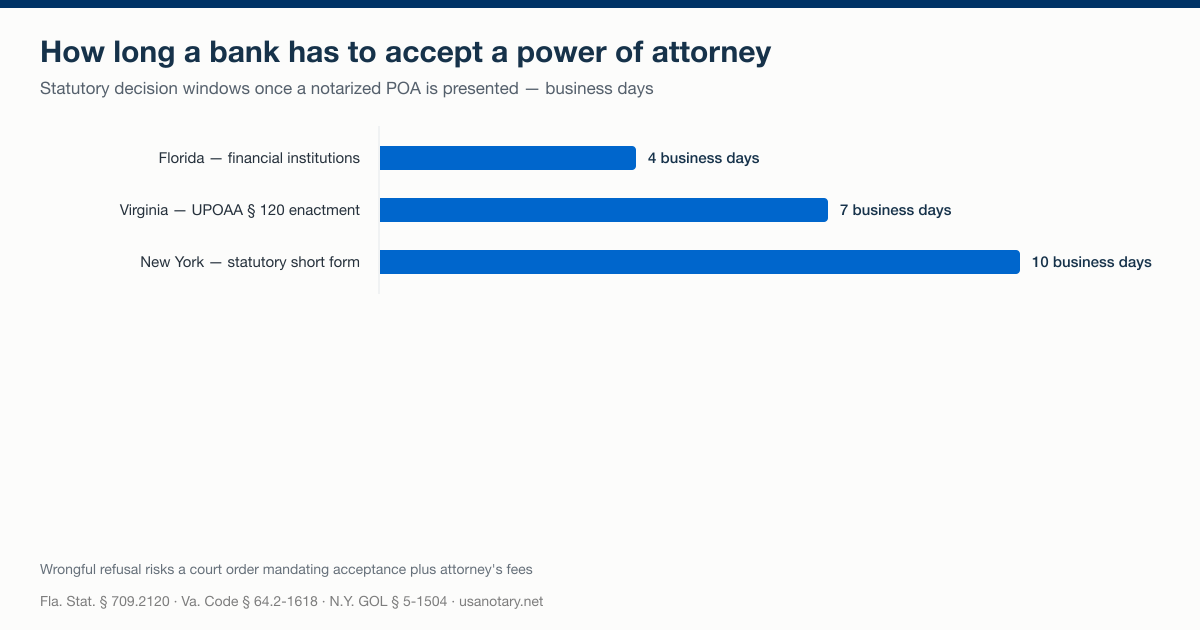
The statutory decision clocks from this article’s acceptance table — four to ten business days, depending on the state, before a bank’s silence becomes actionable. July 2026.
Two boundaries keep the table honest. First, these statutes protect acknowledged documents — the UPOAA defines the protected class as POAs “purportedly verified before a notary public,” which loops back to why notarization comes before the bank appointment. Second, the acceptance duty is not absolute anywhere: every statute in the table preserves the good-faith exceptions listed in the previous section, and UPOAA § 120 excuses a bank that is “not otherwise required to engage in a transaction with the principal in the same circumstances.” A stranger cannot use a POA to force a bank to open a brand-new relationship.
How do Bank of America, Chase, and Wells Fargo handle POAs?
The big banks accept attorney-drafted POAs but wrap them in their own review workflows — and each publishes a different set of demands. This comparison reflects each bank’s own published materials as of July 2026:
| Bank of America | Chase | Wells Fargo | |
|---|---|---|---|
| What they require | ”A fully executed, notarized power of attorney document,” a list of account numbers, and valid IDs for principal and agent | The POA document plus the agent’s primary and secondary IDs; sometimes the owner’s IDs and, depending on circumstances, a physician statement or letter of incapacity | A POA Submission Cover Sheet, a notarized Attorney-in-Fact Affidavit, a copy of the POA, and identity documents if the principal is incapacitated (personal-loan packet) |
| How you submit | Scheduled appointment at a financial center; the principal is encouraged to come along | Scheduled meeting with a banker; “the named agent … must be present,” and more than one branch visit may be needed | Mail, email, branch, or fax to its document-verification unit |
| Review posture | ”Multiple reviews may be required" | "The bank will review the POA to confirm the agent’s authority before approving any changes” | The agent swears, under penalty of perjury, that the POA has not been amended, revoked, or terminated and that the principal is living |
| House form | Optional limited POA form for BofA deposit accounts and safe deposit boxes, available “in most states” at no cost | Optional Chase POA form, completed at a branch | State-specific agent guides for Georgia, Illinois, Oregon, and Virginia |
Wells Fargo’s packet deserves the closest read even though it is published for personal-loan servicing, because it shows what banks increasingly do instead of unlawfully demanding their own POA form: they demand a notarized agent affidavit alongside it. That affidavit is exactly the “agent’s certification under penalty of perjury” that UPOAA § 119(d) authorizes — sworn before a notary, confirming the POA is unrevoked and the principal alive. Expect some version of it at any large institution, and expect it to need its own notarization.
For banks and credit unions on the receiving side of this workflow, the same session solves both documents at once: a branch that cannot notarize a customer’s POA or agent affidavit in-house can hand off to a staff-initiated remote session instead of turning the customer away — that handoff is what our online notarization service for financial institutions is built for, with multi-signer support when the POA and the affidavit need principal and agent in one session.
What should you do when the bank refuses your power of attorney?
A refusal is a legal position, not a final answer — and the statutes above give you a sequence for testing it:
- Get the reason in writing. Ask specifically which defect the bank claims. In New York, a rejecting third party must state its reasons in writing; everywhere else, a written reason still pins the bank to a position it may have to defend later.
- Cure what is curable, on the record. Offer the agent certification under penalty of perjury, and the opinion of counsel if the bank asks for one — the UPOAA obliges the bank to decide within five business days of receiving what it requested. If the objection is a missing or defective notarization, fix it the same day: a remote session can complete the notarization online in 15–30 minutes.
- Escalate past the branch. The CFPB’s guidance is to raise the refusal with branch management or the bank’s own attorney — front-line staff apply the cautious default; the legal department knows what § 120 liability costs.
- Invoke the statute by name. A letter citing your state’s acceptance provision — § 64.2-1618 in Virginia, § 709.2120 in Florida, GOL § 5-1504 in New York — and noting the court-order-plus-fees remedy changes the bank’s risk calculation from “safe refusal” to “priced refusal.”
- Take it to court if the account matters enough. The CFPB notes that a court order may compel acceptance and that the refusing institution can be liable for legal fees and court costs; the UPOAA and its state enactments say the same in statutory text. New York routes this through a special proceeding in which the court may award damages, including attorney’s fees.
Families setting this up for an aging parent should run the sequence before the crisis: present the POA while the principal can still stand next to the agent at the appointment, cure objections while there is time to cure them, and keep the registration confirmation with the estate papers. Our guide to setting up a power of attorney for an elderly parent covers that planning side.
Get the POA bank-ready before the appointment
The pattern across every statute and every bank page in this guide is the same: the notarized, acknowledged power of attorney is the one the law protects and the one the bank processes. The un-notarized version has no § 119 safe harbor, no acceptance deadline working in its favor, and no chance at Bank of America’s front desk.
Remote online notarization gets the document to that protected status without a branch hunt: sessions run 24/7 for signers in all 50 states, take 15–30 minutes over live video, and produce a tamper-evident PDF with a complete audit trail — the identity checks behind it use credential analysis plus knowledge-based authentication run by a third-party identity-verification service. At $25 per document, the POA and the bank’s agent affidavit can both be notarized in one sitting, with multi-signer sessions when principal and agent sign together and remote witnesses supported where state law and the document’s rules permit.
Questions about a specific bank’s requirements or a recurring branch workflow? Call 804-767-7500 or reach out through our contact page.