
This is general information, not legal advice. Power of attorney rules are set by each state, and an elderly parent’s situation often involves capacity, Medicaid, and estate questions that interact. Consult an elder-law attorney in your parent’s state before relying on anything here.
Can you get power of attorney for an elderly parent?
A power of attorney for an elderly parent is granted by the parent, not taken by the child — and that correction is the single most important thing to understand before you start. Your parent is the principal: the person who signs the document and grants authority to an agent, the attorney-in-fact. You cannot file for it, petition for it, or obtain it over their objection. As the American Bar Association’s estate-planning guidance puts it, “a power of attorney gives one or more persons the power to act on your behalf as your agent” — the “your” is always the parent.
The timing consequence is unforgiving: a parent must sign while they can still understand what they are signing. Once that window closes, the ABA notes, “it may become necessary for a court to appoint one or more people to act for you” — a guardianship or conservatorship proceeding in which “you may not have the ability to choose the person who will act for you.” Everything below is about using the window while it is open. If your parent’s memory is already failing, start with our companion guide on dementia and power of attorney.
Which powers of attorney does an aging parent need?
Most families end up preparing two documents, because financial authority and medical authority travel separately:
| Document | What your parent grants | Key feature for aging parents | Deep dive |
|---|---|---|---|
| Durable financial POA | Authority over money and property — banking, bills, benefits, real estate | Durable means it keeps working after incapacity. The ABA notes most states permit a durable POA “that remains valid once signed until you die or revoke the document” | What is a power of attorney? |
| Durable POA for health care (health care proxy) | Authority over medical decisions if the parent cannot communicate | The National Institute on Aging defines it as “a legal document that names your health care proxy, a person who can make health care decisions for you if you are unable to communicate these yourself” | Same guide — see the durable POA section |
| Living will (often paired) | Written treatment instructions for end-of-life care | Complements the proxy — the NIA notes a proxy “can be chosen in addition to or instead of a living will” | — |
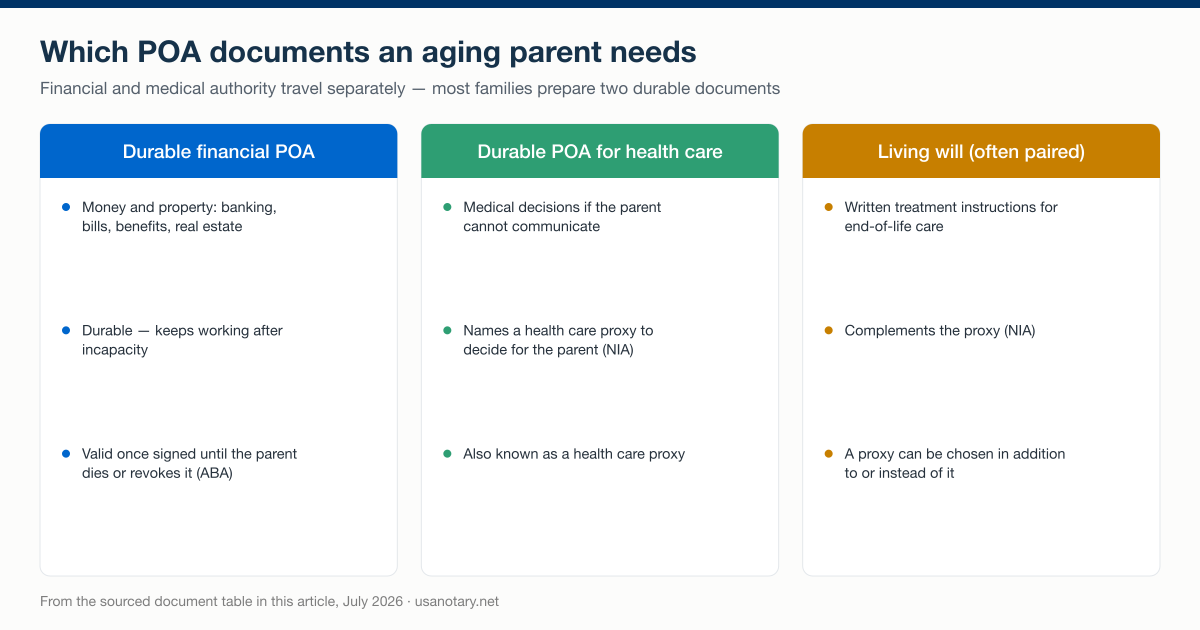
The three documents most families prepare for an aging parent, from the sourced table in this guide — July 2026.
One design decision worth discussing: an immediate durable POA versus a springing POA, which the ABA describes as one that takes effect “only upon the occurrence of a future event, usually a determination that you are unable to act for yourself due to mental or physical disability.” Springing sounds safer to a reluctant parent, but it forces banks to judge whether the trigger has occurred — an elder-law attorney can weigh the trade-off for your family. This post covers the process; the full type-by-type breakdown lives in our power of attorney explainer.
How to get power of attorney for an elderly parent: 7 steps
- Have the conversation early. The document only works if your parent signs while competent — and the discussion is easier framed around their control, not your convenience (more below).
- Decide the types together. For most aging parents: a durable financial POA plus a durable POA for health care, per the table above.
- Choose the agent and a successor. The ABA advises naming “one or more successor agents” in case the first choice is unavailable, and notes “integrity, not financial acumen, is often the most important trait of a potential agent.”
- Prepare the documents under your parent’s state law. Attorney-drafted or a state form — the next section compares them. The governing law is where your parent lives, not where you live.
- Execute the documents properly. Your parent — the principal — appears before a notary, proves their identity, and acknowledges signing. Some states require witnesses in addition to the notary.
- Distribute copies. The agent, the parent’s bank, physicians, and the care facility all may need one — the ABA notes that “[o]ften your agent must present the actual document to invoke the power.”
- Onboard the agent. The Consumer Financial Protection Bureau publishes free guides “for those who have been named in a power of attorney to make decisions about money and property for someone else” — worth reading before the first bill gets paid.
How to raise it with your parent
The conversation fails when it sounds like a demotion, and it works when it sounds like a plan. Two evidence-backed framings help. First, control: a POA is how your parent chooses who acts — the alternative, per the ABA, is a court proceeding where the family may not choose at all. Second, accuracy: the National Institute on Aging cites a study in which “people guessed nearly one out of three end-of-life decisions for their loved one incorrectly” — writing wishes down protects the parent from being guessed about.
Practical openers that keep the parent in the driver’s seat:
- “Who would you want handling the bills if you were in the hospital for a month?”
- “Your doctor can’t talk to me without paperwork — want to fix that while it’s easy?”
- “Let’s do this while it’s your decision, so a judge never has to make it.”
Preparing the document: attorney or state form?
Both routes produce a valid document; they differ in tailoring and cost. The ABA cautions that while “a power of attorney is accepted in all states,” the “rules and requirements differ from state to state” — which is the argument for either an elder-law attorney in your parent’s state or, at minimum, that state’s own form rather than a generic template. A number of states, including New Hampshire, have enacted the Uniform Power of Attorney Act, which standardizes execution rules — New Hampshire’s enactment is RSA 564-E.
For the health care side, cost is rarely a barrier: the NIA notes “many states have their own forms that you can access and complete for free,” lists AARP and the American Bar Association as places to download your state’s advance directive form, and answers the lawyer question directly — “a lawyer can help but is not required to create your advance directives.” For the financial POA, attorney drafting earns its fee when the parent has real estate, gifting or Medicaid-planning needs, or property in more than one state.
Signing and notarizing the POA
Execution is where families stumble, and it is state-specific. Under the Uniform Power of Attorney Act as enacted in New Hampshire, a general power of attorney “must be signed (other than by electronic signature) by the principal” and “must be acknowledged before a notary public or other individual authorized by law to take acknowledgments” (RSA 564-E:105). Note the parenthetical: New Hampshire is an example of a state that restricts electronic signatures on general POAs — which matters for the remote-signing option below. The pattern in most states matches on the core act: the principal appears before a notary, proves their identity, and acknowledges signing — and some states require one or two witnesses on top.
The mechanics — which notarial act applies, who must appear, what the notary checks — are covered in full in our guide to notarizing a power of attorney online. The short version for this step: only your parent’s signature gets notarized; the agent generally does not need to be present.
Getting a parent’s POA notarized when you live in another state
Distance is the practical blocker for most adult children — the parent is in Florida, the children are in three other states, and coordinating a same-room signing means plane tickets. Remote online notarization removes the room. The National Association of Secretaries of State reports that 47 states and the District of Columbia have a law that allows for remote e-notarization, and a remote notarization session works like this for a POA signing:
- Your parent joins a live video session from home or their care facility — a tablet is enough. The platform verifies their identity, and they acknowledge signing before the notary on camera.
- A multi-signer session lets you join the same video call from your own state, so the family witnesses the moment together even when witnesses aren’t legally required.
- The session runs 15–30 minutes, is available 24/7, costs $25 per document, and produces a tamper-evident notarized PDF plus a digital audit trail — useful evidence if anyone later questions the signing.
In assisted-living and skilled-nursing settings, staff commonly coordinate these signings: USA Notary supports staff-initiated workflows, so a facility team member can set up the resident’s session and invite the out-of-state family onto the call. Our notary services for senior care page covers how facilities put this in place; for a parent who can’t leave home at all, see notarization for homebound or hospitalized signers. Two confirmations first: that your parent’s document type is eligible for RON under the governing state’s law, and that the banks and agencies receiving the POA accept a remotely notarized version. To schedule a session, book online or call 804-767-7500.
What if it’s already too late?
A parent who can no longer understand what a POA does can no longer grant one — that line is legal, not medical convenience, and where exactly it falls is a question for an elder-law attorney. Without a valid POA, the ABA’s guidance applies: a court may appoint a guardian, conservator, or committee, and for medical decisions the NIA notes “the state laws where you live will determine who may make medical decisions on your behalf” — typically a spouse, parents, or adult children, in an order the family doesn’t set. The capacity question — what “understanding” requires, how dementia stages interact with signing, and what options remain after a diagnosis — is the subject of our companion guide: dementia and power of attorney.