
Can someone with dementia sign a power of attorney?
Often, yes — and the reason surprises many families: a dementia diagnosis is not the same thing as legal incapacity. The Alzheimer’s Association states it directly: “The person living with dementia maintains the right to make his or her own decisions as long as he or she has legal capacity”. What the law cares about is not the diagnosis on a chart but whether the signer understands the document and its consequences at the moment they sign.
That distinction is the whole question. A parent in early-stage dementia who can explain what a power of attorney does, who they’re naming as agent, and why, may well have the capacity to sign one. A parent who can no longer understand what the document means does not — and no amount of family urgency changes that. This guide covers what capacity means, how the window works, what the notary checks, and what the options are once the window closes. For the document itself — agent, principal, durable versus springing — start with our plain-English guide to what a power of attorney is.
This is general information, not legal advice. Capacity standards vary by state and by document, and only a qualified professional can assess a specific person’s situation. Consult an elder-law attorney before relying on any document discussed here.
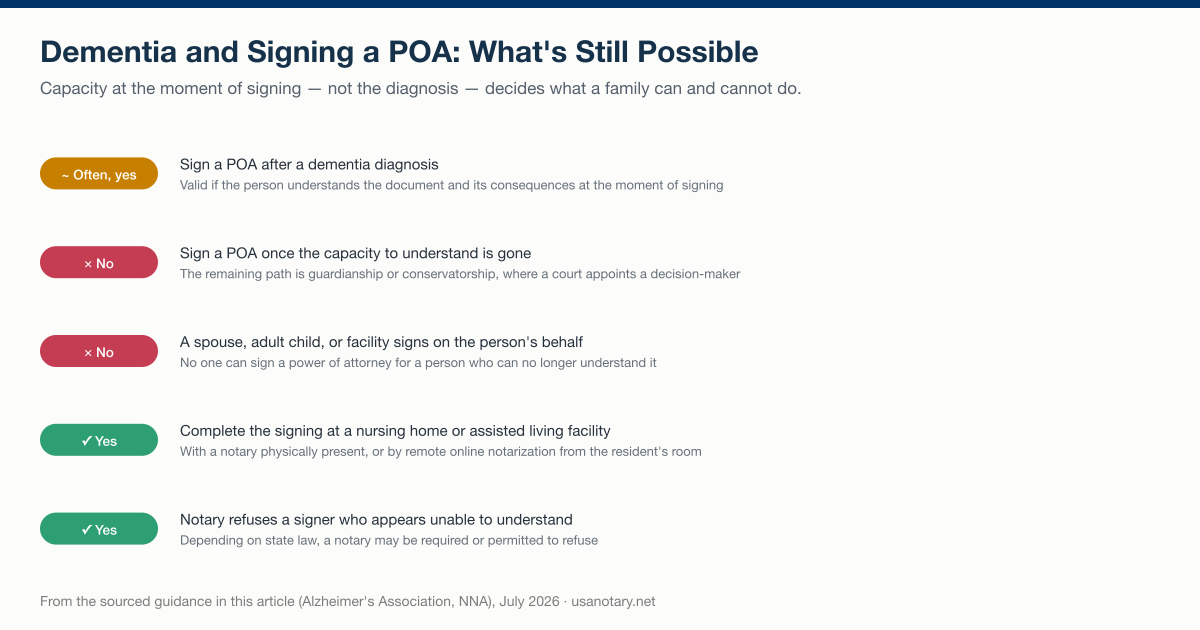
What a family can and cannot do after a dementia diagnosis, from the sourced guidance in this article, July 2026.
Diagnosis is not incapacity: what “legal capacity” actually means
The Alzheimer’s Association defines the standard in caregiver terms: “Legal capacity is the ability to understand and appreciate the consequences of one’s actions and to make rational decisions”. And it draws the conclusion that matters for POA signing: “In most cases, if a person with dementia is able to understand the meaning and importance of a given legal document, he or she likely has the legal capacity to execute (to carry out by signing) it.”
Two more points from the same guidance shape how families should think about this:
| A dementia diagnosis | Legal capacity | |
|---|---|---|
| What it is | A medical finding about a progressive condition | The ability to understand a specific document and its consequences |
| When it’s assessed | At a clinical evaluation | At the moment of signing |
| Who assesses it | A physician | Varies — a lawyer can advise on the standard; a doctor can help assess; a court decides in a dispute |
| Effect on signing | Does not, by itself, bar signing | Determines whether the signature is valid |
| Fixed or variable | The diagnosis stays | Capacity requirements vary from one type of document to another |
First, capacity is document-specific: the Association notes that “a lawyer can help determine what level of legal capacity is required for a particular document, as it can vary from one type of document to another.” Second, if there is doubt, get medical input — its pre-signing guidance says that if you have concerns about the person’s ability to understand, “a doctor will be able to help determine the level of his or her mental capacity.”
The National Notary Association adds a practical caution from the signing table: Alzheimer’s “can impair a signer’s ability to communicate with the Notary and understand the nature and consequences of a document being signed,” and “the effects of the disease can vary or not be readily apparent.” That variability is exactly why a signer’s apparent condition is assessed at the moment of signing, not from the diagnosis date.
Why timing is everything after a dementia diagnosis
The window for signing a valid power of attorney narrows as dementia progresses, and every authority on the subject says the same thing: move early. The federal government’s dementia-planning guidance is blunt about the deadline — financial directives, including a durable power of attorney for finances, “must be created while the person still has the legal capacity to make decisions”. The Alzheimer’s Association frames the same urgency from the family’s side: “The sooner these plans are put in place, the more likely it is that the person living with dementia will be able to participate in the process”.
One drafting detail matters enormously here. The Association recommends that POA documents “should be written so that they are ‘durable,’ meaning they are valid even after the principal is incapacitated and can no longer make his or her own decisions” — and it’s equally clear that a POA does not strip the signer of control: “Power of attorney does not give the agent the authority to override the principal’s decision-making until the person with dementia no longer has legal capacity.” Signing early doesn’t mean surrendering anything early. It means the document is ready before it’s needed.
For the step-by-step family playbook — choosing the agent, the conversation, the paperwork sequence — see our guide to getting a power of attorney for an elderly parent.
What the notary checks at the moment of signing
A power of attorney usually needs to be notarized — requirements vary by state; what a POA notarization requires covers the specifics — and the notary is the last independent check before the signature becomes official. The National Notary Association describes the duty precisely: notaries “are responsible for determining whether a signer appears aware, willing, and able to understand the transaction at the time of notarization” — while also noting that notaries are not medical or psychiatric experts. The notary screens for apparent awareness and willingness; the notary does not diagnose.
If the screen fails, the notarization stops. Per the NNA, “if a signer appears confused, disoriented, or unable to understand the document, a Notary may be required or permitted to refuse notarization, depending on state law.” Some states make it explicit: Florida prohibits a notary from proceeding if the signer appears unable to understand the nature of the document or has been declared mentally incapacitated by a court, and in North and South Carolina the notary certifies that the signer appears to understand the nature and consequences of the document. The NNA’s suggested screening method is simple and humane — open-ended conversation, and asking the signer to tell the notary the title of the document.
Everything above applies identically whether the notary is standing at a bedside or connected by video. In a remote online notarization, the platform verifies the signer’s identity before the notary ever appears, the notary performs the same awareness-and-willingness screen over live video, and the session produces a tamper-evident notarized PDF and a digital audit trail. One practical difference favors the online route for dementia-adjacent signings: the session is documented. If a signer completes a notarization online, the audit trail records that the session took place, when, and with whom — a contemporaneous record a family can point to later. A notary in either setting can and will refuse if the signer doesn’t appear to understand; a refusal is the system working, not failing.
Coordinating a POA signing at a nursing home or assisted living facility
Families rarely handle this alone: the resident is in one place, the adult child who’ll serve as agent is often in another state, and facility staff are in the middle. Remote online notarization fits this geometry because nobody has to travel — sessions run 24/7, work in all 50 states, and typically take 15–30 minutes. Here’s how the signing itself usually comes together:
- Confirm the document and the plan first. Have the elder-law attorney finalize the POA before scheduling anything — the notary notarizes the signature, not the document’s drafting.
- Pick a time when the signer is typically at their best. Capacity is assessed at the moment of signing, and families and facility staff usually know when that is; online sessions are available around the clock, so the schedule bends to the signer, not the notary.
- Set up the resident’s device. A tablet or laptop with a camera and internet in the resident’s room is enough. Facility staff or a visiting family member can have it ready.
- Bring the family in remotely. Online sessions support multiple participants, so an agent, siblings, or the attorney can join from anywhere, and the platform verifies signers’ identities.
- Let the notary run the session. The notary conducts the awareness-and-willingness screen, witnesses the signature, and completes the notarization. The session produces a tamper-evident notarized PDF and a digital audit trail the family can retain.
Facilities that see regular POA, advance-directive, and consent signings can go a step further: staff-initiated workflows let a social worker or administrator start the notarization request on the resident’s behalf, with role-based access controlling who at the facility can do what. Our notary support for senior-care facilities page covers how nursing homes and assisted living communities set this up — and for residents who can’t manage a device at all, an in-person visit is the fallback; see notarization for homebound or hospitalized signers.
What if capacity is already gone? Guardianship and conservatorship
When a person can no longer understand what a power of attorney means, no one — not a spouse, not an adult child, not a facility — can sign one on their behalf. The remaining path runs through a court. The Alzheimer’s Association describes it plainly: “A guardian or conservator is appointed by a court to make decisions about a person’s care and property,” and guardianship “is generally considered when a person with dementia is no longer able to provide for his or her own care and either the family is unable to agree upon the type of care needed or there is no family.”
The contrast with a POA is stark. Per the same guidance, “acquiring guardianship takes time. It involves enlisting the help of an attorney and testifying in court for guardianship proceedings,” and guardians “are responsible to and supervised by the court.” Rules vary by state, and the Association advises any family considering this route to consult an elder care attorney familiar with the guardianship process in that state. A durable POA signed while capacity remained is precisely what makes this court process unnecessary — which is the strongest argument for acting during the window rather than after it.
Steps to take before the signing
The Alzheimer’s Association’s pre-signing checklist for families, expanded with the practical items above, comes down to five moves:
- Discuss the document. Per the Association, make sure the person understands the document, the consequences of signing it, and what he or she is being asked to do.
- Ask for medical advice if there’s doubt. A doctor can help determine the person’s level of mental capacity when the family has concerns.
- Review existing documents. Even if a living will, trust, or POA was completed in the past, the Association advises reviewing them for needed updates.
- Involve an elder-law attorney. Capacity requirements vary by document and by state; an attorney confirms the right standard and the right document.
- Then schedule the notarization. With the document final and the timing chosen, the signing itself is the short part — what a POA notarization requires covers witnesses, ID, and state specifics.
Questions about setting up a session for a facility resident? Call 804-767-7500 or book a demo — and remember the line that should guide every step: this is general information, not legal advice, and an elder-law attorney should confirm anything that touches capacity.