
What is a contractor’s final payment affidavit?
A contractor’s final payment affidavit is the sworn statement Florida lien law requires a contractor to give the property owner at the end of a job, disclosing whether everyone working under the contractor has been paid. The document belongs to Florida’s Construction Lien Law: Fla. Stat. § 713.06(3)(d) opens with the trigger — “When the final payment under a direct contract becomes due the contractor” — and then tells the contractor exactly what to hand over. The affidavit must state, “if that be the fact, that all lienors under his or her direct contract who have timely served a notice to owner on the owner and the contractor have been paid in full or, if the fact be otherwise, showing the name of each such lienor who has not been paid in full and the amount due or to become due each for labor, services, or materials furnished.”
Read that sentence twice, because it defines the whole document. The affidavit is not a receipt and not a release. It is a disclosure: either every lienor who preserved rights by serving a notice to owner has been paid in full, or here is the name of each one who has not, with the amount due. The owner uses it to make final payment safely — paying the contractor without knowing which subcontractors and suppliers are still owed money is how owners end up paying twice.
Two boundaries before going further, because the same phrase gets used loosely across the industry. First, the contractor’s final payment affidavit in this guide is the Florida statutory document — the one county clerks publish fill-in forms for and Florida construction lawyers litigate over. Second, it is not the Michigan/Illinois “contractor’s sworn statement,” which is a per-draw itemized list rather than a one-time closeout disclosure; the two are compared side by side below. The affidavit is also frequently confused with the AIA G706, the national closeout form that plays a similar role by contract rather than by statute.
Does a contractor’s final payment affidavit have to be notarized?
Yes — notarization is required, because the statutory form is built around an oath. Florida did not leave execution to taste: § 713.06(3)(d) says “The affidavit must be in substantially the following form,” and the prescribed CONTRACTOR’S FINAL PAYMENT AFFIDAVIT form begins, “Before me, the undersigned authority, personally appeared (name of affiant), who, after being first duly sworn, deposes and says of his or her personal knowledge the following.” It ends the same way it begins — with the notary: “Sworn to and subscribed before me this ___ day of ___ by (name), who is personally known to me or produced ___ as identification, and did take an oath.”
That closing block is a jurat, the notarial certificate that certifies the signer personally appeared, was identified, and took an oath before signing. It is a different act from an acknowledgment, where the signer merely confirms a signature already made — the distinction between the two certificates is covered in our guide to how a jurat and an acknowledgment differ. On this document the oath is the point. The affidavit’s power comes from the contractor swearing, under penalty of perjury, that the lienor list is complete and true; an unsworn version is just a letter, and it does not match the form the statute prescribes.
The affidavit is not the only sworn document at closeout
The final payment affidavit sits inside a lien statute that leans on oaths repeatedly. The claim of lien itself — the document a lienor records to attach the lien — must under Fla. Stat. § 713.08 be “signed and sworn to or affirmed by the lienor or the lienor’s agent acquainted with the facts stated therein,” and § 713.08’s own form closes with “Sworn to (or affirmed) and subscribed before me.” A Florida contractor closing out a disputed project can therefore need a notary twice in the same month: once when the claim of lien is recorded, and again when the final payment affidavit is delivered. Both are sworn documents; neither works as a plain signature.
What does Florida’s § 713.06(3)(d) actually require?
Section 713.06(3)(d) requires three distinct things: give the affidavit when final payment comes due, deliver it again on a 5-day clock before any lien suit, and get the contents right — with a harsh default rule and a narrow safe harbor around them.
The five-day delivery rule
The statute’s operative sentence is worth quoting in full, because each clause closes an escape hatch: “The contractor shall execute the affidavit and deliver it to the owner at least 5 days before instituting an action as a prerequisite to the institution of any action to enforce his or her lien under this chapter, even if the final payment has not become due because the contract is terminated for a reason other than completion and regardless of whether the contractor has any lienors working under him or her or not.”
Unpack the three clauses. The affidavit is delivered at least 5 days before filing suit — a prerequisite, in the statute’s own word, not a courtesy. It is still required when the contract was terminated before completion, so a contractor fired mid-project cannot skip it on the theory that final payment never came due. And it is still required when the contractor has no lienors at all — a solo contractor with no subs and no suppliers still swears to that fact before suing. There is no project too small and no termination too messy to escape the affidavit.
What happens if you skip it
The default consequence is written into the same subsection: “The contractor shall have no lien or right of action against the owner for labor, services, or materials furnished under the direct contract while in default for not giving the owner the affidavit.” No lien, and no right of action — the statute suspends both while the default lasts.
The safe harbor is deliberately narrow: “the negligent inclusion or omission of any information in the affidavit which has not prejudiced the owner does not constitute a default that operates to defeat an otherwise valid lien.” An honest mistake in the lienor list that cost the owner nothing will not kill the lien. Failing to deliver an affidavit at all is not an inclusion or omission in the affidavit — it is the default the statute punishes. A January 2026 analysis by the Florida construction firm Southern Atlantic Law describes the missed affidavit in exactly those terms: fatal to the lien claim regardless of other compliance, with courts able to dismiss a foreclosure action with prejudice.
Who owes the affidavit to whom
The duty runs from the contractor in a direct contract with the owner — the party Florida’s lien law calls the contractor, as opposed to subcontractors and sub-subcontractors further down the chain. The affidavit is delivered to the owner. What it discloses is the payment status of “all lienors under his or her direct contract who have timely served a notice to owner,” which is why a well-run closeout starts with the notice-to-owner file: the affidavit’s lienor list is checked against every notice received during the project, not against memory.
How does the affidavit fit Florida’s lien deadlines?
The final payment affidavit is one gear in a three-deadline machine, and the three deadlines are what make late preparation dangerous. Here is the full clock, statute by statute:
| Step | Deadline | Statute |
|---|---|---|
| Record the claim of lien | “Not later than 90 days after the final furnishing of the labor or services or materials by the lienor” | Fla. Stat. § 713.08 |
| Deliver the final payment affidavit | “At least 5 days before instituting an action” to enforce the lien | Fla. Stat. § 713.06(3)(d) |
| Commence the enforcement action | Within 1 year — the lien “does not continue for a longer period than 1 year after the claim of lien has been recorded … unless within that time an action to enforce the lien is commenced in a court of competent jurisdiction” | Fla. Stat. § 713.22 |
In sequence, a Florida contractor chasing an unpaid balance works through four steps:
- Final furnishing. The last day of labor, services, or materials under the direct contract starts every clock.
- The claim of lien is recorded — sworn and recorded in the county records not later than 90 days after final furnishing.
- The final payment affidavit is delivered to the owner, sworn and notarized, at least 5 days before the lawsuit is filed.
- The enforcement action is commenced within 1 year after the claim of lien was recorded, or the lien expires.
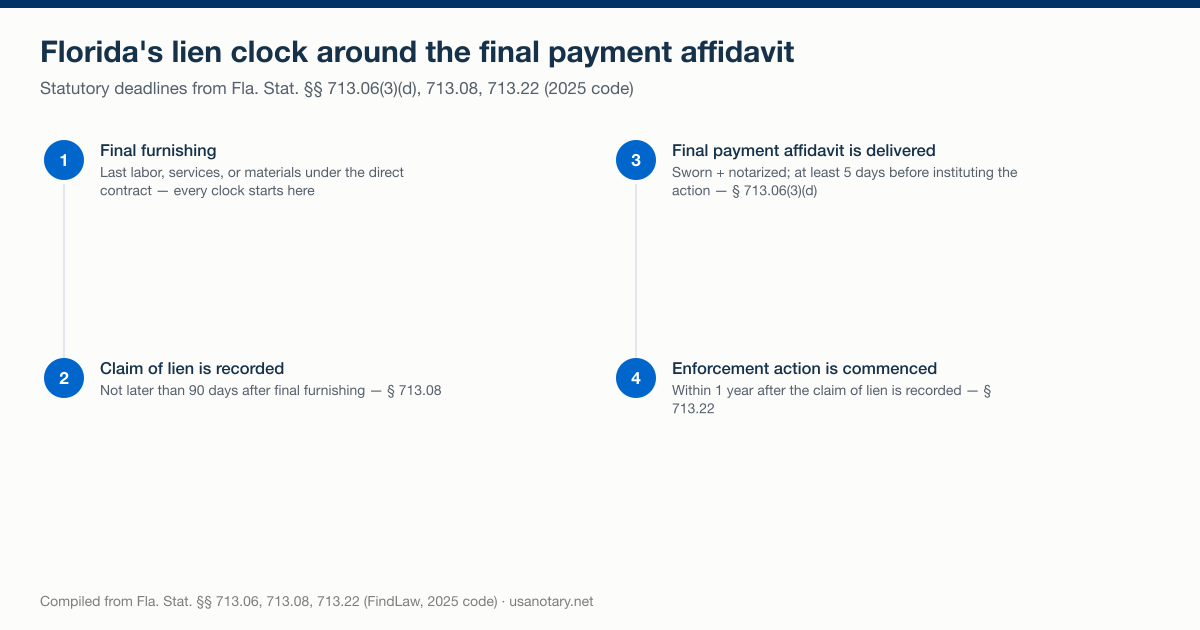
The statutory sequence from Fla. Stat. §§ 713.06, 713.08, and 713.22 — the affidavit’s 5-day window sits inside the 1-year enforcement deadline. Statute text re-checked October 2026.
The trap at the end of the year
The 5-day rule and the 1-year rule interact badly for procrastinators. Southern Atlantic Law’s January 2026 analysis flags the specific failure mode: a contractor who waits until the final days of the one-year enforcement window to prepare the affidavit can run out of room for the mandatory five-day pre-suit interval — the suit gets filed late or the affidavit gets delivered late, and either way the lien rights are lost entirely. The affidavit takes minutes to prepare and minutes to notarize; the only way it kills a lien is by being left for last. Closeout practice at well-run Florida contractors treats the affidavit as a document to execute when the file is fresh, not a pre-filing formality for the eve of litigation.
Final payment affidavit vs. AIA G706 vs. contractor’s sworn statement
Three documents share the “contractor swears about payment” job, and mixing them up causes real closeout mistakes. The Florida affidavit is a statutory prerequisite tied to lien enforcement; the AIA G706 is a national contract deliverable; the contractor’s sworn statement is a Michigan/Illinois draw-cycle disclosure. Side by side:
| Florida final payment affidavit | AIA G706 | Contractor’s sworn statement (Michigan) | |
|---|---|---|---|
| Governing rule | Fla. Stat. § 713.06(3)(d) | The construction contract’s closeout requirements | MCL 570.1110 |
| Trigger | Final payment becomes due; delivered again ≥ 5 days before a lien suit | Final payment closeout on AIA-administered projects | “When payment is due to the contractor from the owner or lessee or when the contractor requests payment,” or on demand |
| What it discloses | Each lienor under the direct contract not paid in full, with the amount due or to become due | That “payment has been made in full … and that there are no known claims other than those listed on the affidavit" | "Each subcontractor and supplier with whom the person issuing the sworn statement has contracted relative to the improvement” |
| Frequency | Once, at closeout | Once, at closeout | Potentially every draw |
| Consequence of skipping | “No lien or right of action against the owner” while in default | Contract-driven — the closeout package is incomplete | Statutory payment-process document under Michigan’s Construction Lien Act |
The G706’s full name is the Contractor’s Affidavit of Payment of Debts and Claims. Procore’s library describes it as the closeout form a general contractor or subcontractor signs swearing that suppliers have been paid, listing the vendors or subcontractors still owed money, and notes that “the owner or bank may request or require supporting documents” alongside it — lien waivers and consent forms among them. On a Florida project run on AIA documents, the two affidavits stack rather than substitute: the G706 satisfies the contract, and the § 713.06(3)(d) affidavit preserves the lien remedy. Whether a given owner requires the G706 itself sworn before a notary is set by the project’s closeout requirements — check the contract’s closeout checklist rather than assuming.
The Michigan document lives in a different rhythm altogether. Under MCL 570.1110, the sworn statement lists every subcontractor and supplier the contractor has engaged, declares the property “is free from claims of construction liens, or the possibility of construction liens, except as specifically set forth in this statement,” and is provided whenever payment is due or requested — which on an active project means draw after draw, not once at the end. Our companion guide to the Michigan and Illinois contractor’s sworn statement covers that document’s draw-package mechanics in full.
One more neighbor worth separating: the lien waiver. A waiver releases lien rights in exchange for payment, usually signed by the parties being paid; the final payment affidavit discloses who has not been paid, signed by the contractor. The two travel together in a Florida closeout package, and the rules for the release side — including which states put a notary block on their waiver forms — are covered in our state-by-state guide to whether a lien waiver needs to be notarized.
How do you notarize a final payment affidavit online?
A contractor’s final payment affidavit can be notarized over live video, and Florida wrote that option directly into its notary law. Fla. Stat. § 117.209 authorizes an online notary public to perform the notarial acts in part I of the chapter as online notarizations, and answers the personal-appearance question head-on: “If a notarial act requires a principal to appear before or in the presence of the online notary public, the principal may appear before the online notary public by means of audio-video communication technology.” The oath behind the jurat — the “did take an oath” line in the statutory form — is administered on camera. Nationally, the National Association of Secretaries of State reports that 47 states and the District of Columbia have a law that allows for remote e-notarization, so the same session works when the signing officer is out of state at closeout.
That last scenario is the practical reason online notarization fits this document. The affidavit’s affiant is typically the qualifying officer or an owner of the contracting company — the person hardest to put in a chair at a UPS store on short notice. When the five-day window is live, the session runs like this:
- Upload the affidavit. Use the county-published or attorney-prepared form tracking the § 713.06(3)(d) language — the notary administers the oath and completes the jurat; the notary does not draft the lienor list.
- Verify identity. Before the video session starts, identity is verified through credential analysis of a government-issued ID plus knowledge-based authentication, run by a third-party identity-verification service.
- Swear and sign on video. A commissioned notary administers the oath on live video — sessions run 24/7 and take 15–30 minutes, and a multi-signer session covers the case where two company officers execute closeout documents together.
- Deliver the notarized PDF. The session produces a tamper-evident PDF with a complete audit trail, backed by an audio-video recording and electronic journal entry retained for 10 years or longer where state law requires — a record that answers questions about who swore to what, years after closeout.
Each notarization is $25 per document, with volume pricing for back offices that handle closeout paperwork on every project. Construction firms that also cycle through sworn claims of lien, payment-bond affidavits, and waiver packages can set up staff-initiated sessions through our notarization workflow for construction closeout teams — the walkthrough of how an affidavit is notarized online shows what the affiant sees screen by screen.
Get the affidavit sworn before the clock runs out
The rule to remember: the contractor’s final payment affidavit is required by statute, sworn by design, and cheap to execute — the only expensive version is the one that never gets delivered. Florida suspends the lien and the right of action while the affidavit is in default, the five-day pre-suit window forgives no late starts, and the statutory form’s jurat means a notary is part of the document, not an add-on. Execute it when the file closes, deliver it to the owner, and keep the notarized PDF with the notice-to-owner file.
Closing out a Florida project this month, or running closeouts across several states? Call 804-767-7500 or reach us through the contact page to set up a workflow before the next final payment comes due.