
What is a contractor’s sworn statement?
A contractor’s sworn statement is an itemized disclosure, signed under oath, of every subcontractor, supplier, and laborer on a construction project — and of the amounts already paid, currently owing, and left to complete for each of them. In Michigan and Illinois, the two states whose mechanics lien statutes build the document into the payment process itself, the sworn statement is required before draw money moves from the owner or lender to the contractor.
The sworn statement exists to fix the paying party’s blind spot. An owner or construction lender can read the prime contract, but cannot see who the contractor hired underneath it — and each of those unseen subcontractors and suppliers can attach a construction lien to the property if they go unpaid. The sworn statement forces the full downstream roster into the open before funds are released, so the paying side knows exactly which parties could lien the project and for how much.
The form itself is a table. Washtenaw County, Michigan publishes a version of the statutory form, and its columns show precisely what the document demands for each listed party: name, address, and phone number of the subcontractor, supplier, or laborer; the type of improvement furnished; total contract price; amount already paid; amount currently owing; balance to complete; and, for laborers, wages plus fringe benefits and withholdings due but unpaid. Above the signature lines, the deponent represents that the property “is free from claims of construction liens, or the possibility of construction liens,” except as specifically set forth in the statement.
One sense-pin before the statutes, because the phrase is ambiguous. In ordinary legal usage, a “sworn statement” is any written statement sworn before a notary — essentially an affidavit, covered in our guide to how to notarize an affidavit. In construction, the phrase is a term of art: Michigan’s Construction Lien Act calls the document a sworn statement (MCL 570.1110), while Illinois’ Mechanics Lien Act calls its equivalent a contractor’s statement — practitioners say “Section 5 affidavit” or “sworn statement” interchangeably. This guide covers that statutory draw-package instrument. It does not cover the closeout affidavit Florida requires at the end of a job; that document has its own guide below.
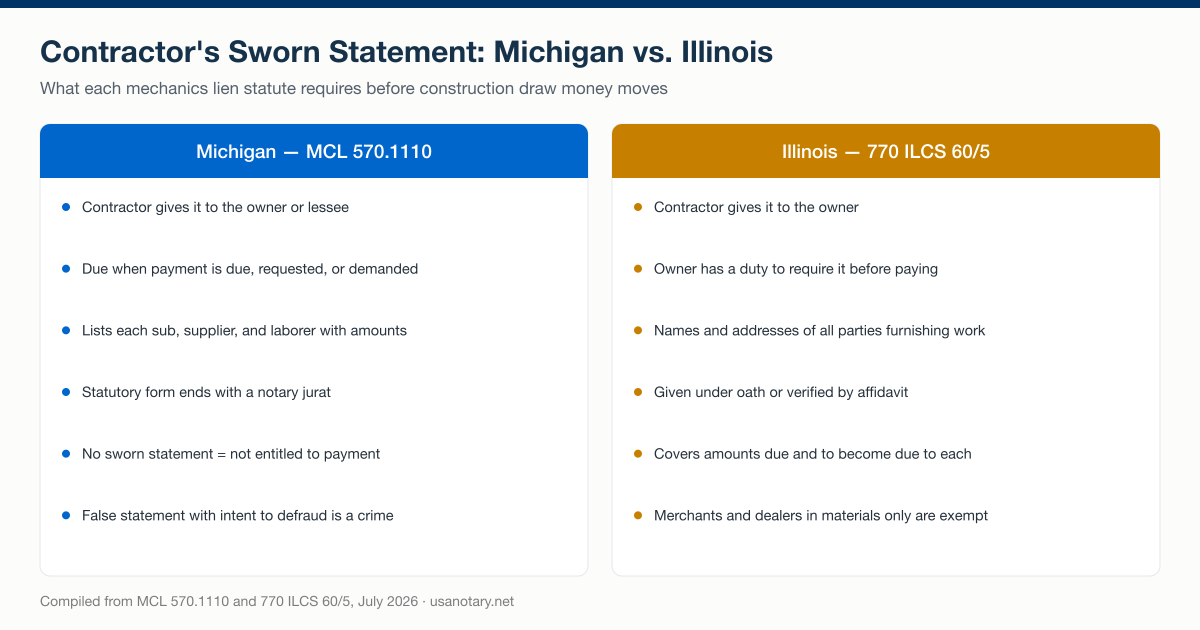
The two statutory versions of the contractor’s sworn statement side by side — Michigan’s MCL 570.1110 and Illinois’ 770 ILCS 60/5, re-verified against the statutes October 2026.
When is a sworn statement required in Michigan?
Michigan requires a sworn statement under MCL 570.1110 whenever contract money is about to move — not once per project, but at every payment event. Under subsection (1), a contractor shall provide a sworn statement to the owner or lessee “when payment is due to the contractor from the owner or lessee or when the contractor requests payment from the owner or lessee,” and separately “when a demand for the sworn statement has been made by or on behalf of the owner or lessee.” On a project with monthly draws, that means a fresh sworn statement rides with every pay application, updated to reflect what has been paid and what is owed as of that draw.
The statute reaches down the chain, too. This is not only the general contractor’s paperwork.
When a subcontractor must provide one
A subcontractor owes the document in two directions. Under MCL 570.1110, a subcontractor shall provide a sworn statement to the owner or lessee “when a demand for the sworn statement has been made by or on behalf of the owner or lessee,” and shall provide one to the contractor when payment is due to the subcontractor or when the subcontractor requests payment. A first-tier sub with its own suppliers and second-tier subs is disclosing its downstream roster, the same way the general contractor discloses the project-level one. On a large Michigan job, a single draw can therefore generate several sworn statements — each itemized, each sworn, each notarized.
What the owner or lender does with it
The sworn statement is not filed anywhere; it is used at the draw table. The statute gives the paying side real leverage: under subsection (7), the owner or lessee may withhold from the amount due to the contractor “an amount sufficient to pay all sums due to subcontractors, suppliers, or laborers, as shown by the sworn statement.” The document’s itemization is the measuring stick — the paying party can hold back exactly what the statement shows as owed downstream, or route payments directly to the listed parties, before anything reaches the contractor’s account.
The statutory form also polices its own limits. In capital letters, the form warns: “AN OWNER OR LESSEE OF THE PROPERTY SHALL NOT RELY ON THIS SWORN STATEMENT TO AVOID THE CLAIM OF A SUBCONTRACTOR, SUPPLIER, OR LABORER WHO HAS PROVIDED A NOTICE OF FURNISHING.” In other words, the sworn statement protects the owner against the parties it discloses and who stayed silent — not against a claimant who already put the owner on notice through the Construction Lien Act’s notice-of-furnishing system.
The teeth: no statement, no payment — and criminal exposure
MCL 570.1110 enforces itself through the contractor’s cash flow. Under subsection (9), a contractor who fails to provide a sworn statement does not lose the construction lien — the lien “is not invalid” — but the contractor “is not entitled to any payment” until the sworn statement has been provided. A missing or defective sworn statement therefore stalls the draw itself, which is why Michigan back offices treat the document as a gating item on every pay application rather than an afterthought.
The oath carries criminal weight as well. The form closes with a warning to the deponent that a false sworn statement given with intent to defraud is subject to criminal penalties under the same section. Those penalties scale with the dollar amount involved — a misdemeanor at the lowest tiers, rising to a felony punishable by up to 10 years’ imprisonment and fines up to $15,000 or three times the amount involved at the highest tier. Signing the itemization is not clerical; it is testimony.
What does Illinois’ Section 5 contractor’s statement require?
Illinois requires the equivalent document under Section 5 of the Mechanics Lien Act, 770 ILCS 60/5 — and frames it as a two-way obligation. The statute makes it “the duty of the contractor to give the owner, and the duty of the owner to require of the contractor,” before the owner pays or advances any consideration, a statement in writing, under oath or verified by affidavit, of the names and addresses of all parties furnishing labor, services, material, fixtures, apparatus or machinery, forms or form work, and of the amounts due or to become due to each.
Two details in that sentence do a lot of work. First, the owner’s duty to require the statement means an Illinois owner who pays without demanding one is not just being casual — the owner is skipping a step the statute assigns to them by name. Second, “amounts due or to become due” makes the Illinois statement forward-looking: it captures not only what is owed as of the draw, but what will come due to each party as the work completes, which is why Illinois sworn statement forms carry both columns.
The statute carves out one group: merchants and dealers in materials only — sellers who simply supply stock materials without furnishing labor — are exempt from the listing requirement.
The residential notice wrinkle
Owner-occupied single-family residences get an extra protection. For those projects, Section 5 requires the contractor to give the owner a statutorily worded notice — printed in at least 10-point boldface type — before the first payment, alerting the owner to the lien law’s mechanics. A residential remodeler working in Illinois is therefore handling two Section 5 obligations: the boldface notice up front, and the sworn contractor’s statement at each payment.
Michigan vs. Illinois at a glance
The two statutes solve the same problem with different machinery:
| Michigan | Illinois | |
|---|---|---|
| Statute | MCL 570.1110, Construction Lien Act (1980 PA 497) | 770 ILCS 60/5, Mechanics Lien Act |
| Common name | Sworn statement | Contractor’s statement / “Section 5 affidavit” |
| Who provides it | Contractor; subcontractor on demand or when requesting payment | Contractor |
| Trigger | Payment due or requested, or demand by the owner or lessee | Owner’s duty to require it before paying or advancing any consideration |
| Verification | Statutory form with a notary jurat — “Subscribed and sworn to before me" | "Under oath or verified by affidavit” |
| What it lists | Each subcontractor, supplier, and laborer: contract price, amount paid, amount owing, balance to complete | Names and addresses of all parties furnishing labor, services, or materials; amounts due or to become due |
| If it’s missing | Contractor is not entitled to any payment until provided (MCL 570.1110(9)) | Owner has breached no one — but has skipped a duty the statute assigns to the owner by name |
Does a sworn statement need to be notarized?
Yes — and in Michigan, the answer is printed on the form itself. The statutory sworn statement form under MCL 570.1110 opens with the deponent “being sworn, states the following,” and closes with a jurat: “Subscribed and sworn to before me on (date),” followed by signature lines for a “Notary Public, ___ County, Michigan” and the notary’s commission expiration. Washtenaw County’s published version of the form carries the same block, worded “being duly sworn” at the top and “Subscribed and sworn to before me this ___ day of ___” at the bottom. A document whose statutory form ends in a jurat is a notarized document by design — there is no unsworn version of a sworn statement.
That is the answer most articles about construction paperwork never state squarely, and the confusion is understandable: the best-known notarization question in construction is about lien waivers, and the answer there runs the opposite direction — most states require only a signature on a waiver. The sworn statement is the member of the draw package that actually earns its name. The itemization of subcontractors, suppliers, and amounts is testimony given under oath, which is what gives the owner’s statutory right to withhold and the criminal false-statement penalty something to attach to.
Jurat, not acknowledgment
The distinction matters for how the signing must happen. A jurat requires the deponent to swear an oath before the notary and sign in the notary’s presence; an acknowledgment merely requires the signer to confirm to the notary that an existing signature is theirs. The sworn statement’s “Subscribed and sworn to before me” language is a jurat — so the contractor’s project manager or officer cannot sign the form at a desk on Tuesday and have it stamped on Thursday. The oath and the signature happen in front of the notary, every draw. Our comparison of a jurat versus an acknowledgment walks through what each certificate obligates the notary to do.
Illinois’ “under oath or verified by affidavit” standard
Illinois takes a different drafting route to the same place. Section 5 prints no statutory form; it sets a verification standard instead — the contractor’s statement must be “under oath or verified by affidavit.” A statement under oath is one sworn before an officer authorized to administer oaths, and for construction paperwork that officer is, in nearly every case, a notary public. A statement verified by affidavit is itself a notarized instrument. Either way the statute is read, an Illinois contractor’s statement that arrives as a bare, unsworn spreadsheet does not meet the standard Section 5 describes.
How is a sworn statement different from a lien waiver or a final payment affidavit?
The three documents answer three different questions, and a draw package on a Midwest project routinely contains the first two side by side:
| Document | Question it answers | Where it’s used | Notarized? |
|---|---|---|---|
| Contractor’s sworn statement | Who is on this project, and what is each party owed? | Michigan (MCL 570.1110) and Illinois (770 ILCS 60/5), refreshed every draw | Yes — Michigan’s form carries a jurat; Illinois requires it under oath or verified by affidavit |
| Lien waiver | Does this party give up lien rights in exchange for this payment? | Every state, exchanged payment by payment | Usually no — most states require only a signature |
| Contractor’s final payment affidavit | Is everyone paid, so final payment can close out the job? | Florida, once, before final payment | Yes — it is an affidavit by definition |
The sequence inside a Michigan draw package shows how the first two mesh. The sworn statement is required from the contractor and discloses the downstream parties and amounts; the owner or title company then collects waivers from the very parties the statement names, and each waiver releases lien rights as its payment lands. Disclosure first, releases second — one document maps the exposure, the other retires it. The waiver side of that hand-off, including which states do require a notary on waivers, is covered in our state-by-state guide to whether a lien waiver needs to be notarized.
The third instrument is the one this post deliberately does not cover: Florida’s contractor’s final payment affidavit is a one-time closeout document served before final payment on a Florida job, with its own statutory timing and contents. It shares the oath and the notary with the Midwest sworn statement, but it is a different tool for a different moment — end of project, not every draw.
How do construction teams notarize sworn statements online every draw cycle?
The sworn statement is required at every payment event, and its jurat is required every time — which turns notarization from a one-off errand into a recurring operational task. A Michigan general contractor on a 10-draw project executes at least 10 sworn statements; add subcontractor statements on demand and multiple concurrent projects, and an AP team can face a stack of jurats every month, each one needing an officer or project manager physically in front of a notary under the traditional process.
Remote online notarization removes the geography. The National Association of Secretaries of State reports that 47 states and the District of Columbia have a law allowing remote e-notarization, and the legal foundation — how a video session satisfies the “personally appeared” requirement — is laid out in our explainer on whether online notarization is legitimate.
Here is what the draw-cycle workflow looks like for a construction back office:
- Prepare the itemization from your pay application. The sworn statement’s table mirrors the schedule of values — pull each subcontractor’s and supplier’s contract price, paid-to-date, and currently owing figures from AP before the session, because the deponent will swear to those numbers.
- Upload the completed but unsigned form. A jurat requires signing in the notary’s presence, so the signature waits for the session itself.
- Verify identity. The signer completes credential analysis and knowledge-based authentication through a third-party identity-verification service before meeting the notary.
- Join the video session and take the oath. A commissioned notary administers the oath on live audio-video, watches the deponent sign, and completes the jurat certificate. Sessions run 24/7 and take 15–30 minutes, and multi-signer sessions handle the jobs where a company officer and a project manager both need to swear statements the same morning.
- Attach the finished document to the draw package. The session produces a tamper-evident PDF with a complete audit trail, and the audio-video recording and electronic journal entry are retained for 10 years or longer where state law requires — a stronger record than a stamped paper form, available to the lender the same day.
At $25 per document, with volume pricing for teams that swear statements every pay cycle, the economics favor the recurring use case — and business-initiated workflows let an office administrator queue up each month’s sworn statements and route signing sessions to the right officers without anyone leaving the trailer. Construction back offices that handle sworn statements, waivers, and closeout affidavits together can set the whole document stack up through our notarization workflows for construction teams.
Questions about a recurring draw-package setup? Call 804-767-7500 or reach out through our contact page.