
Does a DNR need to be notarized?
Usually not. A DNR order — the instruction that tells medical teams not to perform CPR — is a medical order, not a notarized legal document. MedlinePlus defines it plainly: “A do-not-resuscitate order, or DNR order, is a medical order written by a health care provider.” A DNR order is issued by a physician, and an order takes its validity from the clinician who writes it — a notary has no role in a chart order, in any state.
The notary question becomes real only for out-of-hospital DNR forms — the state-issued documents that tell EMS crews not to resuscitate at home, in a nursing home, or in hospice. Those forms follow each state’s execution rules, and the rules vary: Texas accepts two witnesses or a notary, Florida requires only signatures on yellow paper, and Arizona wants a provider attestation plus one witness on an orange form. Of the five states checked against statute and health-department text below, none requires notarization. Texas alone offers it, as an alternative to witnesses.
That answer directly contradicts a page that ranks near the top of Google for this exact question — a page claiming that “in most states the DNR must be signed by a physician as well as notarized by a notary public.” The state sources below say otherwise, one by one, and this article walks through them.
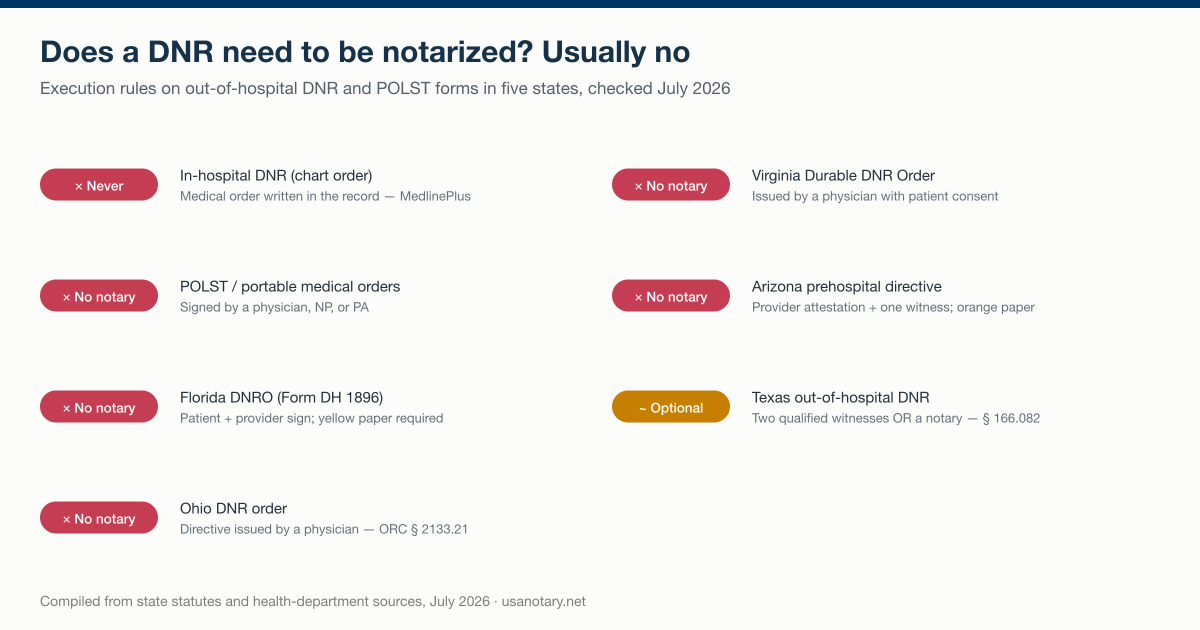
The verdicts from this article’s state review — no state checked requires a notary on a DNR, and Texas treats one as a witness substitute, July 2026.
In-hospital vs. out-of-hospital DNR: only one ever involves a notary
The DNR conversation actually covers two different documents, and only one of them has execution formalities at all. Sorting out which one you’re dealing with answers most of the notarization question before any statute gets opened.
The in-hospital DNR: a chart order, never notarized
An in-hospital DNR order is written by the treating provider directly into the medical record. MedlinePlus again: “Your provider writes the DNR order in your medical record if you are in the hospital.” There is no signing ceremony — no witnesses, no seal, often no separate document for the patient to hold. The patient or their decision-maker consents in conversation, and the provider documents that decision as an order. Asking whether this document needs a notary is like asking whether a prescription does: the clinician’s authority is the validation.
The out-of-hospital DNR: a state form with execution rules
Out-of-hospital DNR forms exist because emergency responders arriving at a private home or a care facility can’t consult a hospital chart. States solve this with standardized, instantly recognizable documents — Florida prints its DNRO on yellow paper; Arizona prints its prehospital medical care directive on an orange background. MedlinePlus notes that “standard forms may be available from your state’s Department of Health.”
Because the form travels outside the chart, states attach execution rules: patient and clinician signatures, sometimes witnesses, occasionally a notary option. This is the only DNR context where a notary can appear at all — and even here, the notary is typically absent or optional rather than required.
State-by-state: witness and notary rules on out-of-hospital DNR forms
Here is how five states with well-documented out-of-hospital DNR programs handle execution, checked against current statute and health-department text:
| State | Form | Witnesses | Notary |
|---|---|---|---|
| Texas | Out-of-hospital DNR order (Tex. Health & Safety Code § 166.082) | Two qualified witnesses | Optional — replaces the two witnesses |
| Florida | DNRO, Form DH 1896, yellow paper (Florida DOH) | None | Not required — DOH answers “No” |
| Ohio | DNR order (ORC § 2133.21) | None in the statute | Not mentioned in the statute |
| Virginia | Durable DNR Order (Va. Code § 54.1-2987.1) | None in the statute | Not mentioned in the statute |
| Arizona | Prehospital medical care directive, orange background (A.R.S. § 36-3251) | One witness attestation | Not mentioned in the statute |
Texas: two witnesses or a notary — the signer’s choice
Texas is the state that makes this question interesting, because the notary appears in the statute as a genuine alternative. Under § 166.082, the declarant signs the out-of-hospital DNR order in the presence of two witnesses who qualify under § 166.003, and “the witnesses must sign the order.” In lieu of witnesses, the declarant may sign the order and have the signature acknowledged before a notary public. Either way, the statute adds: “The attending physician of the declarant must sign the order and shall make the fact of the existence of the order and the reasons for execution of the order a part of the declarant’s medical record.”
The witness qualification rules are why the notary option matters in practice. As TexasLawHelp summarizes, one of the two witnesses cannot be a relative, an heir to the signer’s estate, the signer’s health care provider, a facility employee, or anyone designated to make the signer’s medical decisions. In a nursing home, that disqualifies most of the people standing in the room. A notary sidesteps the eligible-witness hunt entirely.
Florida: signatures on yellow paper — and a flat “No” on notarization
Florida’s health department answers the notarization question in its own FAQ: “No. The DNRO should simply be signed by the competent patient or the patient’s representative at the same time that it is signed by the patient’s health care provider.” The provider signature can come from a Florida-licensed physician, osteopathic physician, an APRN registered for autonomous practice, or a physician assistant. Florida’s execution formality is paper stock, not a seal: “In order to be legally valid, this form MUST be printed on yellow paper prior to being completed.”
Ohio: a physician’s directive with no execution block
Ohio Revised Code § 2133.21 defines a do-not-resuscitate order as “a directive issued by a physician that identifies a person and specifies that CPR should not be administered to the person so identified.” The section contains no witness requirement and no notary language — the order is the physician’s directive, full stop.
Virginia: issued by a physician with the patient’s consent
Virginia’s statute puts the physician’s role right in the operative sentence: “A Durable Do Not Resuscitate Order may be issued by a physician for his patient” — and only with the consent of the patient or, for a patient incapable of an informed decision, the person authorized to consent on the patient’s behalf. The section contains no witness or notarization requirement.
Arizona: orange paper, a provider attestation, one witness
Arizona’s prehospital medical care directive is printed on an orange background and signed by the patient — or, if the patient is no longer competent, by the agent or guardian authorized to make health care decisions. A licensed health care provider signs an attestation (“I have explained this form and its consequences to the signer…”), and a witness attests: “I was present when this was signed (or marked). The patient then appeared to be of sound mind and free from duress.” The words “notary” and “notarized” appear nowhere in the statute.
Two honest caveats on the table. First, five states is a representative review, not a 50-state survey — DNR statutes get amended, and the safe move is always the current form your state’s health department publishes. Second, some states fold DNR-style instructions into broader advance-directive frameworks whose execution rules differ from the standalone EMS forms shown here.
Why do so many articles say a DNR must be notarized?
Because a page ranking near the top of Google says it. MedicAlert Foundation’s DNR guide states: “Before it is legally binding, in most states the DNR must be signed by a physician as well as notarized by a notary public.” The same page also states — correctly — that “pre-hospital DNR orders are considered physician orders, and therefore require a physician’s signature.” The second sentence undercuts the first: a physician’s order takes its validity from the physician, which is exactly why the state sources above keep coming back signature-only.
As a blanket claim, “most states require notarization” did not survive contact with a single state checked for this article. Florida’s health department answers “No” outright. Texas makes the notary an alternative to witnesses, never a requirement. Ohio’s and Virginia’s statutes never mention one. Arizona asks for a witness instead. Estate-planning platform Trust & Will states the general rule the way the statutes actually read: “Most DNR forms do not need to be notarized, although they can be.”
The confusion has a traceable source: document-class blending. A DNR order usually sits inside a stack of end-of-life paperwork — a living will, a medical power of attorney, sometimes a HIPAA release — and several of those documents genuinely are executed with witnesses, a notary, or both, depending on the state. Writers collapse the stack into one “DNR paperwork” blob, and the strictest rule in the stack migrates onto the wrong document. Whether a living will needs to be notarized is a legitimately state-by-state question; whether a DNR does is mostly settled by what the document is: an order issued by a physician. If you’re untangling the adjacent question of when a notarization needs witnesses, keep the same distinction in view — witness rules attach to specific documents, not to the whole folder.
DNR vs. POLST vs. living will — which needs notarization?
Only one of the three commonly touches a notary, and it’s the one this article is not about:
| Document | What it is | Who signs | Notarized? |
|---|---|---|---|
| DNR order | Medical order addressing CPR only | Provider; patient or representative also signs state out-of-hospital forms | No — Texas offers a notary as a witness substitute |
| POLST | Portable medical order covering a range of life-sustaining treatments | Physician, NP, or PA — plus the patient or decision-maker where the state’s form provides for it | No |
| Living will / advance directive | Legal document you sign stating future treatment wishes | You | Witnesses and/or a notary, depending on the state |
POLST — Physician (or Practitioner) Orders for Life-Sustaining Treatment — is the DNR’s broader cousin, and it follows the same logic. UCLA Health describes POLST as “a written medical order from a physician, nurse practitioner or physician assistant,” and notes the form “is not valid until it is signed by you (or if you are not able, your appropriate decisionmaker) AND your physician/nurse practitioner/physician assistant.” New Jersey’s health department lists the same signing authority for its POLST form: the patient’s attending physician, advanced practice nurse, or physician assistant. Neither source mentions a notary, because a portable medical order is validated the same way a chart order is — by the clinician who issues it.
The living will is the different animal. That document is yours, not the doctor’s: you sign it, and state law decides what formalities surround your signature. Many states involve witnesses, a notary, or a choice between them — which is precisely the execution question our living-will guide covers state by state. The practical takeaway for families: when someone tells you “the DNR paperwork needs a notary,” they are almost always talking about the living will or the power of attorney in the same folder.
Can you notarize a DNR — or the rest of the advance-care packet — online?
Yes, where notarization actually applies. In senior care, the notary enters this paperwork in two specific ways:
- The Texas witness workaround. A resident executing an out-of-hospital DNR order needs two qualified witnesses — and facility rooms are full of disqualified ones. Section 166.082’s notary acknowledgment replaces both witnesses, and remote online notarization puts a commissioned notary on screen at the bedside instead of adding a second scheduling problem.
- The documents around the DNR. The living will, the medical power of attorney, and HIPAA releases carry the witness-and-notary rules everyone misattributes to the DNR itself. These are the documents families finish in the same week a DNR conversation happens — and the ones that stall when a resident can’t travel.
The legal footing is broad: the National Association of Secretaries of State reports that 47 states and the District of Columbia have a law allowing remote e-notarization. A remote session runs like this:
- Upload the document. The notary notarizes the signature on your state’s form — the notary does not draft, alter, or approve the form’s medical content.
- Verify identity. Identity verification runs before the session through credential analysis and knowledge-based authentication handled by a third-party identity service — no hunting for two eligible witnesses with unexpired IDs.
- Join the video session. Sessions run 24/7 and take 15–30 minutes; multiple signers can join from different locations, and remote witnesses are supported where state law and the document’s rules permit — useful when an adult child in another state needs to sign the same packet.
- Receive the completed document. The session produces a tamper-evident notarized PDF with a complete audit trail, and the audio-video recording and electronic journal entry are retained for 10 years or longer where state law requires.
Notarization costs $25 per document, with volume pricing for organizations that handle admissions paperwork weekly. Facilities that want this available on demand — rather than per-crisis — can set up staff-initiated workflows through our online notarization service for healthcare and senior-care teams.
What senior-care and hospice staff should verify before a DNR signing
A DNR signing that stalls at the bedside usually stalls on process, not on the resident’s wishes. Five checks prevent most of the failures:
- Identify the document class first. A chart order needs the physician and the chart — calling a notary for it wastes everyone’s afternoon. A state out-of-hospital form needs the state’s execution rules; pull the statute’s requirements, not a blog’s.
- Print the state’s current official form, on the right paper. Florida’s DNRO must be printed on yellow paper to be legally valid; Arizona’s directive is printed on an orange background. A correctly signed form on plain white paper can fail on stock alone in those states.
- Line up the required clinician. The physician’s signature is what makes the order an order. Know who qualifies in your state — Florida accepts a physician, osteopathic physician, autonomous-practice APRN, or PA on the DNRO; Texas requires the attending physician.
- Screen witnesses before the room fills. In Texas, a relative, an heir, the resident’s health care provider, a facility employee, or the named medical decision-maker can’t fill the qualified-witness slot — check eligibility before the signing gathers, or plan on the notary alternative.
- Split the packet. Handle the medical orders with the clinician and the notarizable documents — living will, power of attorney, HIPAA release — as their own track. Our guide to getting documents notarized for homebound and hospitalized signers covers the bedside logistics for that second track.
The rule to remember
The DNR is issued by a physician; the notary belongs to the documents around it. In the hospital, a DNR order is written into the record and never notarized. Outside the hospital, state forms run on signatures and, sometimes, witnesses — with Texas letting a notary stand in for both witnesses. When a facility, a form, or a family member insists that “the DNR paperwork needs a notary,” check which document they’re holding: it’s almost always the living will or the power of attorney, and both of those can be completed over live video without moving the resident.
Questions about a resident’s advance-care packet or a recurring facility workflow? Call 804-767-7500 or reach our team.