
What should you do first when a cashier’s check is lost?
Report the lost cashier’s check to the issuing bank the same day you notice it missing, then ask for the bank’s declaration of loss form. A cashier’s check is the issuing bank’s own payment obligation — UCC § 3-312 calls that issuer the “obligated bank” — so replacement runs through the bank that issued the check, not through the account the funds came from. Citi’s guidance is blunt about the first move: “If you lose a cashier’s check, contact your bank immediately to report it.”
The lost cashier’s check does not stop being payable just because you reported it. Until your claim becomes enforceable, UCC § 3-312(b)(2) says the claim “has no legal effect and the obligated bank may pay the check” to whoever is entitled to enforce it. That is the single most misunderstood fact in this process, and it is why the statute’s timing rules — covered below — matter as much as the paperwork.
Here is the sequence that protects you:
- Call the issuing bank and report the loss. Have the check number, date, amount, and payee name ready — § 3-312 requires the claim to describe the check “with reasonable certainty,” and the communication must reach the bank in time for it to act before the check is paid.
- Request the declaration of loss form. Every major issuer has one; Capital One’s version is titled “Affidavit of Lost, Destroyed, or Stolen Cashier’s Checks” and doubles as the statutory declaration and the claim for payment.
- Ask two questions while you have the bank on the phone: does the form need to be notarized, and does the check’s amount trigger an indemnity bond requirement? Both answers vary by bank, and both are settled policy you can plan around.
- Calendar the 90th day from the date printed on the check. That date — not the day you lost the check, and not the day you filed — is what starts the statutory clock.
- Keep your purchase receipt and ID handy. The statute lets the bank ask the claimant for “reasonable identification,” and the receipt establishes you as the remitter.
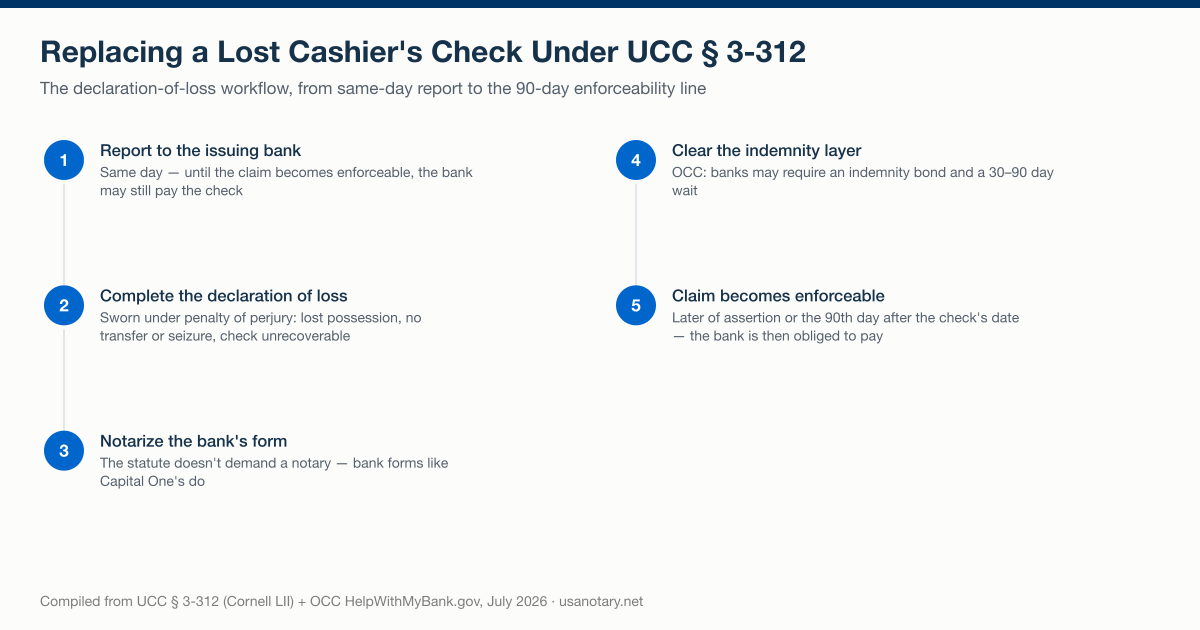
The replacement workflow from same-day report to the 90-day enforceability line, compiled from UCC § 3-312 and OCC guidance, July 2026.
What does UCC § 3-312 require the declaration of loss to say?
The declaration of loss is a sworn statement with four fixed elements, defined in § 3-312(a) as a statement “made in a record under penalty of perjury.” The declarer must attest that:
- the declarer lost possession of the check;
- the declarer is the drawer or payee of a certified check, or the remitter or payee of a cashier’s check or teller’s check;
- the loss of possession was not the result of a transfer by the declarer or a lawful seizure; and
- the declarer cannot reasonably obtain possession of the check because it was destroyed, its whereabouts cannot be determined, or it is in the wrongful possession of an unknown person or a person that cannot be found or is not amenable to service of process.
Those four elements are not boilerplate — they are the entire legal substance of the claim. Element 3 screens out the person who handed the check over in a deal that went sideways (that is a transfer, not a loss), and element 4 makes the declarer swear the check is genuinely unrecoverable, not sitting in a drawer at the other party’s office.
The statute attaches real teeth to the signature: “Delivery of a declaration of loss is a warranty of the truth of the statements made in the declaration.” A false declaration is not just perjury exposure — it is a warranty breach the bank can sue on directly.
Who counts as a claimant?
Only the parties named in element 2 can use this procedure. For a lost cashier’s check, that means the remitter — the person who bought the check from the bank — or the payee it was made out to. A later endorsee who received the check by transfer falls outside the declaration’s required statements and cannot swear to them. Banks build this into their forms: Capital One’s affidavit instructs that “you must either be the remitter of the check (the person whose account the funds were debited from) or the payee (the person to whom it was made payable).”
What else must accompany the claim?
Section 3-312(b) adds three procedural conditions around the declaration itself: the communication must describe the check with reasonable certainty, it must be received in time for the bank to act before the check is paid, and the claimant must provide reasonable identification if the obligated bank requests it. Description, declaration, timing, identification — that is the complete statutory list.
Does the declaration of loss need to be notarized?
UCC § 3-312 does not require notarization — the statute asks for a record “under penalty of perjury” — but the bank forms that implement it frequently do, so in practice notarization is required whenever the issuing bank’s form says so. This two-layer structure trips people up: the statute sets the floor, and the bank’s form sets the paperwork you actually have to produce.
Capital One’s declaration of loss form is the clearest public example of the stricter layer. Its instructions state that “you must complete this form before a notary public and return it to us.” The document is structured as a classic sworn affidavit: the claimant appears “before me, the undersigned notary public,” is “first duly sworn,” declares the four statutory elements “under penalty of perjury,” and the form closes with a “Sworn to me and subscribed before me” jurat block and the notary’s signature line. Citi’s guidance points the same direction for its customers: “You’ll likely have to fill out a declaration of loss form and may need to purchase an indemnity bond.”
Why do banks add a notary block the statute doesn’t demand?
The declaration is the bank’s only shield when it pays a claimant on a check that might still surface. The four sworn statements are warranties, and a bank that later faces the original check wants those warranties made under the strongest available formality — an identity-verified oath, administered by a notary, in a form that holds up as evidence. A sworn-and-subscribed declaration is a jurat-type notarization: the notary administers an oath and certifies the signer swore to the contents, which is a different act from a simple acknowledgment. Our guide to the difference between a jurat and an acknowledgment unpacks why the oath matters on documents like this one.
Because the declaration of loss is functionally an affidavit, everything in our walkthrough of how to notarize an affidavit applies: the signer must appear before the notary, be placed under oath, and sign (or acknowledge signing) in the notary’s presence. What the notary never does is vouch for whether the check is actually lost — the truth of the four elements rides entirely on the signer’s oath.
How does the 90-day rule work?
The claim becomes enforceable at “the later of (i) the time the claim is asserted, or (ii) the 90th day following the date of the check” — that is the uniform text of § 3-312(b)(1) for cashier’s checks and teller’s checks; for a certified check the trigger is the 90th day following the date of acceptance. The 90 days run from the date printed on the check, not from the loss or the filing. Two consequences follow directly:
| Timeline point | Legal status of your claim | What the bank may or must do |
|---|---|---|
| Loss reported, declaration delivered (before day 90) | Claim asserted but not yet enforceable — it “has no legal effect” | Bank may pay the check to a person entitled to enforce it |
| The 90th day after the check’s date (or the moment of assertion, if later) | Claim becomes enforceable | Bank “becomes obliged to pay the amount of the check to the claimant if payment of the check has not been made” |
| After the bank pays your claim | Bank’s liability on the check is discharged | Payment to the claimant “discharges all liability of the obligated bank with respect to the check” |
| Check later presented by a holder in due course | § 3-312(c) obligations attach to you | You must refund the bank if it pays the check, or pay the holder yourself if the check is dishonored |
The design is a deliberate trade. During the 90-day window, the law protects whoever is lawfully holding the check — maybe it wasn’t lost at all, maybe it is moving through the collection system right now. After the window closes, the law protects the claimant: the bank is obliged to pay you, and your payment cuts off the bank’s exposure on the instrument.
Can you get funds sooner than 90 days?
Sometimes — through the statute’s own “later of” mechanics. If the cashier’s check was dated more than 90 days before you assert the claim, the claim becomes enforceable the moment it is asserted, because the 90th day has already passed. There is no additional waiting period in the uniform text.
One state runs a shorter clock. Capital One’s form carves out Wisconsin residents explicitly: “Please note that your claim is not effective until the 30th calendar day following the date the cashier’s check was issued” — a 30-day line where the uniform rule says 90. Bankrate’s 2025 guide flags the same Wisconsin 30-day departure. Everywhere else, plan on the full 90.
Bank policy adds its own layer on top of the statute. The OCC’s consumer-help site notes that “a bank may require you to wait 30–90 days before it will issue a replacement check,” and Bankrate summarizes the practical rule the same way: “the declaration of loss is not enforceable until 90 days after the check was issued.”
What if the check surfaces after the bank pays you?
Section 3-312(c) shifts the residual risk onto the claimant. If a person with the rights of a holder in due course presents the check after you have been paid, you must “refund the payment to the obligated bank if the check is paid, or pay the amount of the check to the person having rights of a holder in due course if the check is dishonored.” You cannot end up double-recovering, and an innocent holder cannot end up empty-handed — the loss lands on the person who swore the check was gone.
When is an indemnity bond required?
An indemnity bond is required when the issuing bank’s policy demands one — typically on larger checks — and it is a bank-policy requirement, not a statutory one. Section 3-312(b)‘s claim conditions are description, declaration, timing, and identification; an indemnity bond appears nowhere in that list. The bond lives in the risk-management layer the OCC describes on HelpWithMyBank.gov: it is “a type of insurance policy” that “ensures that you—not the bank—will be liable for any losses if the lost check is found and presented for payment.”
Getting one is the hard part. The OCC’s guidance is unusually candid: “You can purchase indemnity bonds through several insurance companies, however, they are often difficult to obtain. Contact your insurance broker for help.” Budget time for this step if your bank requires it — the bond, not the declaration, is usually the bottleneck on large-dollar replacements.
Indemnity bond vs. the indemnification clause in the bank’s form
Two different instruments get called “indemnity” in this process, and separating them saves confusion:
- An indemnity bond is a third-party surety product you purchase from an insurance company, at the bank’s demand, before it reissues. It backs your promise with an insurer’s balance sheet.
- An indemnification clause is a promise built into the declaration form itself. Capital One’s affidavit has the claimant agree to “indemnify and hold Capital One bank harmless at all times from and against any and all claims, actions, proceedings, losses and expenses, including counsel fees” arising from the replacement. No insurer stands behind it — just the signer.
Many banks settle for the built-in clause on ordinary amounts and reserve the bond requirement for checks large enough that a personal promise isn’t sufficient comfort. Which threshold applies to you is a question for the issuing bank on that first phone call.
How do bank replacement requirements compare?
Requirements cluster around the same statutory skeleton, but the notarization, waiting-period, and indemnity details differ by issuer. Here is what the sources we verified this session actually show:
| Issuer / authority | Declaration form | Notarization | Waiting period | Indemnity layer |
|---|---|---|---|---|
| Capital One | Affidavit of Lost, Destroyed, or Stolen Cashier’s Checks — “constitute[s] a Declaration of Loss and claim for payment” | Required — “complete this form before a notary public” | Claim “not effective until the 90th calendar day following the date the cashier’s check was issued” (30th day for Wisconsin residents) | Indemnify-and-hold-harmless clause built into the form |
| Citi | ”You’ll likely have to fill out a declaration of loss form” | Not stated on its consumer page | ”Generally 30 to 90 days” before replacement or refund; a replacement/cancellation fee may apply | ”May need to purchase an indemnity bond” |
| Wells Fargo (per Bankrate) | Declaration of loss claim | Not stated | Standard 90-day framework | Requires “an indemnity agreement as a condition of stop payment and reissuance” |
| Citizens (per Bankrate) | Declaration of loss claim | Not stated | Waiting period applies; customers visit a branch in person and confirm the check did not clear | Not stated |
| OCC baseline (HelpWithMyBank.gov) | Declaration of loss under UCC § 3-312 | Bank’s choice | ”A bank may require you to wait 30–90 days before it will issue a replacement check” | Bank “may require” an indemnity bond |
The pattern for a claimant: assume the declaration is required everywhere, assume notarization is required unless the bank says otherwise, and ask about the indemnity threshold up front. The pattern for bank and credit union staff: your declaration form is the customer’s first bottleneck, and the notary requirement on it is the step most likely to send them away from your branch unserved.
Who files the claim — the purchaser or the payee?
Either the remitter or the payee of a lost cashier’s check may file the declaration of loss — UCC § 3-312 gives the claim to both, and whoever files takes on both the payout and the risk. The declaration’s second sworn element requires the declarer to state which role they hold, and Capital One’s form has checkboxes for exactly those two capacities (with an authorized-signer warranty when a business files).
In practice the roles sort themselves by who was holding the check when it vanished. A buyer who lost the check between the teller window and the closing table files as remitter. A seller or contractor who deposited nothing because the envelope never arrived files as payee. For a certified check — a personal check the bank has accepted — the statute puts the claim in the hands of the drawer or payee instead.
Filing is not a formality for the claimant: once the bank pays, § 3-312(c)‘s refund-or-pay obligations attach to the person who filed. The party who swears the declaration is the party holding the tail risk if the check reappears in the hands of a holder in due course.
How to notarize the bank’s declaration form online
A notarized declaration of loss does not require a branch visit. The National Association of Secretaries of State reports that 47 states and the District of Columbia have a law that allows for remote e-notarization, which means the sworn declaration can be completed over live video with a commissioned notary — the same oath, administered remotely. The legal footing for video notarization is covered in our explainer on whether online notarization is legitimate.
Here is how the session works:
- Upload the bank’s form. Use the issuing bank’s own declaration of loss — the notary notarizes your signature on it and never alters the form’s contents.
- Verify your identity. Credential analysis and knowledge-based authentication run through a third-party identity-verification service before the notary appears — a stricter identity check than most walk-in notarizations.
- Join the video session and take the oath. A commissioned notary administers the oath on live video. Multi-signer sessions are supported if the check was purchased jointly.
- Send the completed form to the bank. The session produces a tamper-evident notarized PDF with a complete audit trail, and the audio-video recording and electronic journal entry are retained under the applicable state’s record-retention rules — a stronger evidentiary record behind a sworn warranty than a paper stamp.
One caution before you book: a small number of banks still prefer ink on their own forms, so confirm the issuing bank will accept a remotely notarized declaration — our guide to whether banks accept online notarization explains how acceptance works and what to say if a branch hesitates. Pricing is flat: $25 per document, with volume pricing for institutions.
For the banks and credit unions on the other side of the counter: every declaration of loss your operations team mails out with a “have this notarized” instruction is a customer stalled at the hardest step. A staff-initiated remote notarization workflow lets a branch employee or call-center agent launch the session for the customer instead of sending them hunting for a notary — that model, along with multi-signer trustee and estate paperwork, is covered on our page for online notarization for banks and credit unions.
Get the declaration notarized today, collect on day 90
The rule to remember: the statute makes the claim, the bank’s form makes the paperwork. UCC § 3-312 defines what you swear and when the claim becomes enforceable — the later of assertion or the 90th day after the check’s date — while the issuing bank decides whether the declaration is notarized and whether an indemnity bond backs it. Report the loss immediately, get the form moving the same day, and the 90-day line becomes a payout date instead of a surprise.
If the form in front of you says “notarize,” that part can be handled online in a single video session. Questions about a specific bank’s requirements, or setting up a declaration-of-loss workflow for your institution? Call 804-767-7500 or contact us.