
What is a lost policy release?
A lost policy release (LPR) is a signed statement declaring that an insurance policy is lost, destroyed, or being retained, and releasing the insurer from claims under that policy after the cancellation date. Insuranceopedia defines it as “a form that a person signs if they have lost their physical insurance policy and wish to terminate the insurance contract.” In day-to-day agency work, the document that carries this function is the ACORD 35, titled “Cancellation Request / Policy Release.”
The lost policy release is a leftover from an older mechanic of insurance. Cancelling a policy once meant surrendering the physical policy back to the insurer — and when the insured couldn’t produce it, the release stood in for the surrendered document. Insuranceopedia notes that modern cancellation no longer requires returning the policy, so lost policy releases are “typically not necessary in most cases” — yet the form persists, because the ACORD 35 folds two functions into one page: a cancellation request when the policy can be attached, and a policy release when it can’t. Auto insurers, Insuranceopedia adds, may still ask a policyholder to sign one when switching to a different provider.
One name causes most of the confusion around this document. “Lost policy release” describes the property-and-casualty cancellation form above — but life insurers use a near-identical phrase, lost policy affidavit, for a very different document that beneficiaries and policyowners sign when a life policy goes missing. The release is witnessed; the affidavit is sworn before a notary on many carrier forms. This guide covers both, because the execution rules — witness or notary — are exactly where the two documents split.
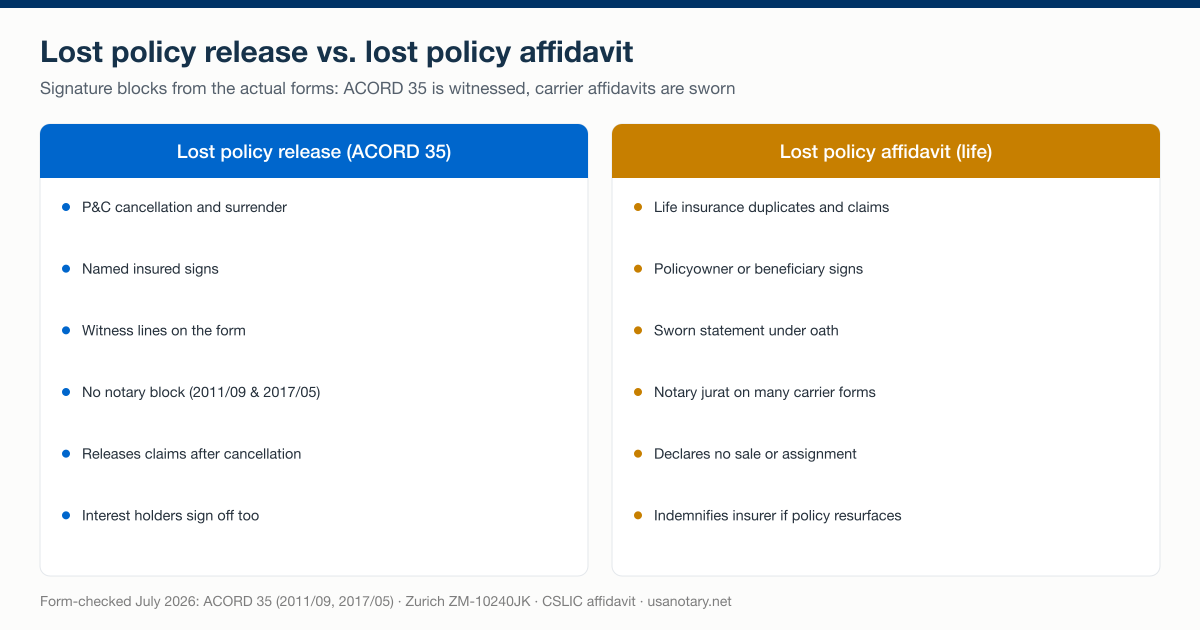
The signature-block split, checked against the actual forms: ACORD 35 carries witness lines; carrier lost policy affidavits are sworn, and many carry a notary jurat.
What does the ACORD 35 actually say?
The ACORD 35 is a one-page standardized form that pairs a cancellation request with a policy release — and everything below is checked against two specimen editions, the 2011/09 and the 2017/05. The top half identifies the producer, the insurance company, the insured, and the cancelled policy: policy number, policy term, and the effective date and hour of cancellation. Below that sit the form’s two paths, each with its own checkbox:
- “CANCELLATION REQUEST (Policy attached)” — used when the original policy can be surrendered with the request.
- “POLICY RELEASE (Complete Statement Section Below)” — used when it can’t. This is the lost policy release path.
The policy release statement is short, and its wording is identical across both editions:
“The undersigned agrees that: The above referenced policy is lost, destroyed or being retained. No claims of any type will be made against the Insurance Company, its agents or its representatives, under this policy for losses which occur after the date of cancellation shown above. Any premium adjustment will be made in accordance with the terms and conditions of the policy.”
Three commitments live in those three lines: the policy’s physical status (lost, destroyed, or retained), a release of post-cancellation claims, and an agreement that any return premium follows the policy’s own terms. The signature section then closes with a warning in bold: “This representation is true and accurate, and I understand that any misrepresentation may be deemed a fraudulent act.”
Who signs which line
| Signature line | Who signs it | Notes from the form |
|---|---|---|
| Signature of Named Insured (two lines) | The named insured(s) on the cancelled policy | Each line carries its own date field |
| Witness (two lines) | A person who watches the insured sign | One witness line sits beside each insured signature line |
| Authorized Signature — lienholder / mortgagee / loss payee / lender’s loss payable | The interest holder’s representative, with title | Printed note: “(Not applicable in NH per RSA 412:5 I)”; the 2017/05 edition adds the lender’s loss payable checkbox |
| Producer’s Signature | The agent or broker of record | Sits in the request/release distribution section |
The bottom half of the form is agency and company machinery: a reason-for-cancellation block (not taken, requested by insured, rewritten, other), a method-of-cancellation block (flat, short rate, pro rata), and return-premium fields. A New York-only paragraph warns auto policyholders that letting insurance lapse during a registration period leads to suspended registration — and, after 90 days uninsured, a suspended driver’s license — because insurers must report terminated auto coverage to the DMV.
Does a lost policy release need to be notarized or witnessed?
A lost policy release is witnessed, not notarized. On the standard ACORD 35, each named insured’s signature line sits beside a witness line, and no notary block appears anywhere on the form — a fact confirmed on both the 2011/09 and 2017/05 specimen editions. Anyone telling you an ACORD 35 must be notarized is describing a carrier’s house rule or a one-off request, not the form itself.
The qualifier matters, though: the form sets the floor, and the carrier sets the ceiling. If an insurer’s cancellation instructions ask for a notarized release, the insurer’s instructions govern — a notarization the form doesn’t call for won’t invalidate it, but a missing formality the carrier demanded can stall the cancellation and the return premium behind it.
Why a witness instead of a notary
The ACORD 35 polices honesty through its fraud clause, not through a notarial certificate. The signer’s representation is bracketed by the printed warning that “any misrepresentation may be deemed a fraudulent act,” and the witness lines add a second person who saw the signature happen. That is a lighter execution standard than a sworn document carries — deliberately so, because the release moves inside routine cancellation workflows where the parties already know each other: insured, agent, carrier.
Notarization is required when a document is sworn — when the signer takes an oath and the notary completes a jurat — or when a signer must formally acknowledge a signature for recording. The lost policy release does neither: it is a private agreement between insured and insurer, never recorded, never sworn. Our guide to the difference between a jurat and an acknowledgment unpacks why that distinction decides how a signing session actually runs.
A release is not a proof of loss
Sense-check the document in your hand before worrying about execution. A lost policy release ends coverage; a proof of loss demands payment under coverage — it is the sworn statement of a claim’s details and dollar amount, and it carries an oath the release never does. If a carrier has asked you to swear to claim figures, you are dealing with a sworn proof of loss, a different document with its own deadlines and its own notarization rules.
Lost policy release vs. lost policy affidavit: which one are you holding?
The lost policy release and the lost policy affidavit share a fact pattern — a policy nobody can find — and almost nothing else. The release cancels a property-and-casualty policy; the affidavit keeps a life insurance policy’s value reachable when the paper is gone. Here is the split, drawn from the actual forms:
| Lost policy release (ACORD 35) | Lost policy affidavit | |
|---|---|---|
| Line of business | Property & casualty — auto, home, commercial | Life insurance |
| Trigger | Cancelling or surrendering a policy that can’t be returned | Requesting a duplicate policy, or supporting a claim, when the policy document is lost |
| Who signs | Named insured(s), plus lienholder / mortgagee / loss payee when listed | Policyowner (duplicate requests) or beneficiary (claims) |
| What the signer states | Policy “is lost, destroyed or being retained”; no claims after the cancellation date | Policy is lost or destroyed, has not been sold, transferred, or assigned; signer indemnifies the insurer if it resurfaces |
| Execution | Witnessed — witness lines, no notary block | Sworn — many carrier forms carry a notary jurat; some accept a witness |
| Form source | ACORD standardized form, used industry-wide | Carrier-drafted forms that vary company to company |
The execution row is the one that changes what you do next. A witnessed document needs a second adult in the room. A sworn document needs a notary who administers an oath — and that turns a five-minute signature into a notarization appointment, unless the oath happens over video.
What do beneficiaries sign when a life insurance policy is lost?
Beneficiaries who cannot find the policy can still claim — the policy’s value does not depend on the paper. TruStage’s guidance states it directly: “Although it’s ideal to have a life insurance policy document on hand, losing or misplacing one doesn’t mean the policy loses its value.” The same guide flags the myth worth killing: some beneficiaries assume that “without a policy document, they cannot make a claim. But that’s not necessarily true.”
When the policy — or even the carrier’s identity — is missing, the NAIC’s Life Insurance Policy Locator is the free, official search tool. A requester submits details from the death certificate — Social Security number or ITIN, legal name, dates of birth and death — and participating insurers check their records through a secure portal. If a policy is found and you are the beneficiary, the NAIC explains, the insurance company contacts you directly.
What the insurer asks you to sign next is the lost policy affidavit — and the two carrier specimens below show what beneficiaries are actually committing to.
What the affidavit makes you swear
Zurich American Life’s Affidavit of Lost Policy (form ZM-10240JK) is a policyowner’s document for obtaining a duplicate: the signer, “of lawful age, being first duly sworn,” states that the policy “has been lost or destroyed; that it has not been delivered to any person having any right, title or interest in it,” and agrees to return any duplicate if the original resurfaces. The form ends with a full notary jurat — a State/County venue block, “Subscribed and sworn to before me this ___ day of ___,” a notary signature line, and a commission-expiration line. This affidavit is sworn before a notary by design.
Central Security Life’s Lost Policy Affidavit is the beneficiary-side version, and its commitments run further. The beneficiary warrants and declares that the policy “has been lost or destroyed,” that “there has been no sale, transfer, or assignment of said policy,” and that no one else “has any claim, title or interest therein.” Then comes the clause with real weight: the beneficiary agrees to “indemnity and protect the Company against any claim that may be asserted against the Company under said original policy.” Sign that, and you have personally agreed to cover the insurer if the lost policy turns up in someone else’s hands — pledged as loan collateral, assigned, or sold. That is why these statements are executed formally at all: the affidavit is the insurer’s protection against paying the same policy twice.
Read the signature block, not the title
Carrier practice splits on execution, and the two specimens prove it: Zurich’s form carries a notary jurat, while Central Security Life’s takes a beneficiary signature beside a witness signature, with no notary block. The signature block — not the document’s title — decides whether notarization is required. Look for “subscribed and sworn to before me”: that phrase means a jurat, an oath, and a notary. A bare “Signature of Witness” line means a witness suffices. Our walkthrough of how to notarize an affidavit covers what happens when the block does demand a notary.
One boundary worth drawing while you have the claim packet open: the lost policy affidavit proves the document is gone. Changing who receives the payout is a different form with different fraud sensitivities — a beneficiary change request, which most carriers process on their own form rather than through this affidavit.
How to notarize a lost policy affidavit online
A lost policy affidavit that carries a jurat can be sworn over live video instead of at a desk. The National Association of Secretaries of State reports that 47 states and the District of Columbia have a law allowing remote e-notarization, and the legal footing behind those sessions is covered in our explainer on whether online notarization is legit. For a beneficiary mid-claim — often in a different state from the insurer, the estate, or the other beneficiaries — the online route replaces an in-person errand with a video session available any hour of the day.
Here is how the session works:
- Confirm the form actually requires a notary. Read the signature block first. “Subscribed and sworn to before me” means a jurat and a notary; a plain witness line means you may not need a notarization at all.
- Upload the carrier’s form. The notary notarizes your signature on the carrier’s own affidavit — the form is not redrafted or altered. Zurich’s specimen even prints “A FACSIMILE OF THIS FORM IS AS VALID AS THE ORIGINAL” across its footer.
- Verify your identity. Before the video session starts, identity verification runs through credential analysis of your government ID plus knowledge-based authentication, handled by a third-party identity service.
- Swear the oath on camera. A commissioned notary administers the oath the jurat requires, watches you sign, and completes the notarial certificate. Sessions run 24/7, and multiple signers can join one session. Where state law and the document’s rules permit, a remote witness can join too — useful when a carrier form wants both.
- Return the completed affidavit to the insurer. The session produces a tamper-evident notarized PDF with a complete audit trail, and the audio-video recording and electronic journal entry are retained for the period the notary’s state law requires — a durable record if the claim is ever questioned.
Pricing is flat: $25 per document, with volume pricing for teams that process claim packets routinely. Carriers, TPAs, and agencies that handle lost policy affidavits, releases, and claim paperwork every week can set up staff-initiated sessions through our online notarization service for insurance teams — the signer receives an invitation, and the completed document lands back in the claim file.
The right execution for the right document
The rule this whole topic reduces to: the release is witnessed; the affidavit is sworn. An ACORD 35 lost policy release needs a witness and a truthful signer — no notary block exists on the form. A life insurer’s lost policy affidavit needs whatever its signature block says, and on many carrier forms that is a notary jurat, complete with an oath. Check the block before you book anything, and when the block does demand a notary, a video session gets a displaced policyowner or an out-of-state beneficiary sworn, signed, and back to the claim the same day.
Questions about a specific carrier form or a recurring claims workflow? Call 804-767-7500 or reach us through the contact page.