
What is a sworn proof of loss?
A sworn proof of loss is the policyholder’s formal, itemized statement of what an insurance claim is worth — signed under oath. It is not the phone call that reports the fire, and it is not the adjuster’s estimate. It is the document where the insured personally attests, line by line, to the time and origin of the loss, who holds an interest in the property, the actual cash value of each item, the amount of loss, the encumbrances on the property, and any other insurance covering it. That list comes straight from the policy: the standard fire policy set out in New York Insurance Law § 3404 requires “a proof of loss, signed and sworn to by the insured, stating the knowledge and belief of the insured” as to exactly those items.
The word sworn is doing real work in that sentence. A proof of loss is signed and sworn to — the policyholder takes an oath before a notary public that the statements in it are true, and the notary completes a jurat certificate at the bottom of the form. The widely used blank form published by United Policyholders, titled “Sworn Statement in Proof of Loss,” ends the same way every version of this document has for decades: “Subscribed and sworn before me this ___ day of ___” over the signature line marked Notary Public.
Two sense distinctions keep claimants out of trouble. First, a proof of loss is not the notice of loss: the notice tells the carrier a loss happened; the proof of loss states, under oath, what the claim is worth. The federal flood policy lists them as separate duties. Second, a proof of loss is not the adjuster’s paperwork. The adjuster works for the carrier; the proof of loss is the insured’s own sworn statement, and the insured is the one the oath binds.
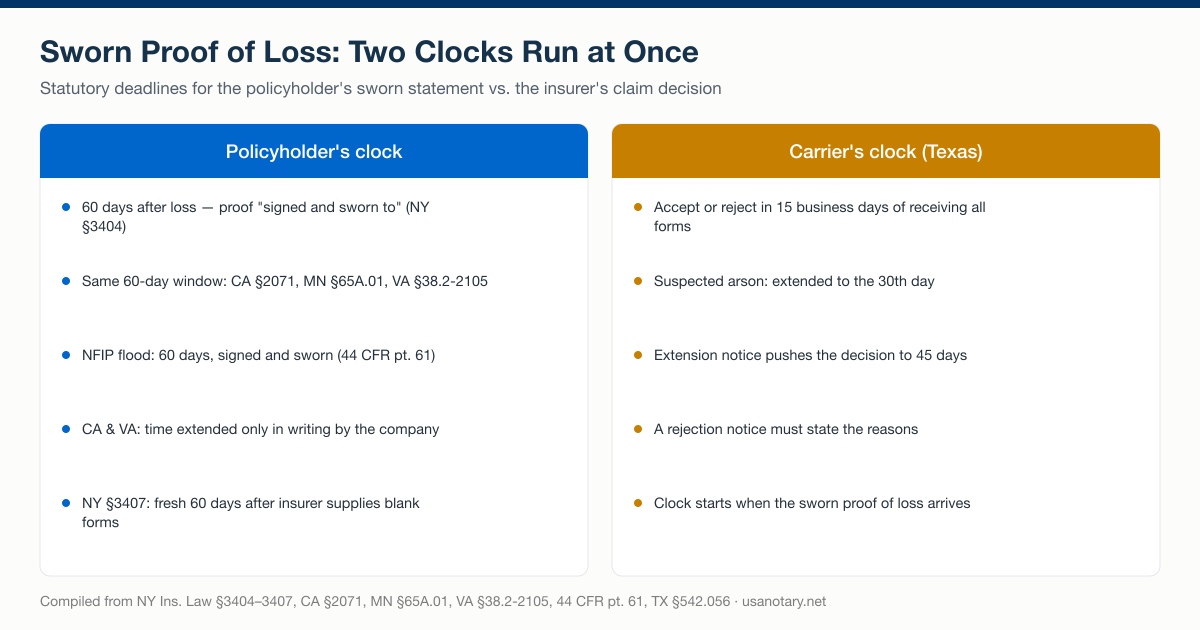
Two clocks run on every sworn claim: the policyholder’s 60-day proof-of-loss window and, in states like Texas, the carrier’s decision deadline that starts when the proof arrives.
Why does a proof of loss have to be sworn?
A proof of loss is sworn because the oath is the policy’s primary fraud control — and the policy says so in blunt terms. The concealment-and-fraud clause of the New York standard fire policy voids the entire contract for dishonesty in the claim papers: “This entire policy shall be void if, whether before or after a loss, the insured has wilfully concealed or misrepresented any material fact or circumstance concerning this insurance or the subject thereof … or in case of any fraud or false swearing by the insured relating thereto.” “False swearing” is only possible on a statement that was sworn in the first place — the oath is what converts an inflated estimate into a voidable act.
The blank form repeats the warning in its own header. The United Policyholders form opens with a boxed fraud prevention warning: any person who, knowingly and with intent to defraud any insurance company, files a statement of claim containing any materially false information “commits a fraudulent insurance act, which is a crime, and subjects such a person to criminal and civil penalties.” A policyholder who signs and swears to the form is signing directly beneath that language.
The carrier’s view: a sworn number the file can rely on
Carriers require the proof of loss to be sworn because it fixes the claim to a specific, attested set of numbers. Before the proof of loss arrives, the file holds estimates, photographs, and adjuster notes; after it arrives, the file holds the insured’s own oath on the actual cash value, the whole loss and damage, and the amount claimed. That sworn figure is what the carrier evaluates, pays against, or — where the numbers cannot be squared with the evidence — investigates under the false-swearing clause.
The sworn filing also starts the carrier’s own clock in prompt-payment states. Under Texas Insurance Code § 542.056, an insurer must notify the claimant in writing that the claim is accepted or rejected within 15 business days after receiving all items, statements, and forms it required — the proof of loss chief among them. A rejection notice “must state the reasons for the rejection.”
The policyholder’s view: the oath cuts both ways
Policyholders should treat the oath as protection as well as exposure. A sworn proof of loss is the insured’s formal demand in the insured’s own words — not a number the adjuster chose. Once the carrier receives it, statutory decision deadlines attach, and the insured has a dated, notarized record of exactly what was claimed and when. The discipline the oath imposes — state only what you know and believe, mark estimates as estimates — is the same discipline that makes the claim durable if it is later disputed.
Where does the 60-day rule come from?
The 60-day deadline comes from the standard fire policy — the fixed, standardized policy wording that New York codified in Insurance Law § 3404 and other states adopted in near-identical form. The proof-of-loss provision on the policy’s second page requires the insured to render the sworn statement “within sixty days after the loss,” and because state legislatures copied the wording into their own insurance codes, the same 60-day clock appears from coast to coast. The federal flood program wrote the same number into its policy by regulation.
Deadline table: the 60-day rule across five regimes
| Policy regime | Deadline | Statutory language (fetched from the current text) |
|---|---|---|
| New York — Ins. Law § 3404 | 60 days after the loss | “the insured shall render to this Company a proof of loss, signed and sworn to by the insured” |
| California — Ins. Code § 2071 | 60 days after the loss | “within 60 days after the loss, unless the time is extended in writing by this company, the insured shall render to this company a proof of loss, signed and sworn to by the insured” |
| Minnesota — Stat. § 65A.01, subd. 3 | 60 days | “a statement in writing, signed and sworn to by the insured, shall within 60 days be rendered to the company” |
| Virginia — Code § 38.2-2105 | 60 days after the loss, unless extended in writing | “the insured shall render to this Company a proof of loss, signed and sworn to by the insured” |
| NFIP flood — 44 CFR pt. 61, App. A(1), Art. VII(G)(4) | Within 60 days after the loss | “send us a proof of loss, which is your statement of the amount you are claiming under the policy signed and sworn to by you” |
Three details in that table matter more than the headline number. California and Virginia both write the escape hatch into the form itself — the time can be “extended in writing” by the company, which is why claimants in large disasters often hold written deadline extensions from their carriers. Minnesota phrases the duty as a “statement in writing, signed and sworn to” rather than using the words proof of loss, but the content requirements — value of the property, the insured’s interest, other insurance, occupancy, time and manner of origin — track the same anatomy. And the flood policy defines the document in one clause: your statement of the amount you are claiming, signed and sworn to by you.
New York’s safety valve: § 3407 and the blank-form demand
Missing the 60-day window is not automatically fatal in New York. Insurance Law § 3407 provides that the failure to furnish proofs of loss “shall not invalidate or diminish any claim” unless the insurer gives the insured a written notice that it desires proofs of loss to be furnished — and supplies a blank form for the purpose. Once the insured receives that notice and form, a fresh clock runs: furnish the proofs “within sixty days after the receipt of such notice and such form or forms, or within any longer period of time specified in such notice,” and the insured “shall be deemed to have complied.” Other states allocate the risk of a late proof differently, so the safe reading everywhere is the same: file within 60 days of the loss and the question never arises.
The carrier’s clock: what happens after the proof of loss arrives
The proof of loss is also the trigger for the insurer’s statutory deadlines, and Texas shows how tightly that clock is wound. Under Texas Insurance Code § 542.056, the insurer must accept or reject the claim in writing within 15 business days after it receives all items, statements, and forms it required from the claimant. If the insurer reasonably believes the loss resulted from arson, the deadline extends to the 30th day. If the insurer cannot decide in time, it must notify the claimant of the reasons it needs more time — and must then accept or reject the claim no later than 45 days after that notice. A displaced homeowner scrambling to meet the 60-day filing window can take some comfort in the symmetry: once the sworn statement lands, the waiting has a statutory endpoint too.
How do you fill out a sworn statement in proof of loss?
Fill out the form from the policy documents, not from memory — every field on the standard “Sworn Statement in Proof of Loss” corresponds to something the policy or the claim file already states. Working from the United Policyholders blank form, here is what each section asks for:
- Policy header. Policy number, the amount of the policy at the time of loss, the dates the policy was issued and expires, plus the carrier’s file number, company claim number, and agent. Copy these from the declarations page and the claim acknowledgment letter.
- Time and origin. The hour and date the loss occurred and its cause and origin, stated to your knowledge and belief. If the cause is undetermined, say so — the oath covers this line like every other.
- Occupancy. How the building was occupied at the time of loss — the form’s own words are “and for no other purpose whatever,” so describe the actual use (primary residence, rental, vacant).
- Title and interest. Your interest in the property and every other person’s interest or encumbrance — co-owners, mortgagees, lienholders. This mirrors the policy requirement to state “the interest of the insured and of all others in the property.”
- Changes. Any assignment, or change of interest, use, occupancy, possession, location, or exposure of the property since the policy was issued. “None” is a common and acceptable answer — but it is a sworn “none.”
- Total insurance. The total amount of all insurance covering the property, including other policies. The standard fire policy demands disclosure of “all other contracts of insurance” — leaving a second policy off this line is the kind of omission the false-swearing clause exists for.
- Value, loss, and amount claimed. Three numbers: the actual cash value of the property at the time of loss, the whole loss and damage, and the amount claimed under this policy. These are the figures the oath most directly binds; build them from a documented inventory and repair estimates, and keep the backup.
- Statements of insured. The pre-printed attestation that the loss “did not originate by any act, design or procurement” of the insured, that nothing has been concealed, and that no attempt to deceive the company has been made. Read it before signing — this paragraph is the substance of the oath. The form calls the signer the affiant here; our explainer on what an affiant is covers why that word matters.
- Signature and notary block — leave it blank. The “Subscribed and sworn before me” block belongs to the notary, and the signature belongs in the notary’s presence. Signing at the kitchen table before the session defeats the jurat.
Attach the supporting schedules the form references — the apportionment of other insurance and the inventory of damaged property — and keep a complete copy. Under the flood policy, the inventory must show quantity, description, actual cash value, and amount of loss for each damaged item.
What does the notary actually do on a proof of loss?
The notary performs a jurat — the notarial act for sworn statements — not an acknowledgment. California Government Code § 8202 states the three elements plainly: the notary administers an oath or affirmation to the affiant, verifies the affiant’s identity by satisfactory evidence, and watches the affiant sign — “the affiant shall sign the document in the presence of the notary.” That in-the-presence signature requirement is why step 9 above says to leave the form unsigned until the session. The taxonomy behind the two certificate types is covered in our guide to the difference between a jurat and an acknowledgment; the short version is that an acknowledgment confirms a signature already made, while a jurat puts the signer under oath.
What the notary does not do
The notary does not vouch for your numbers. California requires every jurat to carry a boxed notice making the boundary explicit: the notary “verifies only the identity of the individual who signed the document to which this certificate is attached, and not the truthfulness, accuracy, or validity of that document.” The truthfulness of the actual cash value and the amount claimed is the affiant’s burden under the oath — which is precisely why the carrier wants the oath administered by a disinterested commissioned officer rather than collected as a bare signature.
How do you get a proof of loss notarized online when you’re displaced?
Remote online notarization solves the practical absurdity of the sworn proof of loss: the document is due 60 days after a fire or flood, and the person who must swear to it often cannot live at the insured address — or in the same city — while the clock runs. The legal foundation is broad: the National Association of Secretaries of State reports that 47 states and the District of Columbia have a law that allows for remote e-notarization, and the mechanics of validity are covered in our review of whether online notarization is legitimate.
From a hotel room or a relative’s spare bedroom, the session looks like this:
- Upload the completed-but-unsigned form. The proof of loss with every field filled in, signature line blank.
- Verify your identity. Credential analysis and knowledge-based verification run before the notary appears — satisfying the “satisfactory evidence” element of the jurat.
- Take the oath on camera. A commissioned notary administers the oath over live video, watches you sign, and completes the jurat block. Sessions run 24/7 and are usually a single short sitting, and multi-signer sessions handle policies with co-insured spouses who need to swear jointly.
- Receive the sworn document. The session produces a tamper-evident PDF with a complete audit trail, plus an audio-video recording and an electronic journal entry that state law requires be preserved — Florida, for example, requires an online notary to keep both for at least 10 years after the notarial act — a stronger evidentiary record than a walk-in stamp, on a document whose whole purpose is evidentiary.
At $25 per document, the notarization costs less than the gas to drive back to a loss address. Claims operations run the same flow at scale: carriers, TPAs, and adjusting firms use business-initiated sessions to send a displaced claimant a notarization link with the proof of loss already loaded — the workflow our online notarization service for insurance claims is built around. One caution on remote witnesses for any supplementary claim documents that need them: they are supported where state law and the document’s rules permit, so confirm the requirement per document.
File the sworn proof of loss before the clock runs out
The rules compress to three sentences. The proof of loss is signed and sworn to — an oath before a notary, completed as a jurat, with the signature made in the notary’s presence. The deadline runs 60 days from the loss under the standard fire policy states and the NFIP flood policy, extendable in writing where the form allows. And once the insurer receives the sworn statement, its own statutory decision clock starts.
The notarization itself is the easiest step in the chain — the same process as notarizing any affidavit, available around the clock from wherever the loss has put you. Questions about a claim document or a recurring claims workflow? Call 804-767-7500 or contact us.