
What is a non-collusion affidavit?
A non-collusion affidavit is a sworn statement submitted with a public-works bid, certifying that the bidder priced the bid independently — no price fixing, no bid rigging, no agreement with any competitor about who would win the work. The affidavit is submitted with the bid as one page of the bid package, alongside the bid bond, the ownership disclosure, and the proposal form itself. Public owners collect it on advertised construction projects because sealed competitive bidding only protects the taxpayer when the competition behind the seals is real.
Read any agency’s version and the same three promises appear. New York wrote them into statute, and Pennsylvania printed nearly identical language on its state form:
- Independent pricing. The prices and amount of the bid “have been arrived at independently and without consultation, communication or agreement” with any other contractor or bidder, in the words of Pennsylvania’s DCED form.
- No early disclosure. The bid amount has not been shown to any competitor and will not be disclosed to one before the bid opening.
- No induced or complementary bids. The bidder has not tried to persuade anyone to refrain from bidding, to bid intentionally high, or to submit any other “complementary bid” — the form defines that term as any bid “submitted for the purpose of giving a false appearance of competition.”
The legal backdrop explains why one page carries so much weight. Bid rigging is a criminal violation of Section 1 of the Sherman Act, which declares every contract, combination, or conspiracy in restraint of trade illegal — a felony punishable by a fine of up to $100,000,000 for a corporation, up to $1,000,000 for an individual, and up to 10 years in prison. The non-collusion affidavit converts that abstract prohibition into a named person’s signed, sworn record attached to one specific bid on one specific letting. If collusion later surfaces, investigators hold not just an antitrust theory but a sworn document with a signature under it.
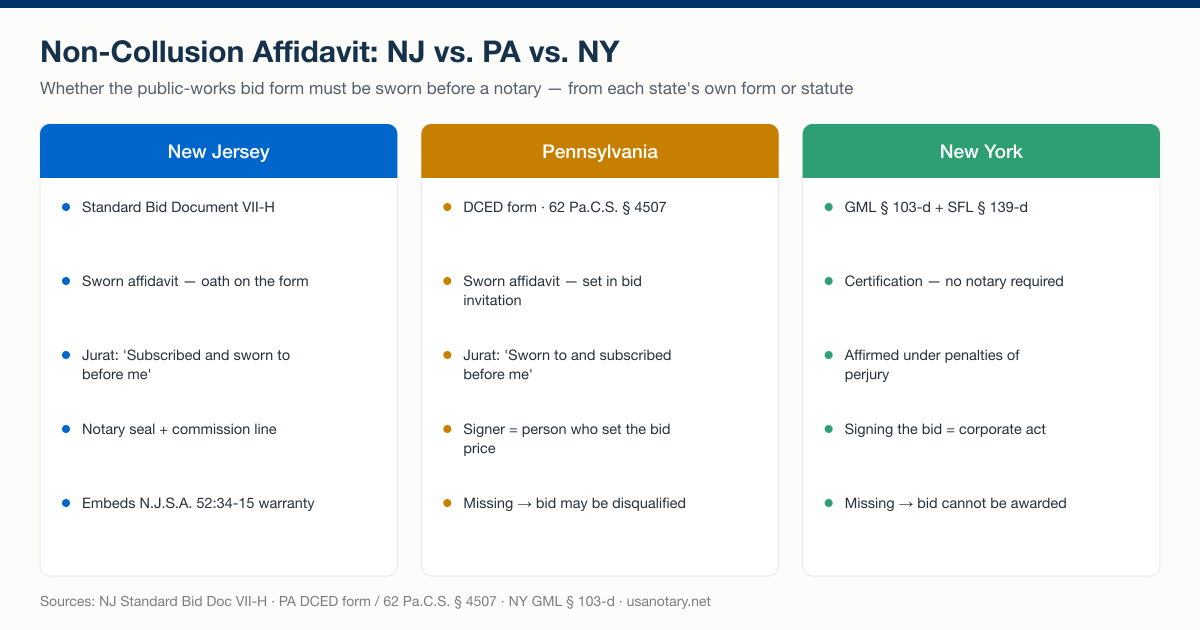
Three states, three instruments: New Jersey and Pennsylvania print a notary jurat on the bid form; New York’s statute requires a certification with no notary — compiled from the forms and statutes cited in this guide, July 2026.
Does a non-collusion affidavit need to be notarized?
Yes on most forms that call themselves affidavits — and the deciding detail is the closing block printed on the agency’s own form, not a general rule of law. An affidavit-format form ends with a jurat — “sworn to and subscribed before me this ___ day of ___” — and a document carrying a jurat must be sworn before a notary. A certification-format form ends with a signature line under the penalties of perjury and involves no notary at all. Both formats sit in live bid packages today, sometimes in neighboring states.
The two Mid-Atlantic examples run notarized. New Jersey’s Non-Collusion Affidavit — Standard Bid Document VII-H in the Division of Local Government Services’ model bid documents, reproduced in agency packages like the NJDEP environmental infrastructure financing forms — opens with the classic oath language (“being duly sworn according to law on my oath depose and say”) and closes “Subscribed and sworn to before me,” with lines for the notary’s commission expiration and a seal. Pennsylvania’s DCED form ends the same way: “SWORN TO AND SUBSCRIBED BEFORE ME THIS ___ DAY OF ___,” over a “MY COMMISSION EXPIRES” line.
New York runs the opposite direction. General Municipal Law § 103-d requires a non-collusive bidding certification “affirmed by such bidder as true under the penalties of perjury” — statutory wording, a signature, and no jurat anywhere. The perjury exposure does the work the oath would otherwise do.
How to spot the notarization requirement in ten seconds
Flip to the bottom quarter of the form and scan for jurat vocabulary: “sworn,” “subscribed,” “before me,” “Notary Public,” an “SS:” venue line, “My Commission expires,” or a seal box. Any one of those means the form is an affidavit and must be sworn before a notary. If the closing line instead reads “under penalty of perjury” over a bare signature and date, the form is a declaration or certification and no notary is involved. The distinction between these notarial certificates matters in practice — a jurat differs from an acknowledgment precisely because the jurat requires the signer to swear an oath and sign in the notary’s presence. An officer cannot sign the affidavit at a desk on Tuesday and have someone carry it to a notary on Wednesday.
What the oath adds beyond the signature
A jurat is not an identity formality alone. The notary administers an oath, and the affiant swears the contents are true — which is what puts false-swearing exposure behind every sentence of the document. Pennsylvania’s form instructions state the stakes directly: bid rigging, other efforts to restrain competition, “and making false sworn statements in connection with the submission of bids are unlawful and may be subject to criminal prosecution.” The same instructions tell the signer to be assured every statement is accurate, “making diligent inquiry, as necessary, of all other persons employed by or associated with the bidder” about how the bid was prepared, approved, and submitted. The oath reaches the whole estimating room, not just the signer’s own conduct.
Who signs a non-collusion affidavit?
The person with real authority over the bid price signs — not whoever happens to be free when the package is assembled. Pennsylvania’s DCED instructions require the affidavit to “be executed by the person responsible (i.e; owner, employee, officer) for making decisions on price(s) and amount(s) quoted in the bid.” New Jersey’s form has the affiant state a title or position, name the firm, and swear that they “executed the said proposal with full authority to do so.”
Three practical rules fall out of the forms and statutes:
- An authorized officer signs, and the corporate record should back the signature. New York resolves the authority question inside the statute itself: under GML § 103-d, a corporation’s authorization of the bid “shall be deemed to include the signing and submission of the bid and the inclusion therein of the certificate … as the act and deed of the corporation.” The certification is corporate conduct, not a personal side letter.
- Joint ventures multiply the paperwork. Pennsylvania’s instructions require each party to the venture to be identified in the bid proposal and “an affidavit be submitted separately on behalf of each party.” Two venture partners means two sworn affidavits — and two notarizations — before one bid goes out the door.
- The signer answers for the estimating team. Because the DCED instructions impose that diligent-inquiry duty, delegating the signature down to a project coordinator with no visibility into pricing defeats the document’s purpose and concentrates criminal exposure on someone who cannot truthfully swear to it. The estimator who built the number and the officer who approved it are the natural signers; on most forms the officer signs.
How do New Jersey, Pennsylvania, and New York handle the requirement?
Each of the three states reaches the same anti-collusion goal through a different instrument — two sworn affidavit forms and one statutory certification. Here is the comparison from the forms and statutes themselves:
| State | Instrument & authority | Sworn before a notary? | If it’s missing |
|---|---|---|---|
| New Jersey | Non-Collusion Affidavit — Standard Bid Document VII-H in the DCA model bid documents; state statutory reference N.J.S.A. 52:34-15 | Yes — “Subscribed and sworn to before me” jurat with notary seal | Required bid documents appear on the contracting unit’s checklist under N.J.S.A. 40A:11-23.1, which bidders initial entry by entry |
| Pennsylvania | Non-Collusion Affidavit — DCED form DCED-CDO-HR-015, authorized by 62 Pa.C.S. § 4507 | Yes — “Sworn to and subscribed before me” jurat | Form states failure to submit it with the bid proposal “may result in disqualification of the bid” |
| New York | Non-collusive bidding certification — GML § 103-d (political subdivisions) and State Finance Law § 139-d (state contracts) | No — affirmed under the penalties of perjury | Bid cannot be awarded without it; a bidder unable to certify must furnish a detailed signed explanation for agency review |
New Jersey: a standard form the owner chooses to require
The VII-H reference sheet describes the form’s job in one sentence: it “is used to ensure that the bidder has not participated in any collusion with any other bidder or Owner representative or otherwise taken any action in restraint of free and competitive bidding.” The same sheet notes that “the Owner’s use of this form is optional” — there is no single NJ statute commanding a non-collusion affidavit on every bid — yet the form sits in the state’s model bid documents and shows up in bid package after bid package. Its second paragraph does double duty: the affiant also warrants that no one was retained to solicit the contract for “a commission, percentage, brokerage, or contingent fee,” which mirrors the warranty every negotiated state contract must contain under N.J.S.A. 52:34-15. And once an owner puts the affidavit in the package, New Jersey’s checklist mechanics take over: N.J.S.A. 40A:11-23.1 has the contracting agent list the required submissions on a form the bidder initials item by item, so a missing affidavit is visible to everyone at bid opening.
Pennsylvania: the invitation to bid controls
Pennsylvania legislated the practice in its Antibid-Rigging Act: under 62 Pa.C.S. § 4507, governmental agencies may require noncollusion affidavits from bidders on public contracts, and “any requirement for noncollusion affidavits shall be set forth in the invitation to bid.” The practical instruction for a Pennsylvania estimator is to read the invitation, because the requirement lives there. The DCED form built on that authority goes further than the three core promises — the affiant also represents, to their best knowledge, that the contractor and its affiliates, officers, and directors are not under investigation for bid collusion, have no recent convictions or findings of liability for it, and are not under suspension or review by any government entity. A bidder who cannot make one of those statements must attach a written explanation to the bid rather than swear falsely.
New York: no notary, sharper statutory teeth
New York skipped the notary and hard-wired the requirement into two parallel statutes: GML § 103-d for bids to political subdivisions and State Finance Law § 139-d for bids to the state. Both demand the same certification triplet — prices arrived at independently, prices not disclosed before the opening, no attempt to induce another to submit or withhold a bid — subscribed and “affirmed by such bidder as true under the penalties of perjury.” No jurat, no seal. The enforcement is structural instead: a bid that does not contain the certification cannot be awarded, and a bidder unable to certify must furnish a signed statement setting out the reasons in detail, which the head of the purchasing unit reviews before any award. The statutes even carve out ordinary commercial behavior — publishing price lists or selling identical items at identical prices to other customers is not, “without more,” an improper disclosure.
Affidavit vs. declaration: why some bid forms skip the notary
Legislatures created the unsworn alternative deliberately, and knowing the two formats keeps a bid team from “fixing” a form that is not broken. In federal matters, 28 U.S.C. § 1746 permits an unsworn declaration to substitute for a sworn affidavit wherever federal law calls for one, as long as it carries the prescribed language: “I declare (or certify, verify, or state) under penalty of perjury that the foregoing is true and correct. Executed on (date). (Signature).” California applied the same logic to public bidding wholesale: Public Contract Code § 7106 requires every bid on every public-works contract of a public entity to include a noncollusion declaration ending “I declare under penalty of perjury under the laws of the State of California that the foregoing is true and correct” — no notary appears anywhere in the statute. New York’s certification statutes and California’s declaration statute rest on the same premise: perjury liability attaches through the signature, so the oath ceremony is dispensable.
The rule for a contractor is simpler than the legal theory: the bidder does not choose the format — the form in the bid package chooses. Retyping an agency’s affidavit as a penalty-of-perjury declaration to dodge the notary produces a nonconforming submission on a document the agency told you was material. If the printed form carries a jurat, the affidavit is required to be sworn before a notary. If the printed form is a certification, adding a notary block accomplishes nothing the statute asks for. Match the form.
What happens when the affidavit is missing or defective?
The cheapest page in the bid package can cost the entire bid. Pennsylvania’s DCED form says so on its face — failure to submit the affidavit with the bid proposal “may result in disqualification of the bid” — and New York’s statutes go further, barring award altogether when the certification is absent unless the bidder supplies that detailed signed explanation and the agency head makes the required determination. New Jersey’s checklist system means the omission is caught in public, at bid opening, with competitors watching.
Defects invite the same trouble as omissions. An affidavit signed by someone without pricing authority, a joint-venture bid carrying one affidavit instead of one per party, or a jurat left blank because no notary ever administered the oath — each hands a losing competitor a ready-made bid-protest argument on a low-bid public contract. Public bidding disputes are fought over exactly this kind of formal defect because the dollar gap between first and second bidder is often smaller than the cost of the litigation. The affidavit takes minutes to execute properly; the protest it prevents takes months.
How to get a non-collusion affidavit notarized online before the bid deadline
The notarization is the one step of bid assembly that requires a second human being, which is why it surfaces at the worst possible time — the estimator finds the jurat page the night before the bid opens, after the numbers are final and every notary’s office is closed. Remote online notarization removes that dependency: the National Association of Secretaries of State reports that 47 states and the District of Columbia have a law that allows for remote e-notarization, so the officer who priced the bid can swear the affidavit from the office, a truck, or home the same night.
Here is how the online session works for a bid-package affidavit:
- Upload the agency’s form exactly as issued. The notary notarizes the signature on the agency’s own affidavit — the DCED form, the VII-H form, or whatever the invitation to bid prescribes. Nothing about the form’s wording changes.
- Verify identity before the session. Identity verification runs through credential analysis and knowledge-based checks handled by a third-party identity service, so the notary knows exactly who is swearing.
- Take the oath on live video. A commissioned notary administers the oath and completes the jurat on camera — sessions run 24/7 and take 15–30 minutes, and multi-signer sessions cover the joint-venture case where each party’s officer must swear a separate affidavit the same evening.
- Download the completed affidavit. The session produces a tamper-evident notarized PDF with a complete audit trail, ready to print for a sealed paper envelope or attach directly to an electronic bid submission.
One caution belongs in every bid team’s playbook: the invitation to bid governs the submission format, so if it demands wet-ink originals, confirm with the contracting unit how it treats electronically notarized documents before relying on one.
At $25 per document, the affidavit costs less than the fuel to drive to a notary — and estimating departments that bid public work every month can put sworn bid documents on volume pricing with staff-initiated sessions through our online notarization service for construction teams.
Keep the bid sworn, sealed, and on time
The rule to remember: the promises are the same everywhere; the execution format is not. New Jersey and Pennsylvania print a jurat, so the non-collusion affidavit is sworn before a notary; New York and California put perjury liability behind a bare signature. The form in the bid package — not a general rule — decides whether you need a notary, and the signer is always the person who can truthfully swear to how the price was built. Sworn documents keep appearing after the award, too: the payment side of public work runs on documents like the contractor’s sworn statement, and progress payments turn on lien waivers, which carry their own state-by-state notarization rules.
Bidding public work on a deadline and staring at a jurat? Call 804-767-7500 or reach the team — a commissioned notary can complete the oath tonight.