
What is a notarized transcript?
A notarized transcript is an academic record — an official transcript or a diploma — packaged with a short certification statement that a school official signs and a notary notarizes. The notary notarizes the school official’s signature; the notary never certifies the grades, the courses, or the degree itself. Oregon’s Secretary of State reduces the whole process to three moves in its school-notarization guidance: the school records office certifies to the record in the presence of the notary, the notary notarizes that statement, and the notarized transcript or diploma is sent to the Secretary of State for authentication or an apostille.
That one design fact — the signature under the notary’s seal belongs to the registrar, not the student — decides everything else on this page. It determines who has to appear before the notary (a school official), which state’s notary can do the job (usually the school’s own state), and why a graduate refreshing their email overseas is waiting on the wrong person: the document holding everything up sits on a registrar’s desk back in the United States.
Foreign universities, foreign employers, professional licensing boards, and immigration authorities are the usual requesters. In almost every case, “we need a notarized transcript” is shorthand for the first link in an authentication chain: the school official signs a certification statement, the notary notarizes that signature, the state’s apostille office authenticates the notarization, and the destination country accepts the packet. What each link may and may not certify is the part the request never explains — so that is where this guide starts.
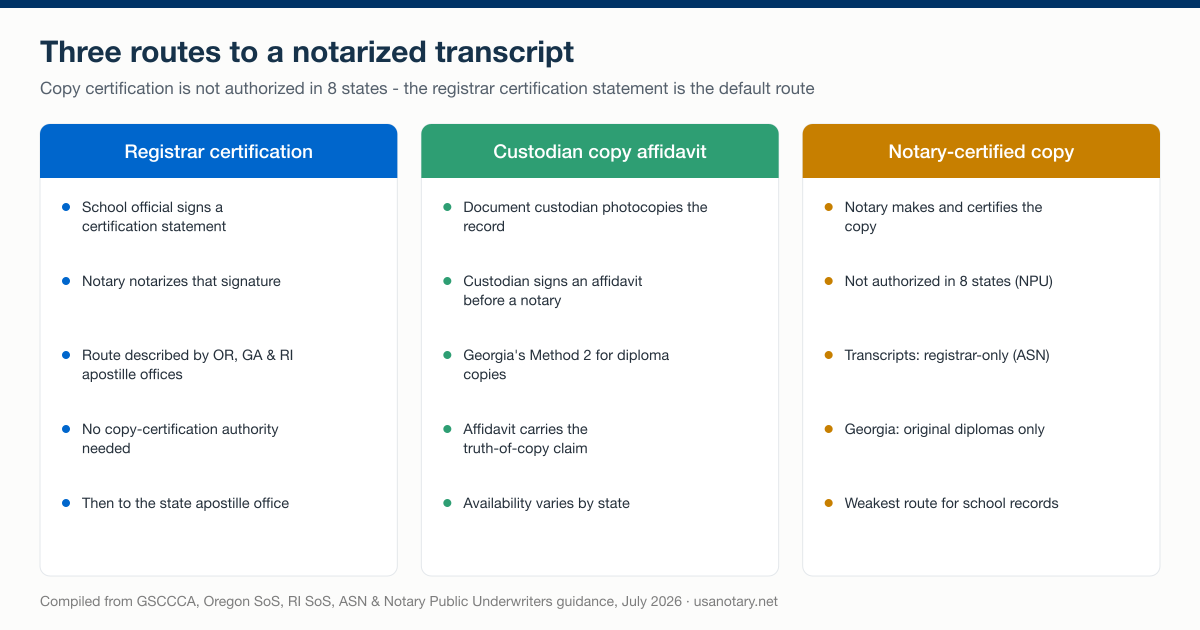
The three routes to a notarized academic record, compiled from GSCCCA, Oregon SoS, Rhode Island SoS, ASN, and Notary Public Underwriters guidance — July 2026.
How do you get a transcript notarized? The three routes
Three routes produce a notarized academic record, and they are not interchangeable — two of them fail in large parts of the country. Georgia’s apostille authority, the Superior Court Clerks’ Cooperative Authority (GSCCCA), documents all three in its school-documents instructions, which makes Georgia the cleanest reference set for seeing how the routes differ.
Route 1 — registrar certification (the default). A school official signs a statement vouching for the record, and the notary notarizes that signature. GSCCCA calls a letterhead letter “the simplest means”: the school writes a short letter on school letterhead “stating that attached are the official school documents for this student,” and a school official physically signs it in the presence of a notary. The alternate version skips the cover letter — the official signs the transcript itself in the notary’s presence, and per GSCCCA “the notary public must include the exact date of notarization as required by statute.”
Route 2 — document custodian copy. The person in possession of the original makes a photocopy and signs a sworn statement before a notary attesting it is a true copy. Georgia’s Method 2 for diploma photocopies works exactly this way: the document custodian makes the photocopy and signs a “Copy Certification by Document Custodian” affidavit in the presence of a Georgia notary. The notary, again, notarizes the custodian’s signature — the affidavit is what carries the truth-of-copy claim, not the notary’s certificate.
Route 3 — notary-certified copy. The notary personally makes the photocopy and certifies it as a true, correct, and complete copy of the original. Georgia allows this for diplomas — per GSCCCA, “any Georgia notary public can make a certified copy of an original diploma” — but this is the route with the most legal landmines, which is why it gets its own section next.
Which route you use is mostly decided for you. Apostille-bound transcripts run through Route 1 in every state instruction set reviewed for this guide. Route 2 exists mainly for diplomas and records where the holder, not the school, produces the copy. Route 3 survives only where state law authorizes the act and the document type allows it — and for transcripts specifically, it usually doesn’t.
Which route is legal in your state?
State law on copy certification — not preference — decides whether Routes 2 and 3 are available, and for transcripts the notary-copy route is closed almost everywhere. The American Society of Notaries states the rule without hedging: “You may not make ‘certified’ or attested copies of school records (transcripts). Only the school registrar has the authority to provide certified copies of student records.” A transcript is a student record under the school’s custody; the registrar’s certification is the only copy-certification that counts.
The state-level restrictions stack on top of that document-level rule:
| Route | Where it works | The catch |
|---|---|---|
| Registrar certification statement | The route described in every state apostille instruction reviewed here (Oregon, Georgia, Rhode Island; Pennsylvania requires the notarization it feeds) | A school official must sign in the notary’s presence — the student cannot substitute |
| Document custodian copy affidavit | Georgia offers it for diploma photocopies (Method 2); availability elsewhere depends on state law | The custodian swears to the copy; a transcript’s custodian is the school, not the graduate |
| Notary-certified copy | Georgia permits it for original diplomas | Eight states generally do not authorize notaries to certify copies of any document: Michigan, Mississippi, Nebraska, New York, North Carolina, Ohio, South Carolina, Tennessee (per Notary Public Underwriters) — and transcripts are registrar-only under ASN guidance everywhere |
Georgia shows how narrow Route 3 is even where it exists. The state’s official copy-certification certificate requires the notary to attest that “the original record is neither a public record nor a publicly recordable document, certified copies of which are available from an official source other than a Notary Public.” A diploma in the graduate’s hands clears that bar; a transcript — whose official source is the registrar — does not. That is why GSCCCA’s school instructions offer the notary-copy method for diploma photocopies only, and route transcripts through the school official’s signature every time.
Rhode Island adds one pragmatic middle path: if a document already bears an original school official’s signature but was never notarized, the RI Department of State notes a student may bring it to an RI notary for copy certification. The full national picture of when a notary can and cannot certify a copy — including the vital-records ban — is covered in our guide to state rules on notary-certified copies.
Step-by-step: registrar certification for an apostille
The registrar certification route runs in six steps, and steps two and three are where rejected packets go wrong:
- The school issues the record. Order the official transcript, or locate the original diploma. The registrar’s office is the document custodian — everything that follows hangs off its signature authority.
- A school official prepares the certification statement. The clean version is GSCCCA’s: a short letter on school letterhead stating that the attached documents are the student’s official school records. Georgia’s sample letter is signed “and sworn to (or affirmed)” — the official swears the statement is true, with identity checked against government-issued photo ID under O.C.G.A. § 45-17-8(e).
- The official signs in the notary’s presence. Every state instruction reviewed here requires it: Oregon requires the official’s signature “signed in the notary’s presence,” and Rhode Island requires the official to “physically sign the document in the presence of a RI notary public.” A pre-signed statement notarized after the fact is the classic rejection.
- The notary completes the notarial certificate. Oregon’s checklist for a compliant certificate: the jurisdiction, a “statement by school official (principal/registrar) as to the authenticity and type of document being notarized,” the notary’s own statement of who signed and when, the notary’s signature, and a “clear and legible imprint of the notary seal/stamp with the notary’s name, commission number and expiration date.” Rhode Island describes the finished product the same way — a document carrying two original signatures, the school official’s and the notary’s.
- The packet goes to the apostille office of the notarizing state. In Oregon that is the Secretary of State; in Georgia it is the GSCCCA, which the U.S. State Department has designated “as the only agency authorized to issue apostilles for documents originating in Georgia.” Fees are modest — $3.00 per document in Georgia, $15.00 per document in Pennsylvania.
- The destination country accepts the apostilled packet. Hague Convention members accept the apostille without further legalization; non-member countries need embassy legalization instead. Our explainer on what an apostille is and which countries accept one covers that split — and Oregon’s practical advice applies at every step: “check with an official of the destination country before getting school records certified and authenticated.”
Which state’s notary do you need?
The school’s own state’s notary is the safe default, and in at least one state it is the rule. Pennsylvania’s Department of State says it flatly on its document-certification page: “Diplomas, transcripts and criminal record checks must be notarized by a Pennsylvania notary public prior to requesting an apostille or certification.” Rhode Island’s school-documents instructions likewise specify an RI notary public. The logic sits in what an apostille does: per Pennsylvania, it authenticates “the authenticity of an official signature on a document; the capacity in which the person signing the document acted; and the identity of any stamp or seal affixed to the document” — and a state can only vouch for notary commissions it issued.
Here is what the state sources reviewed for this guide instruct:
| State | What its instructions say about notarizing school records |
|---|---|
| Oregon | School records office certifies to the record in the notary’s presence; the notarized transcript or diploma is sent to the Secretary of State for authentication/apostille |
| Pennsylvania | Diplomas and transcripts “must be notarized by a Pennsylvania notary public” before the apostille request; $15.00 per document |
| Rhode Island | School official must “physically sign the document in the presence of a RI notary public”; the finished document carries two original signatures |
| Georgia | GSCCCA is the only agency authorized to issue apostilles for Georgia documents; letterhead-letter or sign-the-record routes, before a Georgia notary; $3.00 per document |
| California | UCLA’s registrar notarizes only documents it issues and directs apostille seekers to the California Secretary of State for authentication |
The practical takeaway for a graduate abroad: don’t book a notary where you are. Ask the registrar which notary the school uses, and confirm the apostille office of the school’s state — the notarization is only as useful as the apostille office’s willingness to authenticate it.
Can the registrar complete the notarization remotely?
Remote online notarization fits this document unusually well, because the signer is the registrar — the graduate never signs anything on the registrar-certification route. NASS reports that “currently, 47 states and the District of Columbia have a law that allows for remote e-notarization,” which means the certification statement can, in most of the country, be signed and notarized over live video from the registrar’s own desk: no campus notary desk queue, no walk to a bank branch between transcript requests.
A remote session works the same way for this document as for any other. The registrar uploads the certification statement, completes identity verification (credential analysis plus knowledge-based authentication, run by a third-party identity service), and signs before a commissioned notary on camera. Sessions run 24/7 and take 15–30 minutes, and the output is a tamper-evident PDF with a complete audit trail; the audio-video recording and electronic journal entry are retained for 10 years or longer where state law requires. Records offices that field a steady stream of these requests can use staff-initiated workflows through our online notarization service for schools and universities — the registrar’s desk becomes the notary desk. The mechanics of a session, from upload to stamped PDF, are walked through in how to notarize a document online.
For the documents a graduate signs personally — a sworn degree-verification statement for a foreign employer, for instance — the same video session works from anywhere, and our guide to getting a document notarized from overseas covers the signer-abroad case in detail.
The apostille-office caveat
Two of the state instruction sets quoted above — Rhode Island’s and Georgia’s sample letter — say the official must “physically sign” in the notary’s presence, wording written for the walk-in era. Whether a particular state’s apostille office accepts a remotely notarized certification statement on a school record is the question to settle before the session, not after: call the apostille office, or have the registrar ask, and match the notary’s commission state to the school’s state where instructions require it.
Notarized vs. official vs. certified transcript: which one is being asked for?
Three different documents hide behind these labels, and requesters mix them up constantly — so pin down which one the destination actually needs before paying anyone:
- Official transcript. The registrar-issued record itself, carrying the school’s seal and security features. Domestic graduate schools and employers almost always mean this one. No notary is involved.
- Certified copy. A reproduction verified as matching the original. For student records, ASN’s guidance gives the registrar a monopoly: only the school registrar has the authority to provide certified copies. A notary-certified copy of a transcript is not a substitute anywhere.
- Notarized transcript. The official record plus a notarized certification statement from a school official. This is the version that feeds an apostille, because the apostille needs a signature chain to authenticate.
UCLA’s registrar illustrates the boundary in practice: its notary service covers only documents the office itself issues — “diplomas, official transcripts, and proofs of enrollment.” A school notarizes its own records; it will not notarize records from another institution, which is why each school in a multi-degree apostille packet gets its own certification statement.
What does it cost, and how long does it take?
The notarization is the cheapest and fastest link in the chain — the queue is what costs you. UCLA’s campus notary service, one of the few registrars publishing a benchmark, states that “processing takes up to one week, not including delivery time,” plus a special handling charge. The apostille itself is cheap at the state counter; the mail time on either side of it is not.
| Line item | Figure | Source |
|---|---|---|
| Campus notary desk processing (UCLA benchmark) | Up to one week, not including delivery; special handling charge applies | UCLA Registrar |
| Georgia apostille fee | $3.00 per document; walk-in service 9:00 a.m.–4:00 p.m. Mon–Fri | GSCCCA |
| Pennsylvania apostille/certification fee | $15.00 per document | PA Department of State |
| Remote online notarization of the certification statement | $25 per document; sessions 24/7, typically 15–30 minutes | usanotary.net |
For a single graduate, the arithmetic favors whichever notary the registrar can reach fastest. For a records office notarizing certification statements every week — international student offices and registrars at globally recruited universities do — the per-document math changes, and volume pricing applies past the first documents.
The registrar signs once — the chain does the rest
The rule that untangles every notarized-transcript request: the notary notarizes the school official’s signature, never the record’s contents. Get the certification statement signed in the notary’s presence, match the notary’s commission to the school’s state where the apostille office requires it, and send the packet to that state’s apostille office. Copy-certification shortcuts fail for transcripts in every state, and for all documents in eight of them — when in doubt, route through the registrar.
Records offices that want the notary step handled from a desk instead of a queue can talk through a staff-initiated workflow: call 804-767-7500 or reach us here.