
Can a notary certify a copy of a document?
It depends on your state. Copy certification — also called an attested copy, certified photocopy, or “true copy” notarization — is a notarial act in which a notary certifies that a photocopy is a true, complete, and accurate reproduction of an original document. Some states authorize notaries to perform it; many restrict it or don’t allow it at all. Because the authority is granted state by state, the first question is always whether your state permits notarial copy certification in the first place — not whether the copy itself looks accurate.
Copy certification is a distinct act from the two you meet most often. It is not an acknowledgment, where a signer acknowledges signing, and it is not a jurat, where a signer swears the contents are true and signs in front of the notary. In fact, copy certification is unusual among notarial acts because it often involves no signer at all — the notary is vouching for a document reproduction, not a signature. If you are still sorting out those building blocks, our guide to what “notarized” actually means covers them first.
What copy certification actually verifies
A copy certification verifies exactly one thing: that the copy matches the original the notary examined. Washington’s official notary guide puts it plainly — a notary who certifies or attests a copy “is verifying that the document in question is an exact copy of another document,” and under RCW 42.45.030(4) must determine the copy is “a full, true, and accurate transcription or reproduction.” Washington’s guidance even recommends the notary make the photocopy personally to be sure that standard is met.
The act says nothing about whether the underlying document is genuine, legally valid, or truthful. A notary can copy-certify a contract without knowing whether the contract is enforceable, just as an acknowledgment verifies identity rather than a document’s contents.
Copy certification also has a home in the model law many state notary statutes are drawn from. The Revised Uniform Law on Notarial Acts (RULONA), published by the Uniform Law Commission, includes certifying or attesting a copy among authorized notarial acts. Pennsylvania — a RULONA state since October 26, 2017 — lists “certify or attest a copy or deposition” among a notary’s powers and states that a notary who certifies a copy “shall determine that the copy is a complete and accurate transcription or reproduction of the record or item,” per the Pennsylvania Department of State. So in RULONA states, copy certification is generally an authorized act; in non-RULONA states, authority ranges from broad to nonexistent.
Certified copy vs. notarized copy: not the same thing
The terms get used interchangeably, but they describe two different products from two different issuers. Cornell Law School’s Legal Information Institute defines a certified copy as a duplicate of an original document “endorsed by a governmental or independent agency” to verify its authenticity — and notes directly that “a certified copy is not notarized.” An agency-certified copy of a death certificate, for example, is what banks require to release a deceased person’s funds.
| Agency-certified copy | Notary-certified copy | |
|---|---|---|
| Who issues it | The government office or institution that holds the original (vital records office, court clerk, registrar) | A notary public, in states that authorize copy certification |
| What it proves | The copy matches the official record on file | The copy matches the original the notary examined |
| Typical documents | Birth, death, and marriage certificates; court records; recorded deeds | Personal papers: contracts, letters, and (in some states) powers of attorney |
| Where required | Probate, passports, benefits claims, estate settlement | Whenever a receiving party accepts a notarized copy |
| Availability | Every jurisdiction issues them | Only in states whose law permits the act |
The practical rule: when a receiving party asks for a “certified copy” of a government record, they almost always mean the agency-issued kind. A notarized copy is not a substitute unless the receiving party says it is.
Which documents a notary generally can’t copy-certify
Even in states that allow copy certification, one category is almost universally off-limits: vital and public records. The National Notary Association (NNA) states the rule plainly — “as a general rule, Notaries cannot certify copies of birth, death or marriage certificates because these documents are vital records.” An original vital record is kept by the public office that recorded it, and that office is normally the only authority allowed to issue certified copies. California writes the same rule into statute: under Health and Safety Code section 103545, certified copies of birth, fetal death, death, and marriage records may be made only by the State Registrar, duly appointed local registrars, and county recorders — never a notary.
The same logic reaches other government-held records, and the American Society of Notaries (ASN) fills in the specifics in its copy certification guidance: school transcripts can be certified only by the school’s registrar; a tax return that has already been filed belongs to the IRS, which issues its own certified copies; and ASN recommends declining requests to copy-certify Social Security cards. Federal immigration papers go a step further — Notary Public Underwriters warns that “it is illegal to make unauthorized copies of certain federal immigration documents,” including naturalization certificates, regardless of any certification.
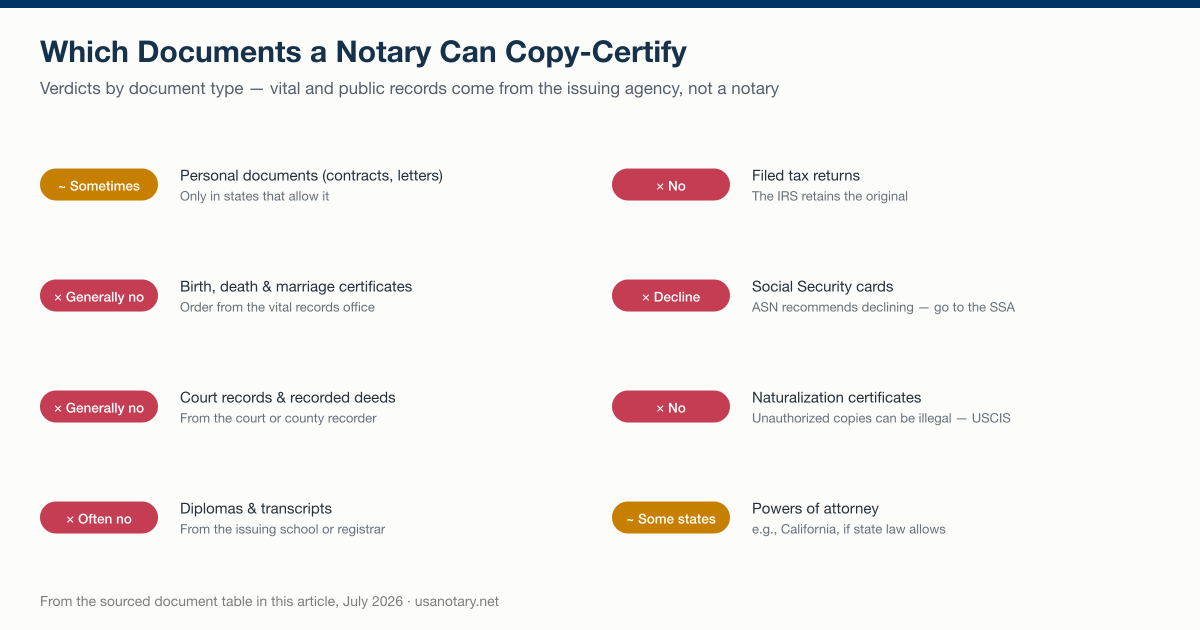
Whether a notary can certify a copy of each document type, from the sourced table in this article, July 2026.
| Document type | Can a notary certify a copy? | Where to go instead |
|---|---|---|
| Personal documents (contracts, letters) | Sometimes — only in states that allow it | Confirm your state’s rule first |
| Birth / death / marriage certificates | Generally no — vital records | The state or county vital records office |
| Court records and recorded deeds | Generally no | The court or county recorder that holds the original |
| Diplomas and transcripts | Often no | The issuing school or registrar |
| Filed tax returns | No — the IRS retains the original | Request a certified copy or transcript from the IRS |
| Social Security cards | ASN recommends declining | The Social Security Administration |
| Naturalization certificates | No — unauthorized copies can be illegal | USCIS |
| Powers of attorney | Yes in some states (e.g., California) | Your notary, if state law allows |
The safe default: if a public agency issued the document and can reissue a certified copy, a notary usually cannot certify a copy of it.
Which states restrict or prohibit copy certification
Authority varies sharply by state, so a copy that is valid in one state may be impossible to obtain from a notary in the next. State rules fall into rough tiers:
| Tier | What the state allows | Examples (as reported by the cited guidance) |
|---|---|---|
| Broad authority | Copy certification of most non-public documents | RULONA states such as Pennsylvania and Washington |
| Vital-records carve-out | Copies allowed, but vital records explicitly excluded | Arkansas, Colorado, Connecticut, Florida, Kansas, Pennsylvania, Texas (per the NNA) |
| Recordable-document bans | No copies of documents that could be publicly recorded | Arizona, Texas, Georgia (per the NNA) |
| Narrow authority | Only specific document types | California (powers of attorney; notary’s own journal entries) |
| No authority | Notaries may not certify copies of any document | Michigan (per the NNA); Notary Public Underwriters lists eight states in total |
Drawing on the fetched guidance behind that table:
- States that prohibit certifying copies of vital records (while allowing other copies): the NNA lists Arkansas, Colorado, Connecticut, Florida, Kansas, Pennsylvania, and Texas as states that explicitly prohibit notaries from certifying copies of vital records, though they permit certifying copies of other types of documents.
- States that don’t allow notarial copy certification at all: the NNA notes that some states, such as Michigan, do not permit notaries to certify copies of any documents. Notary Public Underwriters’ March 2026 guidance counts eight states that disallow the act entirely: Michigan, Mississippi, Nebraska, New York, North Carolina, Ohio, South Carolina, and Tennessee.
- States that block recordable documents: Arizona and Texas prohibit certifying copies of any recordable document; Georgia prohibits copy certification of publicly recordable documents such as divorce decrees and university transcripts. If a document is potentially recordable, it usually can’t be copy-certified even if you never intend to record it. Georgia builds the restriction into its official certificate: the Georgia Superior Court Clerks’ Cooperative Authority form has the notary certify that “the original record is neither a public record nor a publicly recordable document, certified copies of which are available from an official source other than a Notary Public.”
- Narrow-authority states: California notaries may only certify copies of powers of attorney, or copies of the notary’s own journal entries if requested by the Secretary of State or a court. For a power of attorney, the California Notary Public Handbook has the notary examine the original and the copy and certify that “the copy is a true and correct copy of the original power of attorney.”
- Extra-procedure states: Notary Public Underwriters reports that West Virginia adds requirements on top of authorization — a written certification request, confirmation that a public-record version isn’t available, legal-compliance verification, and document retention by the notary.
State legislatures amend notary law regularly, so treat any list — including this one — as a starting point and confirm the current rule with your state’s notary authority before relying on it.
How copy certification works where it’s allowed
In states that authorize the act, the procedure is short but strict. Synthesizing the Washington and ASN guidance, a compliant copy certification looks like this:
- The original is presented. The notary must work from the original document, not from a copy of a copy. As ASN puts it, “you cannot take someone else’s word that a photocopy is ‘true,’ no matter how trustworthy that person may be.”
- The notary makes or verifies the copy. Washington’s guide recommends the notary make the photocopy personally; other states allow comparing an existing copy against the original, line by line.
- The notary completes a copy-certification certificate. Not a stamp and signature alone — ASN warns that “you cannot just write ‘true copy’ on the photocopy and put your seal on it.” Washington’s certificate reads: “I certify that this is a true and correct copy of a record in the possession of [name],” followed by the date, signature, stamp, title, and commission expiration.
- The certificate is attached and the act is recorded. The certificate should describe the document (title, date, page count) so it can’t be detached and misused, and the act goes in the notary’s journal or recordbook where one is required.
Fees are capped by state law like any other notarial act. California’s cap is concrete: Government Code section 8211 sets the maximum fee for certifying a copy of a power of attorney under Probate Code section 4307 at $15. Under that Probate Code section, a notary-certified copy of a power of attorney “has the same force and effect as the original power of attorney” — one of the few places where a notarized copy carries statutory weight equal to the original. If the underlying document still needs to be signed and notarized first, our walkthrough of how to notarize a document covers that process end to end.
The alternative: copy certification by the document custodian
Where a notary can’t certify a copy directly, there’s a widely used workaround. The person who holds the original — the custodian — signs a statement swearing the copy is a complete and accurate reproduction, and the notary notarizes that sworn statement as a jurat. In this pattern the custodian certifies the copy; the notary certifies only that the custodian swore to it. It’s the same jurat structure explained in our breakdown of how a jurat differs from an acknowledgment — the signer swears the contents are true and signs in front of the notary.
The steps mirror an ordinary jurat:
- The custodian photocopies the original document they hold.
- The custodian writes or completes a statement affirming the copy is true, complete, and accurate.
- The custodian appears before a notary, who verifies identity and administers the oath or affirmation.
- The custodian signs the statement in the notary’s presence, and the notary completes the jurat certificate.
California puts a version of this into statute. Under its Tangible Copy Certification rule (Government Code section 27201.1), a “disinterested custodian” — a person who is not a grantee, beneficiary, or someone who directly benefits from the record — may certify that a tangible copy is a complete and accurate reproduction of an electronic record, including documents notarized via remote online notarization. The certification “shall be subscribed and sworn to, or affirmed, by the disinterested custodian before a notary public” and accompanied by a jurat. The custodian certifies, under penalty of perjury, that the printout is accurate, that the electronic record displayed intact tamper-evident security procedures, and that nothing changed after the record was created, executed, or notarized. The purpose there is narrow — letting an electronically notarized document be recorded in California’s real property records — but it shows the structure clearly: the custodian swears, the notary completes a jurat.
One important limit applies to every version of this method: a custodian can only swear to a copy of a record they legitimately hold. A signer cannot swear that a copy of a vital record is a true copy, because the official original is held by the recording office, not the signer — for those, order an agency-certified copy from the source.
Certifying copies of IDs, passports, and recordable documents
Requests to copy-certify a driver’s license or passport are common — and the answer is still governed by state law. Georgia, for instance, allows copy certification of a U.S. passport but requires the passport holder to provide an affidavit. On driver’s licenses, the American Society of Notaries reports that Michigan, Texas, and Wisconsin prohibit the practice outright, and it cautions notaries never to make color copies of passports or visas. Where a notary can’t certify the copy directly, the holder can often swear a custodian statement instead — the ID holder is, after all, the custodian of their own ID.
Recordable documents carry their own trap: in states like Arizona, Texas, and Georgia, the question isn’t whether you plan to record the document but whether it could be recorded — divorce decrees and deeds fail that test even sitting in a drawer. And before you rely on a notarized copy of an ID for an employer, court, or foreign agency, confirm both that your state permits it and that the receiving party will accept a notarized copy rather than an agency-issued one. Documents heading abroad often need a further layer of authentication on top of notarization — our guide to what an apostille is explains when that applies.
Can you get a copy certified online?
Whether a copy can be certified through remote online notarization depends on two separate questions: does your state authorize notarial copy certification (or custodian copy certification) at all, and does its remote online notarization law cover that act? Remote online notarization is a legally valid consumer service in all 50 states, but the underlying commissioning law is set per state, and not every state authorizes every notarial act online.
The custodian route travels especially well online, because it’s structurally just a jurat — an act most remote-notarization laws support. California’s tangible copy certification statute even anticipates the pairing, since its whole purpose is putting remotely notarized electronic records on paper for county recording.
For acts that are supported, an online session works the way any notarization does: the signer appears on live video before a commissioned notary and completes the act — on USA Notary, online notarization costs $25 per document. If you need a document sworn or acknowledged online, you can start a remote online notarization session and see whether your document type is supported. USA Notary provides notary services and does not decide which agency-issued records you must instead order from the source.
What to do
- Check your state first. Confirm whether notarial copy certification is allowed and whether your document type is excluded — the rule varies from “yes for most documents” to “no documents at all.”
- For vital and public records, go to the source. Order a certified copy from the vital records office, court, or registrar that holds the original.
- If a notary can’t certify it, use custodian certification. The person holding the original swears the copy is true and complete before a notary, completed as a jurat.
- Ask the receiving party what they accept. Some agencies require an agency-issued certified copy and will not accept a notarized copy at all.
- For a supported act, consider doing it online. If your state authorizes the act remotely, you can handle it over live video instead of finding a notary in person.
To go deeper on the underlying acts, compare a jurat and an acknowledgment, or start with the basics of what a notarization actually proves.