
A notary public occupies a narrow, well-defined role in immigration paperwork — and the gap between what people expect and what a notary is legally allowed to do is where real harm happens. This guide draws the line precisely: which documents a notary legitimately notarizes, which USCIS forms need no notary at all, and why the word “notario” has cost some immigrants their cases.
What a notary can and can’t do for immigration paperwork
A notary public verifies identity and witnesses signatures. That is the entire office. Applied to immigration paperwork, the line looks like this:
| A notary CAN | A notary CANNOT |
|---|---|
| Notarize an affidavit or sworn statement a recipient asks for | Tell you which immigration forms to file, or when |
| Notarize a relative’s support or character-reference letter | Give advice about your immigration case or options |
| Notarize a child travel consent form | Prepare immigration forms while claiming immigration expertise |
| Notarize the translator’s signature on a translation certification | Certify that a translation is accurate |
| Notarize documents headed abroad before apostille | Represent you before USCIS or an immigration court |
| Administer oaths and take acknowledgments | Guarantee an outcome, or charge for legal services |
Everything in the right-hand column is the practice of law. USCIS is blunt about who can cross that line: an authorized legal representative must be a licensed attorney in good standing, or a representative accredited by the Department of Justice working for a DOJ-recognized organization. Nobody else — and that includes every notary public in the country acting as a notary.
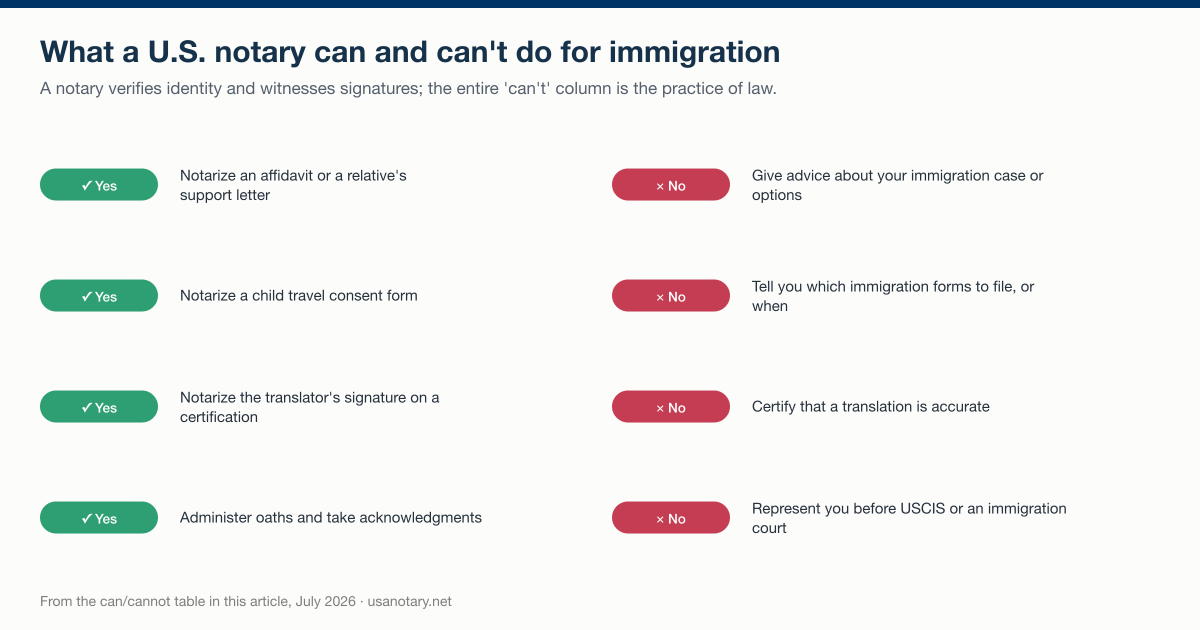
The can/cannot line drawn by this article’s sourced table, July 2026.
Do USCIS forms need to be notarized?
Mostly, no. USCIS forms rely on a different legal mechanism entirely: the signature under penalty of perjury. Signing the form is itself the sworn act — no notary required.
Form I-864, the Affidavit of Support, is the clearest example, because “affidavit” in its name leads many sponsors to assume a notary is involved. It isn’t. The current Form I-864 (Edition 10/17/24) has the sponsor sign a declaration stating “I certify, under penalty of perjury, that all of the information in my affidavit and any document submitted with it were provided or authorized by me” — and across all twelve pages of the form, there is no notary section, seal block, or notarization instruction at all. A false statement is punished as perjury, which is exactly the deterrent a notarial oath would provide.
The practical rule: before paying to notarize any USCIS form, read that form’s official instructions on uscis.gov. If the instructions don’t ask for notarization — and for most forms they don’t — a notarization adds nothing. This page can’t tell you what any specific form requires for your case; the form’s own instructions, or an attorney, can.
Where a notary does enter the picture is the supporting documents around a case — sworn statements from relatives, consent forms, personal letters a recipient wants sworn. Those are covered below.
The “notario público” trap
The most important thing to know about a notary for immigration isn’t a service — it’s a warning. In many Latin American countries, “notario público” refers to a powerful attorney with special legal credentials. In the United States, the same words describe someone with no legal training requirement beyond a state commission. USCIS lists “notarios públicos” among its common immigration scams and states directly: “A notario público is not authorized to provide you with any legal services related to immigration. Only an attorney or an accredited representative working for a Department of Justice (DOJ)-recognized organization can give you legal advice.”
The Florida Bar — one of several state bars that publishes consumer guidance on this exact confusion — spells out the stakes: in Latin American countries, the notary public must be a lawyer, while a Florida notary needs only a one-time three-hour education course. Its pamphlet adds that some people “have been harmed after mistakenly seeking legal assistance from notaries,” and that “incorrect advice can even begin or accelerate a deportation process.” Under Florida law, violating the statute that sets the requirements for a notary commission is a felony.
Three red flags that a “notario” is operating outside the law:
- They choose or recommend forms. Deciding which forms to file and when is legal advice. A notary witnesses your signature on documents you bring — nothing more.
- They charge large fees for “immigration counseling.” Notary fees are modest and, in some states including Florida, set by statute. A big fee signals legal services the person cannot lawfully provide.
- They advertise as “notario público” to Spanish speakers. Some states restrict this outright — Florida requires non-English ads to carry a disclaimer that the notary is not an attorney and may not give legal advice.
If you need help with your case itself, use the Department of Justice’s list of accredited representatives and recognized organizations or a licensed immigration attorney — USCIS’s Find Legal Services page links to both.
Immigration-adjacent documents a notary legitimately notarizes
Inside its lane, notarization is genuinely useful in an immigration case. The pattern in every example below is the same: the recipient — an attorney assembling a case, a court, a consulate, a foreign authority — asks for a sworn, notarized document, and the notary verifies the signer’s identity and witnesses the signature.
- Support and character-reference letters. A relative or friend writes a letter — about financial support, the genuineness of a marriage, or the writer’s knowledge of the applicant’s character — and the recipient asks that it be sworn. The notary administers the oath and notarizes the writer’s signature; the content stays entirely the writer’s own. Our guide to getting a letter notarized covers the format recipients expect.
- Proof-of-relationship and other personal affidavits. Sworn statements from people with first-hand knowledge — how long a couple has lived together, that a person has resided at an address — take the form of a notarized affidavit. The mechanics are in our walkthrough of how to notarize an affidavit.
- Child travel consent forms. When a minor travels internationally with one parent or a guardian, border officials commonly expect a notarized consent form from the non-traveling parent.
- Translation certifications, where a recipient requires it. The notary notarizes the translator’s signature on their certification — see the next section for why that distinction matters.
- Documents headed abroad. Powers of attorney, civil-status affidavits, and similar documents destined for a foreign country are often notarized first and then authenticated with an apostille — our explainer on what an apostille is picks up from there.
Certified translation vs. notarized translation
These two terms get conflated constantly, and USCIS’s own requirement is the anchor. For documents submitted to USCIS in a foreign language, the Form I-864 instructions state the standard: “The translator must sign a certification that the English language translation is complete and accurate, and that they are competent to translate from the foreign language into English.” That is a certification — the translator’s signed statement. No notary appears in the requirement.
| Certified translation | Notarized translation | |
|---|---|---|
| Who acts | The translator signs a certification | A notary notarizes the translator’s signature on that certification |
| What it attests | The translation is complete and accurate; the translator is competent | The translator’s identity — NOT the translation’s accuracy |
| USCIS requirement | Yes, for foreign-language documents | No |
| Who typically asks for it | USCIS, most U.S. recipients | Some foreign consulates, universities, and authorities abroad |
The precision matters in both directions. Paying to notarize a translation bound for USCIS buys nothing the certification didn’t already provide. And when a recipient does ask for a “notarized translation,” what they mean is the translator’s signature notarized on the certification — a notary cannot certify that a translation is accurate, because vouching for content is outside the notarial office.
How to notarize an immigration-support document online
When a recipient asks for a notarized affidavit, support letter, or consent form, remote online notarization completes it without an office visit — which solves the most common logistical snag in immigration paperwork: the signer who lives in another state than the person assembling the case. A relative writing a support letter from across the country can complete the notarization from home; family members outside the United States can often notarize remotely as well, with U.S.-specific conditions worth reading first.
- Confirm with the recipient that a remotely notarized document is accepted, and whether any specific wording is required.
- Upload the signed-ready document — the affidavit, letter, or consent form, complete except for the signature.
- Verify your identity on a recorded video session; the platform verifies identity before the notary witnesses the signature.
- Sign before the commissioned notary. Sessions run 15–30 minutes, are available 24/7, and cost $25 per document.
- Receive the tamper-evident notarized PDF with its digital audit trail — the session produces both, and the recipient can verify the notarization from them.
One boundary worth restating at the end, because it is the whole point: an online notary is still a notary. The session verifies identity and witnesses a signature — it does not, and cannot, include advice about your immigration case. For that, use a licensed attorney or a DOJ-accredited representative.