
What is an owner-builder affidavit?
An owner-builder affidavit is the sworn disclosure a property owner signs — and files with a building-permit application — to act as their own general contractor without holding a contractor’s license. State contractor-licensing laws all reserve construction work for licensed contractors, and each carves out an exemption for owners building on their own property. The affidavit is the paperwork gate of that exemption: the permit office will not issue an owner-builder permit until the owner has certified, in writing, that they qualify and that they accept the legal responsibilities a licensed contractor would otherwise carry.
The document wears different names from one permit counter to the next. Palm Beach County, Florida calls it the Owner/Builder Affidavit & Disclosure Statement Form. Nevada issues a statewide Owner Builder Affidavit of Exemption through its State Contractors Board. Florida’s statute simply calls it a “disclosure statement.” Whatever the label, the substance is the same: you certify that you are building or improving the property for your own use and occupancy, not for sale or lease, and you initial a list of obligations that make you — not a contractor — the responsible party on the permit.
Two of the states covered in this guide write the disclosure duty directly into statute. Florida requires the local permitting agency to provide a disclosure statement “in substantially the following form” under Fla. Stat. § 489.103(7), and the owner signs it as part of the permit application. Nevada’s NRS 278.573, reproduced on the Contractors Board form, requires the building official who issues a residential permit to an owner to deliver a statement of restrictions — and the owner “shall acknowledge in writing receipt of the statement.”
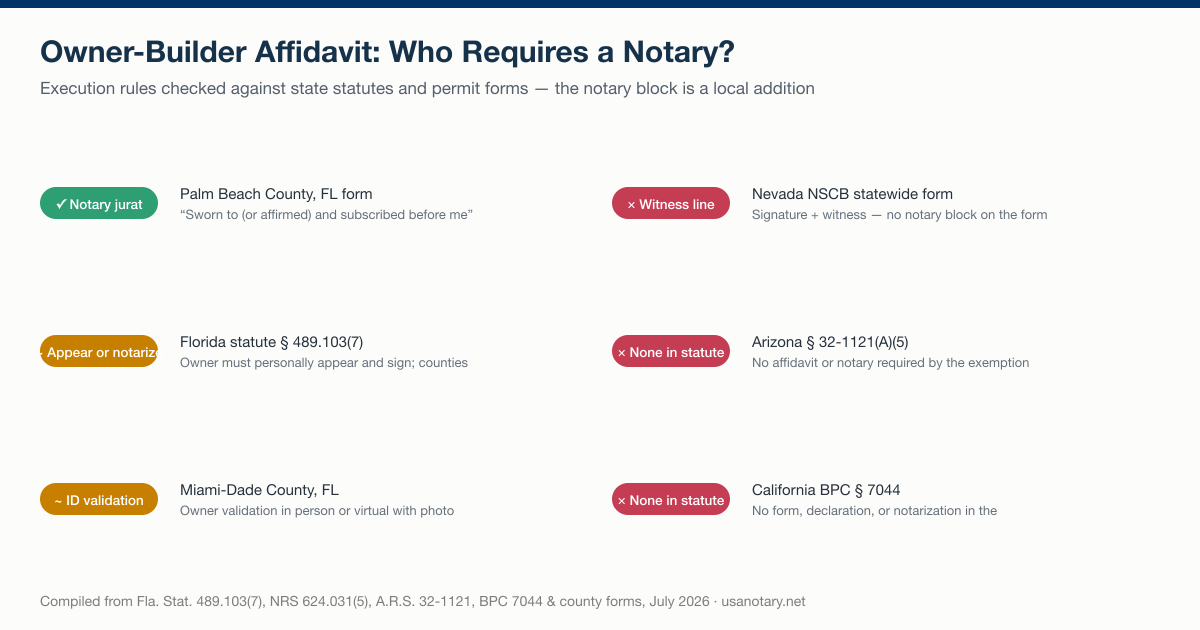
Execution requirements on owner-builder affidavits, re-checked in October 2026 against the statutes and permit forms cited in this article — the notary block is a local addition, not a statutory rule.
Does an owner-builder affidavit need to be notarized?
Notarization is required by many county and city permit offices — but rarely by the state statute that creates the owner-builder exemption. That split is the single most useful thing to understand about this document, because it means the answer lives on your local form, not in a statewide rule.
The Florida example makes the split concrete. The disclosure statement prescribed inside § 489.103(7) ends with nothing more than a signature line and a date — no notary certificate appears anywhere in the statutory form. The statute’s closing paragraph does name “the notarized signature of the property owner” as one acceptable verification when the permit is issued, alongside a copy of a driver license or “other type of verification acceptable to the local permitting agency,” so the local office chooses which one it wants. Yet Palm Beach County’s version of the same disclosure closes with a full Florida jurat: “Sworn to (or affirmed) and subscribed before me this ___ day of ___,” followed by the notary’s signature, commission stamp, and a record of whether the signer was personally known or produced identification. The county turned a statutory disclosure into a notarized affidavit.
Nevada went a different direction with the same document. The Contractors Board’s statewide Owner Builder Affidavit of Exemption — the form Las Vegas Building & Safety distributes to applicants — ends with the owner’s signature, printed name, and a witness line. No notary block appears on it. Arizona and California sit at the far end of the spectrum: A.R.S. § 32-1121(A)(5) and Cal. Bus. & Prof. Code § 7044 create owner-builder exemptions without requiring any affidavit, declaration, or notarization in the statute itself — whatever form you sign at an Arizona or California permit counter is a local requirement layered on top.
What the notary block on the affidavit actually is
The notary block on a form like Palm Beach County’s is a jurat — the notarial act in which you swear (or affirm) to the truth of the document’s contents before the notary, rather than merely acknowledging your signature. The distinction matters because a jurat puts you under oath: the Palm Beach form states plainly that “any falsification of the above statements constitutes fraud and may result in revocation of this permit.” Our guide to the difference between a jurat and an acknowledgment covers why permit offices choose the sworn version for this document — an owner-builder affidavit is a set of factual promises about occupancy, supervision, and employment, and the oath is what gives those promises teeth.
Why permit offices add a notary the statute doesn’t mention
Identity and accountability drive the local notary requirement. Florida’s statute requires that “an owner must personally appear and sign the building permit application” to qualify for the exemption — and the statute’s own carve-out for solar projects shows what the appearance requirement is interchangeable with, waiving “an owner’s notarized signature or personal appearance to sign the permit application” for electronically submitted solar permits. Appearing at the counter and swearing before a notary are two routes to the same assurance: the permit office knows the actual owner, not someone else, took on the exemption.
The accountability problem is real enough that the disclosure language warns about it. Palm Beach County’s form has the owner attest: “I understand that it is a frequent practice of unlicensed persons to have the property owner obtain an owner-builder permit that erroneously implies that the property owner is providing his or her own labor and materials.” An unlicensed contractor who talks a homeowner into pulling an owner-builder permit shifts every legal duty — and every injury claim — onto the homeowner. A sworn, identity-verified signature is the county’s defense against that arrangement, and the homeowner’s warning flag.
What are you swearing to on an owner-builder affidavit?
The affidavit commits you to five things: owner occupancy, a no-sale window, direct supervision, licensed subcontractors, and employer obligations for anyone unlicensed you put to work. The wording varies by jurisdiction, but the five commitments appear across the Florida statutory disclosure, the Palm Beach County form, and the Nevada Contractors Board form with striking consistency:
- Own use and occupancy. The building or residence must be for your own use or occupancy — “It may not be built or substantially improved for sale or lease,” in the words of Florida’s disclosure. Nevada’s affidavit opens with the owner certifying they are “building or improving a residential structure on this property for my own occupancy and do not intend to sell or lease the property.”
- The no-sale window. Florida’s disclosure states that if a building you built or substantially improved yourself “is sold or leased within 1 year after the construction is complete, the law will presume that I built or substantially improved it for sale or lease, which violates the exemption.” Nevada’s NRS 624.031(5), quoted on the affidavit itself, makes a sale, lease, or offering within 1 year after completion a rebuttable presumption of intent to sell. Arizona’s § 32-1121(A)(5) treats sale or rent within one year after completion or issuance of a certificate of occupancy as “prima facie evidence” the project was undertaken for sale or rent.
- Direct supervision. Palm Beach County has the owner attest to providing “direct, onsite supervision of the construction.” Nevada’s form puts it as an initialed obligation: “I must directly supervise the construction.”
- Licensed subcontractors only. Both states bar outsourcing the contractor role: “I may not hire an unlicensed person to act as my contractor, agent, or construction manager” (Nevada); “I may not hire an unlicensed individual person to act as my contractor or to supervise persons working on my building or residence” (Palm Beach County). Any subcontractor on a Nevada owner-builder project must hold a Nevada State Contractors Board license.
- Employer obligations. Any unlicensed person working on the project must be your direct employee — which the Florida disclosure spells out as complying “with laws requiring the withholding of federal income tax and social security contributions under the Federal Insurance Contributions Act (FICA)” and providing “workers’ compensation for the employee.” Nevada’s version adds industrial insurance coverage and unemployment-compensation contributions.
Initialing each of those lines is not a formality. It converts you, legally, into the general contractor of record — with a contractor’s exposure and none of a contractor’s insurance.
The injury-liability warning
Financial risk from worker injuries is the sharpest edge in the disclosure. Palm Beach County’s form makes the owner attest: “I, as an owner-builder, may be held liable and subjected to serious financial risk for any injuries sustained by an unlicensed person or his or her employees while working on my property. My homeowner’s insurance may not provide coverage for those injuries.” That sentence is why permit offices insist the owner — informed, identified, and under oath — signs personally. The affidavit is as much a warning label as it is an application document.
What projects the exemption covers
Project limits are written into the exemption, and they are narrower than most owners expect. Florida’s § 489.103(7) covers one-family or two-family residences and farm outbuildings, plus commercial buildings “at a cost not to exceed $75,000” — Palm Beach County’s form phrases the commercial cap as $75,000 or less in value within any 12-month period. Miami-Dade narrows the commercial lane further on its owner-builder permits page: a one-story building or addition of 500 square feet or less, or repairs up to $5,000, and the property must be held in a person’s name — not a company or trust. Nevada’s exemption reaches only residential structures the owner will occupy.
How do owner-builder affidavit rules differ by state?
State statutes set the exemption; local permit offices set the paperwork. The table below compares the four states covered by the sources this article is checked against — note that the notarization column reflects the forms, not the statutes:
| State | Exemption statute | Affidavit / disclosure required? | Notary on the form? | Sale/lease presumption |
|---|---|---|---|---|
| Florida | Fla. Stat. § 489.103(7) | Yes — statute requires the local permitting agency to provide a disclosure statement the owner signs | Statutory form: signature + date only. County forms vary — Palm Beach County adds a full jurat | Presumed built for sale if sold or leased within 1 year after construction is complete |
| Nevada | NRS 624.031(5) | Yes — Owner Builder Affidavit of Exemption filed with the building department; owner must apply to the Contractors Board for the exemption | No — signature + witness line on the statewide form | Sale, lease, or offering within 1 year after completion creates a rebuttable presumption |
| Arizona | A.R.S. § 32-1121(A)(5) | Not in the statute — local permit offices set their own forms | Not required by statute | Sale or rent within 1 year after completion or certificate of occupancy is prima facie evidence of intent |
| California | Bus. & Prof. Code § 7044 | Not in the statute — no form, declaration, or notarization requirement appears in § 7044 | Not required by statute | Sale or offering within 1 year after completion creates a rebuttable presumption |
Two patterns are worth pulling out of the table. First, every one of these states polices the same abuse — building “for your own use” and then flipping the property — with a one-year presumption, even though the affidavit paperwork differs completely. Second, the notarization requirement never comes from the exemption statute. Where an owner-builder affidavit is required to be notarized, a county form, city form, or permit-office policy is the source, which is why the honest answer to “does it need to be notarized?” is always: read the execution block on your jurisdiction’s form.
Same statute, different counters: Palm Beach vs. Miami-Dade
Florida’s two largest permit markets show how much room local offices have under one statute. Palm Beach County prints “OWNERS MUST PERSONALLY APPEAR AT THE BUILDING DEPARTMENT TO SIGN THIS DOCUMENT” across its affidavit and closes the form with a notary jurat. Miami-Dade runs an owner validation step instead — completed “in-person or virtual” with photo ID and proof of primary residence — and requires a digitally signed and sealed set of plans from a design professional. Miami-Dade’s disclosure also warns owners about sales “within 24-months of permit issuances,” a stricter horizon than the statute’s 1-year-after-completion presumption. The lesson for anyone permitting in Florida: the statute tells you whether you qualify, but only the county tells you how the affidavit is executed.
Miami-Dade adds one more trap for owner-builders: projects over $2,500 need a recorded Notice of Commencement before work begins — a separate document with its own execution rules.
How to notarize an owner-builder affidavit online
An owner-builder affidavit can be notarized online in the 47 states and the District of Columbia that the National Association of Secretaries of State reports have a law allowing remote e-notarization — provided your permit office accepts a notarized affidavit in place of signing at the counter. The legal footing for a video-session notarization is the same as for any other sworn document, and we cover it in depth in our guide to whether online notarization is legally recognized.
Remote notarization earns its keep on this document in three specific situations:
- The out-of-state owner. Florida permit offices process owner-builder applications for second-home and investment-property owners who live elsewhere. Where the county accepts a notarized affidavit and disclosure rather than a counter appearance, an online session completes the jurat without a flight.
- Co-owners on the deed. When the property is titled in two names, some offices want both owners on the affidavit. A multi-signer session puts both signers in front of the notary at once — even from different cities.
- The permit-appointment deadline. Permit counters run on appointment calendars; a missing notarization is the kind of defect that costs a slot. A remote session can often be booked and completed the evening before the appointment, so a missing jurat need not cost you the slot.
The session itself follows the standard remote-notarization sequence:
- Upload the county’s own form. The notary notarizes your signature on the form your permit office prescribes — the form is not redrafted or altered.
- Verify your identity. Identity verification runs before the session through credential analysis of your government ID plus knowledge-based authentication — a stronger check than the “personally known or produced identification” line on a paper jurat.
- Swear and sign on live video. A commissioned notary administers the oath — this is a jurat, so the oath is part of the act — and watches you sign.
- File the notarized PDF with your permit application. The completed affidavit comes back as a tamper-evident PDF with a complete audit trail. Where state law sets a retention rule, the audio-video recording and electronic journal are kept for the period the statute prescribes — Florida, for example, requires the online notary and the RON provider to maintain both “for at least 10 years after the date of the notarial act” under Fla. Stat. § 117.245(4).
The mechanics match any sworn document — our walkthrough on how to notarize an affidavit covers preparation in detail. Notarization costs $25 per document, with volume pricing for businesses that handle permit packages routinely. Builders, developers, and permit-expediting services that shepherd owner-builder applications alongside their own paperwork can set up business-initiated sessions through our online notarization service for the construction industry.
Call the permit office before you book anything
One honest caveat governs everything above: some offices require the owner at the counter, full stop. Florida’s statute says an owner “must personally appear and sign the building permit application,” and Palm Beach County applies that rule to the affidavit itself. Other offices — Miami-Dade’s virtual owner validation is the visible example — have moved identity checks online. Before scheduling a remote session, ask your permit office one question: do you accept a notarized owner-builder affidavit and disclosure statement submitted with the application, or must the owner sign at the counter? The answer decides whether online notarization saves you a trip or merely a signature.
The affidavit is the easy part — treat it that way
An owner-builder affidavit takes fifteen minutes to execute properly; the obligations inside it last the whole project. Get the execution right — the county’s own form, the owner’s own signature, sworn where the form demands it — and then give the substance the respect the disclosure asks for: supervise directly, hire licensed subs, and treat anyone unlicensed as the employee the law says they are. Owner-builders who later sell into the one-year window, or whose projects generate lien paperwork, should also read our statute-checked guide to lien waiver notarization rules — the same permit file often ends up holding both documents.
Questions about a permit-package document or a recurring notarization workflow? Call 804-767-7500 or reach us through the contact page.