
What is a small claims affidavit?
A small claims affidavit is a written statement sworn before an officer authorized to administer oaths — usually a notary public or a court clerk — and used in a small claims case. The person who swears and signs it is the affiant, and the oath is what separates an affidavit from an ordinary signed statement: the affiant is attesting, under penalty of perjury, that the contents are true.
The term covers two different documents, and knowing which one you’ve been asked for decides everything that follows:
- The filing affidavit. In some states, the paper that starts the lawsuit is itself an affidavit. Michigan is the clearest example: under MCL 600.8402, a small claims action “shall be commenced in the small claims division by filing with the clerk or a deputy clerk of the district court an affidavit” — plus one copy for each defendant to be served. The claim and the sworn statement are one document.
- The supporting affidavit. In every state, a party or witness may submit a sworn statement as evidence or in support of a motion — a witness who can’t attend the hearing, an account of damages, a statement backing a request to set aside a default. These are affidavits in the traditional sense: written testimony, sworn and signed.
One term needs pinning before the state rules make sense. An affidavit is sworn — an authorized officer administers an oath and completes a certificate. A declaration is not sworn — the signer instead writes specific penalty-of-perjury language above the signature, and no officer is involved. Courts treat the two very differently depending on jurisdiction, which is exactly why the notarization question has no single answer.
Does a small claims affidavit need to be notarized?
A small claims affidavit needs to be notarized only when the state or the court’s own form makes it a sworn document — and in many small claims courts, the paper that starts the case is not a sworn affidavit at all. The honest answer most guides bury: check what your state’s filing document actually is before you go looking for a notary.
Three patterns cover most of the country:
- The filing is sworn. Michigan commences every small claims case with an Affidavit and Claim, and the form is signed in front of a court clerk or a notary public. The oath is built into the case itself.
- The filing is a plain pleading. Texas justice courts — which hear the state’s small claims cases — start with a petition, and neither TexasLawHelp’s filing walkthrough nor the Texas Justice Court Training Center’s plaintiff instructions list a notarization step for the petition itself.
- The filing is signed, with local wrinkles. Florida starts with a Statement of Claim, and clerk practice varies by county: Brevard County’s clerk, for example, instructs that a form signed outside the clerk’s office “needs to be notarized,” while a form signed at the counter before a deputy clerk needs no notary.
Layered over all three patterns is the declaration alternative. Federal law and a growing list of states let a signer replace a notarized affidavit with a declaration signed under penalty of perjury — 28 U.S.C. § 1746 for federal filings, and state statutes in Texas, Florida, California, and elsewhere for state ones. Where that swap is allowed, no notary is required at all. Where it isn’t — because the form builds in the oath, or the statute carves the document out — notarization is required, and that’s where a notary earns the fee.
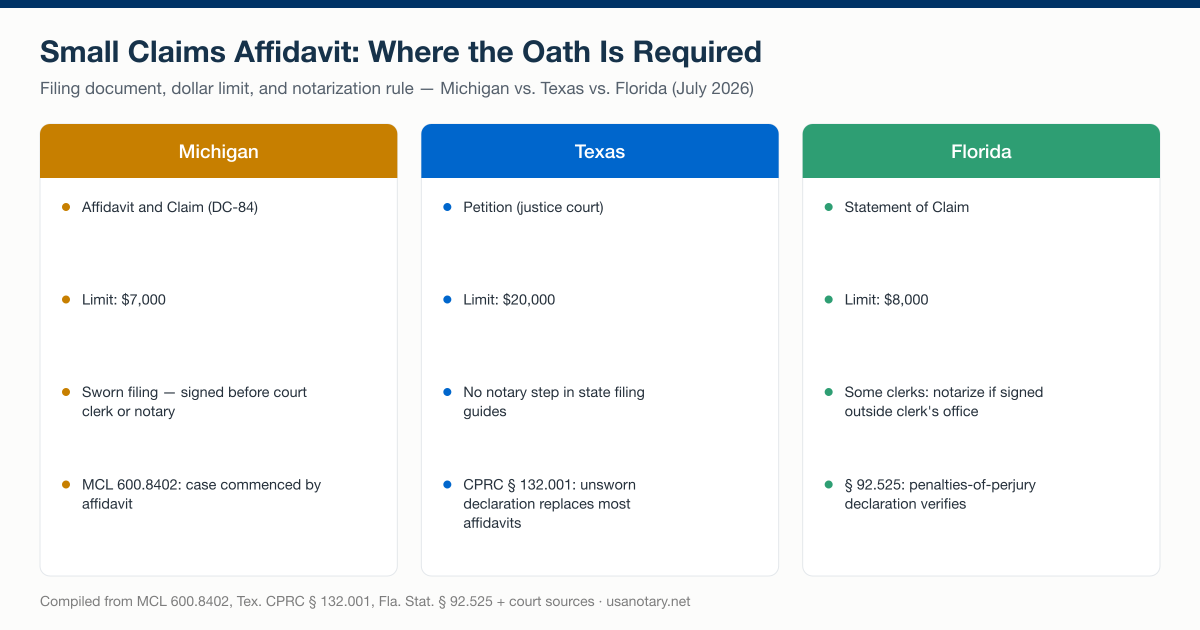
The three filing models side by side — Michigan’s sworn DC-84, the Texas petition, and Florida’s Statement of Claim, compiled from the statutes and court sources cited in this guide, July 2026.
How do Michigan, Texas, and Florida handle the small claims filing?
Michigan, Texas, and Florida each answer the notarization question differently, and together they map the full range of state approaches. Here is the comparison, checked against statute text and official court self-help sources:
| State | Filing document | Small claims limit | Signature rule on the filing |
|---|---|---|---|
| Michigan | Affidavit and Claim (Form DC-84) | $7,000 | Sworn — signed in front of a court clerk or notary public; the filing is itself an affidavit under MCL 600.8402 |
| Texas | Petition (justice court) | $20,000 | State filing guides list no notary step for the petition; sworn statements in the case can generally be replaced by an unsworn declaration under CPRC § 132.001 |
| Florida | Statement of Claim | $8,000 | Signed by the party; some county clerks require notarization when the form is signed outside the clerk’s office, or accept signature before a deputy clerk |
Michigan: the DC-84 Affidavit and Claim is sworn
Michigan builds the oath into the lawsuit. MCL 600.8402 commences the action by filing an affidavit with the district court clerk, and the statute prescribes its contents: the plaintiff’s full and correct name, a statement of whether the plaintiff is a corporation, partnership, sole proprietorship, or individual, any assumed business name in use when the claim arose, and boldface notices about each party’s removal rights.
The State Court Administrative Office publishes that affidavit as Form DC-84, Affidavit and Claim, Small Claims, and the signing instructions are specific. Michigan Legal Help puts it plainly: “When you fill out the form, leave the signature line blank. You must wait and sign the form in front of a notary public or a court clerk.” The oath is mandatory; the notary is one of two officers who can take it. A plaintiff filing in person can simply sign at the clerk’s counter — a plaintiff preparing the form remotely, or a business filing at volume, is the one who reaches for a notary.
Michigan’s small claims division handles claims up to $7,000, excluding interest and costs — Michigan Legal Help’s fee schedule tops out at “claims over $1,750 up to $7,000,” and removal to the district court’s general civil division lifts that cap.
Texas: a petition starts the case, and declarations do the sworn work
Texas justice courts hear small claims cases involving no more than $20,000 in damages, per TexasLawHelp. The case starts with a petition; the court then generates a citation, and both are served on the defendant. Neither TexasLawHelp’s walkthrough nor the Texas Justice Court Training Center’s plaintiff page lists a notarization step for the petition — the filing document is a pleading, not an affidavit.
When a Texas small claims case does call for a sworn statement, the state’s declaration statute usually removes the notary from the picture. Texas CPRC § 132.001 provides that an unsworn declaration “may be used in lieu of a written sworn declaration, verification, certification, oath, or affidavit required by statute or required by a rule, order, or requirement adopted as provided by law.” Texas attaches paperwork to the privilege: the declaration must be in writing, subscribed as true under penalty of perjury, and carry a statutory jurat listing the declarant’s full name, date of birth, and address, with the language “I declare under penalty of perjury that the foregoing is true and correct” and the county, state, and date of execution.
The statute’s own exceptions preview where the notary survives: § 132.001 does not apply to a lien required to be filed with a county clerk, an instrument concerning real or personal property required to be filed with a county clerk, or an oath of office or an oath required to be taken before a specified official other than a notary public.
Florida: a signed Statement of Claim — and clerk counter practice
Florida small claims cases cover disputes of $8,000 or less, excluding costs, interest, and attorney fees. The case is filed as a Statement of Claim, and the Brevard County Clerk of Courts describes the two signing paths a Florida plaintiff actually encounters: “If the form is signed outside of our office, it needs to be notarized. It can also be signed in the presence of a Deputy Clerk here at the Clerk’s Office.” Sign at the counter, no notary; sign at your kitchen table, notarization is required before the clerk will take it.
Florida also runs one of the country’s clearest verification statutes. Fla. Stat. § 92.525 permits a document to be verified either by oath or affirmation taken before an authorized officer or by a signed written declaration bearing this exact wording: “Under penalties of perjury, I declare that I have read the foregoing [document] and that the facts stated in it are true.” The declaration must sit at the end of or immediately below the document being verified, above the signature. Florida backs the shortcut with teeth — a false written declaration under § 92.525 is perjury, classified as a third-degree felony.
The practical read for Florida filers: the state statute offers a notary-free verification path, but the county clerk’s intake practice governs the form in your hand. Call the clerk, or check the county’s Statement of Claim form for a notary block, before assuming the declaration wording alone will be accepted.
When can a declaration under penalty of perjury replace a notarized affidavit?
A declaration under penalty of perjury replaces a notarized affidavit whenever the governing statute says an unsworn declaration may be used in lieu of the sworn document — which is the default rule in federal court and in a growing list of states. The mechanism is substitution: the criminal exposure of the perjury statute stands in for the oath the notary would have administered.
Federal filings: 28 U.S.C. § 1746
Federal law made the swap universal decades ago. Under 28 U.S.C. § 1746, wherever a federal law or rule requires a sworn affidavit, verification, certificate, or oath, the requirement may be satisfied by an unsworn written declaration “subscribed by him, as true under penalty of perjury.” For documents executed inside the United States, the statute prescribes the wording: “I declare (or certify, verify, or state) under penalty of perjury that the foregoing is true and correct. Executed on (date). (Signature).” The statute keeps three carve-outs: depositions, oaths of office, and oaths required to be taken before a specified official other than a notary public.
State declaration statutes: Texas, Florida, California
State small claims courts run on state law, so the federal shortcut doesn’t reach them — but many states enacted their own versions:
- Texas — CPRC § 132.001, covered above: broad substitution for most affidavits, with a jurat that must include the declarant’s full name, date of birth, and address.
- Florida — § 92.525: verification by signed declaration with the exact “Under penalties of perjury, I declare…” wording.
- California — CCP § 2015.5: whenever state law requires a sworn statement, an unsworn declaration works if it is subscribed by the declarant, states the date and place of execution, and recites “I certify (or declare) under penalty of perjury that the foregoing is true and correct.” A declaration signed outside California must add “under the laws of the State of California.” The same three exceptions as federal law apply: depositions, oaths of office, and oaths before specified officials other than notaries.
How to make the swap correctly
Getting the substitution right takes five checks, and courts reject declarations that skip them:
- Confirm the document’s role. A supporting affidavit or verification is usually swappable; a filing form that is the affidavit — Michigan’s DC-84 — is not.
- Confirm your state has a declaration statute and that your document isn’t in its exceptions list (Texas excludes county-clerk liens and real or personal property instruments, for example).
- Use the statute’s exact wording. Each statute prescribes its own perjury language — federal, Texas, Florida, and California all differ. Copy it verbatim.
- Add the required identifiers. Texas demands full name, date of birth, and address in the jurat; California demands the date and place of execution; Florida demands placement immediately above the signature.
- Date and sign. No officer, no seal, no certificate — the declaration is complete when signed.
When any check fails, you’re back to a sworn affidavit — and that’s the next section.
When is notarization still required for a small claims affidavit?
Notarization is required in three situations: when the court’s own form builds the oath into the document, when the declaration statute carves your document out, and when the receiving court or clerk simply demands a sworn affidavit. Each one shows up in real small claims practice.
The form builds in the oath
Michigan’s DC-84 is the standing example — the case is commenced by affidavit, and the form is signed in front of a court clerk or notary public, full stop. Florida’s county-level practice creates the same effect for anyone not signing at the courthouse: Brevard County requires notarization on a Statement of Claim signed outside the clerk’s office. When the prescribed form carries a jurat or verification block naming a notary, the block controls; declaration wording typed underneath doesn’t override the form. Our guide to jurat vs. acknowledgment certificates explains what that block commits the officer to do — administer an oath, not merely witness a signature.
The statute carves the document out
Every declaration statute keeps a reserved list. Federal § 1746 and California’s § 2015.5 both exclude depositions, oaths of office, and oaths required before specified officials other than notaries. Texas § 132.001 additionally excludes liens and real or personal property instruments filed with a county clerk. A small claims dispute that touches those categories — a case built on a lien filing, for instance — keeps its notary requirement no matter how the litigation documents are verified.
The court or clerk asks for it
Judges and clerks retain practical control over their own intake. A court may want a sworn affidavit from an out-of-state witness whose credibility matters, a clerk may hand back a form with an empty notary block, and an agency on the receiving end of a judgment package may require sworn copies. None of this is exotic — it’s the ordinary friction of fifty states’ local practice. When the person behind the counter requires the oath, the fastest path is taking it, not litigating the requirement.
How do you get a small claims affidavit notarized online?
A small claims affidavit can be notarized online in the states where remote online notarization is authorized — and that is now most of the map. The National Association of Secretaries of State reports that 47 states and the District of Columbia have a law allowing remote e-notarization. For an affidavit, the notary administers the oath over live audio-video — the same oath a walk-in notary would administer — then completes the jurat and seals the document electronically. The legal footing behind that session is covered in our guide to whether online notarization is legitimate, and the step-by-step process — upload, identity verification, video session, sealed PDF — is walked through in how to notarize an affidavit online.
The online route fits some small claims situations better than others, so here’s the honest sort:
- Filing in person anyway? Skip the notary entirely where you can. Michigan lets you sign the DC-84 in front of the court clerk; Brevard County, Florida lets you sign before a deputy clerk. The counter handles the oath as part of filing.
- Out-of-state or remote witness? This is where remote notarization earns its keep. A witness in another state who needs to swear an affidavit for your hearing can complete it in a 15–30 minute video session instead of finding a notary and a scanner — sessions run 24/7, signers can join from all 50 states, and multi-signer sessions handle an affidavit that needs more than one affiant. Where state law and the document’s rules permit, remote witnesses can join the same session.
- Business or agency filing at volume? Property managers, collections teams, and government offices that generate recurring small claims paperwork can use staff-initiated workflows — the staffer uploads and invites the signer — through our online notarization service for courts and government agencies. Every session produces a tamper-evident PDF with a complete audit trail, backed by an audio-video recording and electronic journal retained for 10 years or longer where state law requires.
Notarization costs $25 per document, with volume pricing for teams that file monthly. Identity is verified before the session through credential analysis and knowledge-based authentication run by a third-party identity-verification service — which is more scrutiny than a glance at a driver’s license at a counter.
One practical caution that applies to every online option: courts control their own intake. Before a hearing deadline, confirm with the receiving clerk that a remotely notarized affidavit is accepted for your specific filing — acceptance is the norm in RON states, but a two-minute phone call beats a rejected filing.
Affidavit, declaration, or verified statement: which one does the court want?
The court’s form and the governing statute answer the question — not the label at the top of the page. A quick decision path:
- The court prescribes a form with a notary or oath block → it’s an affidavit; the form is sworn before a clerk or notary, and the block must be completed.
- The statute or rule requires a “sworn” statement and your state has a declaration statute → a declaration under penalty of perjury usually substitutes, using the statute’s exact wording.
- The rule requires a “verified” pleading → check the verification statute; Florida’s § 92.525, for example, accepts either the oath or the signed declaration.
The stakes are identical either way. A false affidavit is perjury; a false declaration is perjury — Florida grades the written version as a third-degree felony. The oath ceremony changes; the legal exposure doesn’t.
If your small claims paperwork does need the oath — a DC-84 prepared away from the courthouse, a witness affidavit from out of state, a clerk who wants the notary block filled — a commissioned online notary can administer it on recorded video today. Questions about a one-off affidavit or a recurring court workflow? Call 804-767-7500 or reach us here.