
What is the Statement of Educational Purpose?
The Statement of Educational Purpose is a federal certification that FAFSA applicants selected for V4 or V5 verification were required to sign — a requirement Federal Student Aid removed starting with the 2025-26 award year. In the words of the FSA Handbook’s Application and Verification Guide, the statement “certifies who they are and that the federal student aid they may receive will only be used for educational purposes and for the cost of attending the school” for the award year. It was the anti-fraud backstop of the FAFSA: a signed promise, tied to a photo-ID check, that the person collecting Pell Grants and federal loans is a real student paying for a real education.
Two details made this form stricter than the average financial-aid worksheet. First, the wording was locked: the handbook instructs schools that the statement’s text “is not suggested — you must use the exact language given” in the Department’s Dear Colleague Letter, unlike every other verification document a school may freely redraft. Second, the signature had to be wet ink. The handbook is explicit that students “must also sign (it must be a ‘wet’ signature)” — a typed or e-signed version did not count, which is why aid offices asked distance students to mail paper originals.
The statement itself was never a standalone application. It traveled inside FAFSA verification — the process where a school double-checks information on a student’s aid application — and only two of the verification tracking groups carried it. If your school asked you to sign one, you were in group V4 or V5.
Is the Statement of Educational Purpose still required?
No — the Statement of Educational Purpose was removed from federal verification requirements, and for the 2026-27 award year the Department says schools cannot bring it back. The removal happened in stages across 2025, which is exactly why so many college worksheets and help pages still tell students to find a notary:
| Date | What happened | Where it’s documented |
|---|---|---|
| Sept. 4, 2024 | 2025-26 verification rules published; V4/V5 still include identity and the Statement of Educational Purpose | GEN-24-10, as originally issued |
| June 6, 2025 | “Schools are no longer required to obtain a Statement of Educational Purpose from students who are selected for V4 or V5 verification” — and two new identity methods (video call, NIST IAL2) are added, applying even to students selected before the announcement | Electronic Announcement APP-25-16 |
| July 22-23, 2025 | The 2025-26 acceptable-documentation list is formally updated; the statement is removed from the Department’s suggested verification text | GEN-24-10 update note, citing Federal Register notice 90 FR 34486 |
| Nov. 26, 2025 | “As a reminder, institutions can no longer require applicants to submit a Statement of Educational Purpose” | GEN-25-10 for the 2026-27 award year, citing 90 FR 54316 |
Read that last row carefully, because the language shifted. In June 2025 schools were no longer required to collect the statement; by the 2026-27 guidance, institutions “can no longer require” applicants to submit one. The form went from mandatory, to optional, to off the table — in under 18 months.
Why your school’s website still asks for it
School guidance lags federal guidance. As of mid-2026, the University of Maryland Global Campus help center still walks students through the classic two-route process — “sign the form in person with a UMGC staff member or sign it in front of a notary if you can’t visit in person” — and plenty of verification worksheets in college PDF libraries still carry the old exact-language block with a notary certificate attached. If your aid office sends you a Statement of Educational Purpose in 2026, the productive move is a polite question, not a standoff: ask whether the request reflects the current-year identity-verification process, since identity verification is still real and still stands between you and your aid. The form changed; the ID check did not.
Who gets selected for V4 and V5 verification?
The Department of Education places FAFSA applicants selected for verification into one of three tracking groups — V1, V4, or V5 — flagged on the ISIR record your school receives. Per the FSA Handbook: V1, the Standard Verification Group, covers income and family-size items. V4, the Custom Verification Group, covers identity (plus, before the 2025 change, the statement of educational purpose). V5, the Aggregate Verification Group, “is essentially a combination of V1 and V4” — income items and the identity check. Groups V2, V3, and V6 are reserved for future use.
Selection into V4 and V5 is where federal fraud enforcement now lives. Electronic Announcement APP-25-16 opens with the Department’s blunt assessment that “the rate of fraud through stolen identities has reached a level that imperils the federal student aid programs,” singling out the Pell Grant program as “targeted by technologically advanced fraud rings.” Three enforcement facts from that announcement matter to anyone selected:
- Selection surged in summer 2025. The Department expected “roughly 125,000 students” — concentrated among first-time applicants expecting aid for the first time — to require identity validation during that summer alone.
- A new screening layer runs behind the FAFSA. Starting fall 2025, FSA added an identity-screening process to every application, with the stated goal of driving V4 selection “to near zero in the future” once the model is optimized.
- Money stops until verification finishes. The FSA Handbook is unambiguous: “No disbursements of Title IV aid may be made until the V5 verification is satisfactorily completed.” Schools must also report your identity-verification result to the Department within 60 days of first asking you for documentation.
If you were selected, nothing is presumed wrong with your application — Cornell’s financial aid office tells selected students exactly that. But the disbursement hold means speed matters: every week the identity check sits unfinished is a week your grants and loans cannot pay out.
How do you verify your identity for V4 or V5 now?
Four routes now satisfy the federal identity check, and the Department states a clear preference: “We encourage in-person verification as the preferred method.” The 2026-27 Dear Colleague Letter (GEN-25-10) and APP-25-16 define the full set:
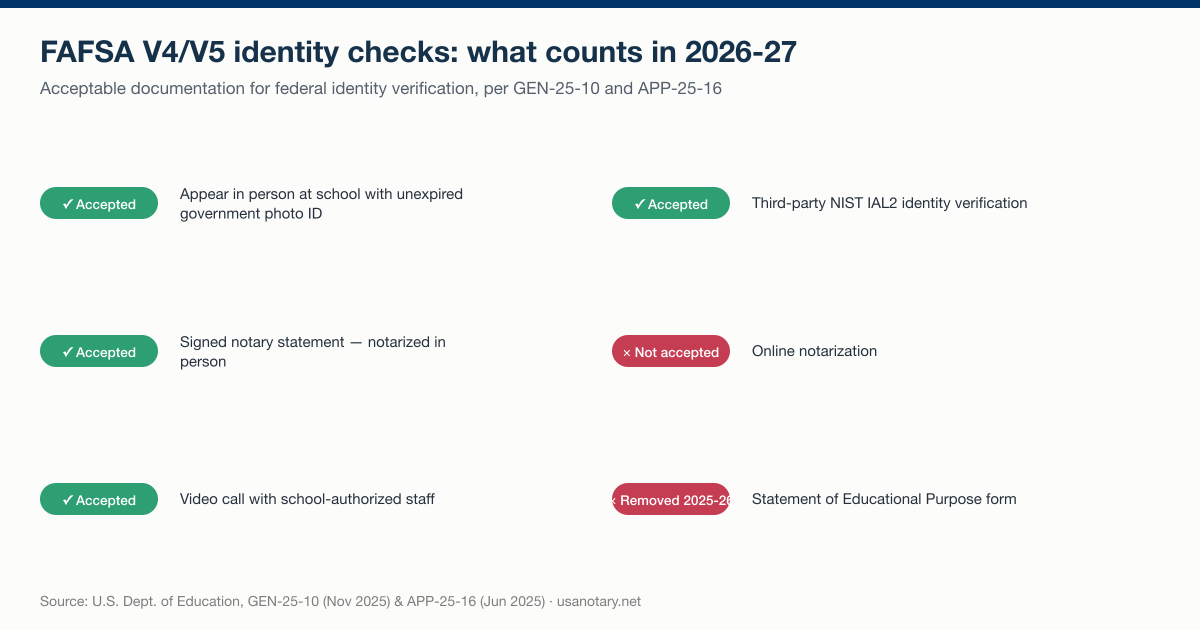
What Federal Student Aid accepts — and doesn’t — for V4/V5 identity verification, per GEN-25-10 and APP-25-16.
| Route | How it works | What the school must keep |
|---|---|---|
| In person at the school | Present a valid, unexpired, government-issued photo ID (U.S. passport, driver’s license, or other state-issued ID) to school-authorized staff | An annotated copy of the ID with the date received and the name of the authorized reviewer |
| Notary statement — in person only | Sign an identity statement before a notary public; the notary certifies you appeared and presented a government-issued photo ID | The signed statement, the notary’s certification, and a copy of the same ID |
| Video call with school staff | Present the same unexpired government-issued photo ID on a live video call to an institutionally authorized individual | A scanned copy of the ID with the date presented and reviewer’s name — a legible screenshot from the call suffices |
| Third-party NIST IAL2 verification | A third party verifies your identity using a method satisfying the NIST Identity Assurance Level 2 standard | Documentation of the verification date and the entity that performed it |
A fifth path exists for confined or incarcerated students in eligible prison education programs: the Department considers identity verified when an authorized official at the correctional facility performs the check, and a student who stays enrolled at the same institution and facility is not re-verified.
Which IDs pass — and which fail
The handbook draws the ID boundary precisely. “Unexpired” means unexpired on the day it is checked, even if the ID lapses before the award year ends. Acceptable issuers include the U.S. government, all 50 states, D.C., Puerto Rico, federally recognized tribes, and the U.S. territories and Freely Associated States. Two common IDs fail: a state university or college ID is “not sufficient for identity verification,” and a military ID cannot be used because 18 U.S. Code § 701 prohibits photocopying it. One common worry is unfounded — an ID that is not REAL ID-compliant is acceptable, since REAL ID restrictions govern airports and federal facilities, not aid verification.
The notary route, step by step
When appearing on campus isn’t possible and your school hasn’t offered the video-call option, the notary statement route works like this:
- Get the school’s form. Ask the financial aid office for its current identity-verification statement — since the 2025-26 change, the Department’s suggested text includes an identity section identifying which method was used, and the notary certificate can follow your state’s own format.
- Appear before the notary in person. Bring your unexpired government-issued photo ID. The notary’s job is to certify that you appeared and presented that ID — which is why this step cannot happen over video for this particular form.
- Sign in wet ink. Sign the statement in the notary’s presence and have the notarial certificate completed.
- Send the original packet. Submit the signed statement, the notary’s certification, and a copy of the same ID to the aid office. Cornell, for example, asks for “the original document” by mail with the ID copy — keep your own copy of everything before it ships.
Can you complete the notarization online?
No — Federal Student Aid does not accept online notarization for FAFSA identity verification, full stop. The 2026-27 guidance in GEN-25-10 says it in two consecutive sentences: “Please note, if a student chooses to verify their identity through a notary, they must do so in-person. Online notarization is not an acceptable method for our requirements.” The FSA Handbook’s verification chapter carries the same rule — the Department “does not authorize the use of online notary services as an alternative to traditional, in-person notary services.”
We run an online notarization platform, so it would be convenient to tell you otherwise. The honest answer is that state law and federal documentation rules are two different gates. The National Association of Secretaries of State reports that 47 states and the District of Columbia have a law allowing remote e-notarization, and our guide to whether online notarization is legally valid covers that legal foundation. But which documentation a federal agency accepts for its own process is the agency’s call — and for this process, the Department of Education chose in-person presentation of your ID, whether to school staff, a notary, or a camera pointed at an authorized school employee.
The Department declined for notaries the very identity toolkit it embraced elsewhere in the same announcement. Remote online notarization platforms verify signers through credential analysis and knowledge-based authentication, and APP-25-16’s new third-party route accepts identity verification meeting the NIST IAL2 standard. The practical takeaway for a selected student is simpler, though — in order of least friction:
- If you can reach campus, walk in with your ID.
- If you can’t, ask the aid office for the video call option first — APP-25-16 added it in June 2025 as an alternative to the notary route: a student can present a government-issued photo ID on a live video call to an authorized school reviewer, and is no longer required to submit a copy of an ID acknowledged in a notary statement.
- If the school insists on paper, complete the notary route in person and mail the original.
Where online notarization does serve students and schools is everywhere else in the education paper trail: guardianship and residency affidavits for enrollment, transcript certifications bound for apostille, consent forms, and the general run of sworn school documents. Our walkthrough of how to notarize an affidavit online covers that process — just not for this one federal form.
What if you attend an online university or live far from campus?
Distance students receive these verification requests at scale, because “appear in person at your school” is the baseline method and fully online universities have no campus within reach of most students. This is the exact population the June 2025 changes were written for — and the reason the video-call route exists.
School practice varies, so check your own aid office’s instructions against the current rules. UMGC — a global online university — tells military-affiliated students they “may be able to complete the form in person with a field representative” near their location, alongside the staff-or-notary routes. Cornell offers all three modern methods: in person at the aid office, a scheduled video call presenting “an unexpired, valid, government-issued photo identification,” or a mailed notarized original with an ID copy.
Cornell’s notary instructions also surface the rule that trips up students abroad: “the notary public must be an approved U.S. Notary Public. We are unable to accept documents that are completed with the use of a foreign equivalent.” A student studying overseas cannot take the school’s identity statement to a local civil-law notary and expect it to count. For that student, the video-call option is usually the workable path — and for the other documents in an international student’s life, our guide to getting documents notarized from overseas explains which tools apply where.
What delays your aid — and how to avoid it
The disbursement hold is the real cost of slow verification, so the errors worth avoiding are the ones that force a second round-trip. The recurring failure points, drawn from the federal documentation rules above:
- An expired ID. The ID must be unexpired on the day it is checked. Renew first, verify second.
- The wrong ID. A student ID from your own university fails the federal standard; so does a military ID, which cannot legally be photocopied for the file.
- A copy where an original is expected. Schools that use the notary route typically want the original signed statement mailed in — Cornell asks for the original document plus the ID copy.
- The wrong form entirely. The Attestation & Validation of Identity form on StudentAid.gov (OMB 1845-0179) looks similar but serves a different population: a parent or spouse without a Social Security number, or a citizen of the Freely Associated States, establishing verified access to Department systems. That form is emailed to Federal Student Aid with ID documentation — no notary, no aid office. Signing it does not complete your V4/V5 verification, and signing a V4/V5 statement does not complete it.
- Waiting out the clock. Schools must report your identity result within 60 days of first requesting documentation, and aid cannot disburse until verification is satisfactorily completed. Start the week the request arrives — verification requests cluster in summer, exactly when campus offices run reduced hours.
For financial aid offices, the 2025-26 changes cut work in the right places: no more exact-language statement to police, and a video call your own staff can run replaces chasing notarized packets from students three time zones away. For the school documents where notarization is still required — enrollment affidavits, registrar certifications, program consents — our online notarization service for schools and universities handles them over live video at $25 per document with volume pricing, 24/7, for signers in all 50 states. Sessions take 15-30 minutes and produce a tamper-evident PDF with a complete audit trail.
Questions about which school documents can — and can’t — be notarized online? Call 804-767-7500 or reach out through our contact page.