
Does a subordination agreement need to be notarized?
Yes — in every sense that matters at closing. A subordination agreement is recorded in the county land records, and state recording statutes require the execution of a recorded instrument to be acknowledged before a notary public. California puts it flatly: Government Code § 27287 says that “before an instrument can be recorded its execution shall be acknowledged by the person executing it.” A subordination agreement without that acknowledgment is rejected at the recorder’s counter, lien priority never changes in the public record, and the refinance the agreement was supposed to unblock stays stuck.
The document itself is a lien-priority contract. Cornell’s Legal Information Institute defines a subordination agreement as “a contract that guarantees senior debt will be paid before other ‘subordinated’ debt if the debtor becomes bankrupt.” In residential lending, the same instrument ranks mortgage liens instead of corporate debt: U.S. Bank describes subordination as “the process of ranking home loans (mortgage, HELOC or home equity loan) by order of importance.” The classic trigger is a refinance with a HELOC in place. Paying off the old first mortgage would let the HELOC ride up into first position — so the new first-mortgage lender demands a signed, acknowledged, recorded agreement pushing the HELOC back down.
Fannie Mae turns that demand into a hard rule. Its Selling Guide section on subordinate financing states: “If subordinate financing is left in place in connection with a first mortgage refinance transaction, Fannie Mae requires execution and recordation of a resubordination agreement.” The only out is statutory — resubordination is not required “if state law permits subordinate financing to remain in the same subordinate lien position established with the prior first mortgage that is being refinanced.” And the Guide closes the escape hatch lenders sometimes assume exists: title insurance against a lien that is not properly resubordinated “does not release lenders from compliance with these resubordination requirements.”
Valid between the parties vs. recordable at the county
The notarization requirement enters through the recording chain, not through contract law. Two signatures on a subordination agreement may create obligations between the two lenders who signed it — but an agreement that never reaches the land records cannot reorder lien priority against anyone else, and recordation is exactly what Fannie Mae requires. The chain is short: the subordination agreement is recorded to work; an instrument is recorded only after its execution is acknowledged; the acknowledgment is the notarial act. If the vocabulary is new, our plain-English breakdown of the difference between an acknowledgment and a jurat covers why this certificate — not an oath — is the one recorded real-estate documents carry.
Who signs a subordination agreement — and who doesn’t?
The subordinating lienholder signs — the junior lender agreeing to stay behind the new first mortgage — and that is the signature the notary must acknowledge. Cape May County, New Jersey’s recording instructions for mortgage subordination agreements say it in one line: the “signature(s) of the postponing/subordinating lender must be fully acknowledged by a notary public or other officer authorized by law to take oaths.” Thin articles on this topic routinely get this backwards and send the borrower hunting for a notary; the acknowledgment that recording turns on belongs to the junior lienholder’s signer, whatever extra signature lines a particular lender’s template carries.
Because that lienholder is almost always a bank, credit union, or servicer, the person in front of the notary is an authorized officer signing in a corporate capacity — and the acknowledgment certificate has to say so. California Government Code § 27287 requires the acknowledgment of an instrument “executed by a corporation” to come from “its president or secretary or other person executing it on behalf of the corporation.” Cape May County demands the same substance: when any party is a corporation or other entity, the acknowledgment must include “a statement that the maker was authorized to execute the instrument on behalf of the entity and that the maker executed the instrument as the act of the entity.” An officer who signs but skips the entity-capacity language has produced a certificate a recorder can bounce.
Who prepares and who requests it
The lenders run this process, not the borrower. U.S. Bank’s explainer notes that when the first mortgage and the home-equity line sit with different institutions, “both financial institutions work together to draft the necessary paperwork,” and that “the process occurs internally if you only have one lender.” Even the fee flows lender-to-lender: USAA’s subordination request form instructs that “the new lender must send the processing fee” and that “payments from the borrower will not be accepted.” The borrower’s role is to authorize the information exchange — both banks’ packages include a borrower authorization — while the new lender assembles the request and the junior lienholder executes the agreement.
Why recording fails: county acknowledgment requirements
County recorders reject a subordination agreement whose execution is not acknowledged, because the acknowledgment requirement sits in state statute — it is not county discretion, and it does not bend for a closing date. The same rule appears wherever you look in the recording acts:
| State | Recording statute | What it requires before the instrument is recorded |
|---|---|---|
| California | Gov. Code § 27287 | “Before an instrument can be recorded its execution shall be acknowledged by the person executing it,” with corporate instruments acknowledged by the officer executing on the corporation’s behalf |
| Texas | Prop. Code § 12.001 | “An instrument concerning real or personal property may be recorded if it has been acknowledged, sworn to with a proper jurat, or proved according to law” |
| New York | Real Property Law § 291 | A conveyance may be recorded “on being duly acknowledged by the person executing the same, or proved as required by this chapter,” with the acknowledgment or proof duly certified |
| New Jersey | N.J.S.A. 46:26A-3(a)(3), as applied by the Cape May County Clerk | Signatures must be acknowledged; the county’s subordination instructions require the subordinating lender’s signature to be “fully acknowledged by a notary public” |
Recording itself is cheap next to the delay it prevents. Cape May County’s fee schedule for a subordination agreement runs $30 for the first page, $10 for each additional recorded page, a $5 Homelessness Trust Fund charge, and a $10 noting fee per instrument. The expensive failure mode is not the fee — it is the rejected instrument that surfaces two days before closing.
The certificate details that trigger rejections
A notarized signature can still fail recording if the certificate is incomplete. Cape May County’s instructions spell out what a compliant acknowledgment on a subordination agreement must contain — and each item doubles as a rejection reason when missing:
- the state and county where the acknowledgment is taken (the venue),
- the full date of the acknowledgment,
- the name(s) of the person(s) signing the document,
- for entities, the authorization statement — that the signer was authorized to execute the instrument on the entity’s behalf and executed it as the entity’s act,
- the notary’s signature, printed name, title, and jurisdiction, and
- a seal, which the county requires notaries commissioned outside New Jersey to apply.
Names printed beneath signatures and record-and-return information round out the checklist. None of this is exotic — it is ordinary acknowledgment mechanics — but a subordination agreement passes through more hands than most recorded documents (junior lienholder’s officer, new lender’s closer, title agent, recorder), so a defective certificate tends to be discovered late.
How long does a subordination take? The refinance bottleneck
Subordination runs on the junior lienholder’s clock, and the junior lienholder is in no hurry — the turnaround policies two major junior lienholders publish on their own request forms both measure in weeks. Bank of America’s subordination request package opens with a boxed warning: “Subordination requests take up to two weeks to complete and mail,” followed by “We are unable to expedite any subordination requests. All requests are processed in the order in which the complete subordination package is received.” USAA’s form goes longer: “Processing for the request may take up to 21 business days from the date we receive the processing fee, completed Subordination Request Form and all other documents listed” — that is more than four calendar weeks, and the clock does not start until the $100 fee and the complete package arrive.
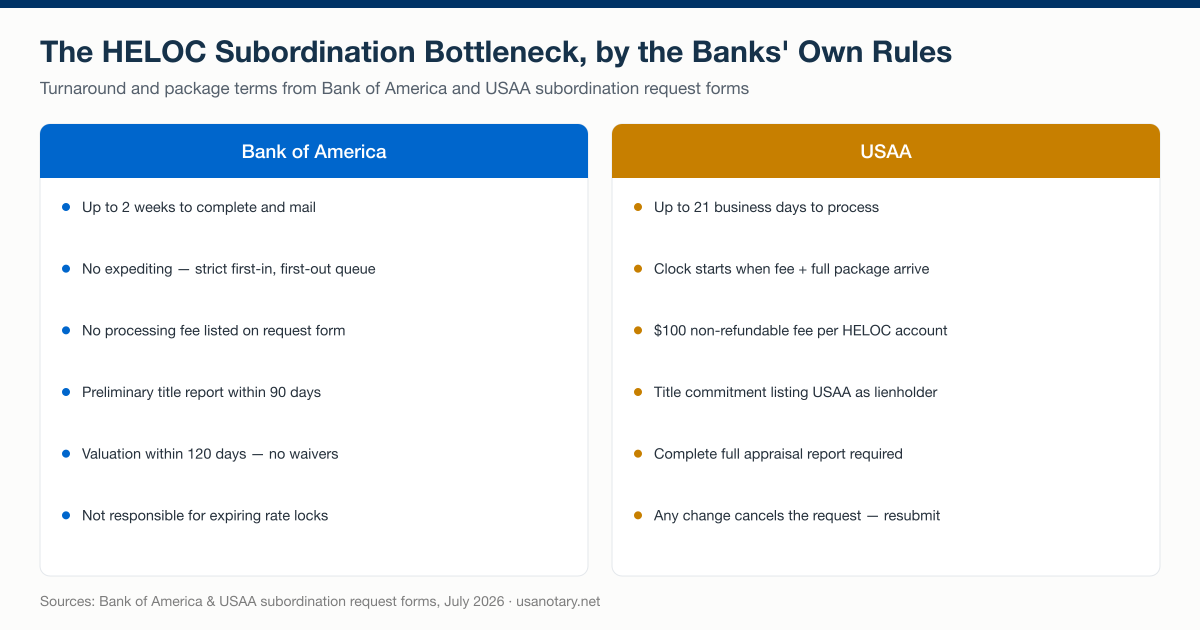
Turnaround and package terms from Bank of America’s and USAA’s own subordination request forms, July 2026.
| Policy | Bank of America | USAA |
|---|---|---|
| Stated turnaround | Up to two weeks to complete and mail | Up to 21 business days |
| When the clock starts | When the complete package is received | When the fee, form, and all documents are received |
| Expediting | “We are unable to expedite any subordination requests” | Not offered; changes cancel the request entirely |
| Processing fee | None listed on the request form | $100 per HELOC account, non-refundable, paid by the new lender |
| Rate-lock risk | “Bank of America is not responsible for expiring interest rate locks or funding deadlines” | Changes after submission cancel the request; a new form must be submitted |
The fine print compounds the delay. Bank of America notes that “incomplete packages, illegibility and counter offers may extend the standard processing times.” USAA warns that if documents are missing “or if you make changes after it has been submitted, we will cancel the request and a new form must be submitted” — a cancel-and-restart rule, not a pause. U.S. Bank’s consumer explainer says the quiet part: “delays can occur, especially if you have two lenders,” and it recommends confirming the agreement is done before the loan closing date.
Where the days actually go
Map the timeline and one step stands out as compressible. The new lender assembles the request package (days), the junior lienholder’s queue processes it first-in-first-out (up to two weeks at Bank of America, up to 21 business days at USAA), the approved agreement is executed and acknowledged by the lienholder’s officer, the paper is mailed — Bank of America’s own phrase is “complete and mail” — and the title agent records it. The queue is immovable; both banks say so in writing. The execution-acknowledgment-delivery tail is the part a lender controls, and it is the part online notarization collapses from a mail cycle into a same-day session.
Can a subordination agreement be notarized online?
Yes, where state law permits — and it usually does. The National Association of Secretaries of State reports that 47 states and the District of Columbia have a law allowing remote e-notarization, so the acknowledgment a subordination agreement is recorded on can be completed over live audio-video instead of waiting for an officer, a branch notary, and an overnight envelope to line up. The legal footing is the same commission and the same certificate; our guide to whether online notarization is legit walks through the statutes behind it. One diligence step remains: confirm the recording county accepts electronically notarized instruments before the session, since the recorder — not the notary — is the gatekeeper.
Here is how the acknowledgment runs as a remote session:
- Upload the executed-form subordination agreement. The notary completes the acknowledgment on the document as drafted — the lenders’ agreed terms are not touched.
- The signer’s identity is verified. Credential analysis plus knowledge-based authentication, run by a third-party identity-verification service, happens before the notary appears.
- The authorized officer joins on video. Sessions run 24/7 and take 15–30 minutes, and multi-signer sessions cover an agreement that needs more than one officer. Remote witnesses are supported where state law and the document’s rules permit.
- The notary completes the acknowledgment certificate — venue, date, signer’s name, entity capacity — the exact fields county instructions like Cape May’s require.
- The output is a tamper-evident PDF with a complete audit trail, backed by the session’s audio-video recording and an electronic journal entry retained for the period the notary’s commissioning state requires. The document is ready for the title agent the same day, with no mail leg.
For a servicing or subordination desk that executes these weekly, the economics are simple: notarization costs $25 per document, with volume pricing for recurring workflows, and staff-initiated sessions let the desk queue documents for signers in all 50 states. That workflow — and the rest of the lien-release and loan-document stack — is what our online notarization service for mortgage lenders is built around.
What should the new lender send the junior lienholder?
A complete package on day one is the only lever that shortens the queue, because both banks start their clocks at “complete” and both extend or cancel on gaps. The two verified request forms converge on the same core list:
- The lienholder’s own subordination request form, completed in full — Bank of America and USAA each require their own.
- The loan application — the URLA Form 1003 (USAA also accepts Form 65).
- The Form 1008 transmittal summary for the new loan.
- Title evidence — Bank of America wants a preliminary title report with complete recording information for all liens, dated within 90 days; USAA wants a title commitment listing USAA Federal Savings Bank as a lienholder.
- Valuation — Bank of America requires a current property valuation report within 120 days and states waivers are not permitted; USAA requires a complete copy of the full appraisal report.
- The Loan Estimate or Closing Disclosure for the new loan.
- A 30-day current payoff letter for the existing first mortgage (Bank of America).
- The borrower’s authorization to release information — both forms build it in.
- The processing fee, from the lender — USAA’s $100 per HELOC account by wire or check, with proof attached.
- Return delivery — Bank of America requires a computer-generated overnight shipping label; USAA returns by FedEx if an account number is provided, otherwise regular mail.
Screen for the automatic denials before submitting at all. Bank of America states it won’t consider subordination requests for a lien currently in senior position, behind a first mortgage with negative-amortization potential, behind a reverse mortgage or equity credit line, for a property under construction and vacant, or behind a first mortgage with a balloon payment, a line of credit, interest-only payments, or an ARM whose initial fixed period is under 36 months. A request that dies on those rules costs the full queue time to find out.
Keep lien priority off the refinance critical path
The chain worth memorizing: a subordination agreement is recorded to work, a recorded instrument is acknowledged before a notary, and the acknowledgment is the one step in a weeks-long process that can finish today. The junior lienholder’s queue will take its two weeks or its 21 business days regardless — what a lender controls is a complete package going in and a same-day acknowledgment coming out. Subordination is one document in a bigger stack: our overview of which mortgage documents must be notarized sorts the rest, and when the junior lien is being paid off rather than resubordinated, the instrument that clears it is covered in our guide to recording a satisfaction of mortgage.
Questions about a recurring subordination workflow — staff-initiated sessions, multi-signer execution, volume pricing? Call 804-767-7500 or reach us through the contact page.