
How a non-resident gets a US address
A US address for non-residents commonly comes from a Commercial Mail Receiving Agency (CMRA) — the regulated business behind every virtual mailbox brand. USPS mailing standards (DMM 508 § 1.8) define a CMRA as “a business that, in whole or in part, accepts the delivery of U.S. Mail on behalf of another person or entity as a business service.” Rent a private mailbox (PMB) from one, and you have a real US street address that receives mail, scans it, and forwards it anywhere in the world.
The path from another country has five steps, and only one of them regularly stalls people:
- Choose a mailbox operator whose street address sits in a state that suits you.
- Complete PS Form 1583, the USPS application that authorizes the operator to receive your mail.
- Present two forms of ID — one government-issued photo ID, one document confirming your home address.
- Have your signature verified — either the operator witnesses it, or you acknowledge it before a US-commissioned notary. From abroad, the notary path runs over live video.
- The operator files the form with the Postal Service, and your mailbox activates.
USPS, IRS and SBA wording checked October 1, 2026; the primary sources are listed at the bottom of the page.
Step 4 is the sticking point for signers outside the United States — and it’s the step remote online notarization exists to solve. The rest of this guide covers why the address matters, which address product actually fits which job, what the current Form 1583 accepts from a non-resident, and what happens to the form after you sign it.
Why a non-resident business needs a US street address
A US street address does one concrete thing no foreign address can: it gives US mail somewhere to physically land. State correspondence, an EIN confirmation letter, bank cards and account notices, returned packages — all of it needs a deliverable US address.
Formation and tax paperwork put boundaries around what an address does and doesn’t solve, and the official sources are specific:
- Registering the business: the SBA’s registration guide states that “if your business is an LLC, corporation, partnership, or nonprofit corporation, you’ll need a registered agent in your state before you file.” That agent — not your mailbox — is who receives service of process.
- Getting an EIN: the IRS EIN application page limits the online tool to applicants whose “principal place of business is in the U.S. or U.S. territories” and who have “the responsible party’s Social Security or individual taxpayer ID number (ITIN).” If your principal place of business is outside the US, the IRS’s international route is a phone application at 267-941-1099 (Monday–Friday, 6 a.m. to 11 p.m. Eastern) or Form SS-4 by fax or mail — a mailbox address doesn’t change which channel applies to you.
This guide stops at the mail: whether you should form an LLC, which state, and how your entity is taxed are questions for the IRS’s own guidance or a qualified professional, not a notarization platform. What we can map precisely is the address itself — and the form that activates it.
Virtual mailbox vs registered agent vs a friend’s address
“Get a US address” hides three different products, and non-residents routinely buy the wrong one for the job. Each column answers a different need:
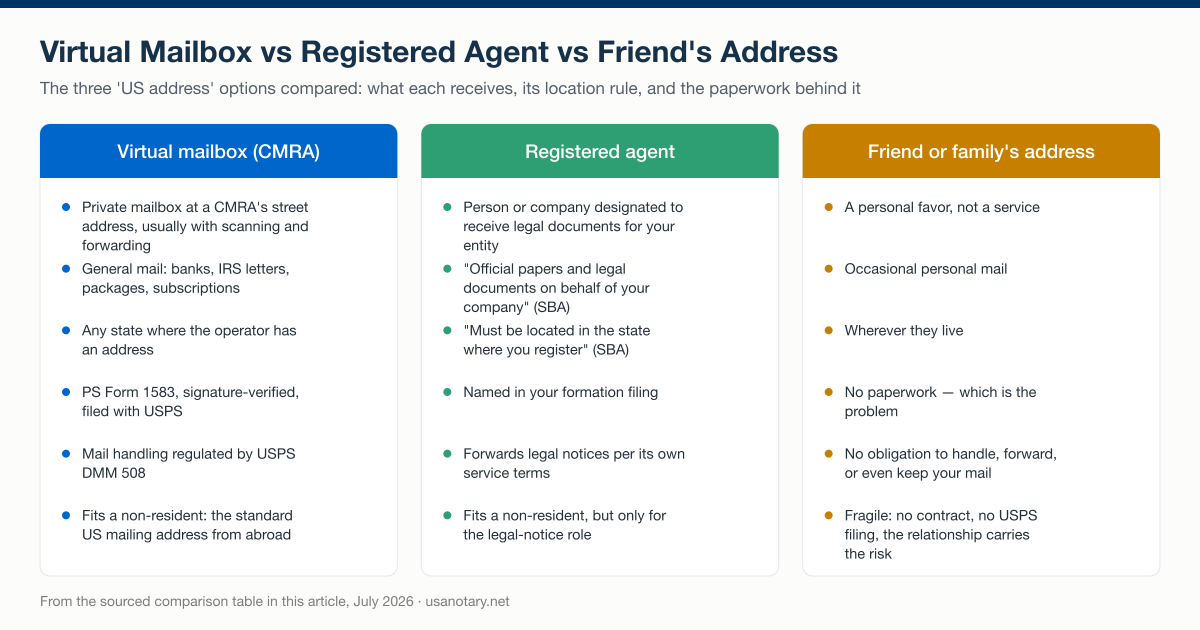
The three US-address options a non-resident can choose from, compared row by row — from the sourced table in this guide, July 2026.
| Virtual mailbox (CMRA) | Registered agent | Friend or family member’s address | |
|---|---|---|---|
| What it is | A private mailbox at a CMRA’s street address, usually with scanning and forwarding | A person or company designated to receive legal documents for your entity | A personal favor, not a service |
| What it’s for | General mail: banks, IRS letters, packages, subscriptions | “Official papers and legal documents on behalf of your company” (SBA) | Occasional personal mail |
| Location rule | Any state where the operator has an address | “Must be located in the state where you register” (SBA) | Wherever they live |
| Paperwork | PS Form 1583, signature-verified, filed with USPS | Named in your formation filing | None — which is the problem |
| Mail handling | Regulated by USPS DMM 508; the operator holds, scans, or remails your mail with new postage | Forwards legal notices per its own service terms | No obligation to handle, forward, or even keep your mail |
| Fits a non-resident founder? | Yes — this is the standard US mailing address from abroad | Yes, but only for the legal-notice role | Fragile: no contract, no USPS filing, and the relationship carries all the risk |
The two paid products are complements, not substitutes. A registered agent receives official papers and legal documents; a CMRA mailbox receives everything else. A founder who needs both holds both. For a deeper look at how the CMRA side is regulated, see what a CMRA is.
PS Form 1583: the step where non-residents get stuck
PS Form 1583, Application for Delivery of Mail Through Agent, is the gate between “signed up for a virtual mailbox” and “mailbox actually receives mail.” The June 2024 edition of the form is built to take a non-US applicant: the home-address fields include a Country box (items 4j and 9f), and its business section states that “the place of registration is the county and state (if domestic), or the country (if foreign).” A company registered abroad can be named on the form exactly as a US company can.
Two requirements still stop non-residents cold — the signature verification and the two IDs. Take them in order, because they are different acts with different rules.
Two verification paths: the CMRA witnesses, or a notary takes your acknowledgment
Identity verification by the CMRA and notarization are distinct acts under the current form, and its instructions spell out both:
“The applicant must sign or confirm their signature in the physical or virtual presence (in real-time audio and video) of the Agent or the Agent’s authorized employee or acknowledge their signature in the physical or virtual presence (in real-time audio and video) of a notary public commissioned in a United States state, territory, possession, or the District of Columbia.”
In the first path, the CMRA witnesses your signature — in person at the counter or over its own real-time video check. In the second, you acknowledge your signature before a notary, who completes the notary box on page 2: the form’s own certificate reads that the applicant “proved to me on the basis of satisfactory evidence” to be the signer and “appeared before me, and acknowledged their signature.” The act is an acknowledgment, not a jurat — the full form-level walkthrough is in our PS Form 1583 notarization guide.
For an applicant abroad, the notary path is usually the practical one: it works over live audio-video from any country, and it hands the operator an independent, sealed identity record to file.
The two IDs — and which ones a non-resident can actually produce
Footnote 9 of the form requires “two types of identification … One ID must be a government-issued photo ID. The second must confirm the Applicant’s … address listed on this form.” Here is the June 2024 form’s complete list, verbatim, with the non-resident reading of each column:
| Slot | Acceptable documents (June 2024 form) | The non-resident angle |
|---|---|---|
| Photo ID (item 8e) | U.S. State/Territory/Tribal Driver’s or Nondriver’s ID Card; Uniformed Service ID; Passport; Certificate of Naturalization; U.S. Access Card; Matricula Consular; U.S. Permanent Resident Card; U.S. University ID Card; NEXUS Card | “Passport” carries no US-only qualifier, while several other entries on the list are expressly US-issued — and the Matricula Consular is itself a foreign-government ID. Operators review and upload your ID, so confirm yours processes a foreign passport |
| Address ID (item 9g) | U.S. State/Territory/Tribal Driver’s or Nondriver’s ID Card; Current Lease; Home or Vehicle Insurance Policy; Mortgage or Deed of Trust; Vehicle Registration Card; Voter Card | The document “Must Contain the Address in 9b–9f” — and 9f is a Country field. A current lease or home insurance policy for your home-country address is what most non-residents can produce |
Three of the form’s own rules round out the picture. A driver’s/nondriver’s ID may count for only one slot, “not for both” (footnote 10). For business or organization use, “an officer must sign the application” and provide their title (footnote 14). And for residential use, a separate Form 1583 is completed for each adult using the mailbox (footnote 3).
The honest caveat: the form lists the document types, but the CMRA is the party that examines and files them, so an operator’s own review policy decides whether your specific foreign documents go through cleanly. Ask before you apply — it’s a one-line email that saves a rejected application.
Completing the Form 1583 notarization from another country
Remote online notarization fits the 1583 because the form’s “virtual presence (in real-time audio and video)” language describes exactly what a RON session is. The location mechanics are the ones our guide to notarizing US documents from overseas establishes: the notary stays physically inside their commissioning state, and the signer can be in a different country. A few states add conditions for signers located outside the US. The National Notary Association’s June 2021 article says that in states with the Revised Uniform Law on Notarial Acts provisions for remotely located individuals, the record must have a “nexus” with the United States — “such as a record relating to a matter before a U.S. court or other government entity, or involving property in a U.S. jurisdiction” — and the act must not be prohibited where the signer is located; it names Washington, Pennsylvania, and Idaho among those states. State laws change, so the notary confirms their state’s rule before the session proceeds. Whether a mailbox application meets a nexus rule is the notary’s determination, not ours.
From your side, a session looks like this:
- Check your equipment and ID. You need a stable internet connection, a device with a camera, and a current government-issued photo ID the platform can verify — confirm the ID requirements before you book, not mid-session.
- Upload the completed but unsigned Form 1583. The notary must watch you sign; a pre-signed form defeats the acknowledgment.
- The platform verifies your identity, then connects you to a commissioned notary on live video — sessions are available 24/7 and typically run 15–30 minutes.
- You acknowledge your signature; the notary completes the notary box on page 2.
- The session produces a tamper-evident notarized PDF and a digital audit trail — the file you hand your mailbox operator, plus the evidence record behind it.
On USA Notary, a signer completes the notarization for $25 per document; the step-by-step platform walkthrough shows the identity check and video session before you commit. The company’s founder — a Certified Notary Signing Agent since 2005 with more than 10,000 notarizations personally completed — built the platform around exactly this kind of high-stakes identity paperwork. One confirmation belongs on your checklist regardless of provider: acceptance of a remotely notarized 1583 is the mailbox operator’s call, so ask yours before the session.
What the operator does with your notarized form
Your job ends at the verified signature; USPS rules script the operator’s side from there. The form’s own instructions state: “The agent uploads the original completed signed PS Form 1583 to the Postal Service’s CMRA Customer Registration Database and retains the completed signed copy at the CMRA business location,” where it “must at all times be available for examination by the postmaster (or designee) and the Postal Inspection Service.”
DMM 508 § 1.8 goes further: the CMRA must “upload a clear and legible copy of each identification document” into the CMRA Customer Registration Database (CRD), keep at minimum a digital copy of your completed form at its business location, and certify in the CRD each quarter — by January 15, April 15, July 15, and October 15 — that every Form 1583 it submitted is current and no identification documents are expired. If an uploaded ID image isn’t legible, the Postal Service tells the operator to collect and upload a replacement — which, for you, means a second round of paperwork.
That compliance load is why operators are exacting about the form and the IDs up front, and why the notary path appeals to them for remote applicants: a notarized 1583 arrives as a clean, independently verified record they can upload once. If you run a mailbox business and that pipeline is your daily problem, our notarization solution for virtual mailbox operators covers staff-initiated workflows built for exactly this form.
For the applicant, the takeaway is simpler. The address is easy; the file behind it is the product. Get the two IDs right, pick the verification path your operator prefers, and — from anywhere in the world — you can notarize your Form 1583 online in a single sitting.