
What is a commercial mail receiving agency?
A commercial mail receiving agency is a private business that receives USPS mail for its customers — the legal machinery behind every virtual mailbox and mail-forwarding service. The Postal Service’s own definition, in Domestic Mail Manual § 508.1.8, reads:
“A Commercial Mail Receiving Agency (CMRA) is defined as a business that, in whole or in part, accepts the delivery of U.S. Mail on behalf of another person or entity as a business service.”
Checked October 1, 2026, against DMM 508.1.8 (the PDF edition headed “Updated 7-12-26”), PS Form 1583 (June 2024) and the 89 FR 35716 clarification. The primary sources are listed at the bottom of the page.
Two things in that sentence do the work. “Accepts the delivery of U.S. Mail on behalf of another” means the Postal Service delivers to the agency, and the agency — not USPS — gets the mail to you. “As a business service” means the arrangement is commercial: you are the CMRA’s customer, and it assigns you a private mailbox (PMB) at its street address. A virtual mailbox provider that scans your mail, a mail-forwarding company, and a storefront that rents physical boxes all fit the same definition, because each accepts USPS delivery for its customers as a service.
That customer relationship is regulated on both sides. The CMRA registers with USPS as an operator, and each customer completes PS Form 1583 authorizing the agency to receive their mail — the two obligations the rest of this guide walks through.
CMRA vs. PO Box vs. registered agent
The three address types get conflated constantly, and they answer different needs under different rules. Per the DMM, PO Box service is “a premium service offered for a fee” and “provided only through receptacles owned or operated by the USPS or its agents” — a box at the Post Office, not a private business address. A registered agent is a state-law creature entirely: Oregon’s Secretary of State describes it as “an individual or a business entity located at a physical street address in Oregon, whose sole responsibility is to accept physical delivery of legal documents (service of process, lawsuits, liens, subpoenas, etc.) on behalf of the business.”
| CMRA / private mailbox | USPS PO Box | Registered agent address | |
|---|---|---|---|
| Who runs it | A private business (virtual mailbox, mail-forwarding, pack-and-ship store) | USPS — “receptacles owned or operated by the USPS or its agents” | A person or company at a physical street address, designated in a state filing |
| Governing rules | DMM 508.1.8 (federal postal regulation) | DMM 508.4 | State business-entity law |
| Address format | The CMRA’s street address + PMB number | Box number at a Post Office (a street-addressing option exists at competitive PO Box locations) | A physical street address where a process server can hand-deliver papers |
| Paperwork to open | PS Form 1583, signature verified | USPS’s own box application | Consent/designation filed with the Secretary of State |
| Accepts legal service of process | Not by default — Oregon SOS: a process server “cannot physically serve the registered agent at a PO Box or a mail forwarding business” | No | Yes — that is its sole purpose |
The boundaries matter in practice. A CMRA gives you the street address of a private business, while a PO Box is a numbered box at a Post Office — but a mailbox address generally cannot double as your registered-agent address, because states require somewhere legal papers can be served in person. And a Post Office is not a CMRA: it rents you a USPS-owned box, and its counter staff generally won’t notarize your paperwork either.
Who uses a CMRA?
CMRA customers cluster into a few groups, all buying the same underlying thing — a U.S. street address serviced by someone else:
- Virtual-mailbox users. People who want mail scanned, forwarded, or held — travelers, remote workers, and anyone managing mail from somewhere other than a fixed home address, including Americans handling U.S. paperwork from abroad.
- Small businesses. A street address for business registration, banking, and customer-facing mail that isn’t the owner’s home. PS Form 1583 itself has a Business/Organization Use track with its own section for business name, type, and place of registration.
- Non-resident founders. The June 2024 form’s address fields include Country boxes (items 4j and 9f), because an applicant’s home address can be outside the United States. A non-resident opening a U.S. mailbox completes the same 1583 as anyone else — the setup path is covered in our guide to getting a U.S. address as a non-resident.
Whichever group you’re in, the DMM’s per-customer rule applies: “A separate PS Form 1583 must be completed for each addressee of a Private Mail Box (PMB) for residential or personal use” — residential customers cannot be lumped onto one authorization. Business boxes use the form’s Business/Organization track instead: an officer signs the application, and each member receiving mail through the box is listed on the form.
What USPS requires from the CMRA operator
Operating a CMRA is a registered, audited role — not just renting out mail slots. The obligations below come from DMM 508.1.8 and the instructions printed on PS Form 1583 itself:
| Obligation | The rule |
|---|---|
| Register with USPS | “Any person who establishes, owns, or manages a CMRA must provide PS Form 1583-A, Application to Act as a Commercial Mail Receiving Agency, to the postmaster (or designee) responsible for the delivery address” |
| Collect PS Form 1583 from every customer | A separate PS Form 1583 completed for each PMB addressee for residential or personal use (business boxes: one form via the Business/Organization track, listing each mail recipient), with the customer’s signature verified |
| File each form with USPS | The agent uploads the original completed, signed PS Form 1583 to the Postal Service’s CMRA Customer Registration Database |
| Retain and produce records | The CMRA keeps the signed copy at its business location, available “at all times” for examination by the postmaster (or designee) and the Postal Inspection Service |
| Certify quarterly | “The CMRA must certify in the USPS CMRA Customer Registration Database each quarter (certification due on January 15, April 15, July 15, and October 15), that every PS Form 1583 it submitted is current,” termination dates are updated, and no ID documents are expired |
| Remail after termination | “The CMRA must remail mail intended for the addressee (customer) for at least 6 months after the termination date of the agency relationship” |
The compliance weight sits in the middle rows: every new customer means a verified 1583, an upload, a retained copy, and a line item in the next quarterly certification. The operator’s full obligation list is in the 2026 CMRA compliance checklist. The form’s own instructions state the stakes plainly — failure to comply “will subject the agency to withholding of mail from delivery until corrective action is taken.” For operators, signature verification is the step that stalls remote signups, which is why many route customers through an online notary; our page for virtual-mailbox operators covers staff-initiated notarization workflows built around exactly this bottleneck.
What the CMRA requires from you: PS Form 1583
The customer side is one form, completed once per mailbox. PS Form 1583, Application for Delivery of Mail Through Agent (June 2024 edition), authorizes the agency to accept mail addressed to you, and its instructions set out a short sequence:
- Complete the application — your name and home address, plus the business section if the box is for an organization. The agent completes items 2a–2e (the CMRA’s delivery address and PMB number); the customer completes every other item.
- Present two forms of ID. Per the form’s footnote 9, “Two types of identification are required,” one “must be a government-issued photo ID,” and the second “must confirm the Applicant’s or Authorized Individual’s address listed on this form.”
- Get your signature verified. Two paths, and this distinction is the one people miss: you sign or confirm your signature in the physical or virtual presence of the agent or the agent’s authorized employee — identity verification by the CMRA — or you acknowledge your signature in the physical or virtual presence of a notary public commissioned in a U.S. state, territory, possession, or D.C. Verification by the CMRA is not a notarization; the notary path is a formal notarial act (an acknowledgment), and the form’s footnote 15 confirms only one path applies: if the notary box on page 2 has a seal, the notary completes that box instead of the agent signing item 14a.
- Hand the verified form to the CMRA. The agency uploads it to the CMRA Customer Registration Database and activates your PMB.
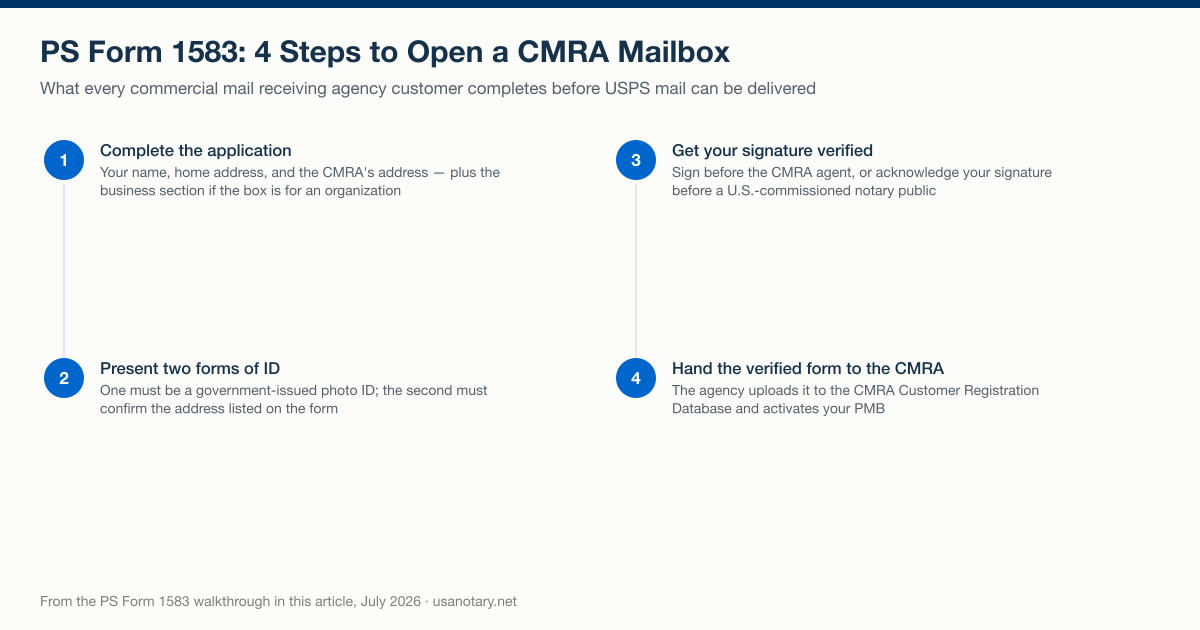
The four PS Form 1583 steps described in this guide, checked October 2026.
The full walkthrough — which IDs qualify, why the notarial act is an acknowledgment rather than a jurat, and how the virtual-presence language works — lives in our canonical guide to getting PS Form 1583 notarized. If your provider routes you to the notary path, you can complete the notarization online for $25 per document: the platform verifies your identity, you acknowledge your signature on live video, and the session produces a tamper-evident notarized PDF and digital audit trail your provider can file.
Why the CMRA rules exist
The regulatory scaffolding — registration, per-customer forms, quarterly certification, Postal Inspection Service access — all serves one purpose stated in the form’s Privacy Act notice: “to verify your identity when applying for service via a CMRA, to ensure proper and secure delivery of mail to the correct recipient, and to permit delivery of your mail to your authorized agent.” Mail delivered to a third party is an identity-fraud surface, and the 1583 chain is how USPS keeps a name attached to every private mailbox in the country.
For customers, that means the ID checks aren’t the mailbox company being difficult — they’re federal postal regulation. For operators, it means the paperwork is recurring, not one-time. This page is the definitional layer; the operational depth lives in the 1583 notarization guide for signers and the virtual-mailbox operator page for the businesses collecting the forms.