
What are the USPS CMRA requirements?
USPS CMRA requirements sit mainly in Domestic Mail Manual § 508.1.8, which defines a commercial mail receiving agency as “a business that, in whole or in part, accepts the delivery of U.S. Mail on behalf of another person or entity as a business service” — and then attaches six standing duties to that status. Virtual mailbox platforms, mail-forwarding services, office business centers, and reshipping providers all sit inside that definition (the DMM classifies office business centers and reshipping/redelivery providers as CMRAs for postal purposes), so the same checklist applies whether you run one storefront or a national platform. Our explainer on what qualifies as a CMRA covers the definitional line; this guide covers the operator’s obligations on the other side of it.
Checked October 1, 2026, against DMM 508.1.8 (the PDF edition headed “Updated 7-12-26”), PS Form 1583-A (January 2023), PS Form 1583 (June 2024) and the USPS CMRA User Guide (Rev. October 30, 2023). The primary sources are listed at the bottom of the page.
The six duties, in the order a new operator meets them:
- Register with the responsible Post Office by submitting PS Form 1583-A before accepting mail for customers.
- Collect a completed PS Form 1583 — with the signature verified and two IDs checked — from every addressee, before delivering their mail.
- Upload each record — the 1583 data plus legible copies of each ID document — to the USPS CMRA Customer Registration Database (CRD).
- Certify the database quarterly (January 15, April 15, July 15, October 15) that every form is current and no ID has expired.
- Use PMB addressing — every customer address carries the “PMB” designation or the ”#” alternative, and the CMRA represents its delivery address as a private mailbox.
- Remail a terminated customer’s mail for at least 6 months (unless the customer gave written instructions not to) and retain the endorsed 1583 copies for at least 6 months after termination.
Each duty gets its own section below, quoting the rule it comes from. One framing note before the detail: USPS CMRA requirements were overhauled in 2023 — a Federal Register proposed rule in January, a final rule in May (effective July 1, with the DMM text published July 9), and a new database user guide in October — and a May 2024 clarification rewrote the signature-verification sentence. Any compliance summary written before that wave describes a system that no longer exists. The timeline section maps the change sequence.
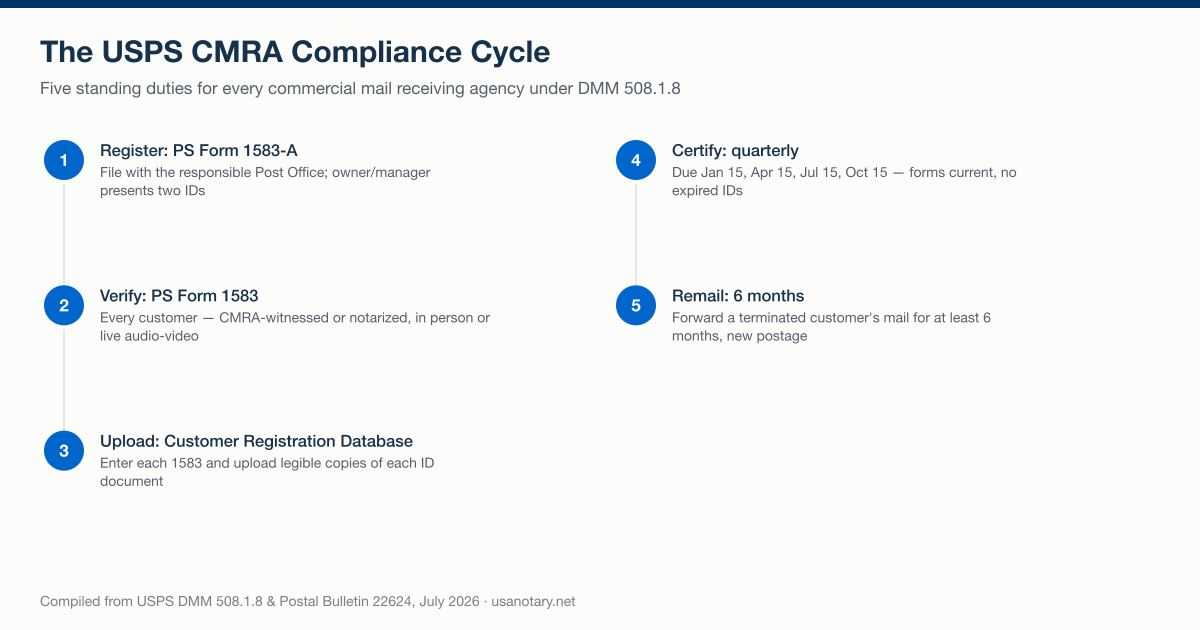
The CMRA compliance cycle under DMM 508.1.8 — five of the six duties that repeat for every operator (PMB addressing is the sixth), compiled from the DMM and Postal Bulletin 22624.
How does a business register as a CMRA with PS Form 1583-A?
Registration runs through the local postmaster before anything else. Under DMM 508.1.8, a CMRA must register with its responsible Post Office by submitting PS Form 1583-A, Application to Act as a Commercial Mail Receiving Agency — the current edition is dated January 2023. The owner or manager presents two types of identification (box 10 of the form): one must contain a photograph of the CMRA owner or manager, and one must bear their home address. The form itself lists what counts — acceptable photo IDs include a valid U.S. state/territory/tribal driver’s or non-driver’s ID card, U.S. Access Card, Uniformed Service ID, passport, Matricula Consular, NEXUS card, certificate of naturalization, or U.S. Permanent Resident Card; acceptable address verification includes a current lease, mortgage or deed of trust, voter or vehicle registration card, or a home or vehicle insurance policy listing the address.
The postmaster or designee is an active participant, not a filing clerk: they verify the owner/manager’s residency, witness the signature, write in the identifying information, and file the completed form. Providing false information — or refusing to provide documentation — is grounds for denial, and the form carries an explicit warning that furnishing false or misleading information may result in criminal and civil sanctions under 18 U.S.C. § 1001.
What the operator agrees to by signing
PS Form 1583-A is short, but the agreement block at the top is the closest thing USPS publishes to a CMRA contract. By signing, the agent agrees to five conditions, printed on the form:
- The CMRA must have on file a PS Form 1583 for the owner/manager and each addressee or firm receiving mail at the agency — the operator files a 1583 too, not just the customers.
- The CMRA must represent its delivery address as a private mailbox.
- The CMRA is not authorized to accept Registered Mail from its clients for mailing — the Post Office is the only acceptable mailing point.
- The CMRA must be in full compliance with DMM 508.1.8 and other applicable postal requirements.
- When any information on the form changes, the owner or manager must file a new application with the postmaster.
That fifth condition catches operators by surprise: a change of manager, address, or contact details means a fresh 1583-A, not a note in the file. Questions about the program itself go to the USPS CMRA office at CMRAprogram@usps.gov — the contact printed on the form.
What does DMM 508.1.8 require for each customer’s PS Form 1583?
Every addressee completes PS Form 1583 before the CMRA may deliver their mail, and the signature on it must be verified through one of exactly two lanes. The DMM’s own sentence, in force since May 1, 2024, is worth quoting in full, because it is the legal basis for remote onboarding:
“The mail addressee (the applicant) must sign or confirm his or her signature in the physical or virtual (in real-time audio and video) presence of the CMRA owner or manager or authorized employee, or acknowledge his or her signature in the physical or virtual (in real-time audio and video) presence of a notary public commissioned in a United States state, territory, possession, or the District of Columbia.” — DMM 508.1.8.3
Both lanes satisfy USPS CMRA requirements; they differ in who does the verifying and who carries the operational load:
| Lane 1: CMRA-witnessed | Lane 2: Notarized | |
|---|---|---|
| Who verifies the signature | The CMRA owner, manager, or an authorized employee | A notary public commissioned in a U.S. state, territory, possession, or D.C. |
| What the applicant does | Signs or confirms their signature | Acknowledges their signature |
| Presence permitted | Physical, or virtual in real-time audio and video | Physical, or virtual in real-time audio and video |
| Who checks the signer’s identity at signing | Your staff, against the DMM’s ID standards | The notary, as part of the notarial act |
| Where the work lands | On your team — training, live sessions, documentation | On the notary — your team receives the completed form |
| Typical fit | Walk-in storefront signups | Remote signups at scale, where no staff member meets the customer |
USPS added that the CMRA owner or manager may witness the signature “provided the applicant presents themself along with two acceptable forms of identification,” and that it “has not prescribed the steps a CMRA must follow when witnessing the execution of PS Form 1583 during a virtual session” (89 FR 35716). Neither lane removes the CMRA’s own duties. In both, the CMRA still collects the two IDs, verifies that the documentation confirms the address on the form, enters the data and uploads legible ID copies to the CRD, and retains a digital copy of the form. The DMM also lists only these two lanes. When a commenter asked USPS to endorse a digital identity verification process in addition to employee verification, USPS answered in its 2023 final rule that it “requires either that” the form “be notarized, or” the applicant’s “identity be verified in person by a CMRA employee” (88 FR 32112). The 2024 rule added virtual presence to both lanes; it did not add a third. On the customer side, an officer signs one form for a business, while each adult on a residential account completes their own — who signs Form 1583 for an LLC or corporation covers the split.
The applicant’s identification must meet the DMM’s standard regardless of lane: acceptable primary and secondary forms of identification as specified under DMM 608.10.0, current (not expired), containing sufficient information to confirm the applicant is who they claim to be, and traceable to the bearer. The 2023 DMM revision added two rules operators should build into intake screening: spouses must each complete a separate PS Form 1583 to receive mail at the same private mailbox, and the address information on the form “must match the photo and address verification documents provided with the application, or the application will be rejected” (Postal Bulletin 22624).
The DMM states the match-or-reject rule bluntly: “If information on the application does not match the identification, the CMRA must deny the application.” It is an easy rule to trip — a customer lists their new apartment while their driver’s license still shows the old one. USPS’s final-rule response to commenters gives the fix: the applicant lists on the form the address that matches the address document, and that document may show an address from before a move (88 FR 32112). Our companion guide on why 1583s get rejected maps each rejection cause to the form box that triggers it, and the signer-side walkthrough of USPS Form 1583’s rules and ID list is the page to hand your customers. This article stays on the operator’s side of the counter.
How does the CMRA Customer Registration Database work?
The CRD replaced paper filing at the Post Office. The January 2023 Federal Register proposed rule (FR doc. 2023-00437) set the direction — CMRA owners or managers would enter each PS Form 1583’s data and upload copies of the supporting identification documents into the Postal Service’s electronic CMRA Customer Registration Database. The DMM revision that followed made it a standing duty, in its own words: “The CMRA must enter the information provided on each PS Form 1583 and upload a clear and legible copy of each identification document into the USPS CMRA Customer Registration Database” (Postal Bulletin 22624).
Access runs through the USPS Business Customer Gateway. Per the CMRA User Guide (Rev. October 30, 2023), you must have a BCG account and an authorized 1583-A location to access the CMRA system — the guide notes that no prior approval is needed to create the BCG account itself, but an approved PS Form 1583-A is required before you can create and access a CMRA account and claim your location. Once inside, the workflow mirrors the form: the add-a-customer flow walks through the applicant’s details, business/organization information, additional mail recipients, identification information, and document upload before submission, and a separate function updates existing customers.
What document types the CRD accepts
The User Guide’s ID table is the database’s own validation list. It states that “Social Security cards, credit cards, and birth certificates are unacceptable as identification” and that each applicant “must present two valid forms of identification (ID), one of which must include a photo.”
| Slot | Document types listed in the User Guide (Table 1) |
|---|---|
| Photo ID | U.S. state/territory driver’s license or non-driver’s ID card; U.S. Access Card / DOD Common Access Card / Personal Identity Verification card; U.S. certificate of citizenship or naturalization; U.S. passport; U.S. permanent resident card; U.S. tribal ID card; U.S. uniformed service ID card; U.S. university identification; foreign passport; Matricula Consular; NEXUS card |
| Address ID | Deed of trust; home or vehicle insurance policy; lease; mortgage; U.S. state/territory driver’s license or non-driver’s ID card; vehicle registration card; voter ID |
Three database behaviors follow from the rule text. First, the CRD tells the CMRA when an ID lapses: USPS says the database “will automatically notify the CMRA when a photo identification document entered has expired” (88 FR 32112). Second, USPS reviews the uploads: “If, upon review by the Postal Service, the image uploaded is not clear and legible, the CMRA will be notified to promptly collect and upload a replacement image.” Third, an operator need not keep its own copies of the ID images once they are uploaded; the DMM says they “are not required to be retained at the CMRA after they are uploaded.” The same final rule gave each CMRA about nine months from USPS’s notification to migrate existing customers onto new forms and database records.
Three CRD habits keep the database defensible at inspection time:
- Upload quality matters. The duty is a “clear and legible copy of each identification document” — a cropped, glare-covered phone photo fails the standard the rule sets.
- Termination dates go in promptly. The DMM requires the CMRA to enter the date of termination in the CRD “as soon as practical” — and stale termination dates are one of the three things the quarterly certification attests to.
- The CRD does not replace local records. The CMRA must still maintain, at minimum, a digital copy of each completed PS Form 1583 at the CMRA business location, available for examination by Postal Service representatives.
Technical problems with the system have their own channel — CMRATechSupport@usps.gov, per the User Guide — separate from the CMRA program office.
When are CMRA quarterly certifications due?
Four dates anchor the CMRA compliance calendar: January 15, April 15, July 15, and October 15. The rule, as published in Postal Bulletin 22624: “The CMRA must certify in the USPS CMRA Customer Registration Database each quarter (certification due on January 15, April 15, July 15, and October 15), that every PS Form 1583 it submitted is current, all termination dates have been updated, and no identification documents are expired.”
Read as an operator’s task list, each certification is a three-part sweep of the customer base:
- Currency sweep — every active PMB has a current PS Form 1583 in the CRD; customers whose details changed need a new application on file, not a note.
- Termination sweep — every closed account shows its termination date in the database.
- ID-expiry sweep — no active customer’s uploaded identification document has passed its expiration date. An ID that was valid at signup and has since expired now fails the certification, which converts ID expiration dates into a recurring re-verification trigger. Our guide to when a Form 1583 must be redone covers what that means for customers mid-lifecycle.
The consequences of falling short are spelled out in two places. PS Form 1583-A warns that failure to comply with DMM 508.1.8 “may subject the agency to withholding of mail until corrective action is taken” — for a mailbox business, an operational stop. And the 2023 DMM revision requires a CMRA to correct all deficiencies the Postal Service identifies in no more than 30 days, or the Postal Service may terminate its authorization to accept mail on behalf of others. The certification itself is an affirmative statement to USPS that the records are current, so run the three sweeps before you certify. The 18 U.S.C. § 1001 warning printed on the 1583-A covers the information on that application.
What are the PMB addressing rules?
Every CMRA customer’s address must carry the private-mailbox designation. Under DMM 508.1.8, customers must use “PMB” or the alternative ”#” sign in their delivery address, and the DMM’s example shows the designator riding on the street line:
JOE DOE 10 MAIN ST STE 11 PMB 234 HERNDON VA 22071-2716
The addressing duty pairs with two of the operator’s 1583-A commitments: the CMRA represents its delivery address as a private mailbox, and it is not authorized to accept Registered Mail from clients for mailing, because the Post Office is the only acceptable mailing point. Two further DMM rules shape the address itself. When the CMRA’s physical address already contains a secondary element such as “suite,” the customer must use “PMB” in the three-line format, and the DMM bars combining the two; its own example of what not to write is “10 MAIN ST STE 11-234.” And USPS may return mail without a proper address to the sender endorsed “Undeliverable as Addressed, Missing PMB or # Sign.” For operators, the practical task is enforcement at signup: publish the exact address format each customer must use, PMB designator included.
USPS address data also carries a CMRA flag. The USPS Web Tools Address Information guide (version 6.1, October 7, 2024) documents a DPVCMRA field described as “Indicates a private business that acts as a mail-receiving agent for specific clients,” where “Y” means “Address was found in the CMRA table.” Address-validation software that reads that field can tell a mailbox address from a residence, whatever the customer writes on the second line.
What must a CMRA do when a customer terminates?
Termination starts a six-month clock, not a clean break. DMM 508.1.8.4 requires the CMRA to remail mail intended for the addressee for at least 6 months after the termination date, and new postage is required for each remailed piece — the forwarding cost sits with the CMRA/customer relationship, not with USPS. The obligation has one exception: it “need not be fulfilled if the CMRA customer provides written instructions to the CMRA that the mail (or specific types of mail) not be remailed.” Those instructions may sit in the service agreement, but they cannot tell the CMRA to refuse or return the mail, hold it during the period, or redeposit it without new postage. After the 6-month period ends, the CMRA may return to the Post Office only First-Class Mail, USPS Ground Advantage - Retail, Priority Mail, Priority Mail Express, or accountable mail, endorsed “Undeliverable, Commercial Mail Receiving Agency, No Authorization to Receive Mail for this Addressee.” The CMRA returns it the next business day after receipt, without new postage.
The records side has its own retention rule: the CMRA must retain the endorsed copies of PS Forms 1583 for a minimum of 6 months after the termination date. Add the CRD duty — the termination date entered “as soon as practical” — and a compliant offboarding runs three steps: enter the termination date in the CRD, keep the endorsed 1583 copies for six months, and remail arriving mail with new postage until the window closes (unless the customer instructed otherwise in writing). Stale records are what the quarterly certification is built to catch: it attests that “all termination dates have been updated.” Build the three steps into an offboarding checklist and the next certification has nothing to reconcile.
How did the 2023 overhaul change CMRA compliance?
The current USPS CMRA requirements arrived in one coordinated wave across 2023, with a 2024 clarification of the signature sentence, and the sequence explains why so much older guidance is wrong:
| Date | What changed | Source |
|---|---|---|
| January 2023 | PS Form 1583-A re-issued — the current edition of the operator registration form | PS Form 1583-A (edition date on form) |
| January 12, 2023 | Federal Register proposed rule published: electronic CRD to replace paper filing, digital 1583 submissions, quarterly certification — comments due February 13, 2023; proposed March 1, 2023 implementation | FR doc. 2023-00437 |
| May 19, 2023 | Federal Register final rule published (88 FR 32112), effective July 1, 2023: adopts the proposal with three changes — private mailboxes may not be used for unlawful activity, CMRAs may dispose of ID copies after upload, and a digital copy of each 1583 suffices | FR doc. 2023-10536 |
| July 1, 2023 | Standards take effect, announced in Postal Bulletin 22624 (issued May 18, 2023); the DMM text was published July 9, 2023: CRD entry and ID-upload duty, quarterly certification dates, spouses-file-separately rule, match-or-reject standard | Postal Bulletin 22624 |
| October 30, 2023 | CMRA User Guide published (Rev –): BCG-based access, add-customer and quarterly-review workflows documented | CMRA User Guide |
| May 1, 2024 | Clarification takes effect (final rule published May 2, 2024; Postal Bulletin 22648 issued April 18, 2024; DMM text published July 14, 2024): the applicant signs or confirms their signature before the CMRA, or acknowledges it before a commissioned notary, in physical or virtual (in real-time audio and video) presence | FR doc. 2024-06989, Postal Bulletin 22648 |
| June 2024 | Current edition of PS Form 1583, which carries that wording; still the edition USPS served on October 1, 2026 | PS Form 1583 (edition line on form) |
Before this wave, a CMRA filed paper 1583 copies with the local Post Office and compliance was largely a filing-cabinet exercise. After it, every customer record is a database entry USPS can query, certification is an affirmative quarterly act with fixed due dates, and ID expiration is a living data point rather than a one-time checkbox. The operational consequence for operators: compliance became continuous. A mailbox business that treats the 1583 as one-and-done onboarding paperwork misses the quarterly certification cycle.
Where does the notarized lane fit an operator’s workflow?
The notarized lane is the verification step an operator can take off its own staff. DMM 508.1.8 puts both lanes on equal footing, so the choice is operational: a storefront with trained staff can witness walk-in signatures in-house, while a remote-first platform either builds a real-time audio-video witnessing program — trained employees, live sessions, session documentation — or routes each signup to a commissioned notary and receives the completed, acknowledged form back.
Routing to online notarization through our PS Form 1583 workflows for virtual mailbox operators works business-initiated: your team uploads the customer’s completed 1583 and sends the session invitation, so the customer never hunts for a notary on their own. Sessions run 24/7 and take 15–30 minutes, signers can connect from all 50 states, and identity verification runs credential analysis plus knowledge-based authentication through a third-party identity-verification service before the notary appears. Each session produces a tamper-evident PDF with a complete audit trail, and the audio-video recording and electronic journal entry are retained for 10 years — or longer where state law requires — which gives an operator a verification record it can point to at inspection time, independent of its own files. Pricing is $25 per document, with volume pricing for operators moving steady signup counts.
The two lanes also mix. Many operators witness in-store signups themselves and reserve the notarized lane for remote customers — the DMM does not require one lane across the whole customer base. Whichever split you run, the downstream duties stay identical: upload to the CRD, certify quarterly, retain the copies, remail for six months after termination.
Questions about wiring the notarized lane into your signup flow? Call 804-767-7500, email ryon@usanotary.net, or reach us through the contact page.