
Does Form 1583 expire?
PS Form 1583 does not expire on a fixed schedule — no USPS rule attaches a validity period, renewal date, or re-signing interval to the form itself. “Form 1583 renewal” is the phrase customers type into search bars; USPS never uses it. The rules speak instead of a new application, and the trigger is a change in the form’s information, not the passage of time.
The obligation is printed on the form. The agreement terms on page 2 of the current PS Form 1583 (June 2024 edition) commit the applicant to five conditions, and the fifth is the one that governs the form’s whole lifecycle: “when any information required on this form changes or becomes obsolete, the applicant must file an updated application with the agent.” The USPS Domestic Mail Manual repeats the rule from the other side of the counter — under DMM 508.1.8, “when any information required on PS Form 1583 changes, the addressee must complete a new application with the CMRA.”
So the honest answer to “does my 1583 need renewing?” is: not because a year passed. A new application is required when the facts on the form stop being true — and, increasingly since 2023, when your mailbox provider can no longer certify to USPS that the form on file is current. Both halves of that rule are covered below, because they land on different people: the first is the customer’s problem, the second is the operator’s.
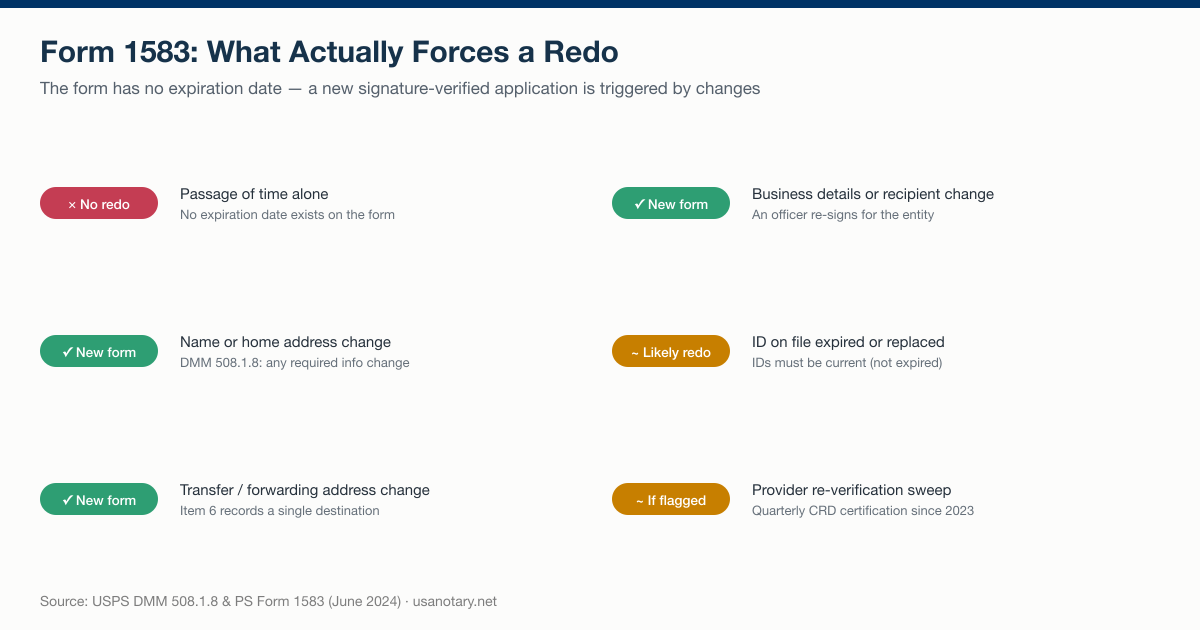
What actually forces a Form 1583 redo under DMM 508.1.8 and the June 2024 form — time alone is the one thing that doesn’t. USPS wording checked October 1, 2026; sources are listed at the bottom of the page.
Where the “renewal” idea comes from
Two real mechanisms feel like renewal from the customer’s side. First, the quarterly certification duty: DMM 508.1.8 requires that “the CMRA must certify in the USPS CMRA Customer Registration Database each quarter (certification due on January 15, April 15, July 15, and October 15), that every PS Form 1583 it submitted is current.” “Current” here means accurate — the information still matches reality — not recently signed. Second, the ID on the form ages even when the form doesn’t: item 8d of the June 2024 form records the expiration date of the applicant’s photo ID, and Postal Bulletin 22624 requires identification documents to be “current (not expired).” A driver’s license that expires two years into your mailbox subscription is exactly the kind of quiet obsolescence that clause 5 of the agreement — “changes or becomes obsolete” — was written for.
Neither mechanism puts a date stamp on the form. Both give your provider a compliance reason to email you asking for a fresh one.
Which changes require a new Form 1583?
Any change to information the form requires is the trigger — USPS wrote the rule as broadly as it reads. DMM 508.1.8’s exact words: “when any information required on PS Form 1583 changes, the addressee must complete a new application with the CMRA.” There is no materiality threshold and no short list of qualifying changes; if a box on the form would now be filled differently, a new application is required.
Mapping that rule onto the June 2024 form’s actual boxes makes it concrete:
| What changed | Where it lives on the June 2024 form | What the rules require |
|---|---|---|
| Legal name | Item 4 (applicant name); item 8a (name on photo ID) | New signature-verified application |
| Home address | Items 4f–4j; the address ID in item 9 must contain the same address | New application, with an address document that matches |
| Transfer / forwarding address | Item 6 (“If Transferring PMB Mail to Another Address”) | New application recording the new destination |
| Business name, type, or address | Item 7 (Business/Organization Information) | New application, signed by an officer with their title |
| Who receives mail at the box | Item 5 (authorized individual); the listed recipients for business use | New application reflecting the change |
| Photo or address ID replaced or expired | Items 8–11 record ID numbers and expiration dates | A current ID must be on file — Postal Bulletin 22624 requires IDs to be “current (not expired),” and USPS says applicants “must update” an expired photo ID (88 FR 32112). USPS has not said whether an ID update alone needs a newly verified form, so ask your provider |
| Nothing — time passed | Item 1a records only the date the PMB opened | No redo; the form is required to stay on file, not to be re-signed |
Residential accounts multiply the effect: the form’s own instructions require “a separate PS Form 1583 for each adult using this PMB,” and Postal Bulletin 22624 adds that “spouses must each complete and sign a separate PS Form 1583 to both receive mail at the same PMB.” A household move therefore means one new application per adult, not one per mailbox. Business accounts work differently — one officer signs for the entity — and the mechanics of that are covered in our guide to who signs Form 1583 for a business or LLC.
“New application” vs. “write Revised on the form”
Older provider help pages still tell customers to mark the redone form “Revised” — that instruction has a real source, but it predates the current rules. Postal Bulletin 22519 (May 9, 2019) told addressees to “file a revised application (write ‘revised’ on the form)” and to re-present acceptable primary and secondary identification with it. The post-2023 DMM text drops the “revised” marking and says plainly that the addressee “must complete a new application.” The practical difference is small — either way you are completing the form again with fresh ID — but the current language settles a question the old wording left open: the redo is a full new application, with everything a new application requires. That includes signature verification, which is the next question.
Does a redone Form 1583 need a new notarization?
Yes — whenever the redo is a new application, new signature verification is required, because verification attaches to each completed form rather than to the customer. The June 2024 form’s own terms give exactly two lanes: the applicant “must sign or confirm their signature in the physical or virtual presence (in real-time audio and video) of the Agent or the Agent’s authorized employee or acknowledge their signature in the physical or virtual presence (in real-time audio and video) of a notary public commissioned in a United States state, territory, possession, or the District of Columbia.”
A notary’s certificate on page 2 acknowledges the signature on that application — “appeared before me, and acknowledged their signature,” in the form’s notary block — and cannot carry over to a different document signed later. The same logic binds the witness lane: the CMRA employee who signs item 14a is verifying the signature event in front of them. Whichever lane verified the original form, the new application goes through a lane again:
| CMRA witness lane | Notary lane | |
|---|---|---|
| Who verifies the signature | CMRA owner, manager, or authorized employee | Notary public commissioned in a U.S. state, territory, possession, or DC |
| How presence works | Physical or virtual presence (real-time audio and video) | Physical or virtual presence (real-time audio and video) |
| What gets completed | Item 14a, signature of CMRA or authorized employee | The notary box at the bottom of page 2, with seal |
| Where it fits a redo | Customers who can walk into the store | Remote customers — the majority of virtual mailbox redos |
For a first-time filing the two lanes are interchangeable; for a re-verification wave they are not, because the customers being re-verified signed up remotely and will redo the form remotely. That is why “form 1583 renewal” traffic converges on online notarization. The full session mechanics — rules, the two-ID list, what the notary checks — are in our step-by-step guide to USPS Form 1583 notarization; the short version is that the National Association of Secretaries of State counts 47 states and the District of Columbia with a law allowing remote e-notarization, and the June 2024 form’s “virtual presence” language invites exactly that path.
The ID does not carry over either
A new application re-collects identification, not just a signature. Postal Bulletin 22519’s revised-application instruction said it directly — the addressee “must provide acceptable primary and secondary forms of identification” with the redo — and the current form’s structure enforces it: items 8 and 9 record the ID documents themselves, and under the post-2023 rules the CMRA “must enter the information provided on each PS Form 1583 and upload a clear and legible copy of each identification document into the USPS CMRA Customer Registration Database” (DMM 508.1.8). A customer redoing the form after a move needs an address document that matches the new address in item 9g’s list — a current lease, mortgage or deed of trust, insurance policy, vehicle registration, or voter card — which is worth telling them before the session, not after it fails. Our breakdown of why 1583s get rejected — and who fixes each cause covers the mismatches that surface at exactly this step.
Why are providers suddenly re-verifying everyone?
Re-verification waves trace to the 2023 CMRA rule overhaul, which turned the Form 1583 from a paper file in a drawer into a live database record USPS can audit. Postal Bulletin 22624 (May 18, 2023) announced the revision with an unusual urgency note: “Although the Postal Service will not publish these revisions in the DMM until July 9, 2023, the standards are effective July 1, 2023.” From that date, every commercial mail receiving agency — every virtual mailbox platform, mail center, and coworking space that takes delivery of customers’ mail; see what qualifies as a CMRA — took on three standing duties:
- Database entry and ID upload. The CMRA must enter each form’s information and upload “a clear and legible copy of each identification document” into the USPS CMRA Customer Registration Database.
- Quarterly certification. The CMRA must certify in the database each quarter — January 15, April 15, July 15, October 15 — “that every PS Form 1583 it submitted is current.”
- Retention and inspection. The CMRA must keep at minimum a digital copy of each completed 1583 at its business location, available “at all times” for examination by Postal Service representatives and inspectors, and must retain endorsed copies for at least 6 months after a customer terminates.
The operator’s side of these rules, item by item, is in the CMRA compliance checklist.
The enforcement teeth are printed in the same bulletin: “If the CMRA does not comply in 30 days or less, the Postal Service may terminate the CMRA’s authorization to accept mail on behalf of others.” The form itself adds the customer-facing version — non-compliance subjects the agency to “withholding of mail from delivery until corrective action is taken.” The same final rule stated that existing private-mailbox customers “will need to complete a new PS Form 1583 and provide copies of their identification documents,” and gave CMRAs nine months to migrate them (88 FR 32112). An operator whose archive still holds paper forms, missing ID copies or scans too blurred to meet the “clear and legible” standard has a gap against the certification statement, and the way to close it is collecting new, signature-verified forms. From the customer’s inbox that looks like an arbitrary “renewal” demand; from the operator’s side it follows from the certification duty.
The compressed timeline of how the rules got here:
- May 18, 2023 — Postal Bulletin 22624 publishes the revised CMRA standards.
- July 1, 2023 — the new standards take effect, ahead of their DMM publication.
- July 9, 2023 — the revisions appear in Domestic Mail Manual 508.1.8.
- June 2024 — USPS issues the current edition of PS Form 1583, with the virtual-presence verification language and expanded ID fields.
- Every quarter since — certification deadlines on January 15, April 15, July 15, and October 15 keep every CMRA’s customer file under a recurring accuracy attestation.
What to do if you’re the customer being re-verified
Comply, quickly — the leverage sits entirely with the rules, not the provider. A CMRA is barred from delivering mail to an addressee without a compliant form on file, and its authorization to operate depends on certifying your record. Redoing the form costs one video session; arguing about it can cost you your mail. Before the session, check three things: your photo ID is unexpired, your address document matches the home address you’ll enter, and every box that changed since your original filing is updated in the same pass, so one redo covers everything.
Do you need one Form 1583 per forwarding address?
USPS rules never state “one form per forwarding address” in those words — the requirement emerges from the form’s structure. Item 6 of the June 2024 form, “If Transferring PMB Mail to Another Address,” records a single destination, and the form’s footnote instructs: “Complete item 6 if the mail addressed to this PMB is to be transferred, mailed, shipped, or emailed to another address.” The transfer destination is therefore information required on the form — and information required on the form, when it changes, requires a new application under DMM 508.1.8.
Change where your provider forwards your mail, and item 6 no longer matches reality; the compliant result is a new signature-verified 1583 showing the new destination. Providers that ask for a fresh form per forwarding address are not inventing paperwork — they are applying the change rule to the box that changed. For digital nomads who redirect mail as they move, this is the single most frequent redo trigger, and it is worth planning around: consolidate to one stable forwarding destination (a permanent address or a freight forwarder) rather than updating item 6 with every border crossing, or budget for a session per change.
How should operators run a re-verification wave?
A re-verification wave is a compliance project with a churn risk attached, and the operators who run it well treat the notarization step as the bottleneck to engineer around, not an afterthought. Every redone form must come back signature-verified through one of the two lanes — and a witness lane built for walk-in retail cannot re-verify a remote customer base. A staff-initiated online notarization workflow can: the operator’s team uploads the pre-filled form, invites the customer, and receives the completed, notarized PDF back for database upload. That workflow, with volume handling for exactly this scenario, is what our Form 1583 notarization service for virtual mailbox operators is built for.
The working sequence:
- Audit the database against the active customer list. Every active box needs a record in the CMRA Customer Registration Database with a legible ID copy. The gap list is the wave.
- Segment by defect. Missing ID copy, expired ID recorded in item 8d, information that no longer matches, pre-June-2024 editions missing current fields — each defect determines what the customer must bring to the redo.
- Pre-fill the June 2024 edition for each customer. The customer should verify and sign, not transcribe. Pre-filling also lets staff catch the mismatches that cause rejections before a notary ever joins.
- Send staff-initiated session invitations. Sessions that run 24/7 matter here: a re-verification wave hits customers in every time zone, and a weekend session beats a Monday queue.
- Upload and retain on receipt. Enter the form’s information and the ID copies into the database as each notarized PDF lands, and keep the digital copy available for inspection at the business location.
- Sweep the stragglers before the certification date. The quarterly deadlines — January 15, April 15, July 15, October 15 — are the wave’s real calendar. Customers still unverified as the date approaches are the ones to escalate from email to phone.
Two record-keeping rules keep applying after the wave ends. Customers who refuse and cancel do not leave the books immediately: the CMRA “must remail mail intended for the addressee (customer) for at least 6 months after the termination date,” and endorsed 1583 copies must be retained for a minimum of 6 months after termination. Terminated accounts still occupy your compliance file for two more quarterly cycles.
At wave volume, per-document economics decide the tooling. A rate of $25 per notarized document, with volume pricing available, prices a thousand-customer re-verification as a known line item instead of an open-ended staffing problem — and each session returns a tamper-evident PDF with a complete audit trail, which is precisely the artifact an operator wants sitting behind a quarterly certification it must sign.
The fastest redo: one 15–30 minute session
A Form 1583 redo is among the quickest notarizations there is — the form is two pages, the notarial act is a simple acknowledgment, and the June 2024 edition was drafted with live audio-video verification written into its terms. The customer joins with their unexpired photo ID and matching address document, the notary verifies identity, watches the acknowledgment, and completes the notary box on page 2. Sessions run 24/7 and take 15–30 minutes; multi-signer sessions handle the household case, where each adult using the PMB completes their own form in one sitting. The redone form arrives as a tamper-evident notarized PDF, ready for the provider to upload to the registration database the same day.
The rule to carry away: the form never expires; the facts on it do. When a fact changes — name, home, business, recipients, forwarding destination — a new signature-verified application is required, and when a provider’s 2023-era database duties catch an old file, the same redo is required even though nothing about the customer changed. Either way the redo is one session, not a project.
Operators planning a re-verification wave or wiring notarization into a signup funnel can call 804-767-7500 or reach us here — bring your monthly 1583 volume and we’ll map the workflow.