
Every set of interrogatory answers a law firm serves needs one more signature after the drafting is done — the client’s, on the verification page. A verification of interrogatories is the short statement, attached to the answers, in which the answering party confirms the answers are true. The rules put that duty on the client personally: the attorney can draft every word of the answers, but the attorney cannot supply the oath.
Whether that verification page must be notarized is a forum-by-forum question, and it decides whether your client signs at the kitchen table in two minutes or has to find a notary before the deadline. Federal courts accept an unsworn declaration under 28 U.S.C. § 1746. Texas, California, and New York each maintain their own unsworn-substitute statutes. Nevada’s court self-help forms still send the signer to a notary. This guide works through the rule texts — FRCP 33, Texas Rule 197.2, NY CPLR 3133, and their unsworn-declaration counterparts — and ends with the workflow litigation teams use when a sworn, notarized verification is required and the client is three states away.
One term pinned before we start: “verification” in this guide means the discovery verification page — the truth certificate at the back of the answers — not the identity verification a notary performs at the start of a notarization session. Both come up below; they are different things.
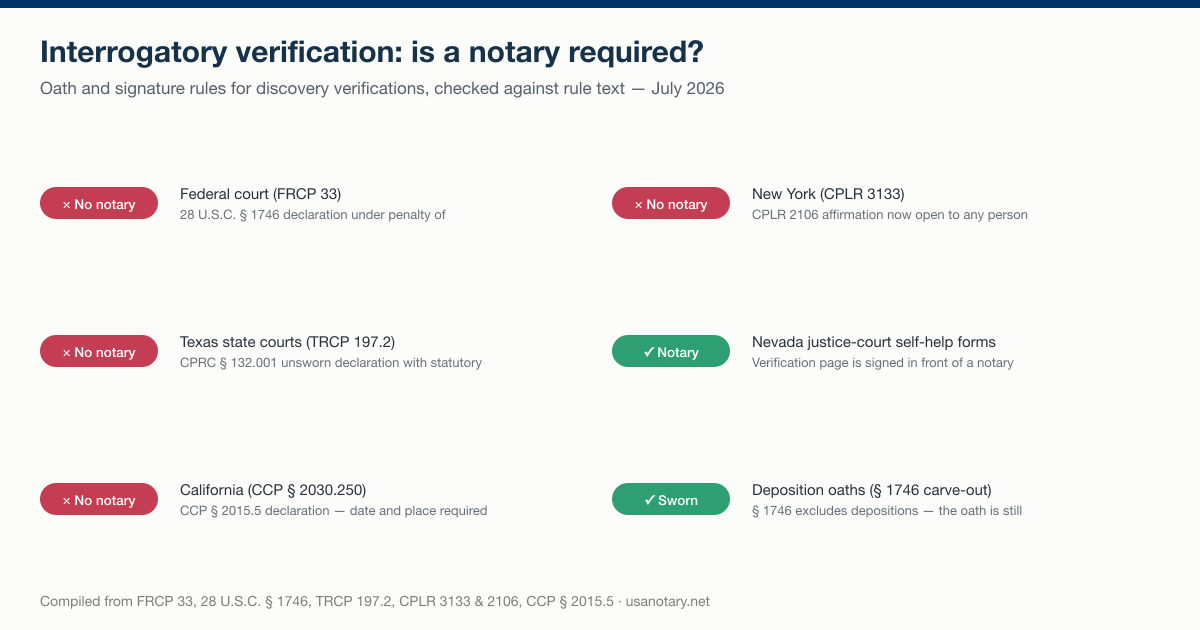
Forum-by-forum verdicts from this article’s rule-text review — most forums now accept an unsworn substitute, July 2026.
What is a verification of interrogatories?
A verification of interrogatories is a signed truth statement attached to written discovery answers, and it exists because the rules require the answers themselves to be given under oath. FRCP 33(b)(3) states the federal requirement in one sentence: “Each interrogatory must, to the extent it is not objected to, be answered separately and fully in writing under oath.” New York’s CPLR 3133(b) requires answers in writing under oath, with each answer preceded by the question it responds to. Texas Rule 197.2(d) is titled, bluntly, “Verification required; exceptions.” The verification page is the mechanism that attaches the oath to the answers — without it, the answers are a draft, not testimony.
The verification can take one of two legal forms, and the difference between them is the entire notarization question:
- A sworn verification. The client signs before a notary public or another officer authorized to administer oaths; the officer administers the oath and completes a jurat certificate. This is the classic notarized verification — the same execution ritual as an affidavit. Our guide to the difference between a jurat and an acknowledgment covers the certificate the notary completes here.
- An unsworn declaration. The client signs a statement under penalty of perjury with no notary involved, under a statute that gives the unsworn signature the same legal force — 28 U.S.C. § 1746 in federal court, CCP § 2015.5 in California, CPRC § 132.001 in Texas, CPLR 2106 in New York.
A verification is not quite an affidavit, though the two travel together in litigation. An affidavit is a standalone sworn narrative that tells its own story; a verification attaches to another document and certifies that document’s truth. The broader instrument-choice question — when a matter calls for one or the other — is the subject of our affidavit vs. declaration decision guide; this article stays on the discovery-specific version.
Who must sign the verification: the client, not the attorney
The answering party must sign the answers under oath in every forum covered here — FRCP 33, Texas Rule 197.2, NY CPLR 3133, and California CCP § 2030.250 all place the signature on the client, and reserve the attorney’s signature for objections. This is the single most common mistake in discovery verification: a verification signed by counsel instead of the client does not satisfy the rule.
The federal rule draws the line twice. FRCP 33(b)(1) directs that interrogatories “must be answered: (A) by the party to whom they are directed; or (B) if that party is a public or private corporation, a partnership, an association, or a governmental agency, by any officer or agent, who must furnish the information available to the party.” Then FRCP 33(b)(5) splits the signatures: “The person who makes the answers must sign them, and the attorney who objects must sign any objections.” Answers belong to the party; objections belong to the lawyer.
Texas says it even more directly. Rule 197.2(d) provides that “a responding party — not an agent or attorney as otherwise permitted by Rule 14 — must sign the answers under oath except that: (1) when answers are based on information obtained from other persons, the party may so state, and (2) a party need not sign answers to interrogatories about persons with knowledge of relevant facts, trial witnesses, and legal contentions.” Those two exceptions matter in practice: a Texas client who answered from company records or other people’s knowledge can say so, and the classic “identify persons with knowledge” and contention interrogatories need no client signature at all. Everything else does.
New York’s CPLR 3133(b) requires the answers to be made by “the party served, if an individual,” and, for a corporation, partnership, or sole proprietorship, by “an officer, director, member, agent or employee having the information.” California’s CCP § 2030.250 has the party sign the response under oath unless the response contains only objections, with an officer or agent signing on behalf of an entity — and it adds a trap worth knowing: if the person signing for an entity is its attorney acting in that capacity, the entity waives lawyer-client privilege and work-product protection as to the sources of the information in the response. Even where an attorney signature is technically possible, California prices it at privilege.
The pattern across all four rule texts is consistent: the verification of interrogatories carries the client’s own exposure to perjury consequences, which is precisely why the rules refuse to let the attorney absorb it.
Is notarization required for a verification of interrogatories?
Notarization is required for a verification of interrogatories only where the forum offers no unsworn substitute — and federal court, Texas, California, and New York all now offer one, while Nevada’s justice-court self-help forms still route the signer to a notary. Here is the forum-by-forum picture, checked against the current rule and statute texts:
| Forum | Oath rule | Unsworn substitute | Is a notary required? |
|---|---|---|---|
| Federal court | FRCP 33(b)(3): answers “in writing under oath” | 28 U.S.C. § 1746 declaration under penalty of perjury | No |
| Texas state courts | TRCP 197.2(d): the party “must sign the answers under oath” | CPRC § 132.001 unsworn declaration with statutory jurat block | No |
| California | CCP § 2030.250: the party signs “under oath” | CCP § 2015.5 declaration (date and place if signed in CA) | No |
| New York | CPLR 3133(b): answers “in writing under oath” | CPLR 2106 affirmation under the penalties of perjury | No |
| Nevada (justice-court self-help forms) | Verification page signed and sworn | Self-help instructions provide none | Yes — “in front of a notary” |
Federal court: the § 1746 declaration
Federal practice removed the notary from most verifications in 1976. 28 U.S.C. § 1746 provides that wherever any matter under federal law or rule “is required or permitted to be supported, evidenced, established, or proved by the sworn declaration, verification, certificate, statement, oath, or affidavit” of the person making it, the matter “may, with like force and effect, be supported, evidenced, established, or proved by the unsworn declaration.” The word “verification” sits right in the statute’s list — the FRCP 33(b)(3) oath requirement is satisfied by a § 1746 declaration.
The statute carves out three situations where the unsworn substitute does not work: “a deposition, or an oath of office, or an oath required to be taken before a specified official other than a notary public.” A deposition witness still gets sworn in live; a § 1746 signature cannot replace that oath. But for the verification page on interrogatory answers, the declaration is the standard federal-court instrument.
Texas, California, and New York: the state unsworn substitutes
Texas built the same bridge in CPRC § 132.001: “An unsworn declaration may be used in lieu of a written sworn declaration, verification, certification, oath, or affidavit required by statute or required by a rule, order, or requirement adopted as provided by law.” Again, “verification” appears in the statutory list, which is how Texas litigants satisfy Rule 197.2(d)‘s oath without a notary. Texas demands more form than federal law: the declaration must be in writing and subscribed as true under penalty of perjury, with a statutory jurat block containing the declarant’s name, date of birth, address, the county and state of execution, and the date. The statute’s exceptions — liens and instruments concerning real or personal property filed with county clerks, and oaths of office or oaths before officials other than notaries — do not touch discovery verifications.
California’s CCP § 2015.5 allows any matter that requires a sworn affidavit to be supported instead by an unsworn declaration “certified or declared … to be true under penalty of perjury.” One California-specific wrinkle: a declaration executed inside the state must state the date and place of execution, while one executed elsewhere must recite that it is made “under penalty of perjury under the laws of the State of California.” Like § 1746, the section does not apply to depositions or oaths of office.
New York historically demanded the notarized affidavit more often than any other large forum — and then rewrote the rule. The current CPLR 2106 allows “the statement of any person wherever made, subscribed and affirmed by that person to be true under the penalties of perjury” to substitute for a sworn statement in a New York action. What was once a privilege reserved for attorneys, physicians, and a few other professions now extends to every litigant, which reaches the CPLR 3133(b) verification.
Where the sworn, notarized verification is still required
A notarized verification is required, or is the only safe choice, in a shorter but stubborn list of situations. Nevada’s Civil Law Self-Help Center tells justice-court litigants directly: “Your interrogatory answers must be ‘verified,’ meaning you must sign the verification page included with the form below in front of a notary and swear that your answers are true.” A firm following the court’s own form set in that forum sends the client to a notary, full stop.
Beyond any single forum, four recurring scenarios keep the notarized version alive for litigation teams:
- The substitute statute does not reach the act. § 1746 and § 2015.5 both exclude depositions and oaths of office; an oath that must be administered live stays live.
- The forms do not transfer between forums. Each statute prescribes its own formula — California wants the place of execution, Texas wants a jurat block with date of birth and address, New York wants its specific affirmation sentence. A verification drafted to one state’s formula can misfire in another, so multistate teams either match the forum’s wording exactly or default to the sworn version, which every forum accepts.
- A local rule, court form, or opposing counsel demands it. The unsworn substitute is a floor; nothing stops a court’s own form set — Nevada’s is the live example — from building the notary in.
- The same signing session covers documents that independently must be notarized. If the client is also executing an affidavit for a motion or a sworn statement headed for recording, one notarized session covers the whole stack — see our walkthrough of how to notarize an affidavit online for that companion workflow.
What does the verification actually say? Sample language by forum
The operative language of the verification is prescribed by statute in the declaration forums, so the safest drafting move is to lift the statutory formula verbatim. Here are the forms exactly as the statutes give them.
Federal — 28 U.S.C. § 1746, executed within the United States:
“I declare (or certify, verify, or state) under penalty of perjury that the foregoing is true and correct. Executed on (date). (Signature)”
Federal — § 1746, executed outside the United States (useful when the client is abroad — for a federal filing, the statute solves the overseas-notary problem on its own):
“I declare (or certify, verify, or state) under penalty of perjury under the laws of the United States of America that the foregoing is true and correct. Executed on (date). (Signature)”
California — CCP § 2015.5, executed within California:
“I certify (or declare) under penalty of perjury that the foregoing is true and correct” — followed by date, place, and signature.
New York — CPLR 2106 affirmation:
“I affirm this ___ day of ______, ____, under the penalties of perjury under the laws of New York, which may include a fine or imprisonment, that the foregoing is true, except as to matters alleged on information and belief and as to those matters I believe it to be true, and I understand that this document may be filed in an action or proceeding in a court of law.”
Texas — CPRC § 132.001: Texas does not use a one-line form; the statute requires the unsworn declaration to be subscribed as true under penalty of perjury and to include a jurat block with the declarant’s name, date of birth, address, the county and state where it is executed, and the date of execution, closing with the declaration that the foregoing is true and correct.
The sworn, notarized version: the verification recites that the signer has read the answers and that they are true, and the client signs it in the notary’s presence after the notary administers the oath. The notary then completes a jurat certificate and affixes the seal. The document that comes out of that session is executed the same way as any sworn affidavit — the oath, the observed signature, and the certificate are what make it “sworn.”
What happens if answers go out unverified?
Unverified answers fail the oath requirement that every forum’s rule imposes — FRCP 33(b)(3), TRCP 197.2(d), and CPLR 3133(b) each require the answers to be made under oath — but the forums differ on how fatal the defect is and how gracefully it can be cured.
Texas is the most forgiving on paper, and says so in the rule’s own comments: “The failure to sign or verify answers is only a formal defect that does not otherwise impair the answers unless the party refuses to sign or verify the answers after the defect is pointed out.” The same comments note that answers in amended and supplemental responses need the party’s oath only if the original answers required it. In other words, a missing Texas verification is a fixable oversight — until the client refuses to fix it.
The practical failure mode is rarely refusal; it is logistics. Answers get finalized the afternoon they are due, the client is in another city, and the verification page — the one part of the response the firm cannot sign — is the bottleneck. In a declaration forum, the cure is an emailed signature page. In a forum where the sworn verification is required, the cure historically meant a notary trip, and the deficiency letter from opposing counsel arrives faster than the client can make one. That timing gap, not any dispute about the rule, is what pushes litigation teams toward remote notarization for verifications.
The stakes riding on the page are real even when the defect is curable. Nevada’s self-help center puts the warning in plain terms: “Take the time to make sure your answers are correct and truthful. You will be signing them under penalty of perjury.” The verification is where discovery answers become the client’s own sworn word — the reason every one of these rules insists on the client’s signature in the first place.
How firms get a remote client’s verification notarized online
Remote online notarization lets the client sign the sworn verification in a live, recorded video session with a commissioned notary — and the legal footing is broad: the National Association of Secretaries of State reports that 47 states and the District of Columbia have a law that allows for remote e-notarization. For the recognition question across state lines, see our guide to whether a remote notarization is valid out of state.
Here is the workflow a litigation paralegal runs when the forum requires the sworn verification and the client is remote:
- Send the verification page from the firm. Through a staff-initiated workflow, the paralegal uploads the verification page and enters the client’s contact details — the client receives a session link without creating anything themselves. The notary notarizes the client’s signature on the firm’s document; the notary does not draft or alter it.
- The client verifies identity. Before the session, the client completes credential analysis of a government-issued ID plus knowledge-based authentication, run by a third-party identity-verification service — this is the “identity verification” pinned in the introduction, and it is separate from the discovery verification being signed.
- The client signs in a recorded video session. Sessions are available 24/7 and take 15–30 minutes. The commissioned notary administers the oath on live video, watches the client sign, and completes the jurat and electronic seal. If a companion affidavit needs a witness, remote witnesses are supported where state law and the document’s rules permit.
- The firm receives the sealed document the same day. The session produces a tamper-evident PDF plus a complete audit trail, and the audio-video recording and electronic journal entry are retained for 10 years or longer where state law requires — a durable evidentiary record if the verification’s execution is ever challenged.
The economics favor the remote session heavily for a one-page verification: pricing is $25 per document, with volume pricing for firms that push regular discovery traffic through the platform, and the signer can be in any of the 50 states. Compare that against the real cost of the alternative — a paralegal chasing a client’s calendar, the client leaving work to find a notary, and a response deadline absorbing all of the slack.
Litigation teams that verify interrogatory answers every month can set up business-initiated workflows, multi-signer sessions for corporate officers, and matter-by-matter document delivery through our online notarization service for law firms. Questions about a specific verification or a recurring discovery workflow? Call 804-767-7500 or reach us through the contact page.