
Declaration vs affidavit: what’s the difference?
The difference between a declaration and an affidavit comes down to the notary. An affidavit is sworn before a notary public or another officer authorized to administer oaths, and it carries that officer’s certificate as proof the oath happened. A declaration is signed under penalty of perjury with no notary at all — a federal statute, 28 U.S.C. § 1746, and a growing list of state statutes make that unsworn signature legally equivalent to the sworn version for most court filings.
Both instruments do the same evidentiary job: a written statement of facts, signed by the person with knowledge of them, offered to a court or agency as if the person had testified. Lying in either one is perjury. The choice between them is not a style preference — it is dictated by the forum. Federal courts run on declarations. Some state courts accept declarations by statute; others still require the sworn affidavit. Recording offices, and a handful of document types, are carved out of the substitution statutes entirely, so notarization is required for them no matter what the rest of the state’s practice looks like.
This guide maps the declaration vs affidavit decision the way a litigation team actually meets it — which forum, which statute, which carve-out — with every rule checked against the statute text as of July 2026.
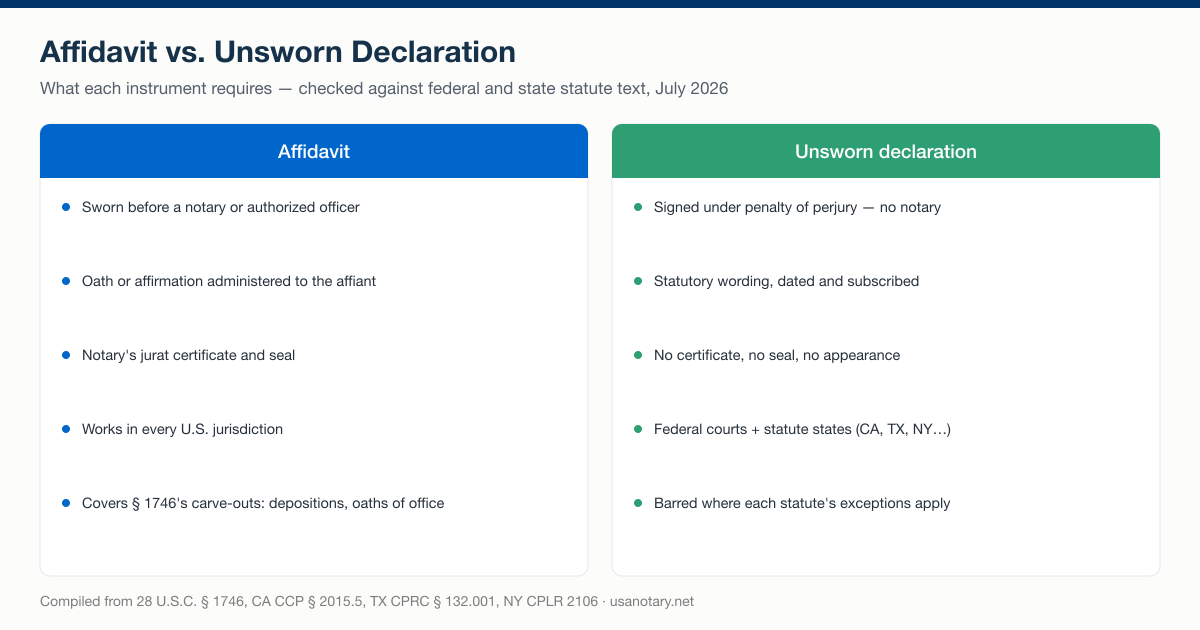
The two instruments side by side — what each requires, compiled from the federal and state statutes cited in this article, July 2026.
What makes an affidavit an affidavit?
An affidavit is a written statement of fact that its signer swears to — or affirms — before an officer authorized to administer oaths, almost always a notary public. Strip out any one of its three elements and the document stops being an affidavit:
The first element is the affiant, the person making the sworn statement. The affiant must appear before the officer — historically in person, now also by live audio-video in the states that authorize remote online notarization — because the officer has to verify who is signing before administering anything.
The second element is the oath or affirmation itself. The notary puts the affiant under oath verbally, in the officer’s presence, before the signature goes on. An affirmation is the secular version of the same act; the perjury exposure is identical. This live ceremony is the piece of legal machinery the declaration statutes were written to replace.
The third element is the notary’s certificate. An affidavit closes with a jurat — the certificate in which the notary states that the affiant appeared, was identified, and swore to the contents before signing. The jurat is one of the two core notarial certificates, and it is the one that carries an oath; the distinction is mapped in our guide to jurat vs. acknowledgment certificates. An acknowledgment on an affidavit is the wrong certificate, because an acknowledgment certifies a signature without administering any oath.
Because all three elements route through a commissioned officer, an affidavit works in every U.S. jurisdiction. That universality is the affidavit’s remaining advantage: no one ever rejects a filing for being too sworn. The declaration’s advantage is everything else — no appointment, no notary fee, no logistics between a paralegal and a client three time zones away.
When can a declaration replace an affidavit in federal court?
In federal court, a declaration replaces an affidavit almost anywhere one is called for. 28 U.S.C. § 1746 provides that whenever a federal law, rule, regulation, or order requires or permits a matter to be supported by a sworn declaration, verification, certificate, statement, oath, or affidavit, the matter “may, with like force and effect, be supported, evidenced, established, or proved” by an unsworn declaration subscribed as true under penalty of perjury. The statute has governed federal practice for decades, and the federal rules have been rewritten around it.
Summary judgment: the rules treat them identically
Rule 56(c)(4) of the Federal Rules of Civil Procedure names both instruments in one breath: “An affidavit or declaration used to support or oppose a motion must be made on personal knowledge, set out facts that would be admissible in evidence, and show that the affiant or declarant is competent to testify on the matters stated.” The 2010 Committee Note to Rule 56 says it directly: “A formal affidavit is no longer required. 28 U.S.C. § 1746 allows a written unsworn declaration, certificate, verification, or statement subscribed in proper form as true under penalty of perjury to substitute for an affidavit.”
The practical consequence for motion practice: the fight over a declaration is never about the missing notary. It is about personal knowledge, admissibility, and competence — the same three attacks that have always applied to affidavits. A declaration signed under penalty of perjury with the correct statutory wording is procedurally bulletproof on form; a declaration reciting facts the declarant could not know is worthless regardless of how it was signed.
Discovery: the client’s signature on interrogatory answers
Rule 33(b)(3) requires each interrogatory to be answered “separately and fully in writing under oath,” and Rule 33(b)(5) requires the person who makes the answers — the client, not the attorney — to sign them. Because § 1746 extends by its terms to any matter required to be supported by an oath, a federal interrogatory verification can be signed as a § 1746 declaration instead of sworn before a notary. That single substitution is why chasing a client’s verification of interrogatories is a same-day email task in federal practice and a scheduling problem in the state forums that still require the sworn version.
The three exceptions written into § 1746
Section 1746 carves out three situations where the unsworn declaration does not work, and each one survives in modern practice:
- Depositions. Deposition testimony stays sworn — the statute expressly excludes depositions, so the oath is administered live at the deposition rather than replaced by paperwork.
- Oaths of office. A declaration cannot substitute for the oath a public officer takes to assume office.
- Oaths required to be taken before a specified official other than a notary public. Where a statute names the officer who must administer the oath, § 1746 steps aside and the named officer’s oath is required.
Everything else in the federal system — summary judgment declarations, verifications, administrative filings under federal law — runs on the penalty-of-perjury signature.
Which states accept unsworn declarations instead of affidavits?
State practice on declaration vs affidavit splits three ways: states with their own general substitution statute, states that enacted the Uniform Law Commission’s Unsworn Declarations Act, and states where the notarized affidavit remains the default because no substitute statute exists. The statutes below were each checked against current text:
| Jurisdiction | Authority | What it allows | Conditions that trip people up |
|---|---|---|---|
| Federal courts | 28 U.S.C. § 1746 | Unsworn declaration in place of any sworn statement, oath, or affidavit | Not for depositions, oaths of office, or oaths before a specified official other than a notary |
| California | CCP § 2015.5 | Unsworn statement, declaration, verification, or certificate under penalty of perjury | Must be dated; must state the place of execution if signed in California; signed elsewhere, the wording must invoke “the laws of the State of California” |
| Texas | CPRC § 132.001 | Unsworn declaration in lieu of a sworn declaration, verification, certification, oath, or affidavit required by statute or rule | Form must include the declarant’s date of birth and address; excluded: liens and property instruments filed with a county clerk |
| New York | CPLR 2106 | Affirmation by any person, wherever made, with the same force and effect as an affidavit | Wording must warn that the penalties of perjury “may include a fine or imprisonment” |
| Other states | Uniform Unsworn Declarations Act, where adopted | Declaration under penalty of perjury as an alternative to the notarized affidavit | Adoption is state by state — confirm the forum state’s statute before filing |
California: the date and place are part of the form
California’s § 2015.5 is the oldest pattern most lawyers know, and its formalities are real filing-rejection risks. The certification must show the date of execution, and — the one everyone forgets — the place of execution when the declaration is signed inside California. A declaration signed outside California must instead recite that it is made “under penalty of perjury under the laws of the State of California.” The section mirrors the federal carve-outs: depositions, oaths of office, and oaths before a specified official other than a notary are excluded.
Texas: an identity block replaces the notary
Texas § 132.001 substitutes self-identification for the notary’s identification. The statutory form requires the declarant’s full name, date of birth, and complete street address above the penalty-of-perjury sentence, closing with the county, state, and date of signing. Texas also shows how a substitution statute protects the recording system: the section does not apply to a lien required to be filed with a county clerk or to an instrument concerning real or personal property required to be filed with a county clerk. In the deed records, notarization is required exactly as before.
New York: any person can now affirm
New York rewrote this rule recently, and much of the internet has not caught up. CPLR 2106 now lets the statement of any person, wherever made, affirmed to be true under the penalties of perjury, be used “in lieu of and with the same force and effect as an affidavit” — expressly including a certificate, a response to a notice to admit, an answer to interrogatories, a verification of a pleading, and a bill of particulars. The prior version of the rule limited affirmations to attorneys, physicians, osteopaths, and dentists; the 2023 amendment removed those restrictions to align New York with federal practice. The trade-off is New York’s stricter form language: the affirmation must warn that the penalties of perjury “may include a fine or imprisonment.”
For states beyond these three, the Uniform Law Commission’s Unsworn Declarations Act is the model — it enables declarations under penalty of perjury as an alternative to notarized affidavits, aligned with 28 U.S.C. § 1746. Where the forum state has enacted neither the uniform act nor its own statute, the default rule stands: the affidavit is sworn before a notary, or the filing is defective.
When is a notarized affidavit still required?
A notarized affidavit is required wherever the substitution statutes stop — and every substitution statute writes its own stopping point. Six situations recur across jurisdictions:
- Depositions. Excluded by § 1746 federally and by California § 2015.5 expressly. The deposition oath is administered live.
- Oaths of office and oaths before a named official. Both the federal statute and its state counterparts step aside when the law specifies who must administer the oath.
- County recording offices. Texas § 132.001 excludes liens and real- or personal-property instruments filed with a county clerk. Documents headed for the land records are the most reliable place to assume notarization is required.
- Documents whose own statute builds in the notary. A will’s self-proving affidavit is the standing example in a law firm: the probate shortcut only works because the testator’s and witnesses’ statements are sworn, so the affidavit is the notarized instrument by design.
- State forums with no substitute statute. Where the legislature never enacted an unsworn-declaration law, the sworn-affidavit requirement in the underlying rule or statute controls by default.
- The receiving party’s own demand. Statutes set the floor, not the ceiling. A court clerk applying a local form, an agency, a bank, or an opposing party’s stipulation can insist on a notarized affidavit even where a declaration would satisfy state law — and arguing with the intake desk costs more than the notarization.
The pattern behind all six: substitution statutes replace the oath, but they never replace the identity-verification function a notary performs for the recording system, and they never override a more specific statute that names its own formalities.
What does the correct wording look like?
Declaration wording is prescribed by statute, and the safest drafting move is to lift the language directly from the governing section — courts expect substantial compliance, and the variations between jurisdictions are exactly where substantial compliance fails. The verified forms:
Federal — signed inside the United States (§ 1746(2)):
“I declare (or certify, verify, or state) under penalty of perjury that the foregoing is true and correct. Executed on (date). (Signature)”
Federal — signed outside the United States (§ 1746(1)):
“I declare (or certify, verify, or state) under penalty of perjury under the laws of the United States of America that the foregoing is true and correct. Executed on (date). (Signature)”
California — signed inside the state (CCP § 2015.5), with date and place of execution:
“I certify (or declare) under penalty of perjury that the foregoing is true and correct”
New York (CPLR 2106), with the mandatory penalty warning:
“I affirm this ___ day of ____, under the penalties of perjury under the laws of New York, which may include a fine or imprisonment, that the foregoing is true…”
Texas does not hang its formality on a single sentence: the § 132.001 form adds an identity block — the declarant’s full name, date of birth, and street address — above the penalty-of-perjury statement, and closes with the county, state, and date of signing.
An affidavit needs none of these recitals from the signer, because the oath lives in the notary’s jurat rather than in the affiant’s sentence. The jurat certifies that the affiant appeared before the notary, was identified, and swore to the contents — which is why an affidavit’s validity travels across state lines more predictably than a declaration’s statutory wording does.
How do you get a remote client’s affidavit notarized?
When the declaration vs affidavit analysis lands on “affidavit,” the client still does not have to find a notary’s office. The National Association of Secretaries of State reports that 47 states and the District of Columbia have a law that allows for remote e-notarization, so the affiant can appear before a commissioned notary by live audio-video, take the oath on camera, and sign — the full jurat ceremony, without the geography problem. The mechanics, document prep, and what the affiant should have ready are covered in our walkthrough of how to notarize an affidavit online.
For a litigation team, the workflow is staff-initiated: a paralegal uploads the affidavit and sends the client a session link; the client completes identity verification (credential analysis plus knowledge-based authentication, run by a third-party identity-verification service); a commissioned notary administers the oath in a recorded video session; and the sealed, tamper-evident PDF comes back with a complete audit trail for the matter file. Sessions run 24/7, take 15–30 minutes, and work for signers in all 50 states — multi-signer sessions handle an affidavit that needs more than one affiant, and remote witnesses are supported where state law and the document’s rules permit. The audio-video recording and electronic journal entry are retained for 10 years, or longer where state law requires.
Two cost notes worth passing to whoever approves vendors. First, notarization is $25 per document, with volume pricing for firms that send recurring work. Second, sometimes the cheapest notarization is none at all: for an overseas client supporting a federal filing, § 1746’s foreign-execution form — “under the laws of the United States of America” — removes the notary requirement entirely, and an honest vendor will tell you so before selling you a session.
The decision rule to keep: declarations replace the oath; they never replace the forum’s carve-outs. Check the forum first — federal court, a § 2015.5/§ 132.001/CPLR 2106 state, or neither — then check whether the document type sits in an exception. When the answer is a notarized affidavit from a client who is anywhere but your conference room, our online notarization service for law firms turns it into a 15-minute video session instead of a week of scheduling. Questions about a recurring affidavit workflow? Call 804-767-7500 or send us the details.