
What is a self-proving affidavit?
A self-proving affidavit is a sworn statement, signed by the testator and the attesting witnesses before an officer authorized to administer oaths, that is attached to a will. The affidavit records — under oath, at the moment everyone is in the room — the facts a probate court would otherwise have to establish through witness testimony after the testator’s death: that the testator declared the instrument to be their will, signed it willingly, and was of sound mind and legal age, and that the witnesses signed in the testator’s presence.
The affidavit is a separate instrument from the will. A will in most states becomes valid through signing and witnessing alone — a will is generally valid without notarization, and that question has its own guide. The self-proving affidavit is the optional add-on that gets notarized: it does not make the will valid, it makes the will easier to prove. For a drafting attorney the trade is lopsided — a few extra minutes at the signing table against a probate filing that needs no witness hunt after the testator’s death.
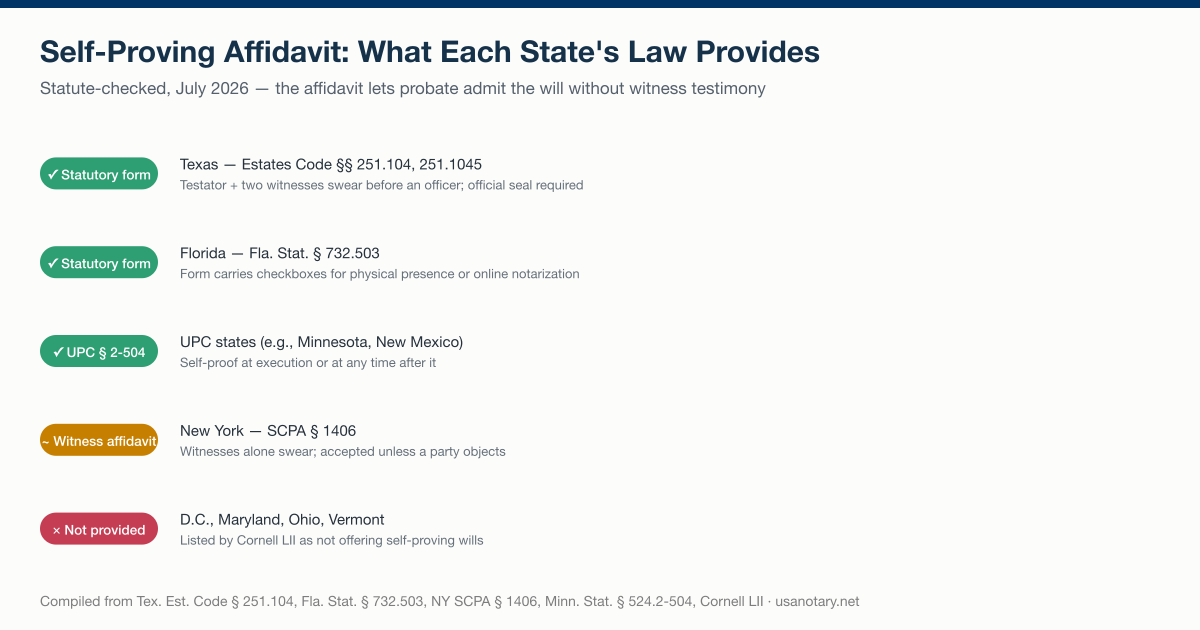
The statute-checked verdicts from this article’s state table — who provides a self-proving affidavit and on what terms, July 2026.
Where the affidavit comes from: UPC § 2-504
Uniform Probate Code § 2-504 is the model provision most state versions trace to. As enacted in UPC states — Minnesota’s version sits at Minn. Stat. § 524.2-504 and New Mexico’s at N.M. Stat. § 45-2-504 — a will may be executed, attested, and made self-proved at the same sitting, “by acknowledgment thereof by the testator and affidavits of the witnesses,” each made before “an officer authorized to administer oaths under the laws of the state in which execution occurs” and evidenced by the officer’s certificate under official seal.
Two details in the UPC design matter in practice. First, an attested will may also be made self-proved later: Minnesota’s statute states that “an attested will may be made self-proved at any time after its execution by the acknowledgment thereof by the testator and the affidavits of the witnesses, each made in the presence of an officer authorized to administer oaths.” Second, New Mexico’s enactment treats a signature on the self-proving affidavit as a signature on the will itself where necessary to establish proper execution — a safety net for a signer who signed the affidavit page but missed a signature line on the will.
What does a self-proving affidavit do in probate?
The affidavit lets the probate court admit the will without calling the attesting witnesses to testify. That is its entire job, and the statutes say so directly. Under Texas Estates Code § 251.102, a self-proved will may be admitted to probate without the testimony of subscribing witnesses. Florida’s probate code is just as blunt: Fla. Stat. § 733.201 provides that “self-proved wills executed in accordance with this code may be admitted to probate without further proof.”
The value compounds with time. The longer the gap between signing and probate, the more the affidavit is worth: witnesses move out of state, forget the signing entirely, or die before the testator. A will without self-proof forces the estate to locate those witnesses — or to fall back on secondary proof procedures — before the court will act. A will with the affidavit attached skips that step: the sworn statements made at execution stand in for the testimony.
What probate looks like without one
A will that is not self-proved must be proved the old way, and Florida’s statute shows what that means in practice. Under § 733.201, the will may be admitted “upon the oath of any attesting witness taken before any circuit judge, commissioner appointed by the court, or clerk.” If the witnesses are dead, incapacitated, or cannot be located within a reasonable time, the court can accept testimony from the nominated personal representative or a disinterested person who believes the document is authentic — a workable fallback, but one that adds filings, delay, and a fact question a contest can exploit. For an estate practice, every non-self-proved will in the file cabinet is a future scheduling problem.
Does a self-proving affidavit need to be notarized?
Yes — notarization is required by the statutes that create the affidavit, because self-proof is built on an oath. The UPC formulation requires the acknowledgment and affidavits to be made before an officer authorized to administer oaths and “evidenced by the officer’s certificate, under official seal.” Texas Estates Code § 251.104 states that a self-proving affidavit must be made by the testator and by the attesting witnesses, directs that “the officer shall affix the officer’s official seal to the self-proving affidavit,” and requires that the affidavit be attached or annexed to the will.
The notarial act involved is oath-based, not signature-based. The testator and witnesses swear that the affidavit’s contents are true and sign in the officer’s presence — the same structure as a jurat, the oath-based notarial act, rather than a simple acknowledgment of a signature. The officer is almost always a notary public — Cornell’s Legal Information Institute describes the affidavits in most states as “signed in front of and stamped by a notary public” — and our guide to who can perform a notarial act covers the other officers who can stand in where a statute allows.
One precision worth keeping straight in client conversations: the will is not notarized; the affidavit is. The statutes call the resulting will “self-proved,” and the attached instrument the “self-proving affidavit.” Conflating the two is how the myth that “wills must be notarized” keeps circulating.
Self-proving affidavit requirements by state
Most states prescribe the affidavit by statute, but who signs it, when it can be made, and what the form must say differ enough that a multi-state estate practice needs a per-state checklist. Here is the picture as confirmed against current statute text this month:
| State / regime | Statute | Who signs the affidavit | Notary / officer required? | Notable rules |
|---|---|---|---|---|
| Texas | Est. Code §§ 251.104, 251.1045 | Testator + attesting witnesses | Yes — officer’s official seal affixed | Two routes: attached affidavit (§ 251.104) or one-step combined execution (§ 251.1045, where substantial compliance with the form suffices) |
| Florida | Fla. Stat. § 732.503 | Testator (acknowledgment) + witnesses (affidavits) | Yes — officer authorized to administer oaths, with certificate | Statutory form includes checkboxes for physical presence or online notarization; out-of-state self-proof honored under § 732.503(2) |
| UPC states (e.g., Minnesota, New Mexico) | Minn. Stat. § 524.2-504; N.M. § 45-2-504 | Testator + attesting witnesses | Yes — officer’s certificate under official seal | Self-proof available at execution or “at any time after its execution” |
| New York | SCPA § 1406 | Attesting witnesses only | Yes — sworn before an officer authorized to administer oaths | Court accepts the affidavit in place of live testimony unless a party entitled to process objects |
| D.C., Maryland, Ohio, Vermont | — | — | — | Listed by Cornell’s Legal Information Institute as the jurisdictions where a self-proving will cannot be created |
Statutes in this area get amended, and the table covers the regimes where the mechanics differ most — it is not a 50-state survey.
Texas: two statutory routes to a self-proved will
Texas gives drafters a choice. The traditional route is the separate self-proving affidavit under § 251.104, subscribed and sworn to by the testator and witnesses and attached to the will. The newer route, § 251.1045, folds everything into one signing: the will “may be simultaneously executed, attested, and made self-proved before an officer authorized to administer oaths,” with the testator’s declaration, the witnesses’ declarations, and the officer’s “subscribed and sworn to before me” certificate all built into the will’s execution block. Either way, the underlying will must satisfy § 251.051: attested by two or more credible witnesses at least 14 years of age who sign in the testator’s presence. Texas also forgives drafting imperfection — a form “in substantial compliance” with § 251.1045 is sufficient to self-prove the will.
Florida: acknowledgment plus affidavits, with an online option in the form
Florida splits the roles cleanly in § 732.503: the testator acknowledges the instrument as their will, the witnesses make affidavits that the testator declared and signed it in their presence, and an officer authorized to administer oaths certifies both, evidenced by the certificate attached to the will. The statutory form is startlingly modern — it contains checkboxes for whether each signer appeared by “physical presence or online notarization.” Florida also honors reciprocity: under § 732.503(2), a will made self-proved under former law or under another state’s law is considered self-proved in Florida. The execution underneath still follows § 732.502: the testator signs in the presence of at least two attesting witnesses, and the witnesses sign in the presence of the testator and of each other.
New York: a witnesses-only affidavit under SCPA § 1406
New York handles self-proof through the Surrogate’s Court Procedure Act rather than a UPC-style attached affidavit. Under SCPA § 1406, the attesting witnesses — not the testator — swear to the will’s genuineness, the validity of its execution, and the testator’s competence and freedom from restraint, before any officer authorized to administer oaths. The affidavit may be made “at the request of the testator or after his death,” and the court accepts it “as though it had been taken before the court” unless a party entitled to process in the proceeding objects or the court orders live testimony. The will itself follows EPTL § 3-2.1: at least two attesting witnesses, who must both attest the testator’s signature within one thirty-day period — and no notary is required for the will’s own validity.
States without a self-proving procedure
According to Cornell Law School’s Legal Information Institute, a person can create a self-proving will in every state except the District of Columbia, Maryland, Ohio, and Vermont. In those jurisdictions the affidavit route is unavailable, and wills are proved through the standard witness procedures. An estate practice drafting for clients with property in multiple states should confirm the current statute in each — probate codes are amended regularly, and a jurisdiction’s status can change.
Can a self-proving affidavit be notarized online?
In a growing number of states, yes — the affidavit is a notarial act, and remote online notarization laws now cover notarial acts in most of the country. The National Association of Secretaries of State reports that 47 states and the District of Columbia have a law allowing remote e-notarization. Florida writes the option into the probate code itself: the § 732.503 self-proof form asks whether the testator and each witness appeared by physical presence or online notarization, which puts the remote ceremony on the face of the statutory form.
The qualifier that bounds all of this: several states treat testamentary documents specially under their RON statutes — carve-outs, extra procedures, or supervision requirements that do not apply to a deed or a power of attorney. The affidavit also never travels alone; it is attached to a will whose execution and witnessing rules must be satisfied first, and whether a will itself can be notarized online is a separate analysis with its own state-by-state answer. The practical rule for a law firm: confirm the state’s RON statute and its probate code both permit the remote ceremony before scheduling one.
Where the ceremony can run remotely, the mechanics are the ones estate lawyers already know, moved onto video: the platform verifies each participant’s identity through credential analysis and knowledge-based authentication run by a third-party identity-verification service, a commissioned notary administers the oath on camera, and remote witnesses are supported where state law and the document’s rules permit. Multi-signer sessions handle the testator and both witnesses in one sitting.
How do estate firms run the self-proving ceremony?
The ceremony succeeds or fails on sequencing — the will is executed, the affidavit is sworn, and the officer certifies, either as separate steps or in a single combined block where a statute like Texas § 251.1045 allows it. Here is the sequence a supervising attorney runs, whether the table is physical or virtual:
- Pull the right form for the state. Texas practices use the § 251.104 affidavit or the § 251.1045 combined block; Florida practices use the § 732.503 form; UPC states use their enacted § 2-504 form. Substantial-compliance rules help, but starting from the statutory text avoids the argument entirely.
- Seat the testator, both witnesses, and the notary together. Confirm witness eligibility before anyone signs — Texas requires credible witnesses at least 14 years of age; Florida requires the witnesses to sign in the presence of the testator and of each other.
- Execute the will first. The testator signs (or acknowledges a prior signature, where the statute allows), and the witnesses attest in the required presence. The affidavit cannot self-prove a will that was not properly executed.
- Administer the oath. The notary swears the testator and the witnesses; each then signs the affidavit. The oath is what makes the document an affidavit rather than a recital — it is not a formality to skip.
- Complete the certificate and seal. The officer’s certificate is filled out, signed, and sealed — Texas § 251.104 makes the seal mandatory — and the affidavit is attached to the will.
- Keep the package intact. The affidavit is attached or annexed to the will and stays that way; a detached affidavit invites exactly the proof questions self-proof exists to prevent.
For estate and probate practices, moving the notarial step online removes the hardest scheduling variable — getting a commissioned notary into the room. Through our online notarization service for law firms, a firm can initiate the session for the client, join sessions that run 24/7 and take 15–30 minutes, and bring the testator and witnesses into one multi-signer video session where the state permits. Every session produces a tamper-evident PDF with a complete audit trail, and the audio-video recording and electronic journal are retained for 10 years or longer where state law requires — a stronger evidentiary record of the ceremony than any paper signing produces. Notarization runs $25 per document, with volume pricing for firms with recurring signing calendars.
Self-proving affidavit vs. attestation clause
The two provisions sit next to each other at the end of a will and get confused constantly, but they do different work. An attestation clause, as Cornell’s LII defines it, is “a provision at the end of an instrument, especially a will, that is signed by witnesses and recites the formalities required to make the instrument effective.” It is not sworn and not notarized, and while a formal attestation clause “can serve as prima facie evidence of the facts within the instrument,” the presumption it creates is rebuttable — and the witnesses may still need to testify.
| Attestation clause | Self-proving affidavit | |
|---|---|---|
| Sworn under oath? | No — a recital signed by witnesses | Yes — testator and witnesses swear before an officer |
| Notarized? | No | Yes — officer’s certificate and seal required |
| Effect in probate | Prima facie evidence; presumption is rebuttable | Will is admitted without witness testimony |
| Required for validity? | No — customary, “not necessary to the valid execution of the will” (LII) | No — optional add-on in every state that offers it |
A well-drafted will carries both: the attestation clause as part of the execution formula, and the self-proving affidavit attached behind it as the probate shortcut. The affidavit is also a true affidavit in the notarial sense — sworn, signed, and certified — so the general mechanics in our guide to how to notarize an affidavit apply to it the same way they apply to any sworn statement.
Get the affidavit sworn without leaving your office
The rule to remember: the will is witnessed; the affidavit is notarized; the self-proved will is admitted without testimony. For a firm that supervises will executions, the self-proving affidavit is the cheapest probate insurance a client can buy — and the notarial step no longer requires anyone to leave the conference room, where state law permits the remote ceremony. Signers can appear from all 50 states, and staff-initiated workflows let a paralegal queue the affidavit before the signing starts.
Questions about a specific execution ceremony or a recurring signing calendar? Call 804-767-7500 or reach us through the contact page.