
What is an affidavit of domicile?
An affidavit of domicile is a sworn statement that fixes where a deceased person legally lived at the time of death. The executor, administrator, personal representative, or surviving joint owner signs it, swearing to the decedent’s last legal address and how long the decedent lived there, and a notary completes the certificate. Merrill’s current form defines the operative term in one sentence: “The term ‘domiciled in’ refers to the place where the decedent lived and intended to remain indefinitely.”
The affidavit exists for one narrow job — moving a decedent’s securities. Securities here means the stocks, bonds, and fund shares the decedent held at a brokerage or directly on a company’s books through its transfer agent. Fidelity’s instructions on its own form state the purpose plainly: “Use this form to provide the correct residency address for a decedent if different from the death certificate, or to deposit securities for an estate account.” Until that sworn address is on file, the account the decedent left behind stays frozen where it is.
The person who signs is the affiant — the same role as on any sworn document, which our explainer on what an affiant is covers in detail. What makes this affidavit unusual is who demands it: not a court, but the financial institution holding the assets. That is why the search results for the term are almost all blank PDF forms — Fidelity’s, Merrill’s, state revenue departments’ — with nothing connecting them. This guide reads those actual forms side by side.
Domicile is not the same as residence
Domicile is a stricter concept than residence, and the affidavit turns on the difference. The Legal Information Institute at Cornell Law School defines domicile as “the place of someone’s true, permanent home, which they have the intention of returning to, when absent,” and adds the rule that does the real work: “A person may have several residences but may only have one domicile at a time.”
A decedent who wintered in Florida and kept a family house in New York had two residences — but only one of those states was the domicile, and only that state’s law and tax regime govern the securities transfer. Fidelity’s form makes the signer certify exactly this: “that the Decedent was not a resident of any state or country other than that of his/her domicile within the United States of America at the time of death.” Merrill goes further and asks whether the decedent was domiciled in any other state “within three years prior to his/her passing,” with blank lines to list them.
Why do brokerages and transfer agents require an affidavit of domicile?
Brokerages and transfer agents require an affidavit of domicile because the decedent’s state of domicile decides which state’s law governs who inherits the securities — and whether a state inheritance tax stands in the way of the transfer. The two big brokerage forms state this purpose in nearly identical language. Fidelity’s version: the affidavit “is made for the purpose of securing the transfer or delivery of property owned by the Decedent at the time of his/her death to a purchaser or the person or persons legally entitled thereto under the laws of Decedent’s domicile.” Merrill’s: “This affidavit is made for the purpose of securing the transfer or delivery of property owned by the decedent at the time of his or her death to a purchaser or persons legally entitled thereto under the laws of the decedent’s domicile.”
“Legally entitled under the laws of the decedent’s domicile” is the whole game. If the decedent left a will, the domicile state’s probate rules validate it. If the decedent died intestate — without a will — the domicile state’s intestacy rules take over: as Cornell’s Legal Information Institute puts it, “The state’s intestacy rules will determine who will inherit the decedent’s assets.” Computershare’s own estate checklist says the same thing to shareholders in plain words: “If there isn’t a Will, state laws will decide who gets the assets.” The institution cannot know which state’s rules apply until someone swears to the domicile.
Transfer agents sit at the center of this. Investor.gov, the SEC’s investor-education site, describes them as the entities that “work for the security issuer to record changes of ownership, maintain the issuer’s security holder records, cancel and issue certificates, and distribute dividends.” When shares are registered directly with a company — dividend reinvestment plans, employee stock plans, old paper certificates — the transfer agent, not a brokerage, is the gatekeeper. Computershare, the largest U.S. transfer agent, lists the “Affidavit of Domicile (confirms where the person lived)” in its deceased-estate checklist alongside the will, letters of administration, and a certified death certificate, noting: “These documents give someone the legal authority to manage or transfer the shares.”
The inheritance-tax side: why states care where the decedent lived
State revenue departments use the same document defensively, and Pennsylvania’s version shows how much weight domicile carries. Form REV-1737-1, the “Nonresident Decedent Affidavit of Domicile” from the Pennsylvania Department of Revenue, is filed to support “the statement that the above individual was not domiciled in the Commonwealth of Pennsylvania at the date of death” — that is, to keep a nonresident’s estate out of Pennsylvania’s inheritance-tax net.
To prove a negative, the form probes seventeen numbered questions: whether the decedent ever lived in Pennsylvania, every place the decedent lived during the five years before death, employers over those five years, whether any will, deed, mortgage, or lease described the decedent as a Pennsylvania resident, where income and intangible-property taxes were paid, which state the decedent’s automobile was registered in, even church and organization memberships. The affidavit “must be completed and sworn to by a person having personal knowledge of these facts, preferably by a surviving spouse or member of the decedent’s family,” and it closes under penalties of perjury.
That is the context behind the line item on Computershare’s checklist that puzzles most executors: “Inheritance Tax Waiver (if your state requires it).” The affidavit of domicile tells the institution which state’s tax rules apply; the waiver, where required, shows that state has no objection to the transfer.
Does an affidavit of domicile need to be notarized?
Yes — every brokerage and transfer-agent version reviewed for this guide must be notarized before the institution will accept it. The qualifier is the tax-department variant: Pennsylvania’s REV-1737-1 is executed as a declaration under penalties of perjury rather than before a notary, because it goes to a revenue bureau, not a securities processor.
The brokerage forms leave no room for interpretation. Fidelity’s notary certificate specifies: “Must be a U.S. Notary. Foreign notary or consular seals may NOT be substituted.” Merrill prints “Notarization is Required” inside each of the form’s three notary blocks and adds, in bold, “Must be signed in the Presence of Notary” — warning that “all fields, including the boxes below, must be completed by the Notary Public or the document will be returned.” A returned affidavit means a re-signed, re-notarized, re-mailed affidavit, and weeks added to an estate that is usually already months in.
Jurat or acknowledgment? The forms answer it themselves
A jurat is the notarial act these forms actually call for — the signer swears the contents are true and signs in the notary’s presence — and the distinction matters for how the signing appointment runs. Merrill labels its three notary blocks “jurat” outright, with separate versions for California, Florida, and all other states. Fidelity’s block is titled “Certificate of Acknowledgement of Notary Public,” yet the certificate’s own text reads “subscribed and sworn to before me by the above-named Surviving Owner/Legal Representative” — the operative language of a jurat. Our guide to the difference between a jurat and an acknowledgment unpacks why the wording, not the title, controls.
The practical takeaway for an executor: do not sign the affidavit at your kitchen table and bring it in for a stamp. Bring it unsigned, swear the oath, and sign while the notary watches — on Merrill’s form that instruction is printed in bold precisely because pre-signed affidavits get bounced.
What if the executor lives abroad?
Fidelity’s rule — no foreign notary, no consular seal — creates a genuine trap for an executor administering a U.S. estate from overseas. A notarization performed by a U.K. notary or at a U.S. embassy will not satisfy the form’s own terms. A remote online notarization performed by a U.S.-commissioned notary does, because the commission is American even when the signer joins the video session from another country. Our walkthrough on notarizing documents from overseas covers the identity documents that work from abroad.
Fidelity vs. Merrill vs. Computershare: what each institution requires
Each institution requires the affidavit at a different point in its estate process, and the forms ask for different levels of detail — reading them side by side is the fastest way to see what you are in for. Here is what the live documents say, retrieved July 2026:
| Requirement | Fidelity (form 1.707344.108) | Merrill (form 0088-0622) | Computershare (estate checklist) |
|---|---|---|---|
| Role of the affidavit | Standalone form; “An affidavit of domicile for each different security must be included” | Standalone form covering up to three MLPF&S account numbers | Listed among required legal documents: “Affidavit of Domicile (confirms where the person lived)“ |
| Notarization | ”Must be a U.S. Notary. Foreign notary or consular seals may NOT be substituted" | "Notarization is Required” in every jurat block; separate CA and FL jurats; “Must be signed in the Presence of Notary” | Affidavit collected with the will, letters of administration, and certified death certificate |
| Domicile detail demanded | Legal address (no PO boxes), county, date of death, “Number of Years the Decedent Resided at This Address Prior to Death” | Domicile address, years and months at that address, plus any other state of domicile within the prior three years | Confirmation of where the person lived, as part of the document package |
| Who may sign | Check one: Executor, Administrator, Surviving Owner, Other | Executor/Executrix, Personal Representative, Administrator/Administratrix, Survivor of Joint Tenancy, Heir at law, Other | The person the legal documents authorize “to manage or transfer the shares” |
| Extra certifications | ”Any and all debts, taxes, and claims against the estate have been paid or provided for”; decedent resided nowhere but the stated domicile | U.S. or D.C. domicile only — a decedent domiciled abroad uses the separate Form 1402 instead | Transfer-on-Death and right-of-survivorship registrations skip the probate documents entirely |
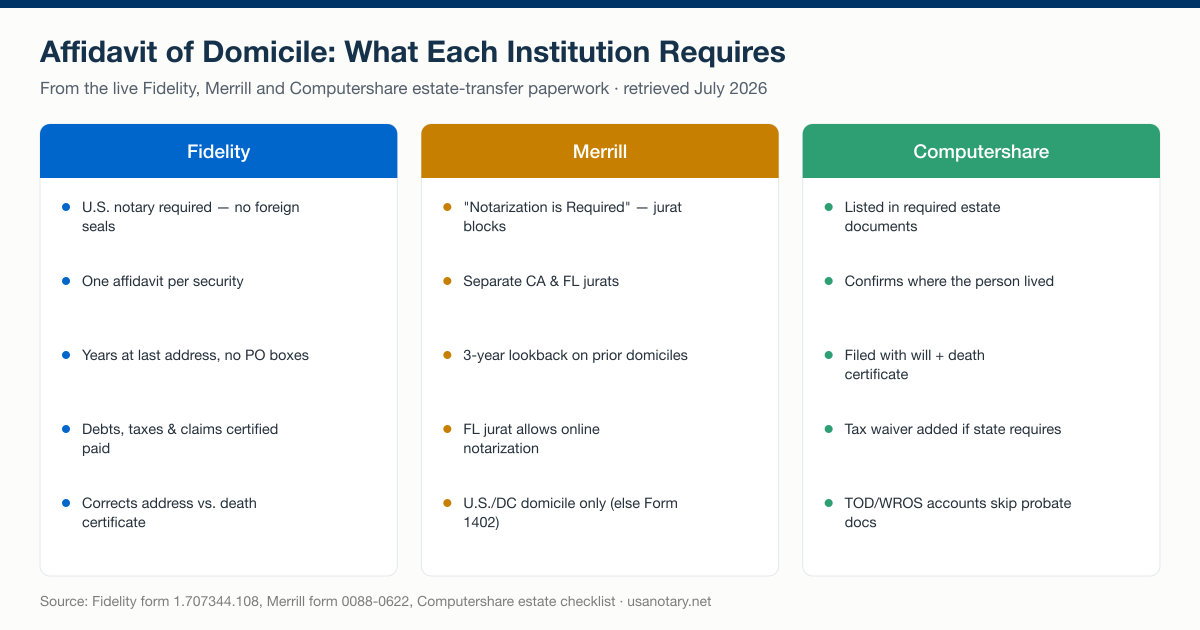
What each institution’s live estate-transfer paperwork demands of the affidavit of domicile — compiled from the Fidelity, Merrill, and Computershare documents cited below, July 2026.
Two patterns are worth noticing across the table. First, the purpose clause is nearly word-for-word identical on the Fidelity and Merrill forms — this is standardized stock-transfer practice, not each firm’s invention, which is why an affidavit of domicile looks the same no matter where the assets sit. Second, the details diverge exactly where each institution’s risk sits: Fidelity wants one affidavit per security and a debts-and-taxes certification; Merrill wants a three-year domicile lookback; Computershare wants the affidavit inside a complete probate package.
How to fill out an affidavit of domicile, step by step
The form itself is short — the mistakes that get affidavits returned are almost all procedural. Here is the sequence that works, built from the instructions printed on the forms above:
- Get the institution’s own form. Fidelity and Merrill each publish their own affidavit of domicile; Computershare supplies its version through its deceased-estate transfer process. Use the holder’s form, not a generic template — each carries that institution’s account fields, certifications, and notary blocks.
- Gather the underlying documents first. Computershare’s checklist names them: the will (if there is one), letters of administration if there is no will, and a certified death certificate. Your authority to sign the affidavit comes from these papers, and the institution will want them in the same package.
- Enter the decedent’s information exactly. The legal address at death — Fidelity’s margin note says “No PO Boxes” — plus county, state, and date of death. If the death certificate shows a different address than the true domicile, this affidavit is precisely where you correct the record; that is the first purpose Fidelity lists for its form.
- State the length of residence. Fidelity asks for the number of years the decedent resided at the address before death; Merrill asks for years and months, and separately for any other state of domicile within the prior three years. Answer from records, not memory — this is a sworn statement.
- Check your capacity. Executor, administrator, personal representative, surviving joint owner, heir at law — check the box that matches your appointment papers, because the institution will compare them.
- Do not sign yet. The signature happens in front of the notary. Merrill’s form says it in bold — “Must be signed in the Presence of Notary” — and a pre-signed affidavit is the most common reason the document comes back.
- Swear, sign, and submit the package. After the notary administers the oath and completes the certificate, the affidavit joins the transfer request, death certificate, and appointment papers. Fidelity’s package mails to its Jersey City processing address printed on the form; remember Fidelity wants a separate affidavit for each different security.
The notarization step itself works like any sworn document — our guide on how to notarize an affidavit walks through the oath, the certificate, and what the notary checks.
Affidavit of domicile vs. medallion signature guarantee vs. inheritance tax waiver
Estate securities transfers stack three instruments that executors constantly confuse, and no one of them substitutes for another:
| Instrument | What it establishes | How it is executed |
|---|---|---|
| Affidavit of domicile | The decedent’s legal state of residence at death — and therefore whose law governs the transfer | Sworn by the estate’s representative; notarized on brokerage and transfer-agent forms |
| Medallion signature guarantee | Per Computershare: “confirms that the signature authorizing the sale or transfer is genuine and that the signer has the legal capacity and authority to sign the document” | A Medallion program stamp on the transfer form itself — a distinct instrument that a notary seal does not replace |
| Inheritance tax waiver | The domicile state’s tax clearance for the transfer, “if your state requires it” (Computershare) | Issued through the state’s revenue process; Pennsylvania’s REV-1737-1 shows the domicile evidence a revenue department weighs |
The division of labor is clean once you see it. Notarization verifies who signed and that they swore to the contents — the California notice printed on both the Fidelity and Merrill forms states that a notary “verifies only the identity of the individual who signed the document… and not the truthfulness, accuracy, or validity of that document.” The Medallion Guarantee, in Computershare’s words, is “a special stamp that’s used when you sell or transfer US securities” vouching for the transfer authorization itself. The tax waiver clears the state’s claim. A large estate transfer routinely needs all three — the affidavit of domicile is simply the one you can complete without visiting a bank branch.
How does an executor notarize an affidavit of domicile online?
An executor can notarize an affidavit of domicile in a 15–30 minute video session, from any state — the National Association of Secretaries of State reports that 47 states and the District of Columbia have a law that allows for remote e-notarization. The institutions have already built for this: Merrill’s Florida jurat is pre-printed for execution “by means of physical presence or online notarization,” and Fidelity’s requirement is simply a U.S. notary, which a remotely commissioned one is.
The session runs the same way for a solo executor in another state or co-representatives signing together:
- Upload the institution’s affidavit — unsigned, exactly as downloaded.
- Verify identity. Credential analysis and knowledge-based verification run before the notary appears, handled by a third-party identity service.
- Swear and sign on camera. The notary administers the oath the jurat requires and watches you sign — satisfying the “in the Presence of Notary” instruction over live video. Sessions run 24/7, and multi-signer sessions handle co-executors in different cities.
- Receive the completed, tamper-evident PDF. The notarized affidavit comes back with a complete audit trail, ready to print and mail with the transfer package the same day.
The cost is $25 per document, with volume pricing for firms that process estates in quantity. That last point matters on the institution side too: brokerage operations teams, bank trust departments, and credit unions that walk beneficiaries through these packages can offer notarization inside their own workflow through our online notarization service for financial institutions — staff-initiated sessions, a 10-year (or longer, where state law requires) retention of the recording and electronic journal, and an audit trail attached to every affidavit. If a beneficiary worries whether the receiving institution will honor an online notarization, our review of whether banks accept online notarization covers the acceptance landscape.
What happens after you submit the affidavit?
The institution’s processing team matches the affidavit against the rest of the estate package — death certificate, appointment papers, transfer request — and then does what transfer agents exist to do: in Investor.gov’s words, “record changes of ownership.” The securities are re-registered to the estate account or directly to the persons the domicile state’s law entitles, and dividends start flowing to the new registration.
Three things keep that final step from stalling. Keep copies of the notarized affidavit — if the decedent held positions at several institutions, each will want its own original, and Fidelity wants one per security. Watch the notary block — Merrill returns any document with an incomplete notary field, so a fully completed certificate is the difference between done and do-over. And match every name and address across the package — the affidavit’s sworn address is the domicile of record, and inconsistencies between it and the death certificate are exactly what the form exists to explain.
An estate that has waited months for probate should not wait another month for a stamp. Upload the affidavit, meet a notary on video tonight, and mail the package tomorrow — or call 804-767-7500 or reach our team if you are settling multiple accounts and want the whole document set handled in one session.