
What is an affidavit of heirship?
An affidavit of heirship is a sworn statement, made by someone with personal knowledge, about a dead person’s family: whom the decedent married, who their children were, and who survived them. The Texas rules for the nonjudicial version sit in Estates Code Chapter 203, titled “Nonjudicial Evidence of Heirship.” Section 203.001 describes “a statement of facts concerning the family history, genealogy, marital status, or the identity of the heirs of a decedent,” and section 203.002 gives a form, headed “Affidavit of Facts Concerning the Identity of Heirs,” saying an affidavit “may be in substantially the following form.”
“Nonjudicial” means the affiant swears the statement before a notarial officer and the affidavit is recorded without a judge deciding anything first. A court enters the picture later, if someone offers the affidavit as evidence. The affidavit identifies the heirs it names, and section 203.001(d) says it “does not affect the rights of an omitted heir or creditor of the decedent.”
The notarization is the part of this document you can do online, if the party receiving the affidavit accepts it. A notarial officer administers the oath the form calls for, and you can notarize it online for $25 per document. The sections below cover what that oath attaches to, what recording does, and what it does not do.
This guide explains what Texas statutes and agency forms say. It is not legal advice, it does not tell you which instrument to use for a particular estate, and it deliberately omits a fill-in template. A title company or a Texas attorney decides whether an affidavit suffices for your file.
Who signs it, and does it have to be notarized?
The affiant signs, and the affiant swears. Section 203.002’s form opens “Before me, the undersigned authority, on this day personally appeared … (“Affiant”) … who, being first duly sworn, upon his/her oath states,” and its first numbered statement has the affiant say “I am personally familiar with the family and marital history of … (“Decedent”) … and I have personal knowledge of the facts stated in this affidavit.” The text of Chapter 203 asks for personal knowledge; it does not say the affiant must be an heir or must not be one. Other Texas forms that carry the same name add their own signer rules:
| Form | Who signs | Notary step in the form | Source |
|---|---|---|---|
| Statutory form, Estates Code 203.002 | An affiant with personal knowledge of the decedent’s family and marital history | “Sworn to and subscribed to before me” with the notarial officer’s signature, seal (if any) and printed name | Texas Legislature |
| Unclaimed-property affidavit, Form 53-111-A | A witness who “cannot be the claimant and cannot benefit from the reported owner’s unclaimed property” | Section D “must be completed in front of a notary public” | Texas Comptroller |
| Motor vehicle affidavit, Form VTR-262 | The heirs the form’s instructions name: a surviving spouse alone, unless the decedent has surviving children with another parent; otherwise all children. “Each heir (up to three) must sign this form before a notary" | "All signatures must be notarized”; the section “may not be completed by execution of a power of attorney” | TxDMV |
Whether the notarial act is mandatory depends on which rule you are asking about. Under Chapter 203, it is a condition of the evidentiary effect. A court “shall receive” the statement as prima facie evidence “if” it is in “an affidavit or other instrument legally executed and acknowledged or sworn to before, and certified by, an officer authorized to take acknowledgments or oaths” and has been of record for five years (section 203.001(a)). The statute accepts either an acknowledgment or an oath; the statutory form is the sworn kind, which is why it ends in a jurat. Our guide to the difference between a jurat and an acknowledgment explains why that choice controls what the notary does, and what an affiant does covers the signer’s side.
Recording has its own rule. Property Code section 12.001(a) says: “An instrument concerning real or personal property may be recorded if it has been acknowledged, sworn to with a proper jurat, or proved according to law.” A Texas notary public “has the same authority as the county clerk to … take acknowledgments or proofs of written instruments” and “administer oaths” (Government Code 406.016(a)), so the notary is the officer who supplies the jurat.
One more quoted rule is worth knowing. Texas lets an unsworn declaration stand in for an affidavit in many settings (Civil Practice and Remedies Code 132.001(a)), but section 132.001(b) says the section “does not apply to … an instrument concerning real or personal property required to be filed with a county clerk.” Whether that carve-out reaches a given affidavit of heirship is a question for the title company or an attorney. Chapter 203 itself speaks of an affidavit acknowledged or sworn before an officer.
What goes in it? The 16 statements of the Texas form
Section 203.002 sets out sixteen numbered statements, followed by a signing block. The statute says an affidavit “may be in substantially the following form,” and section 203.001(c) says an affidavit of facts concerning the identity of a decedent’s heirs as to an interest in real property “that is filed in a proceeding or suit described by Subsection (a) may be in the form prescribed by Section 203.002.” The table paraphrases what each statement asks and notes where the facts typically come from. The “typical source” column is general common sense, not a legal requirement.
| # | What the form asks | Typical source of the fact |
|---|---|---|
| 1 | The affiant’s name and residence, plus the statement of familiarity with the decedent’s family and marital history and personal knowledge | The affiant |
| 2 | How long the affiant knew the decedent; date and place of death; the decedent’s residence at death | The affiant; the death record |
| 3 | The decedent’s marital history, with date and place of a spouse’s death if the spouse is deceased | Family records; marriage, divorce and death records |
| 4 | Each child: name, birth date, the other parent’s name, current address, or the date of death and descendants of a deceased child | Family records; birth records |
| 5 | That the decedent had or adopted no other children and raised none, “except” those listed, or “none” | The affiant |
| 6 | The decedent’s mother (name, birth date, address or date of death). Included “if decedent was not survived by descendants” | Family records |
| 7 | The decedent’s father, on the same terms as statement 6 | Family records |
| 8 | Siblings, with their parents and the descendants of a deceased sibling. Included “if decedent was not survived by descendants or by both mother and father” | Family records |
| 9 | Optional. Persons who have knowledge of the decedent’s children, parents or siblings | The affiant |
| 10 | That the decedent died without a written will (“Modify statement if decedent left a written will”) | The affiant; court records |
| 11 | That there has been no administration of the estate (“Modify statement if there has been administration”) | Court records |
| 12 | That the decedent left no unpaid debts, “except” those listed | The affiant; creditor records |
| 13 | That there are no unpaid estate or inheritance taxes, “except” those listed | The affiant; tax records |
| 14 | “To the best of my knowledge,” the real property in which the decedent owned an interest | County deed records; the decedent’s papers |
| 15 | Optional. The names of the heirs | Follows from statements 3 to 8 |
| 16 | Additional information “as appropriate, such as size of the decedent’s estate” | The affiant |
The signing block follows: “Signed this ___ day of ___,” the affiant’s signature, a state and county line, then “Sworn to and subscribed to before me on ___ (date) by ___ (insert name of affiant),” the notarial officer’s signature, seal (if any), printed name and commission expiration.
Two features of the form matter in practice. Statement 15, which names the heirs, carries an “Optional” label, while the family-fact statements (3 to 5, and 6 to 8 where they apply) do not, so the form is built around giving a reader the facts from which the heirs follow. And statements 10 and 11 carry their own “modify” instructions, which means the form expects someone to change them when the facts differ. If a will exists or an administration has happened, the form tells the affiant to modify those statements.
What does a recorded affidavit of heirship do, and when does it not help?
A recorded affidavit of heirship gives a court a reason it must accept the statement as evidence. Section 203.001(a) directs a court to “receive in a proceeding to declare heirship or a suit involving title to property” the statement as “prima facie evidence of the facts contained in the statement” when two conditions hold: the statement is in an affidavit or other instrument executed and acknowledged or sworn before an authorized officer (or in a judgment of a court of record), and the instrument “has been of record for five years or more in the deed records of a county in this state.” The county can be the one where the property is located when the title suit starts, or the one where the decedent was domiciled or had a fixed place of residence at death.
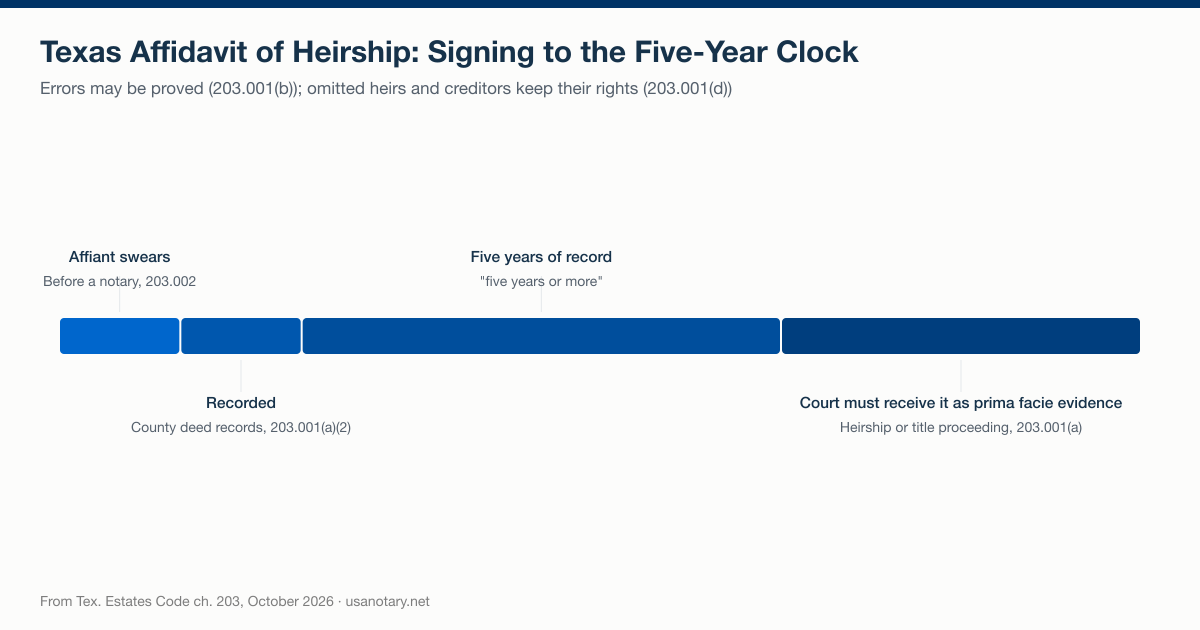
From signing to the five-year clock, as Estates Code section 203.001 describes it. Errors can be proved and omitted heirs and creditors keep their rights.
The same section limits what the affidavit does. Four limits come straight from its text:
- The rule is about evidence in a proceeding. Section 203.001 speaks of what a court receives in “a proceeding to declare heirship or a suit involving title to property”; section 203.002 only supplies the form. The text says nothing about how a title company or lender treats the affidavit, and that decision belongs to them.
- The five-year condition is part of the rule. The mandatory-receipt language applies once the affidavit has been of record “for five years or more.” Section 203.001(d) also says the section “is cumulative of all other statutes on the same subject and may not be construed as abrogating any right to present evidence or rely on an affidavit of facts conferred by any other statute or rule.” Whether any other statute helps a younger affidavit is a question for counsel.
- Errors can be proved. Under section 203.001(b), “anyone interested in a proceeding in which the affidavit or instrument is offered in evidence may prove the true facts.” The evidence is prima facie, not final.
- Omitted heirs and creditors keep their rights. Section 203.001(d): an affidavit “does not affect the rights of an omitted heir or creditor of the decedent as otherwise provided by law.” An affidavit that leaves out a child does not remove that child’s rights.
Affidavit of heirship vs. judgment of heirship vs. small estate affidavit vs. will
Texas has several instruments that people lump together, and the statutes give each a different job. This Texas-only table sets the three paths side by side; the will gets its own paragraph below it.
| Affidavit of heirship | Judgment of heirship | Small estate affidavit | |
|---|---|---|---|
| Statute | Estates Code ch. 203 | Estates Code ch. 202 | Estates Code ch. 205 |
| Purpose | A recorded statement of family facts a court “shall receive” as prima facie evidence once it has been of record five years (203.001) | A court determines “the persons who are a decedent’s heirs and only heirs” and “the heirs’ respective shares and interests” (202.001) | Lets distributees of an intestate estate take it “without waiting for the appointment of a personal representative” (205.001) |
| Who swears or starts it | An affiant with personal knowledge (203.002) | A proceeding may be commenced by, among others, the personal representative or “a person claiming to be a creditor or the owner of all or part of the decedent’s estate” (202.004) | “Two disinterested witnesses” and “each distributee of the estate who has legal capacity” (205.002(a)(1)) |
| Court involved? | Not when it is signed; a court receives it later as evidence | Yes. The judgment must state the heirs’ names and their shares (202.201) | Yes. It is filed with the clerk and the judge “may approve” it (205.001, 205.003) |
| Limits the statute states | Omitted heirs and creditors keep their rights (203.001(d)) | Available in the circumstances listed in 202.002, such as intestacy with no administration in this state | At least 30 days since death; no petition for a personal representative pending or granted; estate assets of $75,000 or less excluding homestead and exempt property (205.001) |
| Real property | Puts the family facts in the deed records; sections 203.001 and 203.002 describe evidence, not a transfer of title | Sets out heirs and shares | “Except as provided by Section 205.006, this chapter does not transfer title to real property” (205.008(b)); section 205.006 covers a homestead that is the only real property in the estate |
A will works on a different track. Section 256.001 says a will “is not effective to prove title to, or the right to possession of, any property disposed of by the will until the will is admitted to probate,” and section 205.008(a) says the small-estate chapter “does not affect the disposition of property under a will or other testamentary document.” The statutory form’s statement 10, “Decedent died without leaving a written will,” carries the instruction “Modify statement if decedent left a written will.” A court may conduct a proceeding to declare heirship when, for example, “a person dies intestate owning or entitled to property in this state and there has been no administration in this state of the person’s estate” (202.002). Which of these paths fits a given estate depends on facts this guide cannot see; that is a question for a Texas attorney or the title company.
Vehicles and unclaimed property: where those heirship forms differ
Two Texas agency forms use the same name and answer different questions. Neither is a Chapter 203 affidavit recorded in the deed records, although the Comptroller’s form borrows the statutory heading, “Affidavit of facts concerning the identity of Heirs.”
- A motor vehicle. TxDMV’s Form VTR-262, “Affidavit of Heirship for a Motor Vehicle,” is submitted with a title application to a county tax assessor-collector’s office. Its instructions require each heir to sign before a notary. Our guide to notarizing a vehicle title places it in the 50-state title picture.
- Unclaimed property. The Comptroller’s Form 53-111-A “may be used for claims under $10,000.01” where the reported owner is deceased and died without a will, or with a will that was not probated or filed as muniment of title where the will’s beneficiaries match the heirs. The claimant uploads the notarized copy to ClaimItTexas.gov. Our guide to notarizing an unclaimed property claim covers where it fits.
How do you notarize one online, and how does it reach the deed records?
Texas statutes provide for online notarization of a sworn statement. Government Code section 406.101 defines “online notarization” as “a notarial act performed by means of two-way video and audio conference technology that meets the standards adopted under Section 406.104,” and an “online notary public” as “a notary public who has been authorized by the secretary of state to perform online notarizations.” Section 406.107 gives an online notary public “the authority to perform any of the functions authorized under Section 406.016 as an online notarization,” and the functions in 406.016 include administering oaths. Section 406.110(a) adds that an online notary “may perform an online notarization … regardless of whether the principal is physically located in this state at the time of the online notarization.” So an affiant who is physically outside Texas can swear to a Texas affidavit over video before a Texas online notary public, subject to the statute’s conditions for oaths in section 406.1107: the online notary identifies the principal under section 406.110(b), and creates, or causes the creation of, a video and audio recording of the principal taking the oath and retains it or causes it to be retained. The statutes say what a Texas online notary may do. Whether the receiving party accepts the result is its own call, so confirm before booking. The notary assigned to a USA Notary session may hold a commission from a state other than Texas, so ask the title company, attorney or county clerk whether it accepts an affidavit sworn before that notary.
Here is the sequence in practice:
- Confirm the instrument and who will receive it. Ask the title company or a Texas attorney which instrument the file needs and whether the receiving party takes a remotely notarized one. This guide does not advise on that choice.
- Gather the facts the form asks for. The affiant swears to personal knowledge, so statements 1 to 14 above are the checklist. Collect dates, addresses and any court records first.
- Book the notarization of the affidavit as the receiving party approved it. Upload the document unchanged. Online notarization on USA Notary costs $25 per document.
- Verify identity and swear on video. Section 406.110(b) requires the online notary to “verify the identity of a person signing a document at the time of the online notarization by using two-way video and audio conference technology.” The notary administers the oath and completes the “Sworn to and subscribed to before me” block.
- Receive the notarized electronic document. The signature and notarial certificate are electronic.
- Get it into the deed records. There are two routes; ask the county clerk which one it follows.
The two recording routes work differently. In the first, someone authorized to e-record submits the electronic original. Local Government Code section 195.003 lists who may file electronically: licensed Texas attorneys, banks, title insurance companies and agents, and a short list of others, and a county of 500,000 or more may add others by memorandum of understanding. Montgomery County’s clerk describes e-recording as “not available to the general public,” and Harris County’s clerk says e-recorded documents are acceptable “if they are submitted through an eRecord Provider.” So the electronic original goes in through a filer on that list, such as a title company or an attorney, and in Harris County through an eRecord provider.
In the second route, a notary or other officer who may take acknowledgments prints the electronic record and signs a declaration. Property Code section 12.0013(b) says a county clerk “shall record a paper or tangible copy of an electronic record that is otherwise eligible under state law to be recorded in the real property records” if the copy contains an image of an electronic signature “acknowledged, sworn to with a jurat, or proved according to law,” and a notary has declared it a true and correct copy under subsection (d), by “executing and attaching an official seal to a tangible paper declaration under penalty of perjury.” The statute sets out the declaration form in subsection (e). Harris County’s page separately says its Real Property Department “can only accept original documents or certified copies of court documents” and that “all signatures must be original,” so call the county clerk to ask which route it follows. Our guide to recording a remotely notarized deed walks through the two routes.
Recording starts the five-year clock in section 203.001(a)(2). Title and escrow teams that collect affidavits from out-of-state family members can read how we handle online notarization for title and escrow companies.
Outside Texas: what this guide has not verified
This guide verified Texas law only, so it describes no other state and offers no state table. Chapter 203 is a Texas statute. If the decedent’s property sits outside Texas, ask the title company or the county recorder in that state which instrument it takes and what notarization it needs, and do not assume the five-year rule travels.