
When does an unclaimed property claim need to be notarized?
An unclaimed property claim is notarized when the holding state’s claim rules require it — and no two states draw that line in the same place. There is no federal standard: every state treasury, comptroller, or revenue department runs its own unclaimed property program and publishes its own documentation rules. California requires a notarized signature once cash claims reach $1,000. Arizona accepts a notarized signature or a photo ID copy. Texas has moved standard claims fully online, and its notarized document is the heirship affidavit filed when the reported owner is deceased.
That patchwork is why the question is so hard to answer from any single state’s website. A claimant who filed in one state without a notary can be genuinely surprised when a second state pends the claim for a missing notarization — the rules sit in program FAQs and form instructions, not in any place claimants think to look first.
Three triggers cover nearly every notarization requirement across the state programs whose rules we verified for this guide:
- Claim value. Higher-dollar claims carry the requirement; small claims usually don’t. California’s published line is $1,000 in cash properties.
- Property type. Securities and safe-deposit box contents are treated as higher-risk than cash. California requires notarization on all securities and safe-deposit claims, at any value.
- Claimant type. Claims filed by heirs, organizations, or guardians add sworn paperwork that the owner’s own claim never needs — Texas’s Affidavit of Heirship and New York’s organizational claim form are both notarized even though neither program’s published baseline for an individual claim calls for one (New York asks for a notarized claim form only if requested; Texas lists a signed claim form and photo ID as the minimum).
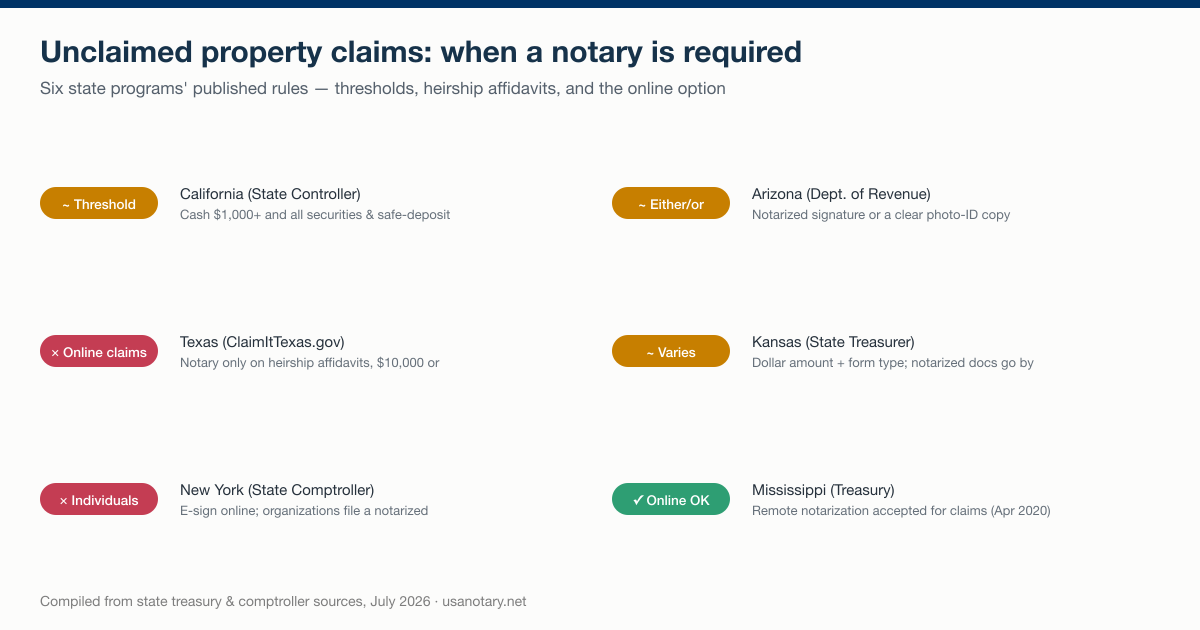
Notarization rules from six state unclaimed property programs, compiled from treasury and comptroller sources, re-verified October 2026.
Where the requirement actually appears
The notarization requirement lives in three places, and checking all three saves a rejected claim. First, the claim form itself: a signature line that reads “sworn to and subscribed before me” is a notary block, full stop. Second, the program’s claim FAQ — that is where Kansas’s it-depends rule is published, and California posts its $1,000 threshold on its claim-forms page. Third, the document checklist the program sends after you start a claim; New York’s required-documentation page lists the notarized items per claimant type rather than printing them on the form.
Kansas states this hierarchy outright in its own FAQ: whether a notary is required “depends on the dollar amount,” on whether the claim needs a legal document such as an Affidavit of Heirship or an Affidavit of Loss, and on the specific type of item being claimed — and then the practical instruction that resolves every edge case: “the document will indicate whether or not a notary is needed.” Read the form the program actually sends you, not the form a template site says the state uses.
Which states require a notarized unclaimed property claim?
State programs split into three camps: threshold states that require notarization above a dollar value or on certain property types, either/or states that accept a notarized signature as one of several identity proofs, and online-first states where the published baseline for an individual claim does not include a notary. Here is what six programs publish, checked against each program’s own pages:
| State (program) | Standard claim notarized? | The published rule |
|---|---|---|
| California (State Controller) | Yes — above threshold | “Your signature must be notarized only if the claim amount is $1,000.00 or greater. All claims for Securities and/or Safe Deposit Boxes must be notarized.” |
| Texas (Comptroller — ClaimItTexas.gov) | Not in the stated minimum | Claims start online; the stated minimum is a signed claim form plus photo ID, and the Comptroller provides no blank claim forms. The notarized document is the Affidavit of Heirship (Form 53-111-A) for non-probate deceased-owner claims of $10,000 or less |
| New York (State Comptroller) | No — filed online | Individual claims can be filed online; a signed or notarized claim form is needed only if the Comptroller requests it. Organizations must submit a notarized claim form with corporate seal; guardians submit a notarized statement that the owner is living |
| Arizona (Dept. of Revenue) | Either/or | “You must provide a clear copy of official photo identification or have your signature on the claim form notarized” |
| Kansas (State Treasurer) | Depends | “Whether a notary is required depends on the dollar amount,” on whether the claim needs an Affidavit of Heirship or Affidavit of Loss, and on the property type — “the document will indicate whether or not a notary is needed” |
| New Hampshire (State Treasury) | Threshold not published | The claim FAQ opens with “Where can I find a Notary Public?” and offers claimants a free notary service at the Treasury office between 8 a.m. and 4 p.m. |
Two caveats belong next to this table. First, these rules are published in program FAQs and form instructions, which agencies revise without the fanfare of a statute change — treat the table as a verified snapshot, and confirm against your state’s program page before filing. Second, the six programs above are the ones whose rules we fetched and verified directly; the other 44 states and D.C. each run their own program, and the same three triggers (value, property type, claimant type) are the pattern to check for.
The Arizona model: notarization as one proof among several
Arizona’s rule deserves its own note because it reframes what the notarization is for. The Department of Revenue accepts either a clear photo ID copy or a notarized signature on the claim form — the two are interchangeable identity proofs. A claimant with a current driver’s license never needs the notary; a claimant whose ID is expired, lost with the rest of an estate’s paperwork, or in a name that no longer matches has the notarized-signature route as the fallback. Several programs treat notarization exactly this way even when their FAQs are less explicit about it.
The New Hampshire model: the state supplies the notary
New Hampshire answers the burden question differently — instead of publishing a threshold, its Treasury removes the obstacle. The claim FAQ’s very first entry is “Where can I find a Notary Public?”, and the answer points claimants to their local bank, their town hall, or the Treasury’s own office, where a free notary service is offered between 8 a.m. and 4 p.m. A program that staffs a notary counter for claimants is telling you two things at once: some of its claim paperwork must be notarized, and it knows the notary trip is the step where claims stall. The 8-to-4 window is also the model’s built-in limit — it serves claimants who can reach Concord on a weekday, and nobody else.
Why do state treasuries require notarization on claims?
Fraud prevention is the whole answer — the treasury is paying out money to someone it will never meet. A claims processor sees a form, copies of documents, and nothing else; the notarization imports an identity check the office cannot perform itself, because the notary verified the signer’s ID face-to-face or over live audio-video before completing the certificate.
Kansas’s claim FAQ says this without any bureaucratic softening: the requirements exist “to safeguard you and fellow Kansans against fraudulent behavior,” because as personal information becomes more accessible to bad actors, “our office must ensure you are the rightful owner and not a fraudster pretending to be you.”
The thresholds follow the same logic. A $40 utility deposit refund is not worth a fraudster’s time, so California lets cash claims under $1,000 through on a signature alone. Securities and safe-deposit contents — where a single claim can be worth tens of thousands of dollars and ownership is harder to trace — are notarized at every value. The notarization requirement scales with what a successful fraud would pay.
What extra notarized affidavits do deceased-owner claims need?
Deceased-owner claims are where notarization shows up even in states that dropped it from standard claims — because the person signing is not the person the property was reported for, the programs demand sworn statements about who the rightful heirs are. Both of the largest programs we verified use a notarized affidavit for exactly this gap.
Texas: the Affidavit of Heirship (Form 53-111-A). When the reported owner died without a probated will and the claim is worth $10,000 or less (the form says “under $10,000.01”), the Comptroller may require this affidavit to establish who the legal heirs are. Its structure is stricter than most claimants expect:
- The affidavit is sworn before a notary — Section D states it “must be completed in front of a notary public,” and the certificate reads “sworn to and subscribed to before me,” which makes it a jurat rather than a simple signature acknowledgment. If those two certificate types are new to you, our plain-English comparison of a jurat versus an acknowledgment covers exactly what the notary does differently in each.
- The person sworn is a disinterested witness, not the claimant. The form is blunt: the individual completing it “cannot be the claimant and cannot benefit from the reported owner’s unclaimed property.” A family friend or longtime neighbor who knew the decedent’s family history is the typical signer.
- The witness attests to the complete marital and family history — every marriage, every child, living or deceased — and the claimant then uploads the completed, notarized affidavit to ClaimItTexas.gov.
New York: the Small Estates Affidavit. The State Comptroller’s deceased-owner rules let the closest living family member (spouse, then children, parents, siblings) claim amounts under $1,000 with a death certificate, a completed Small Estates Affidavit, and a Table of Heirs — no court-appointed representative needed. At $1,000 or more, only a court-appointed representative can complete the claim. The payer of funeral expenses can use the same affidavit to claim reimbursement of up to $5,000. The affidavit itself carries a notary block (“Sworn to before me this ___ day of…”), so this document is sworn before a notary even though New York’s standard individual claim needs no notarization.
Heir claims involving securities often stack a second sworn document on top: transfer agents commonly request an affidavit of domicile establishing the decedent’s legal residence at death before they re-register shares. If you are assembling a deceased-owner claim package, expect the notarized paperwork to multiply — and since these are all affidavits, the general mechanics in our guide to notarizing an affidavit online apply to each one.
Can the unclaimed property notarization be done online?
Yes in a growing number of states — and one state treasury has said so publicly. Mississippi’s Treasury announced in April 2020 that unclaimed property claims can be notarized remotely, after Governor Tate Reeves eased requirements through a temporary executive-order waiver; Treasurer David McRae framed the change around a simple principle: “Unclaimed property is not the state’s money. It’s your money.” The same announcement advised claimants to check that their notary is authorized to offer remote notarization — which is the right instinct in every state.
The legal foundation is broad. The National Association of Secretaries of State reports that 47 states and the District of Columbia have a law that allows for remote e-notarization, so in most of the country a commissioned online notary can lawfully notarize a claim form or heirship affidavit over live audio-video. For claimants whose property is held by a state they no longer live in — the single most common unclaimed property situation — the follow-up question is whether a remote notarization is valid out of state; the short answer is that a notarization lawfully performed under one state’s law is generally entitled to recognition elsewhere, though the receiving program’s acceptance policy is always the final word.
The acceptance check: one call before the session
Acceptance is the program’s call, and programs handle electronically notarized documents differently. Kansas illustrates the wrinkle: its FAQ says most documents can be uploaded through the secure portal, but “if a document requires a notary, or we need an original death certificate, these must be sent to us via mail.” A remotely notarized document is a tamper-evident PDF — so before booking a session, ask the program two questions: Do you accept online notarization on this form? and Do you want it uploaded, or printed and mailed? Five minutes on the phone with the unclaimed property office beats a pended claim by weeks.
How do you complete a notarized claim form remotely?
A notarized unclaimed property claim takes one online session once the paperwork is in order — here is the sequence that avoids the common rejections:
- Start the claim on the state’s portal and download the claim packet. The packet, not the website’s general FAQ, states which documents must be notarized for your claim type and value.
- Confirm the notarization trigger. Check the claim value against the state’s threshold, note whether securities or safe-deposit property is involved, and look for a notary block or “sworn to and subscribed” language on every form in the packet.
- Ask the program about online notarization. One call: is a remotely notarized document accepted, and does it go through the upload portal or the mail?
- Book the session — and bring the right signer. Sessions run 24/7 and take 15–30 minutes, with signers accepted from all 50 states. Identity is verified before the notary appears, through credential analysis of your government ID plus knowledge-based authentication run by a third-party identity verification service. If the notarized document is a Texas-style heirship affidavit, the disinterested witness is the one who must appear and be sworn — multi-signer sessions handle the witness and the claimant together when both need to sign the packet.
- Sign on video and receive the completed document. The notary administers the oath on recorded video for sworn affidavits, and the session produces a tamper-evident notarized PDF with a complete audit trail — a stronger artifact for a fraud-conscious claims processor than an ink stamp, since the program can verify exactly when and how the notarization happened.
- Submit the way the program told you to. Upload the PDF where portals accept it; print and mail it where, like Kansas, the program wants notarized documents by post.
Each notarized document costs $25, with volume pricing for offices that handle claims in bulk. That last case is more common than it sounds: state unclaimed property programs, county administrators, and public guardians process claimant paperwork all day, and a staff-initiated session — where the office sends the signer a link instead of telling them to find a notary — removes the single slowest step in the claim. That workflow, along with how receiving clerks verify a remotely notarized PDF, is covered on our page on online notarization for government programs.
Get the claim notarized without hunting for a counter
The rule to remember: the claim is filed with the state, but the state’s own FAQ decides whether your signature must be notarized. Check the value threshold, check the property type, and check whether a deceased owner adds an heirship affidavit to the packet — then handle whatever needs a notary in one 15–30 minute video session instead of a trip. The same session works for the other sworn documents state programs generate, from heirship paperwork to the annual proof of life certificate pension systems require.
Questions about a claim form or a recurring agency workflow? Call 804-767-7500 or get in touch.