
What is a proof of life certificate?
A proof of life certificate is a form a pensioner signs in front of an approved witness to confirm they are alive, so the pension system that pays them keeps paying. Proof of life documents are forms that foreign and state governments and institutions use to confirm that pensioners and other beneficiaries living abroad remain eligible for financial benefits. The logic behind the form is blunt: a pension is payable only to a living beneficiary, and when that beneficiary lives in another country, the paying office cannot check its own death records to confirm the payments should continue. So it mails a form — and the burden shifts to the pensioner to find a qualified witness, sign in front of that witness, and return the form before payments are interrupted.
Despite the cinematic name, a proof of life certificate has nothing to do with ransom demands — in pension administration it is routine, recurring paperwork that arrives on a schedule for the rest of a cross-border retiree’s life.
The names it goes by
The document travels under several names depending on who requires it. The UK’s Department for Work and Pensions calls it a Life Certificate. The Dutch government calls it a certificate of life. Indian consulates in the United States process it as a Life Certificate for Indian pensioners. You will also see “proof of life form” and “pension life certificate” used interchangeably. The US Social Security Administration takes a different route entirely: instead of a witnessed certificate, SSA sends beneficiaries abroad a questionnaire — its international operations page links the instructions for Forms SSA-7161 and SSA-7162, which it calls the Foreign Enforcement Questionnaire — that the beneficiary signs and returns.
Whatever the label, the function is identical: the program requires periodic, verifiable evidence that the person receiving the pension is still alive.
Why pension systems require one
Cross-border pension payments are where death records stop working. A state pension office in London learns quickly when a pensioner in Leeds dies; it may never learn when a pensioner in Phoenix does. GOV.UK states the purpose plainly: “A Life Certificate is used by the Department for Work and Pensions to check that a person living outside the UK can still get a UK State Pension.”
Two features follow from that purpose. First, the process is demand-driven — the program contacts you, not the other way around. GOV.UK’s instruction on the Life Certificate is explicit: “Do not send us this form unless we have asked you to.” Second, the check repeats. SSA sends beneficiaries outside the United States a questionnaire every year or every two years: Publication 05-10137 says beneficiaries age 90 or over, those with a representative payee, and those not receiving benefits as a spouse, surviving spouse or parent get it annually, while spouses, surviving spouses and parents — and residents of a listed group of countries — get it every two years. A proof of life certificate is never a one-time errand; it is a recurring obligation attached to the pension itself.
Who requires a proof of life certificate?
Foreign pension programs require a proof of life certificate from beneficiaries living outside their borders — including retirees who moved to the United States — and the US Social Security Administration runs the same check in the opposite direction for its beneficiaries living abroad. If you are reading this in the US, the requirement most likely reached you one of two ways: a foreign pension you earned before immigrating, or a US Social Security payment following you overseas.
Foreign pensions paid to retirees living in the US
The UK State Pension is the most common case American notaries see. DWP posts the Life Certificate to pensioners abroad, and the completed, witnessed form goes back by mail to Pension Service 11 at a mail-handling site in Wolverhampton — a UK pensioner in Florida or Arizona completes an entirely paper round trip across the Atlantic.
The Netherlands offers its pensioners in the US more routes. The Dutch embassy in Washington, DC and the consulates-general in Atlanta, Chicago, Miami, New York, and San Francisco will sign and stamp a pre-printed certificate of life for free, or draw one up for €30. A local US notary can also certify the pre-printed certificate — with a caveat the Dutch government itself flags, covered below. And for the AOW state pension specifically, the paper can disappear altogether: “If you have been asked by the Social Insurance Bank (SVB) to provide proof of life, you can submit your proof of life via the SVB app.”
Indian pensioners in the US route Life Certificates through Indian consulates. The Consulate General of India in San Francisco processes them through its Miscellaneous Cell, in person or by postal mail, after the applicant registers on the eSEWA portal. For pension purposes the consulate charges no fee — only $2 for the Indian Community Welfare Fund — and, for Indian passport holders, a mailed application must include notarized copies of the passport, proof of US visa status, and proof of US address, plus a trackable pre-paid return envelope (the consulate lists a slightly different document set for US passport plus OCI holders).
US Social Security beneficiaries living abroad
SSA flips the direction. An American retiree in Portugal or the Philippines receives a questionnaire — the form SSA’s Office of Earnings & International Operations links from its Service Around the World page is Form SSA-7162 — and Publication 05-10137 leaves no room for interpretation about what to do with it: the beneficiary (or their representative payee) must complete, sign, date, and return the questionnaire to SSA in the envelope provided. The consequence spelled out in the same instruction is the part that matters — if the beneficiary does not return it, the payments stop.
Note what SSA’s instruction does not say: it names no witness and no notary. The questionnaire asks for the beneficiary’s signature, dated and returned — which makes the SSA check the lightest of the group on paperwork, and the most unforgiving on silence.
Here is how the four programs compare, from each program’s own published guidance:
| Program | The form | Who witnesses or certifies it | Key rule in the official guidance |
|---|---|---|---|
| UK State Pension (DWP) | Life Certificate | A listed professional — the witness categories include notaries, doctors, lawyers, police officers, teachers, clergy, and government employees | The witness “should not be related to you by birth or marriage, and should not live at the same address as you” |
| Dutch AOW and other Dutch pensions | Certificate of life | Dutch embassy/consulate (free on a pre-printed form; €30 drawn up) or a local notary | “A statement from a local notary is not always accepted by the pension authority without an apostille”; the SVB app can replace the paper form for AOW |
| Indian government pensions | Life Certificate | Consulate General of India (in person or by mail via the Miscellaneous Cell) | No fee for pension purposes beyond $2 ICWF; mailed applications require notarized copies of passport, visa status, and US address proof |
| US Social Security (paid abroad) | Form SSA-7162 questionnaire | No witness listed — beneficiary signs, dates, and returns it | If the beneficiary does not return it, the payments stop |
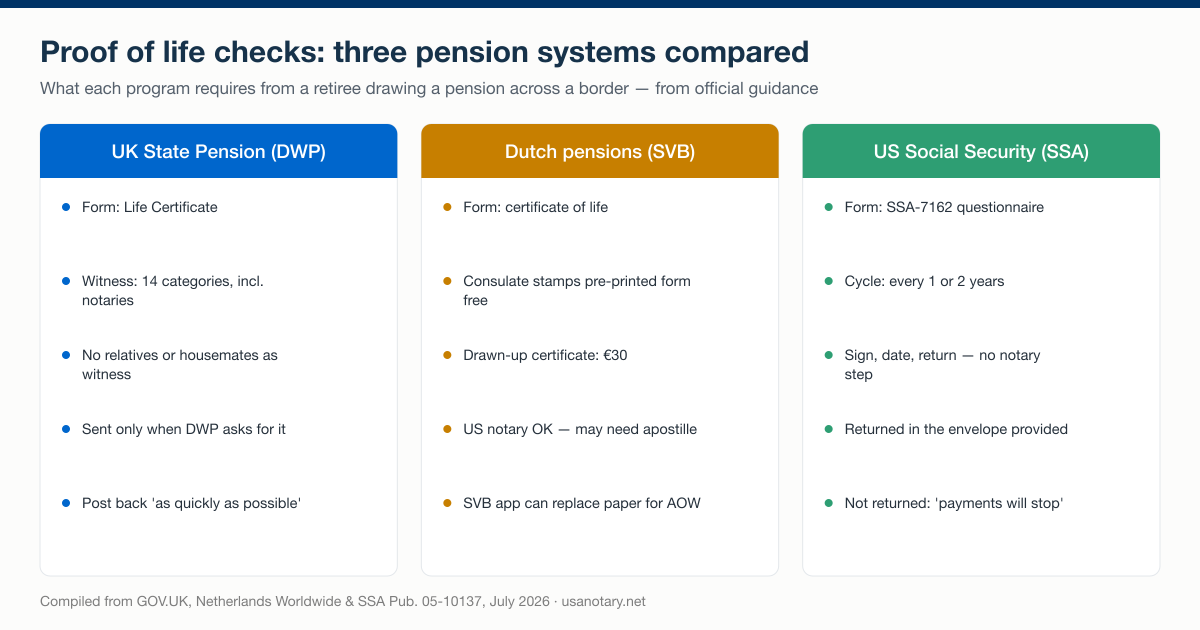
Three pension systems’ proof of life checks side by side, compiled from GOV.UK, Netherlands Worldwide, and SSA Publication 05-10137, July 2026.
Who can witness or notarize a life certificate in the US?
A notary public is the most widely available approved witness for a proof of life certificate in the United States — the UK’s own guidance lists notaries among the eligible witnesses — but a US notary witnesses your signature, not your existence, and that distinction decides how the form gets completed.
The witness restrictions to check first
Every program defines its own witness list, so the form’s instructions outrank any general advice. The UK Life Certificate lists 14 categories of eligible witnesses — including police officers, teachers, doctors, lawyers, notaries, government employees, and clergy — and applies one restriction to all of them: “The person who witnesses the Life Certificate should not be related to you by birth or marriage, and should not live at the same address as you.” That rule quietly disqualifies the two easiest candidates most pensioners think of first — a spouse and an adult child in the same house — and is a large part of why the notary, a neutral professional with no family connection, ends up as the default choice.
What a US notary can — and cannot — certify
Certifying that a person is alive is not an authorized notarial act in most US states. The National Notary Association’s guidance on proof of life documents draws the line clearly, with narrow exceptions: “Washington Notaries are permitted to certify that an event has occurred or an act has been performed,” Montana has a specific notarial act called “certification of life,” Louisiana and Puerto Rico notaries hold broader authority, and Alabama and Florida civil-law notaries — who are attorneys — may certify living status while ordinary commissioned notaries in those states may not.
What a notary everywhere can do is notarize your signature on the certificate. If the form carries standard notarial wording — a jurat, where you swear the statements are true, or an acknowledgment, where you confirm the signature is yours — the notary performs that act, and the completed certificate shows a recognized US notarial certificate with seal and signature. Which of the two acts your form carries changes what happens in the session; the difference between them is covered in our guide to jurats versus acknowledgments.
When the form has no notarial wording
Foreign pension forms are drafted under foreign law, and some arrive with a bare signature line — no jurat, no acknowledgment, just a space where officials expect a stamp. The NNA’s guidance for that situation is firm: notaries (except in Michigan) should not accept requests to simply affix a seal and signature to a document without notarial certificate language, and “California prohibits Notaries from affixing their seals and signatures to a document without completing a certificate.”
Two fixes work. Ask the pension authority in writing which US notarial act it will accept — many programs accept a jurat attached to the form. Or use the NNA’s alternative: “the signer may be able to have it notarized at an embassy or consulate of the issuing nation,” which is exactly the route the Dutch and Indian systems formalize with their US consulates.
How do you notarize a proof of life certificate online?
A proof of life certificate can be notarized online in one 15–30 minute video session, provided the form calls for a standard notarial act and the pension program accepts a notary as witness. The legal footing is broad: the National Association of Secretaries of State reports that “currently, 47 states and the District of Columbia have a law that allows for remote e-notarization.” For a pensioner who no longer drives, lives far from a consulate, or faces this form every single year, the online session replaces the most fragile part of the process — getting a qualified, unrelated witness and the pensioner into the same room.
Here is the process end to end:
- Read the form’s witness section first. Confirm a notary is an accepted witness (the UK list includes notaries; other programs vary) and check whether the form carries jurat or acknowledgment wording. If it has no notarial wording at all, contact the pension office before booking — see the section above.
- Upload the certificate. The notary notarizes the form the program sent you; nothing is redrafted or altered.
- Verify your identity. Before the session starts, identity is verified through credential analysis of your government-issued ID plus knowledge-based authentication, run by a third-party identity-verification service — fitting for a document whose entire purpose is confirming who you are.
- Meet the notary on live video. Sessions run 24/7 and take 15–30 minutes. If the form carries jurat wording, the notary administers the oath on recorded video. The session is recorded, and the recording and electronic journal entry are retained for 10 years or longer where state law requires — durable evidence that you appeared, alive, on a specific date.
- Return the form the way the program demands. You receive a tamper-evident notarized PDF with a complete audit trail. Most pension offices still want paper posted back — GOV.UK tells UK pensioners to print, complete, and post the form “as quickly as possible” — so confirm with your program whether it accepts a printed copy of an electronically notarized certificate before you rely on one. Acceptance is always the receiving authority’s call.
Online notarization costs $25 per document, with volume pricing for recurring needs. Pension administrators, benefits offices, and consular teams that verify beneficiaries at scale can run staff-initiated sessions — where the office queues the document and invites the pensioner — through our online notarization service for government agencies, including multi-signer sessions when a form needs more than one signature.
What are your options if you live abroad or can’t leave home?
Location is the whole problem a proof of life certificate creates — the pension office is in one country, the pensioner in another, and the witness must be wherever the pensioner is. The right route depends on which direction your pension crosses the border.
US retirees abroad: the SSA questionnaire and everything else
For the SSA questionnaire itself, no notary is required: Publication 05-10137 instructs beneficiaries to complete, sign, date, and return it in the envelope provided. Do exactly that, promptly.
The complication for expats is the other paperwork that stacks up alongside it — powers of attorney for a stateside child handling your affairs, benefit forms, account documents — much of which does require notarization. A US-commissioned notary can notarize for a signer located in another country over live video where the notary’s state authorizes it, with some states adding conditions for signers abroad. Our guide to notarizing a document from overseas compares that route against a US embassy appointment, including costs and the state-law conditions that apply.
Foreign-pension holders in the US: consulate route vs. notary route
The consulate route is authoritative but geographic. The Netherlands runs six posts in the US, and most of its consulates-general will sign and stamp a pre-printed certificate of life while you wait, and Atlanta also takes signing-and-stamping visits without an appointment — but that route assumes you can get to Atlanta, Chicago, Miami, New York, San Francisco, or Washington first. India’s San Francisco consulate accepts Life Certificates by mail, which solves distance but adds its own notary errand: the mailed packet must include notarized copies of your passport, visa status, and address proof. Whether a notary in your state may certify those copies — and what to do where they can’t — is covered in our guide to notary-certified copies.
The notary route is local but comes with the acceptance caveat the Dutch government publishes itself: “a statement from a local notary is not always accepted by the pension authority without an apostille.” An apostille is the extra state-level authentication that makes a US notarization recognizable abroad under the Hague Convention — our apostille guide explains when one is needed and how to get it. The practical sequence: ask your pension authority whether it accepts a US notarization alone before assuming the notary appointment finishes the job.
Homebound and hospitalized pensioners
Proof of life requirements land hardest on the people least able to travel — the form recurs annually precisely through the years when driving to a consulate or a bank branch stops being realistic. Remote online notarization moves the appointment to the pensioner’s kitchen table: a computer or tablet, a valid ID, and a live video session. Where the signer can’t manage technology alone or the program’s rules require something different, our guide to notary options for homebound and hospitalized signers walks through the alternatives, including who may assist during a session.
What happens if you miss a proof of life deadline?
Missed proof of life paperwork stops pension payments — that is not a worst-case scenario but the system’s designed response to silence. SSA is blunt about it: if you do not return the questionnaire, your payments will stop. The stop is bureaucratic, not punitive — the program cannot distinguish an unreturned form from a deceased beneficiary, so it halts payments until evidence arrives. Restarting them means completing the verification you missed, with an income gap while it processes. SSA’s international operations page adds a current warning for returns: because some countries have suspended mail service to the United States, “documents sent to the Social Security Administration (SSA) from abroad may be delayed or undelivered,” so check with your local postal service and contact SSA if the questionnaire may not arrive.
The fetched official guidance is thinner on timelines than pensioners would like: GOV.UK sets no published deadline for the Life Certificate, instructing only that pensioners post it back “as quickly as possible.” Treat the absence of a stated grace period as the warning it is. Four habits keep the problem theoretical:
- Watch the mail from your pension program — these forms arrive unannounced, and the DWP’s “do not send us this form unless we have asked you to” rule means you cannot get ahead of it by filing early.
- Calendar the cycle. SSA’s questionnaires run on one- or two-year cycles; foreign programs recur too. A recurring reminder each autumn costs nothing.
- Keep proof of dispatch. India’s consulate requires a trackable pre-paid return envelope for mailed Life Certificates — a requirement worth copying voluntarily for every program, because tracking is your evidence the form went back.
- If a form goes missing or late, contact the program immediately. SSA’s publication directs beneficiaries abroad to contact Social Security or their Federal Benefits Unit; every program has an equivalent, and a phone call beats a stopped payment.
Get the certificate witnessed before the pension office asks twice
The rule to remember: the pension program picks the form and the witness rules; you pick the fastest compliant route. Read the witness section, confirm what the program accepts, and then choose between the consulate counter, the local notary plus apostille, and a 15–30 minute online session from home. For the annual repeat customers — UK pensioners in the US, expat SSA beneficiaries with side paperwork, adult children managing a parent’s foreign pension — online notarization turns a yearly logistics problem into a calendar entry.
Questions about a specific program’s form, or a recurring verification workflow for a benefits office? Call 804-767-7500 or contact us.