
What is an affidavit of no other insurance?
An affidavit of no other insurance is a sworn statement in which an insurance claimant declares, under oath, that no policy other than the one identified covers the loss — or that every policy that might apply has been disclosed in full. The Legal Information Institute at Cornell Law School defines an affidavit as “a sworn statement a person makes before a notary or officer of the court outside of the court asserting that certain facts are true to the best of that person’s knowledge” — and the “before a notary” element is what separates this document from an ordinary claims questionnaire. The affidavit is sworn, so a wrong answer is not a paperwork error; it is a false statement under oath.
Claims departments title the document several ways: affidavit of no other insurance, no-insurance affidavit, affidavit of no other sources of insurance, or — in the version this guide reads line by line — the Texas Property and Casualty Insurance Guaranty Association’s Affidavit Regarding Other Insurance, form PC004. The names vary; the operative oath does not. In every version, the affiant swears that the coverage picture handed to the payer is complete: either no other insurance exists, or everything that does exist has been listed.
One disambiguation before going further, because the names collide. An affidavit of non-use is a DMV document — a vehicle owner’s sworn statement that a car will stay off the road, filed to pause insurance requirements. An affidavit of no other insurance is a claims document — a sworn disclosure to whoever is about to pay you. This guide covers the second one: the affidavit that carriers, third-party administrators, and state guaranty associations require before releasing payment.
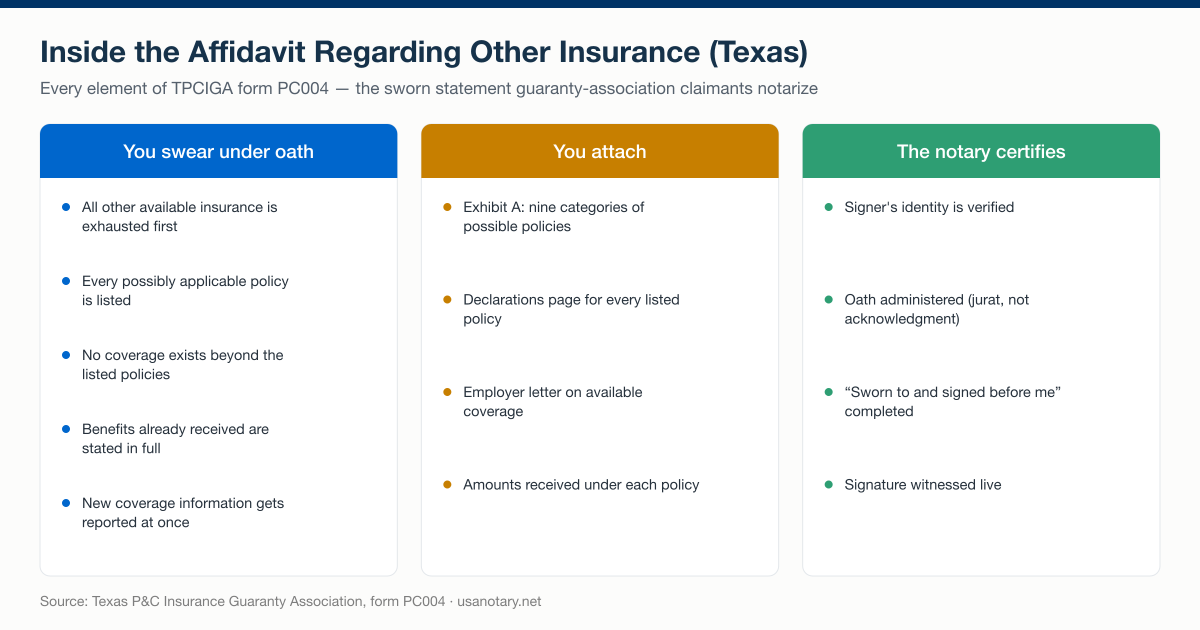
The three working parts of the Texas Affidavit Regarding Other Insurance (form PC004): the sworn commitments, the required attachments, and the notary’s jurat.
When do insurance carriers require an affidavit of no other insurance?
Carriers require the affidavit whenever the size of their payment obligation depends on whether a second policy exists. Overlapping coverage is common — a passenger injured in a crash can sit under the at-fault driver’s liability policy, their own auto policy, a family member’s uninsured-motorist coverage, and an employer health plan all at once — and three separate claims mechanisms turn on the same sworn question.
Coordination of benefits
Coordination of benefits is the health-side reason. The NAIC’s glossary defines coordination of benefits as a “provision to eliminate over insurance and establish a prompt and orderly claims payment system when a person is covered by more than one group insurance and/or group service plan.” COB rules decide which plan pays first and which pays the remainder — and no plan can run that calculation until the claimant states, on the record, what other coverage exists. A sworn affidavit converts the answer from something mentioned on a phone call into evidence the file can rely on.
Other-insurance clauses in property policies
Property policies carry the same question in contract form. New York’s statutory standard fire policy — the template written directly into Insurance Law § 3404 — caps each insurer’s share with a pro-rata clause: “This Company shall not be liable for a greater proportion of any loss than the amount hereby insured shall bear to the whole insurance covering the property against the peril involved, whether collectible or not.” The same statute requires the insured’s proof of loss to state “all other contracts of insurance, whether valid or not, covering any of said property.” Disclosure of other insurance is not a courtesy in a property claim — it is written into the policy’s own loss conditions, inside the same sworn document our guide to the sworn proof of loss walks through.
Subrogation
Subrogation is the recovery-side reason. Cornell’s Wex dictionary explains that “when an insurance company compensates a policyholder for an injury, the policyholder’s right to sue the person responsible for the harm may be subrogated, meaning it is transferred from the policyholder to the insurance company.” Before a carrier pays and steps into your shoes, it wants a sworn map of every other coverage source touching the loss — both to size its own payment and to know where recovery may come from afterward. The affidavit of no other insurance is that map, signed under oath.
Here is how the contexts line up:
| Claims context | Who requires the affidavit | What the sworn statement settles | Where the rule lives |
|---|---|---|---|
| Insurer insolvency | State guaranty association | Other available coverage is exhausted before the association pays | Tex. Ins. Code §§ 462.251–.252 |
| Coordination of benefits | Health or group plan | Which of two or more plans pays first | NAIC COB definition |
| Property loss | Property carrier | Whether another policy shares the loss pro rata | NY Ins. Law § 3404 |
| Liability payment | Paying carrier | What other recovery sources exist before payment and subrogation | Cornell LII, subrogation |
Why do state guaranty associations require the affidavit after an insurer fails?
Guaranty associations require the affidavit because, in their world, other insurance is a legal precondition rather than an adjusting detail. Property and casualty guaranty funds operate in each of the 50 states, the District of Columbia, and Puerto Rico, according to the National Conference of Insurance Guaranty Funds, the coordinating body for the system. When a carrier is placed into receivership, its unpaid claims move to the state’s association — and the association pays covered claims only after every other applicable policy has been used up.
Texas puts the rule in plain statutory language. Texas Insurance Code § 462.251, titled “Exhaustion of Rights Under Other Policy Required,” makes a claimant who also has “a claim for indemnity or medical benefits under a health, disability, uninsured motorist, personal injury protection, medical payment, liability, or other insurance policy” exhaust those rights first. Section 462.252 then does the arithmetic: an amount payable as a covered claim “is reduced by the full applicable limits of another insurance policy” of that kind. Recovery is reduced by what the other policy could have paid — not merely by what it did pay — which is exactly why the association needs the full coverage list before it writes anything. (Workers’ compensation benefits get separate treatment under § 462.252(b).)
TPCIGA’s Affidavit Regarding Other Insurance implements those two sections claimant by claimant. Paragraph 4 of the form has the affiant acknowledge the sequence directly: “I recognize that [the impaired insurer] has been placed into receivership and that I must first exhaust my rights under all other available insurance before proceeding against the guaranty association.” The paragraph then defines “other insurance” broadly — workers’ compensation indemnity and medical benefits, health, disability, uninsured and underinsured motorist, personal injury protection, medical payment, and liability coverage — and extends the search to insurance carried by the claimant’s employer or a family member’s employer. The affidavit is how the association proves, in every single file, that the statutory sequence was honored before public-safety-net money went out.
This guide documents the Texas form because the association publishes it; associations in other states run the same exhaustion inquiry on their own paperwork, so expect a near-cousin of the AROI whenever an insolvency claim lands with a guaranty fund.
What do you swear to when you sign one?
You swear to a complete disclosure — not to a bare “no.” The Texas AROI is worth reading as a specimen because its numbered paragraphs show exactly how much a claimant commits to under oath:
- Other available insurance is exhausted first. The affiant recognizes the receivership and agrees that all other available insurance must be exhausted “before proceeding against the guaranty association.”
- Every possibly applicable policy is listed. Exhibit “A” to the affidavit collects nine categories of coverage: personal health or disability, an employer’s health plan, workers’ compensation, the other party’s auto liability, the claimant’s own auto policy, the driver’s and the owner’s policies on the vehicle the claimant occupied, any family member’s UM/MedPay/PIP coverage, and a catch-all for other policies.
- The paper trail is attached. The form requires a copy of the declarations page for every listed policy, plus a letter from the claimant’s employer (or a family member’s employer) stating what coverage was available — and the affiant swears the information on the attached declaration pages is true as part of the affidavit itself.
- Amounts already received are stated in full. A dollar field records total benefits received to date from other policies for the same incident.
- No additional coverage exists. Paragraph 8 is the core “no other insurance” oath: no coverage applies to the incident beyond the policies listed in Exhibit “A.”
- New information gets reported. The affiant agrees to contact the association immediately if additional information about other insurance becomes available.
- The oath is understood. The form closes the commitments with “under penalty of perjury I swear that everything is true and complete to my knowledge,” and warns that a false representation or failure to disclose other insurance “may jeopardize my right to recover” from the association.
Should you sign it? Read as a disclosure instrument, the affidavit is less menacing than its reputation on legal Q&A boards suggests. The form does not ask you to guarantee that no insurance exists anywhere in the world — it asks you to disclose everything that might apply, and Exhibit “A“‘s own instructions resolve doubt in favor of listing: a policy goes on the list “[e]ven if I am unsure whether or not a policy provides coverage.” The safe way to sign is mechanical: pull declaration pages for every household policy, request the employer coverage letter early, and put uncertain policies on the list rather than off it. Listing a policy that turns out not to apply costs nothing; omitting one that turns up later triggers the perjury and forfeiture language. The affiant — the person swearing — is the one on the hook for accuracy, so the checking happens before the oath, not after.
Does an affidavit of no other insurance have to be notarized?
Yes — notarization is required because the document is an affidavit, and an affidavit without an oath is just a signed letter. Cornell’s definition builds the officer into the concept: the statement is sworn “before a notary or officer of the court.” The Texas form goes further and writes the ceremony into its own text at both ends. It opens: “BEFORE ME, on this day personally appeared [claimant], who first being duly sworn did upon [his/her] oath deposed and said” — and it closes with “Sworn to and signed before me on the ____ day of ____,” above the signature line of a Texas notary public.
That closing certificate is a jurat: the notarial act for sworn statements, in which the notary verifies the signer’s identity, administers an oath, watches the signature happen, and certifies all three. A jurat is a different act from an acknowledgment — the certificate used on deeds and powers of attorney, where the signer merely confirms a signature is theirs — and the difference changes how the signing session runs. Our comparison of the jurat and the acknowledgment covers which documents take which certificate.
The mistake that voids the affidavit
Signing the affidavit at the kitchen table and then finding a notary is the classic failure path. Because the jurat certifies that the oath and the signature happened before the notary, the document must be signed in the notary’s presence — a pre-signed affidavit cannot be “fixed” by stamping it afterward. If the affidavit arrives from the adjuster with the notary block already printed on it (as the TPCIGA form does), leave the signature line blank until you are in front of the notary, whether that is across a desk or across a webcam.
How do you notarize an affidavit of no other insurance online?
Remote online notarization handles this affidavit the same way it handles any jurat document, and the legal footing is broad: the National Association of Secretaries of State reports that 47 states and the District of Columbia have a law that allows for remote e-notarization. For a claimant who is displaced after a loss, or juggling an insolvency claim from another state, the online session replaces the hunt for a notary’s office with a webcam appointment. Here is the sequence:
- Complete the form — but do not sign it. Fill in the policy list, attach the declaration pages and any employer letter, and stop at the signature line. The signature happens on camera.
- Upload the affidavit. The document goes into the session as-is; the notary notarizes your signature on the payer’s form and does not alter its wording.
- Verify your identity. Before the video call starts, identity verification runs through credential analysis of your government ID plus knowledge-based authentication, handled by a third-party identity service.
- Take the oath and sign on video. A commissioned notary administers the oath — the “sworn” in sworn statement — then watches you sign and completes the jurat. Sessions run 24/7 and take 15–30 minutes, and multiple signers can join one session if, say, spouses both need to swear to the household’s coverage list.
- Return the notarized affidavit. The session produces a tamper-evident PDF with a complete audit trail, ready to send back to the adjuster or association the same day. The audio-video recording and electronic journal entry are retained for 10 years, or longer where state law requires — a stronger evidentiary anchor for a sworn claims document than a stamp in a paper journal.
At $25 per document, with volume pricing for claims teams that send these out in batches, the affidavit costs less to notarize than the postage-and-delay cycle it usually rides on. Carriers, TPAs, and guaranty-fund contractors that require sworn affidavits from claimants can run the process from their side — staff-initiated sessions that send the claimant a link instead of a “find a notary” letter — through our online notarization service for insurance claims teams. And if this is your first affidavit of any kind, the general walkthrough of how to notarize an affidavit covers what to bring and what the notary will ask.
Keep the claim moving
The affidavit of no other insurance is a gatekeeping document: until it is sworn, signed, and back in the file, coordination of benefits cannot finish, pro-rata shares cannot be set, and a guaranty association cannot lawfully pay. The document itself takes minutes — the delay usually lives in the logistics around the oath. Handle the checking carefully (list every policy, attach every declarations page), then handle the notarization the fast way.
Questions about a specific affidavit, or a recurring claims workflow that needs sworn documents back faster? Call 804-767-7500 or reach us here.