
Can a lawyer notarize a document?
Yes — a lawyer who holds a notary commission can notarize documents, with the same authority and the same limits as any other notary in the state. The law license is not what confers the power. Notarization is performed under a notary commission — the state appointment that authorizes notarial acts — and a lawyer obtains that commission through the same application the state offers everyone qualified to serve. Our guide to who can notarize a document covers the full roster of officials; this page covers the question that roster can’t answer: when the lawyer holding the stamp is the wrong person to use it.
That is the real issue behind “can a lawyer notarize a document.” The hard cases are never about whether attorneys may hold commissions — they plainly may, and law offices are full of attorney- and staff-notaries. The hard cases are about disqualification: every notary statute we reviewed bars a notary from notarizing a document when the notary is a party to it or holds a financial or beneficial interest in the underlying transaction. A lawyer sits closer to the client’s transaction than almost any other notary ever would, so a lawyer runs into the disqualification line more often than anyone else.
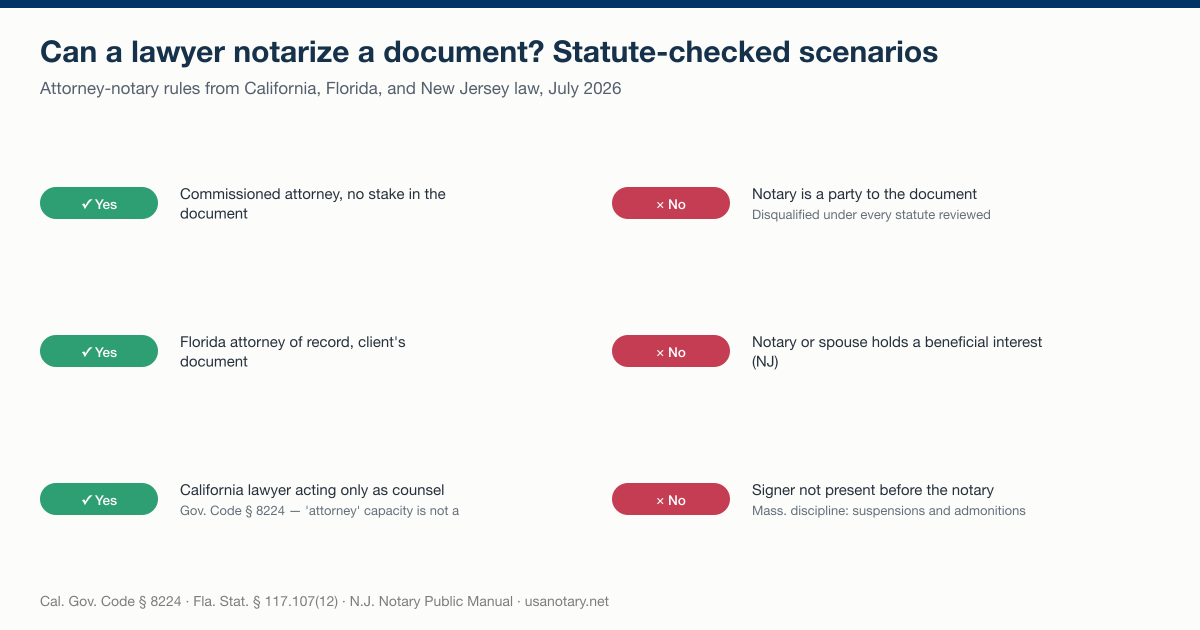
The scenarios this article checks against California, Florida, and New Jersey law — where an attorney-notary is permitted to act, and where the attorney-notary is disqualified.
Can a lawyer notarize their own client’s documents?
A lawyer can notarize their own client’s documents in the states that address the question directly, provided the lawyer’s only stake is the professional fee — and Florida writes that rule into its notary statute verbatim. The anxiety most attorneys feel here (“I drafted it, I’m billing for it — am I interested in it?”) has a statutory answer in the two biggest notary jurisdictions that speak to it, and the answer is more permissive than the folklore.
When the fee is the only interest
Florida is the clearest. Fla. Stat. § 117.107(12) prohibits notarizing “if the notary public has a financial interest in or is a party to the underlying transaction” — and then carves the attorney relationship out of that prohibition: a notary who is an attorney “does not have a financial interest in and is not a party to the underlying transaction evidenced by a notarized document if he or she notarizes a signature on that document for a client for whom he or she serves as an attorney of record and he or she has no interest in the document other than the fee paid to him or her for legal services and the fee authorized by law for services as a notary public.” Drafting the document and billing for it, in other words, is not a disqualifying interest in Florida. The same subsection shelters staff: an employee may notarize for an employer so long as the employee takes no benefit beyond salary and the statutory notary fee — the staff-side rules get their own treatment in our companion guide on whether a paralegal can notarize documents.
California reaches a similar place from the other direction. Gov. Code § 8224 states that “a notary public who has a direct financial or beneficial interest in a transaction shall not perform any notarial act in connection with such transaction,” and the section presumes a direct interest where the notary is named as a principal to a financial transaction or as a party — grantor, grantee, mortgagor, and the like — to a real property transaction. But § 8224 also provides that a notary acting in the capacity of an “agent, employee, insurer, attorney, escrow, or lender” for a person who holds the interest does not, by that alone, hold a direct interest. Representing the interested party is not the same as being one.
When the lawyer is named in the document
The permission collapses the moment the lawyer’s name moves from the letterhead into the instrument. A lawyer named as attorney-in-fact under a power of attorney, as trustee of the trust being signed, as escrow holder, or as a beneficiary is no longer merely counsel — the lawyer is a party to, or directly interested in, the record, and every statute reviewed here disqualifies that notarization. Florida’s carve-out expressly requires “no interest in the document other than the fee”; California’s presumption of direct interest attaches to named principals and parties; New Jersey’s rule (next section’s table) reaches the officer and the officer’s spouse or civil union partner.
There is also a practical layer on top of the legal one. Even a notarization that survives the statute invites the argument opposing counsel will make anyway: the notary who verified this signature is the same lawyer who gets paid when the deal closes. When a will, settlement agreement, or affidavit is likely to be attacked, many firms treat the drafting lawyer’s stamp as a cost they don’t need to carry — an independent notary removes the argument before it can be made. That is the routing decision this article returns to at the end.
When is an attorney-notary disqualified? State rules compared
An attorney-notary is disqualified when the attorney is a party to the document or holds a financial or beneficial interest in the underlying transaction — the same test that binds every notary, applied to someone whose job puts them unusually close to the transaction. Each statute we fetched and checked draws the line in its own words:
| State | Rule checked | Party / interest rule | What it means for own-client work |
|---|---|---|---|
| California | Gov. Code § 8224 | A notary with a “direct financial or beneficial interest in a transaction shall not perform any notarial act in connection with such transaction”; direct interest is presumed for named principals and real-property parties | Acting as the client’s attorney is not, by itself, a direct interest — the statute lists “attorney” among the capacities that don’t create one |
| Florida | Fla. Stat. § 117.107(12) | A notary “may not notarize a signature on a document if the notary public has a financial interest in or is a party to the underlying transaction” | Attorney of record is expressly not disqualified when the only interest is the legal fee plus the statutory notary fee; the same subsection shelters employees notarizing for employers |
| New Jersey | Notary Public Manual, N.J. Treasury (implementing P.L. 2021, c. 179) | “A notarial officer may not perform a notarial act with respect to a record to which the officer or the officer’s spouse or civil union partner is a party, or in which either of them has a direct beneficial interest. An act that violates this provision is voidable.” | No attorney carve-out in the prohibition — the spouse/civil-union extension makes New Jersey’s version the broadest of the three |
Three caveats keep this table honest. First, these are the three states whose rules we fetched and confirmed against the current source text; the other 47 states set their own lines, and several never define “interest” at all — check your commissioning state’s notary statute before relying on a pattern. Second, the consequence differs by state: New Jersey says the violating act “is voidable,” which means the notarization — and whatever filing depended on it — can be undone by challenge. Third, disqualification is about the document, not the relationship: the same lawyer who is disqualified from notarizing a trust that names them trustee can lawfully notarize the same client’s unrelated affidavit tomorrow.
Why the fee question and the party question get different answers
The two statutes that speak to attorneys distinguish compensation from stake. A fee is earned whether or not the transaction closes the way the document contemplates; a party’s benefit rides on the instrument itself. That is why Florida can simultaneously bar interested notaries and shelter attorneys of record, and why California can presume disqualification for a named grantee while excusing the grantee’s lawyer. The question to ask before stamping is not “am I involved?” — it is “does this document, as an instrument, move anything to me or mine?”
Does New Jersey treat attorney-notaries differently?
New Jersey builds attorney accommodations directly into its notary program — the state treats the law license as a substitute for notary training, not as a substitute for the commission. Three features of the New Jersey Notary Public Manual show the design:
- No course, no exam. The manual’s education and testing requirements — a six-hour course of study and a State Treasurer’s examination — apply to a “non-attorney applicant,” a term the manual defines as an applicant “who is not also a licensed attorney-at-law in this State.” A New Jersey attorney applies for the commission without either.
- Law-office files instead of a journal. In lieu of maintaining the notary journal required of everyone else, “a notary public who is an attorney-at-law admitted to practice in this State or who is employed by an attorney-at-law” may keep the record of notarial acts in the files regularly maintained for the law practice.
- The same disqualification. Neither accommodation touches the prohibition: the party/beneficial-interest rule quoted in the table above applies to every notarial officer in the state, attorney or not, and extends to the officer’s spouse or civil union partner.
New Jersey’s design answers a question firms in every state ask: the state wants attorney-notaries — it just refuses to relax the impartiality rule for them. The accommodation is procedural; the disqualification is structural.
What happens when lawyers get notarization wrong?
Discipline, invalidated documents, and in the worst cases criminal exposure — and the record shows the trouble usually starts with a favor, not a fraud. The Massachusetts Board of Bar Overseers’ article Much Ado About Notarizing (Pamela A. Harbeson, Assistant Bar Counsel, August 2020) reviews the pattern across the state’s disciplinary reports: “The Massachusetts Attorney Disciplinary Reports are replete with examples of attorneys sanctioned for misusing or improperly performing notarial acts.”
The cases it catalogs are concrete:
- Matter of Zimmerman, 17 Mass. Att’y Disc. R. 633 (2001) — a two-year suspension for an attorney who notarized a signature not signed in his presence that was later discovered to be a forgery.
- Matter of Decenzo, 28 Mass. Att’y Disc. R. 176 (2012) — a six-month suspension for an attorney who forged clients’ names on one document and added a fictitious notarization to another.
- Admonition 16-11, 32 Mass. Att’y Disc. R. 697 (2016) — an attorney who, relying on the representations of a trusted client, notarized a signature found years later to be a forgery; the attorney was admonished even though no party was harmed.
In each case the conduct was charged as a violation of Rule 8.4(c) — conduct involving dishonesty, fraud, deceit or misrepresentation — and the article notes a lawyer “could even be criminally prosecuted under Mass. Gen. L. c. 222, § 18.” The malpractice angle rides alongside the discipline: as the article puts it, litigation may ensue and documents may be invalidated, so the client inherits the problem the shortcut created.
The BBO distills the prevention into six rules. A notary — attorney or otherwise — should never perform a notarial act when:
- The signatory is not in the notary’s presence at the time of signature and notarization.
- The signatory has not been identified through satisfactory evidence of identity.
- In the notary’s judgment, the signatory is not acting of their own free will or does not realize the consequences of the transaction.
- The document is blank or incomplete.
- The document contains information the notary knows or believes to be false.
- The notarization is done with intent to deceive or defraud.
Rule 1 is where busy firms fall. Every Massachusetts case above began with an absent signer — a client who “would sign it anyway,” a document that had to go out that afternoon. The article closes with former Bar Counsel Constance Vecchione’s line, worth pinning above any firm’s notary stamp: “The road to discipline or malpractice liability is often paved with good intentions. When notarizing or witnessing documents, resisting pressure to take deceptively benign shortcuts, and hewing instead to the line is in the interests of lawyers and clients alike.”
Note what the six rules police: presence, identity, capacity, completeness. Those are the exact elements a proper notarial certificate attests to — the distinction between certificate types is covered in our guide to jurats versus acknowledgments — and they are the elements an audio-video session records rather than merely recites.
How law firms keep client notarizations unimpeachable
The clean answer to every question above is an independent notary — one who is no party to the matter, holds no interest in it, and collects nothing but the notarization fee. Routing client signings to an independent online notary doesn’t just avoid the disqualification statutes; it makes the disqualification analysis unnecessary, because the notary’s distance from the transaction is built in. It also solves the problem that drives most attorney shortcuts in the first place: the client who cannot get to the office. Remote online notarization is lawful at scale — the National Association of Secretaries of State reports that 47 states and the District of Columbia have a law allowing remote e-notarization — and the legal grounding is laid out in our explainer on whether online notarization is legit.
Here is the workflow a firm actually runs:
- A paralegal uploads the document and sends the client a session link. Staff-initiated workflows keep the matter file as the system of record — the client never has to find a notary or explain the document.
- The client verifies identity before the session starts. Identity verification combines credential analysis of a government ID with knowledge-based authentication, run by a third-party identity-verification service — a stronger check than a glance at a driver’s license across a desk.
- The client signs before a commissioned notary on live, recorded video. Sessions run 24/7, take 15–30 minutes, and support multiple signers in one session; remote witnesses can join where state law and the document’s rules permit.
- The sealed document and its evidence come back to the firm. The session produces a tamper-evident notarized PDF with a complete audit trail, and the audio-video recording and electronic journal entry are retained for 10 years — or longer where state law requires — so the challenge that undoes an office-stamped notarization runs into a recording instead.
The economics favor the routing decision too. At $25 per document — with volume pricing for firms that notarize weekly — the independent session costs less than the attorney time spent stamping, journaling, and defending the stamp later. Estate signings, settlement affidavits, verifications, powers of attorney for out-of-state clients: our online notarization service for law firms handles them through the same staff-initiated workflow, for signers in all 50 states.
A commissioned lawyer can notarize a document. The better question — the one the statutes, the discipline reports, and opposing counsel all converge on — is whether the lawyer closest to the transaction should be the officer who certifies it. When the answer matters, keep the stamp independent. Questions about a specific document or a recurring firm workflow? Call 804-767-7500 or reach us here.