
Can a paralegal notarize documents?
A paralegal can notarize documents if the paralegal holds a notary commission from their state — the job title neither grants nor blocks the authority. Notary commissions issue to individuals who meet state requirements (age, residency, an application, and in some states a bond or exam), not to professions, so “paralegal” appears nowhere in the eligibility analysis. What matters is that the person doing the notarizing is a commissioned notary public acting within their state’s rules. Law offices know this well: the Massachusetts Board of Bar Overseers opens its guidance on law-office notarization by observing that “lawyers and their support staff are often also notaries public” — firms commission paralegals deliberately, because affidavits, deeds, and estate documents cross a legal team’s desk every week.
The full roll-call of commission-holders — bank officers, court clerks, UPS store staff — is covered in our guide to who can notarize a document. This guide covers the questions specific to a law-firm workplace: whether the paralegal-notary can notarize for the firm’s clients, when they are disqualified, what the firm can and cannot require, and what the fee rules say.
The commission comes from the state, not the firm
The commission belongs to the individual, not the firm. Delaware’s Secretary of State states the principle in its notary FAQ: the notary “is commissioned by the Governor to serve the public until the commission expires” — the appointment runs from the state to the person, and it follows the person out the door. A firm that wants an in-house notary is really sponsoring an employee’s personal application; the mechanics and costs are covered in our guides to becoming a notary through an online application and what a notary commission costs.
Notarizing is not legal advice — and must stay that way
A notarial act asks the paralegal-notary to do three narrow things: confirm the signer’s identity, witness the signature or take the acknowledgment, and administer any required oath. Massachusetts bar counsel’s checklist of prohibited situations (covered below) is built entirely around those duties — presence, identification, willingness, completeness. None of them involve explaining what a document means. The moment a client asks whether they need an acknowledgment or a jurat, or what signing will do to their rights, the answer has to come from the supervising attorney, because legal advice from non-lawyer staff creates unauthorized-practice-of-law problems the firm — not just the paralegal — has to answer for. A paralegal who notarizes wears two hats, and the notary hat is the narrow one.
Can a paralegal notarize documents for the firm’s clients?
Yes — a paralegal who holds a notary commission can notarize the firm’s client documents, provided the paralegal is not named in the document and takes no direct benefit from it. Working for a law firm that gets paid for the underlying legal work is not, by itself, a disqualifying interest.
California’s statute makes the employee logic explicit. Government Code § 8224 bars a notary with “a direct financial or beneficial interest in a transaction” from performing any notarial act in connection with it — and then defines the term tightly. A notary has a direct interest when “named, individually, as a principal to the transaction,” or in a real-property transaction when named individually as a grantor, grantee, mortgagor, mortgagee, trustor, trustee, beneficiary, vendor, vendee, lessor, or lessee. The exception is the sentence every law-office notary should know: a notary “has no direct financial or beneficial interest in a transaction where the notary public acts in the capacity of an agent, employee, insurer, attorney, escrow, or lender for a person having a direct financial or beneficial interest in the transaction.”
Read that in a firm context: the client has the interest; the firm represents the client; the paralegal is the firm’s employee. Under § 8224’s own definition, that chain does not disqualify the paralegal-notary. The paralegal is disqualified only when the document names the paralegal individually or routes a benefit to them — a distinction that keeps thousands of routine firm notarizations (client affidavits, verifications, powers of attorney) squarely legal.
Where the attorney’s analysis differs
Attorneys face the same disqualification statutes plus a second layer paralegal-notaries don’t: professional-conduct rules and, in some states, special attorney-notary provisions. That analysis — including the discipline cases where drafting lawyers notarized their own clients’ signatures — is covered in the companion guide to whether a lawyer can notarize a document. In day-to-day practice, many firms route signings to the paralegal-notary precisely because the paralegal is less likely to be named in the instrument than the attorney who drafted it or serves as trustee, executor, or escrow agent under it.
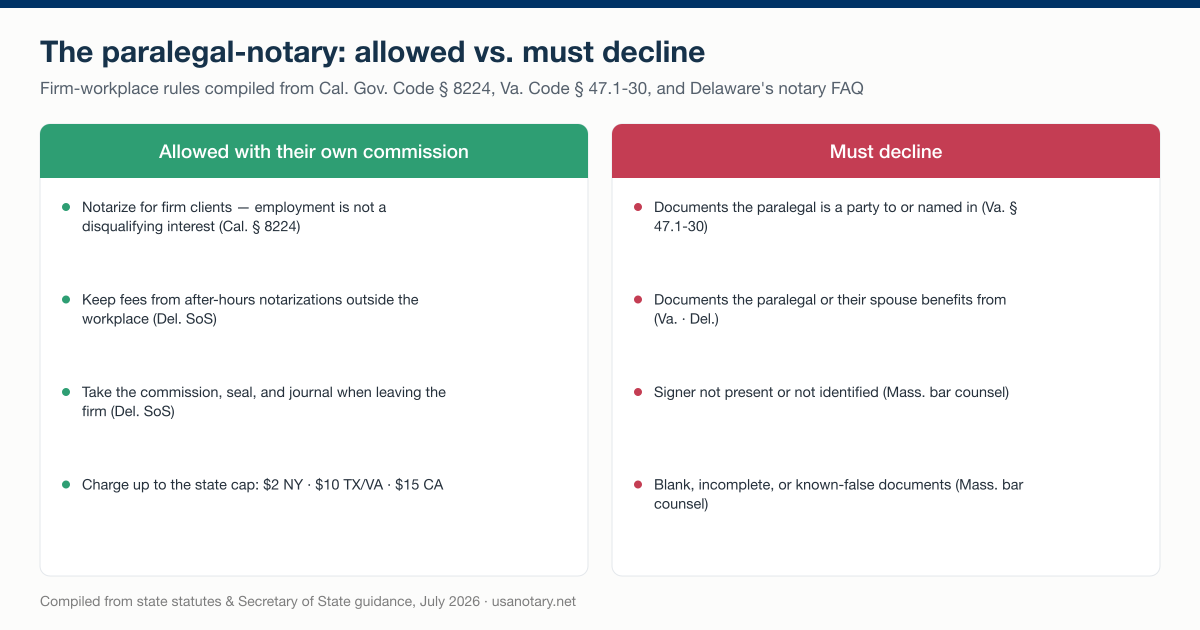
What a paralegal-notary may do versus when they must decline — compiled from Cal. Gov. Code § 8224, Va. Code § 47.1-30, and Delaware’s Secretary of State notary FAQ, July 2026.
When is a paralegal-notary disqualified?
A paralegal-notary is disqualified when the paralegal is a party to the document, named in it, or holds a direct beneficial interest in the transaction — the exact wording varies by state, but the pattern is consistent across the statutes below. Some states extend the disqualification to the notary’s spouse.
| State | Where the rule lives | What it says |
|---|---|---|
| California | Gov. Code § 8224 | A notary with a direct financial or beneficial interest “shall not perform any notarial act in connection with such transaction”; direct interest means being named individually as a principal (or as grantor, grantee, mortgagor, mortgagee, trustor, trustee, beneficiary, vendor, vendee, lessor, or lessee in real-property deals). Acting as an employee, agent, or attorney for an interested person is expressly not a direct interest |
| Virginia | Va. Code § 47.1-30 | No notarial act on a document to which the notary or the notary’s spouse is a party, in which either has a direct beneficial interest, or where the notary is named in the document (with limited fiduciary-notice exceptions). Violation constitutes official misconduct |
| Delaware | Secretary of State notary FAQ | ”A notary may not perform a notarial act with respect to a record to which the notary or the notary’s spouse is a party or in which either of them has a direct beneficial interest” |
| Massachusetts | Board of Bar Overseers guidance | Bar counsel’s six “never notarize” situations (below) plus the prohibited acts of G.L. c. 222, § 16; wrongful notarization can be criminally prosecuted under G.L. c. 222, § 18 |
This table covers the states whose primary sources we verified for this guide — it is not a 50-state survey, and notary statutes get amended. Before a staff notary handles anything unusual, check the current statute in your commissioning state.
What happens to a notarization performed under a disqualifying interest
Virginia answers this directly, and the answer is why firms should care. Under § 47.1-30, a notarization performed in violation of the disqualification rule constitutes official misconduct by the notary — but the notarization itself is not automatically void. It may be challenged and declared voidable by a court if a person injured by the violation brings it there. That is exactly the posture a litigation opponent wants: a colorable attack on the execution of your client’s affidavit or deed, discovered years after the signing. The disqualification rules are cheap to follow at the signing table and expensive to litigate afterward.
Six situations where the answer is always no
Massachusetts bar counsel’s article distills the universal floor — the situations in which a notary should never perform a notarial act, whatever the state:
- The signer is not in the notary’s presence at the time of signature and notarization.
- The signer has not been identified through satisfactory evidence of identity.
- In the notary’s judgment, the signer is not acting of their own free will or does not understand the consequences of the document.
- The document is blank or incomplete.
- The document contains information the notary knows or believes to be false.
- The notarization is done with intent to deceive or defraud.
Number 1 is the one that generates discipline files. A paralegal asked to “just notarize it — the client signed it last night” is being asked to violate the presence rule, and no amount of workplace goodwill changes that.
Can the firm require — or forbid — a paralegal to notarize?
The firm can shape workplace notarizations by agreement, but it cannot own the commission, compel an unlawful act, or keep the notary’s tools. The commission belongs to the individual, not the firm — a rule that holds even when the firm paid every dollar of the application, bond, and seal costs.
California shows how far employer control can lawfully go, because its legislature wrote the deal into statute. Government Code § 8202.7 lets a private employer, under an agreement with a notary-employee, pay the premiums on the notary’s bond and cover stamps, seals, and supplies, with fee arrangements handled in the same agreement. Section 8202.8 then permits an employer that entered such an agreement to “limit, during the employee’s ordinary course of employment, the providing of notarial services.” The structure is telling: the employer buys a contractual say in when and for whom the employee notarizes at work — it never acquires the commission itself.
Outside working hours the firm’s reach ends. Delaware’s Secretary of State FAQ tells notary-employees plainly: “You may perform notarizations outside of your workplace after work hours and collect fees associated with such notarizations.” The same FAQ confirms the notary’s independence inside the workplace too — “You have the right to refuse service at any time” — a right that matters most when the request is improper.
Who keeps the seal and journal when the paralegal leaves
The paralegal does. Delaware’s FAQ answers the departure question in one sentence: “When you leave employment, your stamp/seal, commission and journal/record book (if applicable) leave with you.” A firm that surrenders a departing paralegal’s journal is not losing firm property — the journal never was firm property. Firms that rely on a single staff notary should plan for this: the day that paralegal resigns, the firm’s notarization capacity resigns with them.
Employer pressure is the classic discipline trap
Massachusetts’ discipline reports show what happens when workplace convenience overrides notary law — and the sanctions land on lawyers, including lawyers who “notarized or caused another to notarize a document wrongfully.” In Matter of Zimmerman, 17 Mass. Att’y Disc. R. 633 (2001), an attorney drew a two-year suspension after notarizing a signature not signed in his presence that was later discovered to be a forgery. In Matter of Decenzo, 28 Mass. Att’y Disc. R. 176 (2012), a six-month suspension followed forged client signatures and a fictitious notarization. A string of admonitions — 16-11, 12-06, 05-19, 03-62, 02-36 — involved the same core failure: notarizing the signature of a person who was not present. Each was treated as a violation of Mass. R. Prof. C. 8.4(c), the rule against conduct involving dishonesty, fraud, deceit or misrepresentation, and bar counsel notes a wrongful notarization can even be criminally prosecuted under Mass. Gen. L. c. 222, § 18.
The article’s closing advice, quoting former bar counsel Constance Vecchione, is written for exactly the paralegal-under-pressure scenario: “The road to discipline or malpractice liability is often paved with good intentions. When notarizing or witnessing documents, resisting pressure to take deceptively benign shortcuts, and hewing instead to the line is in the interests of lawyers and clients alike.” A firm policy that documents when the staff notary may decline — and backs them when they do — protects both hats. So does understanding what the notary’s own protection covers: our comparison of a notary bond versus E&O insurance explains which one protects the public and which one protects the notary.
What can a paralegal-notary charge — and who keeps the fee?
State law caps what any notary — staff or independent — may charge per notarial act, and the caps vary widely. A paralegal-notary charging clients directly must stay inside their state’s schedule:
| State | Standard act (acknowledgment) | Oath/affirmation | Online notarization |
|---|---|---|---|
| California | $15 per signature (Gov. Code § 8211) | $15 (including the jurat) | — |
| Texas | $10 first signature, $1 each additional (Gov’t Code § 406.024, as amended eff. Sept. 1, 2023) | $10 with certificate and seal | Up to $25 per online notarization, in addition to § 406.024 fees (§ 406.111) |
| Virginia | Up to $10 per act (Va. Code § 47.1-19) | Up to $10 | Not to exceed $25 for electronic notarial acts |
| New York | $2 per person (Exec. Law § 136) | $2 | Fee set by Secretary of State regulation under § 135-c |
Two workflow implications follow from the numbers. First, in low-cap states like New York, the fee is administrative, not a revenue line — nobody commissions a paralegal to earn $2 acknowledgments. Second, Texas’s Secretary of State may adjust the § 406.024 schedule every five years based on the Consumer Price Index, so even “fixed” caps move; check the current figure before a fee shows up on a client invoice.
Fee agreements with the firm
Who keeps a workplace fee depends on the state and the paperwork. California’s §§ 8202.7–8202.8 agreement structure lets the employer that funds the commission handle fee arrangements in the same written agreement that limits on-the-clock notarizations. Delaware’s FAQ draws the after-hours line: fees from notarizations performed outside the workplace, after work hours, are the notary’s to collect. The clean practice for a firm is a short written policy — what the paralegal notarizes at work, whether clients are charged at all, and where any fee goes — signed before the first stamp hits paper.
When should a firm route notarizations to an independent online notary?
An independent online notary is the cleaner path whenever the staff notary is disqualified, unavailable, or in a different state than the signer — the three gaps a personal commission cannot close. A commission is bounded by its state, its holder’s calendar, and the disqualification rules above; a firm’s signing needs are not.
The legal footing is broad: the National Association of Secretaries of State reports that 47 states and the District of Columbia have a law allowing remote e-notarization. Massachusetts’ pandemic-era experience even wrote paralegals into the story — its temporary 2020 virtual-notarization act authorized only Massachusetts attorneys, and paralegals under their supervision, to notarize remotely while the act was in effect. Remote notarization and law firms have been workflow partners from the start.
Here is how the staff-initiated workflow runs when the firm uses an independent online notary instead of burning paralegal hours:
- The paralegal uploads the client’s document and sends the session link from the firm’s side — the client never has to find a notary or print anything.
- The client completes identity verification — credential analysis of their government ID plus knowledge-based authentication, run by a third-party identity-verification service — before the notary appears.
- The client joins the video session with a commissioned notary. Sessions run 24/7, take 15–30 minutes, and support multiple signers where the document needs them; signers can join from any state.
- The sealed document returns to the matter file as a tamper-evident PDF with a complete audit trail, and the session’s audio-video recording and electronic journal entry are retained for 10 years or longer where state law requires.
At $25 per document with volume pricing, the math favors routing overflow out: the fee sits at the same level as Texas’s and Virginia’s own online-notarization caps, and it arrives without the commissioning costs, renewal tracking, journal custody, or disqualification analysis that come with staffing the function in-house. Practice groups that notarize weekly — estate planning, litigation verifications, real-estate support — can set up standing staff-initiated workflows through our online notarization service for law firms.
The two-hat rule, in one paragraph
A paralegal who holds a notary commission can notarize documents for the firm’s clients — that is the yes. The boundaries are what keep it a yes: the paralegal is disqualified from any document that names them or benefits them, the commission belongs to the individual and leaves with them, fee caps govern every charged act, and no supervisor can order a notarization the statute forbids. Firms that write those four rules into a one-page policy get a reliable in-house notary; firms that treat the commission as office equipment end up in the discipline reports.
Questions about a recurring signing workflow, or a client who needs a notarization today? Call 804-767-7500 or reach us through the contact page.