
What does a caregiver authorization affidavit let you do?
A caregiver authorization affidavit authorizes a nonparent adult — a grandparent, aunt, adult sibling, or family friend the child lives with — to enroll a minor in school and consent to school-related medical care, without a court guardianship. That is the California definition, and California wrote the template: under Family Code § 6550, any caregiver 18 or older who completes items 1–4 of the statutory form and signs it can enroll the minor in school and consent to school-related medical care on the minor’s behalf.
The affidavit authorizes more when the caregiver is a relative. A California caregiver who is related to the child “by blood, adoption, or affinity within the fifth degree of kinship” — the statute’s definition sweeps in stepparents, stepsiblings, and every “great,” “great-great,” and “grand” relative — completes items 1–8 instead and gains the same rights to authorize medical and dental care that court-appointed guardians hold under Probate Code § 2353, including mental health treatment subject to Probate Code § 2356.
Other states draw the powers similarly. The Massachusetts form gives the caregiver “the right to make medical and educational decisions” for a child living in the caregiver’s home, per the Probate and Family Court’s instructions. Ohio’s caretaker authorization affidavit authorizes a grandparent to exercise care, physical custody, and control of the child — enrolling the child in school, discussing educational progress with the district, consenting to school-related matters, and consenting to medical, psychological, or dental treatment, under Rev. Code § 3109.65.
What the affidavit does not do
The affidavit does not transfer custody, in any state that uses one. California’s form carries a printed notice that the declaration “does not mean that the caregiver has legal custody of the minor.” The Massachusetts instructions answer the custody question with a flat “No.” Ohio’s statutory form states the same limit. A parent also keeps decision-making power: California Family Code § 6550(b) provides that a parent’s contravening decision supersedes the caregiver’s medical or dental consent — unless the parent’s decision would jeopardize the minor’s life, health, or safety — and Massachusetts tells caregivers that when the two disagree, “the parent makes the final decision.”
Does a caregiver authorization affidavit need to be notarized?
Notarization is required in Massachusetts, Ohio, and Delaware, but not in California — the state whose form most people mean when they search for one. The split is written directly into each state’s form text, so it is worth reading the exact language before anyone drives to a notary (or skips one they needed):
| State | Notarization required? | Who signs | What the rule says |
|---|---|---|---|
| California | No | The caregiver | The statutory form in Fam. Code § 6552 is signed under penalty of perjury and states — three separate times — “This form is not required to be notarized” |
| Massachusetts | Yes — notary plus two witnesses | The parent; the caregiver adds an acknowledgment | Probate and Family Court instructions: the parent “must sign this form in front of two witnesses (who are not the caregiver) and a notary public” |
| Ohio | Yes | The grandparent-caretaker | Rev. Code § 3109.67: the affidavit is executed when it is completed, signed by the grandparent, and notarized; the § 3109.66 form calls for notarization by an Ohio notary public |
| Delaware | Yes — multiple notarized signatures | The caregiver AND the parents/guardians | 14 Del. C. § 202(f): the Caregivers’ School Authorization must be completed and notarized, with “the notarized and dated signatures of the caregiver, parents, legal custodians or guardians” |
| Other states | Varies | Varies | Many districts use their own caregiver, kinship, or educational-consent forms; ask the enrollment office which form applies and whether notarization is required |
Why California’s form skips the notary
California substitutes a perjury declaration for the notary’s certificate. The § 6552 form closes with “I declare under penalty of perjury under the laws of the State of California that the foregoing is true and correct,” and warns the caregiver in mandatory boldface — § 6550(g) requires the warning statements in at least 10-point boldface type inside a ruled box — that signing a false statement is “a crime punishable by a fine, imprisonment, or both.” The deterrent is criminal liability rather than identity verification, which is why the form tells school officials and health care providers outright that no court seal and no notarization is required.
Who signs — and whose signature is notarized
The signer differs by state, and this is where families most often redo the paperwork. California puts the pen in the caregiver’s hand: the caregiver attests that the minor lives in the caregiver’s home. Massachusetts flips it — the parent signs the front page as the “Authorizing Party” before two witnesses and a notary, while the caregiver completes a separate “Caregiver Acknowledgment” on the back. Ohio’s affidavit is signed by the grandparent, and Rev. Code § 3109.65 reserves it for the situation where the grandparent has made reasonable attempts to locate and contact both parents and has been unable to do so. Delaware demands the most signatures: the caregiver and the parents, custodians, or guardians all sign, and each signature is notarized.
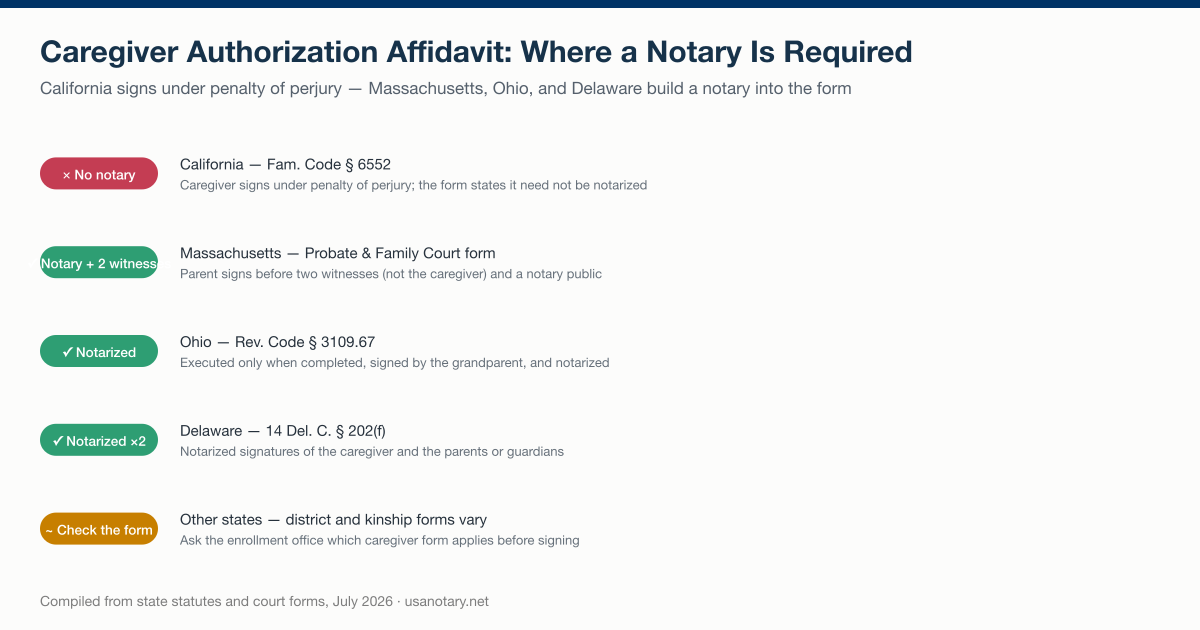
The notarization split from this article’s state table — statute-checked, July 2026.
How is it different from guardianship or a power of attorney?
A caregiver authorization affidavit is the no-court option: it is completed and signed privately, takes effect immediately, and leaves the parent’s rights fully intact. Guardianship and powers of attorney sit at different points on the same spectrum:
| Caregiver authorization affidavit | Court guardianship of a minor | Power of attorney for a minor | |
|---|---|---|---|
| Who grants the authority | The caregiver attests (CA, OH) or the parent authorizes (MA, DE) | A judge, after a court filing | The parent |
| Court involvement | None — the Massachusetts instructions confirm the form works “without a court order” | Required | Generally none |
| Scope | School enrollment, school-related medical consent; broader medical consent for relatives in CA | Broad authority over the minor’s person set by the court | Whatever parental powers the document delegates, within state limits |
| Parent’s rights | Retained — the parent’s decision supersedes | Curtailed by the court’s order | Retained and revocable |
The affidavit and the minor power of attorney are the two easiest to confuse, because neither involves a court. The cleanest distinction is the signer: a power of attorney is always a delegation by the parent, while California’s affidavit is an attestation by the caregiver — designed for exactly the case where a parent is not available to sign anything. Ohio makes the design explicit by reserving its affidavit for grandparents who tried and failed to reach the parents. Our plain-English guide to what a power of attorney is and who signs one covers the delegation side.
One boundary worth naming: everything on this page concerns minor children. When the person who needs a decision-maker is an aging parent rather than a child, the instruments are adult guardianship, conservatorship, and durable powers of attorney — start with our healthcare and senior-care notarization page for that side of the family.
How do you complete the California caregiver’s authorization affidavit?
The California form is completed in two tiers, and the tier decides how much of it you fill out. Per the instructions printed on the § 6552 statutory form: “Completion of items 1–4 and the signing of the affidavit is sufficient to authorize enrollment of a minor in school and authorize school-related medical care. Completion of items 5–8 is additionally required to authorize any other medical care.”
- Items 1–4 — the minor’s name and birth date, the caregiver’s name, and the caregiver’s home address. Any caregiver 18 or older who houses the child can stop here for school purposes.
- Item 5 — a checkbox confirming the caregiver is a “relative” under the fifth-degree-of-kinship definition. Only relatives unlock the broader guardian-level medical consent.
- Item 6 — two checkboxes about the parents: either the caregiver has advised the parents of the intended medical authorization and received no objection, or the caregiver is unable to contact them. The form allows checking both — for example, one parent advised, the other unreachable.
- Items 7–8 — the caregiver’s date of birth and a California driver’s license, ID card, or government-issued consular card number. The form’s own instructions say a caregiver without any of those may provide another identifier, such as a Social Security or Medi-Cal number.
The caregiver then signs under penalty of perjury — no notary, no witnesses, no filing fee, no court. Both § 6550 and § 6552 were amended by AB 495 (Stats. 2025, ch. 664), effective January 1, 2026, which is worth knowing because older printouts of the form circulate widely; use the current version.
Accuracy matters more than formality here. The form’s boxed warning tells the caregiver not to sign if any statement is incorrect, on pain of criminal penalty — and § 6550(c) rewards the honest version by shielding schools and providers who rely on a completed affidavit in good faith from civil, criminal, and disciplinary liability.
How do you notarize the Massachusetts, Ohio, or Delaware version online?
A remote online notarization session handles the notarized versions without anyone leaving home — useful because these forms routinely involve a parent in one city and a caregiver in another, and Delaware’s form needs notarized signatures from both sides. The National Association of Secretaries of State reports that 47 states and the District of Columbia have a law allowing remote e-notarization. Here is how the session runs:
- Confirm the state’s form and its signer list. Massachusetts notarizes the parent’s signature (with two witnesses who are not the caregiver). Ohio notarizes the grandparent’s signature — and the statutory form’s own text calls for an Ohio notary public, so the notary’s commission state matters, not just the signer’s location. Delaware notarizes the caregiver’s and the parents’ signatures.
- Upload the completed-but-unsigned form. The notary notarizes the signatures on the state’s form; the notary does not draft or alter it.
- Verify identity. Before the video session starts, each signer completes identity verification — credential analysis of a government ID plus knowledge-based authentication, run by a third-party identity-verification service.
- Sign in one multi-signer session. A commissioned notary meets the signers on live audio-video — sessions run 24/7 and take 15–30 minutes, and a multi-signer session lets the parent and caregiver appear together from different states. Where state law and the document’s rules permit, witnesses can also appear remotely; our explainer on how witnesses work in a notarization covers when they’re needed.
- Deliver the notarized affidavit to the school. The session produces a tamper-evident PDF backed by a complete audit trail, with the audio-video recording and electronic journal entry retained for 10 years, or longer where state law requires — a stronger record than a stamped photocopy if enrollment is ever questioned.
The cost is $25 per document, with volume pricing for organizations that process caregiver paperwork in bulk. School districts, charter networks, and enrollment offices that see these affidavits every August can run staff-initiated sessions through our online notarization service for schools and districts instead of turning families away to hunt for a notary.
What do schools accept the affidavit for?
Schools accept the affidavit for enrollment and for the medical consents that enrollment drags along. California defines “school-related medical care” precisely: immunizations, physical examinations, and medical examinations conducted in schools, when required by state or local authority as a condition of enrollment or of participation in extracurricular activities — so the affidavit covers the sports physical as well as the shot record.
California goes one step further on residency. The form’s notice to school officials states that under Education Code § 48204, the affidavit “constitutes a sufficient basis for a determination of residency of the minor, without the requirement of a guardianship or other custody order” — though the district may still require additional reasonable evidence that the caregiver actually lives at the address in item 4, and may reject the affidavit if the facts show the minor is not living with the caregiver.
Delaware frames the school’s acceptance most broadly: once the Caregivers’ School Authorization is approved, the caregiver acts in place of the parent for the child’s education decisions — including special education decisions — and becomes the school’s contact for truancy, discipline, and school-based medical care. Massachusetts keeps the checklist practical: give a copy of the affidavit to the child’s school, doctor, and dentist, and keep a list of everyone who received one, because every recipient must be told about changes.
Two acceptance limits appear on the California form itself: the affidavit does not confer dependency for health care coverage purposes, and a school or provider that accepts it “has no obligation to make any further inquiry or investigation” — the reliance protection that makes front offices comfortable taking the form at face value.
When does a caregiver authorization affidavit expire?
The affidavit becomes invalid on different triggers in different states — a duration table hiding inside the notarization table:
- California — event-based. Under § 6550(f), if the minor stops living with the caregiver, the caregiver must notify every school, health care provider, and health plan that holds the affidavit, and the affidavit is invalid once that notice is received. There is no fixed expiration date.
- Massachusetts — time-based. The affidavit is good for up to 2 years; the court’s instructions tell families to complete a new one every 2 years.
- Revocation by the parent — everywhere. A Massachusetts parent revokes by writing a signed, dated letter telling the caregiver the permission has ended, with copies to the child’s school, doctor, and dentist. And even while an affidavit is in force, the parent’s decision supersedes the caregiver’s in California unless the parent’s choice would jeopardize the child’s life, health, or safety.
Expiration questions also decide whether a remotely notarized affidavit keeps working after a family moves. A notarization performed lawfully in one state is generally recognized in others — the full analysis is in our guide to whether a remote notarization is valid out of state — but the form is state-specific: an Ohio caretaker affidavit does not become a California affidavit by crossing the border. When the child’s living arrangement changes states, complete the new state’s form.
Get the affidavit done before enrollment week
The rule to remember: who signs and whether notarization is required both depend on the state — read the form’s own text first. California’s caregiver signs alone under penalty of perjury; Massachusetts, Ohio, and Delaware build a notary (and in Massachusetts, two witnesses) into the form. When a notary is required and the parent and caregiver are in different places, one multi-signer video session completes it in an evening — no courthouse, no waiting room, no missed first day of school.
If the child is traveling rather than relocating — a school trip abroad, a summer with relatives — the school will point you to a different document entirely; see our guide to the notarized child travel consent letter for that scenario.
Questions about a specific state’s form or a district-wide enrollment workflow? Call 804-767-7500 or contact us.